PUBLISHER: Global Market Insights Inc. | PRODUCT CODE: 2101935

PUBLISHER: Global Market Insights Inc. | PRODUCT CODE: 2101935
Hardware Security Modules Market Opportunity, Growth Drivers, Industry Trend Analysis, and Forecast 2026 - 2035
The Global Hardware Security Modules Market was valued at USD 1.7 billion in 2025 and is estimated to grow at a CAGR of 14.7% to reach USD 6.7 billion by 2035.
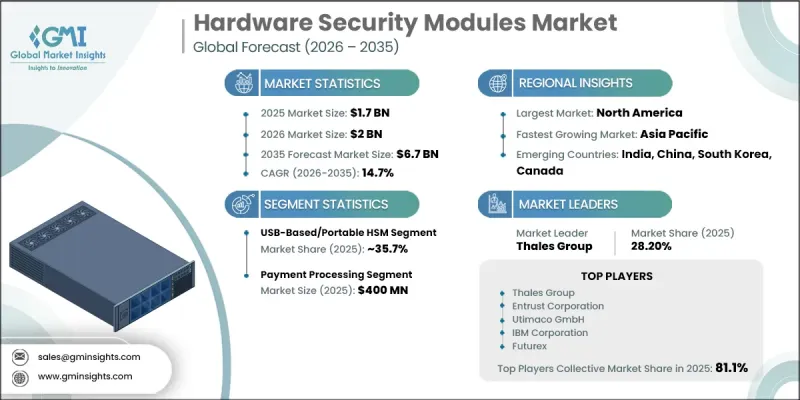
Market expansion is driven by the increasing frequency of advanced cyberattacks that expose vulnerabilities in software-only key management approaches, along with stringent global regulatory frameworks such as PCI DSS v4.0, GDPR, and the NIS2 Directive. A major growth catalyst is the rising adoption of cloud-based HSM-as-a-Service solutions, which are lowering deployment barriers for mid-sized enterprises while maintaining strong cryptographic security standards. Organizations across banking, healthcare, and critical infrastructure are increasingly adopting hardware-based root-of-trust systems to secure cryptographic key generation, storage, and lifecycle management. The growing sophistication of cyber threats, particularly attacks targeting encryption keys rather than encrypted data itself, has elevated the importance of hardware isolation as a core security requirement. Additionally, compliance-driven security investments and the expansion of digital payment ecosystems are reinforcing the long-term demand outlook for hardware security modules across global industries.
| Market Scope | |
|---|---|
| Start Year | 2025 |
| Forecast Year | 2026-2035 |
| Start Value | $1.7 Billion |
| Forecast Value | $6.7 Billion |
| CAGR | 14.7% |
The USB-based and portable HSM segment accounted for USD 600 million in 2025, representing 35.7% share, and is expected to grow at a CAGR of 15% through 2035. This segment maintains a strong position due to its widespread use in secure authentication, digital signing processes, and distributed identity management workflows where compact and portable security devices are required. Increasing integration of portable HSMs into secure development environments and enterprise security architectures continues to support segment growth across various industries requiring flexible cryptographic solutions.
The payment processing application segment was valued at USD 400 million in 2025 and is forecast to grow at a CAGR of 15.1% through 2035. This segment benefits from the critical need for secure transaction processing systems that manage encryption keys, authentication protocols, and payment verification functions. The expanding global digital payments ecosystem, combined with stringent compliance requirements for financial transaction security, ensures consistent demand for hardware-based encryption systems in payment infrastructure.
North America Hardware Security Modules Market accounted for USD 500 million in 2025, which represented 30% share. The region's dominance is supported by strong adoption across financial institutions, government organizations, and cloud service providers. A highly regulated cybersecurity environment continues to drive mandatory adoption of hardware-based encryption systems across multiple sectors, reinforcing sustained market demand and long-term investment in secure cryptographic infrastructure.
Major players operating in the global hardware security modules market include Amazon Web Services (AWS), IBM Corporation, Microsoft Corporation, Thales Group, Entrust Corporation, Utimaco GmbH, Infineon Technologies AG, STMicroelectronics, Microchip Technology Inc., Yubico, Nitrokey, Securosys SA, Futurex, Fortanix, Spyrus, Adweb Technologies, DINAMO Networks, ellipticSecure, ETAS GmbH, JISA Softech Pvt. Ltd., and Kryptoagile Solutions Pvt. Ltd. Companies operating in the hardware security modules market are strengthening their market position through continuous innovation in cloud-integrated HSM solutions and scalable cryptographic architectures. Vendors are focusing on hybrid deployment models that combine on-premises security with HSM-as-a-Service offerings to meet diverse enterprise requirements. Significant investments in research and development are enabling improvements in encryption performance, compliance readiness, and key lifecycle automation. Strategic partnerships with cloud service providers and cybersecurity firms are expanding global distribution capabilities and accelerating enterprise adoption. Companies are also enhancing product interoperability across multi-cloud environments to support digital transformation initiatives.
Table of Contents
Chapter 1 Methodology & Scope
- 1.1 Research approach
- 1.2 Quality commitments
- 1.2.1 GMI AI policy & data integrity commitment
- 1.2.1.1 Source consistency protocol
- 1.2.1 GMI AI policy & data integrity commitment
- 1.3 Research trail & confidence scoring
- 1.3.1 Research trail components
- 1.3.2 Scoring components
- 1.4 Data collection
- 1.4.1 Partial list of primary sources
- 1.5 Data mining sources
- 1.5.1 Paid sources
- 1.5.1.1 Sources, by region
- 1.5.1 Paid sources
- 1.6 Base estimates and calculations
- 1.6.1 Base year calculation for any one approach
- 1.7 Market estimates & forecasts parameters
- 1.8 Forecast model
- 1.8.1 Quantified market impact analysis
- 1.8.1.1 Mathematical impact of growth parameters on forecast
- 1.8.1 Quantified market impact analysis
- 1.9 Research transparency addendum
- 1.9.1 Source attribution framework
- 1.9.2 Quality assurance metrics
- 1.9.3 Our commitment to trust
- 1.10 Market definitions
Chapter 2 Executive Summary
- 2.1 Industry synopsis, 2022 - 2035
- 2.1.1 Type trends
- 2.1.2 Deployment Mode trends
- 2.1.3 Application trends
- 2.1.4 End-user Industry trends
- 2.1.5 Regional trends
Chapter 3 Industry Insights
- 3.1 Industry ecosystem analysis
- 3.2 Industry impact forces
- 3.2.1 Growth drivers
- 3.2.1.1 Rising Cybersecurity Threats and Data Breaches
- 3.2.1.2 Growing Adoption of Cloud and Hybrid Cloud Security
- 3.2.1.3 Stringent Data Protection and Compliance Regulation
- 3.2.1.4 Expansion of Digital Payments and Banking Security
- 3.2.2 Industry pitfalls and challenges
- 3.2.2.1 High Initial Deployment and Maintenance Cost
- 3.2.2.2 Complex Integration with Legacy IT Infrastructure
- 3.2.3 Market opportunities
- 3.2.3.1 Expansion of Post-Quantum Cryptography (PQC) Adoption
- 3.2.3.2 Increasing Demand for HSM-as-a-Service (HSMaaS)
- 3.2.1 Growth drivers
- 3.3 Growth potential analysis
- 3.4 Regulatory landscape (Driven by primary research)
- 3.4.1 North America
- 3.4.2 Europe
- 3.4.3 Asia Pacific
- 3.4.4 Latin America
- 3.4.5 MEA
- 3.5 Technology landscape
- 3.5.1 Current technological trends
- 3.5.2 Emerging technologies
- 3.6 Pricing trend analysis (Driven by primary research)
- 3.7 Future market trends
- 3.8 Patent analysis
- 3.9 Porter's analysis
- 3.10 PESTEL analysis
- 3.11 Impact of AI and Generative AI on the market (Driven by primary research)
- 3.12 Value chain analysis (Driven by primary research)
- 3.13 Investment & funding analysis (Driven by primary research)
- 3.14 Consumer insights (Driven by primary research)
Chapter 4 Competitive Landscape, 2025
- 4.1 Introduction
- 4.2 Company market share analysis, by region, 2025
- 4.2.1 North America
- 4.2.2 Europe
- 4.2.3 Asia Pacific
- 4.2.4 Middle East & Africa
- 4.2.5 Latin America
- 4.3 Key developments
- 4.3.1 Key partnerships & collaborations
- 4.3.2 Major M&A activities
- 4.3.3 Product innovations & launches
- 4.3.4 Market expansion strategies
- 4.4 Competitive positioning matrix
Chapter 5 Market Size and Forecast, By Type, 2022 - 2035 (USD Million)
- 5.1 Key trends
- 5.2 LAN-Based/Network-Attached HSM
- 5.3 USB-Based/Portable HSM
- 5.4 PCI-Based/Internal HSM
- 5.5 Smart Card-based HSM
- 5.6 Others
Chapter 6 Market Size and Forecast, By Deployment Mode, 2022 - 2035 (USD Million)
- 6.1 Key trends
- 6.2 On-Premises
- 6.3 Cloud-Based (as-a-Service)
- 6.4 Others
Chapter 7 Market Size and Forecast, By Application, 2022 - 2035 (USD Million)
- 7.1 Key trends
- 7.2 Payment Processing
- 7.3 Code & Document Signing
- 7.4 SSL/TLS Certificate Management
- 7.5 Authentication
- 7.6 Database Encryption
- 7.7 PKI & Credential Management
- 7.8 Application-level Encryption
- 7.9 Digital Rights Management (DRM)
- 7.10 Others
Chapter 8 Market Size and Forecast, By End-user Industry, 2022 - 2035 (USD Million)
- 8.1 Banking, Financial Services, and Insurance (BFSI)
- 8.2 Government and Defense
- 8.3 IT & Telecommunications
- 8.4 Healthcare & Life Sciences
- 8.5 Manufacturing & Industrial
- 8.6 Energy & Utilities
- 8.7 Retail & Consumer Goods
- 8.8 Aerospace & Defense
- 8.9 Others
Chapter 9 Market Size and Forecast, By Region, 2022 - 2035 (USD Million)
- 9.1 Key trends
- 9.2 North America
- 9.2.1 U.S.
- 9.2.2 Canada
- 9.3 Europe
- 9.3.1 Germany
- 9.3.2 France
- 9.3.3 UK
- 9.3.4 Spain
- 9.3.5 Italy
- 9.4 Asia Pacific
- 9.4.1 China
- 9.4.2 Japan
- 9.4.3 South Korea
- 9.4.4 India
- 9.4.5 Australia
- 9.5 Middle East & Africa
- 9.5.1 Saudi Arabia
- 9.5.2 UAE
- 9.5.3 South Africa
- 9.6 Latin America
- 9.6.1 Brazil
- 9.6.2 Argentina
- 9.6.3 Mexico
Chapter 10 Company Profiles
- 10.1 Adweb Technologies
- 10.2 Amazon Web Services (AWS)
- 10.3 DINAMO Networks
- 10.4 ellipticSecure
- 10.5 Entrust Corporation
- 10.6 ETAS GmbH
- 10.7 Fortanix
- 10.8 IBM Corporation
- 10.9 Futurex
- 10.10 Infineon Technologies AG
- 10.11 JISA Softech Pvt. Ltd.
- 10.12 Kryptoagile Solutions Pvt. Ltd.
- 10.13 Microchip Technology Inc.
- 10.14 Microsoft Corporation
- 10.15 Nitrokey
- 10.16 Securosys SA
- 10.17 Spyrus
- 10.18 STMicroelectronics
- 10.19 Thales Group
- 10.20 Utimaco GmbH
- 10.21 Yubico

