PUBLISHER: Mordor Intelligence | PRODUCT CODE: 2065759

PUBLISHER: Mordor Intelligence | PRODUCT CODE: 2065759
Hardware Security Modules - Market Share Analysis, Industry Trends & Statistics, Growth Forecasts (2026 - 2031)
According to Mordor Intelligence, the hardware security modules market size is expected to increase from USD 1.98 billion in 2025 to USD 2.18 billion in 2026 and reach USD 3.51 billion by 2031, growing at a CAGR of 10.02% over 2026-2031.
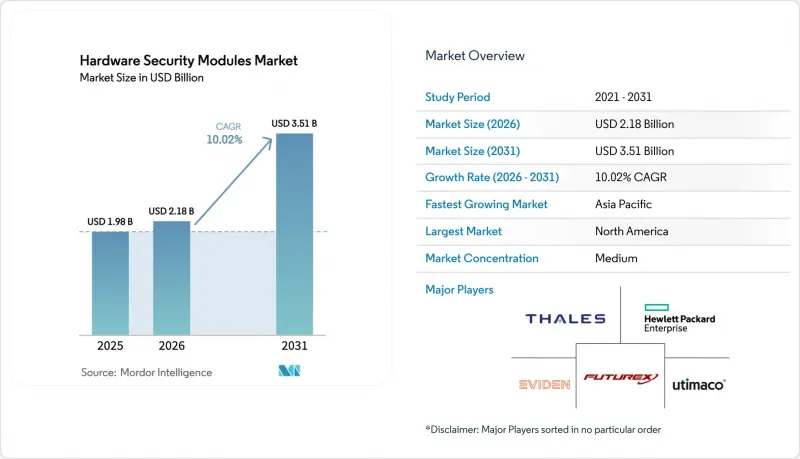
This report is Segmented by Deployment Type (On-Premise, Cloud HSM, Hybrid HSM), Type (General Purpose, Payment, Cloud/Hosted, and More), Application (Payment Processing, Key Management, and More), End-User (BFSI, Government, Healthcare, and More), and by Geography. The Market Forecasts are Provided in Terms of Value (USD).
Global Hardware Security Modules Market Trends and Insights
Post-quantum compliance deadlines accelerating HSM refresh
NIST finalized three post-quantum algorithms in 2024, triggering mandatory migrations across federal agencies and regulated industries. Enterprises now maintain dual cryptographic stacks to support ML-KEM, ML-DSA and SLH-DSA during transition periods, which doubles processing loads and precipitates accelerated appliance refresh cycles. The NSA's Commercial National Security Algorithm Suite 2.0 obliges mission-critical systems to adopt quantum-resistant primitives well before 2035, compressing planning horizons. Thales Luna became the first FIPS 140-3 Level 3 certified HSM in April 2024, giving early adopters a procurement advantage. "Harvest now, decrypt later" threat models further reinforce urgency, particularly for entities that must guarantee multi-decade confidentiality.
Hyperscaler cloud-native key-management boom
Google Cloud, Microsoft Azure and AWS now embed FIPS-validated hardware in multitenant locations, enabling customers to bring their own keys while satisfying domestic data-residency rules. Marvell's LiquidSecurity boards deliver 1 million operations per second to meet hyperscaler throughput targets. National frameworks such as Singapore's PDPA and Japan's cybersecurity guidelines require localized instances, stimulating region-specific capacity roll-outs. Financial-services newcomers like Indonesia's Krom Bank leverage managed CloudHSM to accelerate digital-banking launches while retaining cryptographic control. These deployments substantially expand the HSM market in APAC.
Scarcity of FIPS 140-3 chips
Semiconductor capacity remains constrained because only a handful of foundries can fabricate secure processors that meet FIPS 140-3 test vectors. SK Hynix and Micron have sold out high bandwidth memory allocations through most of 2025, forcing HSM makers to ration supply and raise prices. Certification introduces lengthy zeroization and tamper-response validations, slowing new tape-outs and reinforcing dependence on incumbent suppliers. Smaller entrants therefore face extended lead times, tipping HSM market economics toward vendors with pre-reserved wafers.
Other drivers and restraints analyzed in the detailed report include:
- Instant-payment rails fuelling payment HSM uptake
- Crypto-custody MiCA rules driving EU demand for FIPS HSMs
- Legacy PKI-to-cloud migration complexity
For complete list of drivers and restraints, kindly check the Table Of Contents.
Segment Analysis
On-premise appliances retained 71.85% of Hardware Security Modules market share in 2025 due to direct control over keys required by defense, banking and critical-infrastructure operators. Many firms keep root-of-trust inside data centers to satisfy sovereign data mandates. Nevertheless, cloud HSM subscriptions are scaling at a 10.62% CAGR as hyperscalers guarantee FIPS validations, availability SLAs and API-first consumption. This hybrid approach enlarges the HSM market size because organizations often run dual footprints during transitional years.
Managed offerings reduce capital outlay and refresh risk, attracting startups and mid-tier banks that previously relied on software keystores. Edge computing adds another layer, prompting distributed clusters that enforce local encryption at the 5G boundary while synchronizing policies centrally. Vendors address this by shipping container-based connectors so DevSecOps teams can call hardware services from Kubernetes pods. Over the forecast period, spending tilts toward subscription models even as sizeable regulated workloads remain locked inside private racks. Second-generation deployment strategies now bundle HSM functionality into micro-data-centers that support smart-factory use cases, connected-vehicle update signing and city-wide public-safety networks.
General-purpose units captured 59.45% of revenue in 2025 because they handle PKI root protection, code signing, tokenization and database encryption in a single chassis. Their algorithm agility makes them indispensable for post-quantum migrations that demand both RSA/ECC and lattice-based primitives during a prolonged overlap period. Meanwhile, cloud-hosted variants demonstrate an 10.74% CAGR, supported by hyperscaler pay-per-use economics and uniform regional roll-outs. Payment-class boxes remain essential for PCI DSS, yet vendors are embedding payment and general-purpose firmware on shared boards to optimize inventory under chip constraints.
Containerized plugins translate PKCS#11 calls into REST interfaces, letting builders request secure key operations from micro-services without learning low-level drivers. Specialized silicon for AI model sealing has emerged, as Fortanix integrates confidential-computing enclaves with HSM orchestration to protect machine learning assets at rest and in inference.
Geography Analysis
North America held 37.10% of global Hardware Security Modules market share in 2025 thanks to early FIPS 140-3 adoption, quantum-safe directives across federal agencies and a dense cluster of payment processors that refresh devices on three-year cycles. Ongoing public-sector modernization grants and zero-trust executive orders sustain steady procurement pipelines. Canada follows suit with treasury modernization and open-banking rulemaking, while Mexico shows emerging acceleration as fintechs connect to CoDi and SPEI fast-payment rails, demanding lower-cost cloud HSM gateways.
Asia Pacific exhibits the highest 12.17% CAGR through 2031, buoyed by hyperscaler data-center construction and digital-banking licenses that require sovereign key regimes. China's MLPS 2.0 imposes domestic algorithm usage, compelling dual-stack appliances capable of operating SM2 alongside NIST curves. Japan's automakers integrate embedded IP to comply with connected-vehicle cybersecurity provisions, and India's data-localization policies steer banks toward region-specific key vaults hosted on AWS Mumbai and GCP Delhi zones. ASEAN markets implement interoperable real-time payments, prompting regional banks to adopt shared-service HSM utilities that cut per-transaction costs without sacrificing compliance.
Europe remains a strategic arena shaped by MiCA, GDPR and PSD2. Germany's industrial Mittelstand invests in on-premise clusters to secure IP as factories adopt OPC-UA over 5G. The United Kingdom focuses on post-Brexit divergence in critical-data classifications, driving bespoke appliance certifications. France expands cloud-first mandates under the SecNumCloud label, which still requires root keys inside qualified hardware. Eastern European fintech hubs, notably Lithuania, deploy multi-tenant HSM grids to attract passporting crypto-service providers. Collectively these measures lift the Hardware Security Modules market size across the continent despite slower headline GDP growth.
- Thales Group
- Utimaco Management Services GmbH
- Entrust Corporation
- IBM Corporation
- Hewlett Packard Enterprise (HPE)
- Eviden SAD (Atos Group)
- Futurex
- Amazon Web Services (AWS)
- Microsoft Azure Dedicated HSM
- Yubico
- Securosys SA
- Swissbit AG
- Secunet Security Networks AG
- Infineon Technologies AG
- Marvell Technology Inc.
- Fortanix Inc.
- Microchip Technology Inc.
- Broadcom Inc.
- Crypto4A Technologies
- Nitrokey GmbH
- nCipher (nShield)
- Rambus
Additional Benefits:
- The market estimate (ME) sheet in Excel format
- 3 months of analyst support
TABLE OF CONTENTS
1 INTRODUCTION
- 1.1 Study Assumptions and Market Definition
- 1.2 Scope of the Study
2 RESEARCH METHODOLOGY
3 EXECUTIVE SUMMARY
4 MARKET LANDSCAPE
- 4.1 Market Overview
- 4.2 Market Drivers
- 4.2.1 Post-quantum compliance deadlines accelerating HSM refresh
- 4.2.2 Hyperscaler cloud-native key-management boom in APAC
- 4.2.3 Instant-payment rails fuelling payment HSM uptake
- 4.2.4 Crypto-custody MiCA rules driving EU demand for FIPS HSMs
- 4.2.5 Automotive UNECE R155 mandate pushing embedded HSM IP
- 4.2.6 Multi-tenant HSM-as-a-Service monetisation
- 4.3 Market Restraints
- 4.3.1 Scarcity of FIPS 140-3 chips
- 4.3.2 Legacy PKI-to-cloud migration complexity
- 4.3.3 Secure-memory price spikes hitting SMBs
- 4.3.4 Cross-border crypto-law fragmentation (e.g., China MLPS 2.0)
- 4.4 Value / Supply-Chain Analysis
- 4.5 Regulatory Outlook
- 4.6 Technological Outlook
- 4.7 Porter's Five Forces
- 4.7.1 Bargaining Power of Suppliers
- 4.7.2 Bargaining Power of Buyers
- 4.7.3 Threat of New Entrants
- 4.7.4 Threat of Substitutes
- 4.7.5 Competitive Rivalry
- 4.8 Investment Analysis
5 MARKET SIZE AND GROWTH FORECASTS (VALUE)
- 5.1 By Deployment Type
- 5.1.1 On-Premise
- 5.1.2 Cloud HSM
- 5.1.3 Hybrid HSM
- 5.2 By Type
- 5.2.1 General Purpose HSM
- 5.2.2 Payment HSM
- 5.2.3 Cloud/Hosted HSM (HSM-aaS)
- 5.2.4 USB/Portable HSM
- 5.2.5 PCIe-based HSM
- 5.2.6 Network-attached HSM
- 5.3 By Application
- 5.3.1 Payment Processing
- 5.3.2 Key Management and KMS
- 5.3.3 SSL/TLS and Code-Signing
- 5.3.4 PKI and Certificate Authorities
- 5.3.5 Blockchain and Cryptocurrency Custody
- 5.3.6 Database and Document Encryption
- 5.3.7 IoT/Edge Device Identity
- 5.3.8 Post-Quantum Crypto Acceleration
- 5.4 By End-User Vertical
- 5.4.1 BFSI
- 5.4.2 Government and Defense
- 5.4.3 Healthcare and Life Sciences
- 5.4.4 Retail and E-commerce
- 5.4.5 Telecommunications and IT
- 5.4.6 Industrial and Manufacturing
- 5.4.7 Energy and Utilities
- 5.4.8 Cloud Service Providers
- 5.4.9 Others
- 5.5 By Geography
- 5.5.1 North America
- 5.5.1.1 United States
- 5.5.1.2 Canada
- 5.5.1.3 Mexico
- 5.5.2 South America
- 5.5.2.1 Brazil
- 5.5.2.2 Argentina
- 5.5.2.3 Rest of South America
- 5.5.3 Europe
- 5.5.3.1 United Kingdom
- 5.5.3.2 Germany
- 5.5.3.3 France
- 5.5.3.4 Italy
- 5.5.3.5 Spain
- 5.5.3.6 Rest of Europe
- 5.5.4 Asia Pacific
- 5.5.4.1 China
- 5.5.4.2 Japan
- 5.5.4.3 India
- 5.5.4.4 South Korea
- 5.5.4.5 ASEAN
- 5.5.4.6 Australia
- 5.5.4.7 New Zealand
- 5.5.4.8 Rest of Asia Pacific
- 5.5.5 Middle East and Africa
- 5.5.5.1 Middle East
- 5.5.5.1.1 GCC
- 5.5.5.1.2 Turkey
- 5.5.5.1.3 Israel
- 5.5.5.1.4 Rest of Middle East
- 5.5.5.2 Africa
- 5.5.5.2.1 South Africa
- 5.5.5.2.2 Nigeria
- 5.5.5.2.3 Egypt
- 5.5.5.2.4 Rest of Africa
- 5.5.5.1 Middle East
- 5.5.1 North America
6 COMPETITIVE LANDSCAPE
- 6.1 Market Concentration
- 6.2 Strategic Moves
- 6.3 Market Share Analysis
- 6.4 Company Profiles (includes Global level Overview, Market level overview, Core Segments, Financials as available, Strategic Information, Market Rank/Share for key companies, Products and Services, Recent Developments)
- 6.4.1 Thales Group
- 6.4.2 Utimaco Management Services GmbH
- 6.4.3 Entrust Corporation
- 6.4.4 IBM Corporation
- 6.4.5 Hewlett Packard Enterprise (HPE)
- 6.4.6 Eviden SAD (Atos Group)
- 6.4.7 Futurex
- 6.4.8 Amazon Web Services (AWS)
- 6.4.9 Microsoft Azure Dedicated HSM
- 6.4.10 Yubico
- 6.4.11 Securosys SA
- 6.4.12 Swissbit AG
- 6.4.13 Secunet Security Networks AG
- 6.4.14 Infineon Technologies AG
- 6.4.15 Marvell Technology Inc.
- 6.4.16 Fortanix Inc.
- 6.4.17 Microchip Technology Inc.
- 6.4.18 Broadcom Inc.
- 6.4.19 Crypto4A Technologies
- 6.4.20 Nitrokey GmbH
- 6.4.21 nCipher (nShield)
- 6.4.22 Rambus
7 MARKET OPPORTUNITIES AND FUTURE OUTLOOK
- 7.1 White-space and Unmet-Need Assessment

