PUBLISHER: Global Market Insights Inc. | PRODUCT CODE: 2101938

PUBLISHER: Global Market Insights Inc. | PRODUCT CODE: 2101938
Self Healing Grid Market Opportunity, Growth Drivers, Industry Trend Analysis, and Forecast 2026 - 2035
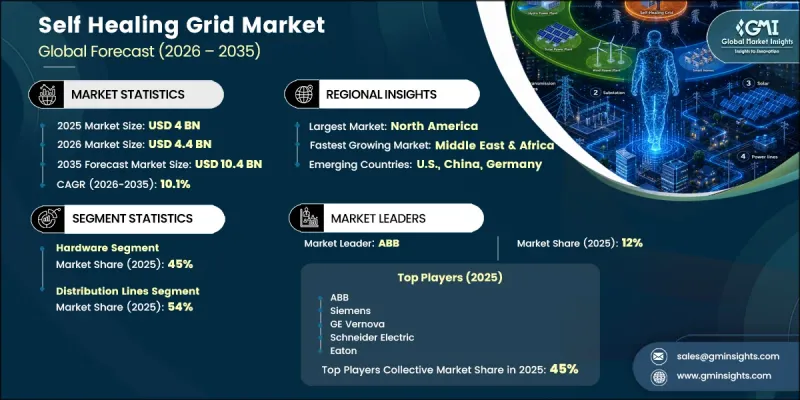
The Global Self Healing Grid Market was valued at USD 4 billion in 2025 and is estimated to grow at a CAGR of 10.1% to reach USD 10.4 billion by 2035.
Market expansion is driven by continued utility investments in grid automation, intelligent network infrastructure, and technologies designed to improve system reliability and minimize service interruptions. The self healing grid industry is undergoing a significant transformation as utilities shift from conventional maintenance practices toward intelligent, data-driven grid operations capable of identifying and responding to network disruptions automatically. Aging power infrastructure, increasing renewable energy integration, and stricter reliability expectations are accelerating the adoption of advanced grid management technologies. Self healing grid solutions improve operational performance by detecting faults in real time, isolating affected network sections, and restoring electricity service with minimal manual intervention, significantly reducing outage duration. The rapid expansion of renewable energy generation is also increasing the complexity of electricity distribution, creating greater demand for intelligent systems that can manage fluctuating power flows and maintain network stability. At the same time, evolving regulatory requirements are encouraging utilities to strengthen grid resilience through greater investment in automation, distributed energy resource management, and advanced control platforms, supporting sustained long-term growth across the global self healing grid market.
| Market Scope | |
|---|---|
| Start Year | 2025 |
| Forecast Year | 2026-2035 |
| Start Value | $4 Billion |
| Forecast Value | $10.4 Billion |
| CAGR | 10.1% |
The hardware segment accounted for 45% share in 2025 and is projected to grow at a CAGR of 8.2% through 2035. Hardware remains the largest market component because it provides the essential physical infrastructure required to monitor, control, and automate grid operations. The segment includes intelligent devices, automated switching equipment, advanced monitoring technologies, measurement systems, and metering infrastructure that collectively enable rapid fault detection, system communication, and automated network restoration. Continued modernization of electricity networks is expected to sustain demand for advanced hardware solutions throughout the forecast period.
The distribution line application segment represented 54% share in 2025 and is anticipated to grow at a CAGR of 9.3% through 2035. Distribution networks remain the primary deployment area because they account for a substantial share of electricity delivery and experience the highest frequency of service interruptions. Utilities continue to prioritize investments in distribution automation to improve service reliability, reduce outage duration, and strengthen operational efficiency. Increasing deployment of intelligent grid technologies across distribution infrastructure is expected to support continued market expansion throughout the study period.
North America Self Healing Grid Market accounted for 33.5% share in 2025 and is projected to register a CAGR of 8.4% through 2035. Regional market growth continues to be supported by substantial investments in grid modernization, expanding electricity infrastructure upgrades, and growing adoption of advanced grid automation technologies. The United States remains the leading market within the region due to ongoing investment in resilient power infrastructure and supportive regulatory initiatives that encourage utilities to strengthen grid reliability, improve operational performance, and integrate advanced distributed energy management capabilities.
Major companies operating in the global self healing grid market include ABB, Siemens, GE Vernova, Schneider Electric, Eaton, AspenTech, Cisco Systems, Duke Energy, G&W Electric, Honeywell, Itron, Landis+Gyr, NovaTech, S&C Electric, Schweitzer Engineering Laboratories (SEL), Sentient Energy, Southern States, Tantalus Systems, Utilidata, and Virtual Peaker. Companies operating in the self healing grid market are strengthening their competitive position by investing in intelligent grid automation technologies, advanced monitoring platforms, and digital energy management solutions. Manufacturers continue to enhance real-time analytics, automation software, communication systems, and fault detection capabilities to improve grid reliability and operational efficiency. Strategic partnerships with utilities, technology providers, and infrastructure developers remain important for expanding market reach and accelerating deployment of smart grid solutions. Companies are also focusing on scalable system architectures, cybersecurity enhancements, and seamless integration with distributed energy resources to meet evolving utility requirements.
Table of Contents
Chapter 1 Methodology & Scope
- 1.1 Research approach
- 1.2 Quality commitment
- 1.2.1 GMI AI policy & data integrity commitment
- 1.2.1.1 Source consistency protocol
- 1.2.1 GMI AI policy & data integrity commitment
- 1.3 Research Trail & Confidence Scoring
- 1.3.1 Research Trail Components
- 1.3.2 Scoring Components
- 1.4 Data Collection
- 1.4.1 Partial list of primary sources
- 1.5 Data mining sources
- 1.5.1 Paid sources
- 1.5.1.1 Sources, by region
- 1.5.1 Paid sources
- 1.6 Base estimates and calculations
- 1.6.1 Base year calculation for any one approach
- 1.7 Forecast model
- 1.8 Research transparency addendum
- 1.8.1 Source attribution framework
- 1.8.2 Quality assurance metrics
- 1.8.3 Our commitment to trust
- 1.8.3.1 Market definitions
Chapter 2 Executive Summary
- 2.1 Industry synopsis, 2022 - 2035
- 2.2 Business trends
- 2.3 Communication trends
- 2.4 Component trends
- 2.5 Application trends
- 2.6 Regional trends
Chapter 3 Industry Insights
- 3.1 Industry ecosystem analysis
- 3.2 Regulatory landscape
- 3.3 Industry impact forces
- 3.3.1 Growth drivers
- 3.3.2 Industry pitfalls & challenges
- 3.4 Growth potential analysis
- 3.5 Porter's analysis
- 3.5.1 Bargaining power of suppliers
- 3.5.2 Bargaining power of buyers
- 3.5.3 Threat of new entrants
- 3.5.4 Threat of substitutes
- 3.6 PESTEL analysis
- 3.7 Cost structure analysis of self-healing grid systems
- 3.8 Impact of AI & generative AI on the market
- 3.8.1 AI-driven disruption of existing business models
- 3.8.2 GenAI use cases & adoption roadmap by segment
- 3.8.2.1 Predictive maintenance & fault detection
- 3.8.3 Risks, limitations & regulatory considerations
- 3.9 Emerging opportunities & trends
- 3.10 Investment analysis & future outlook
Chapter 4 Competitive Landscape, 2026
- 4.1 Introduction
- 4.2 Company market share analysis, by region, 2025
- 4.2.1 North America
- 4.2.2 Europe
- 4.2.3 Asia Pacific
- 4.2.4 Middle East & Africa
- 4.2.5 Latin America
- 4.3 Competitive positioning matrix
- 4.4 Key Developments
- 4.4.1 Mergers & acquisitions
- 4.4.2 Partnerships & collaborations
- 4.4.3 New product launches
- 4.4.4 Expansion plans and funding
Chapter 5 Market Size and Forecast, By Component, 2022 - 2035 (USD Million)
- 5.1 Key trends
- 5.2 Hardware
- 5.2.1 Advanced sensors & monitoring devices
- 5.2.2 Automated reclosers & fault isolation switches
- 5.2.3 Intelligent Electronic Devices (IEDs)
- 5.2.4 Automated switchgear & substations
- 5.2.5 Communication equipment
- 5.2.6 Others
- 5.3 Software
- 5.3.1 Grid management & ADMS platforms
- 5.3.2 Fault detection & diagnosis software
- 5.3.3 Data analytics & real-time monitoring software
- 5.3.4 Demand response management software
- 5.3.5 Cybersecurity & grid protection software
- 5.3.6 Others
- 5.4 Services
Chapter 6 Market Size and Forecast, By Application, 2022 - 2035 (USD Million)
- 6.1 Key trends
- 6.2 Distribution lines
- 6.3 Transmission lines
- 6.4 Substations
Chapter 7 Market Size and Forecast, By Technology, 2022 - 2035 (USD Million)
- 7.1 Key trends
- 7.2 Fault Detection, Isolation & Restoration (FDIR/FLISR)
- 7.3 Advanced Metering Infrastructure (AMI) integration
- 7.4 Communication & networking systems
- 7.5 Others
Chapter 8 Market Size and Forecast, By End User, 2022 - 2035 (USD Million)
- 8.1 Key trends
- 8.2 Public utility
- 8.3 Private utility
Chapter 9 Market Size and Forecast, By Region, 2022 - 2035 (USD Million)
- 9.1 Key trends
- 9.2 North America
- 9.2.1 U.S.
- 9.2.2 Canada
- 9.2.3 Mexico
- 9.3 Europe
- 9.3.1 UK
- 9.3.2 Germany
- 9.3.3 France
- 9.3.4 Spain
- 9.3.5 Italy
- 9.4 Asia Pacific
- 9.4.1 China
- 9.4.2 Australia
- 9.4.3 Japan
- 9.4.4 South Korea
- 9.4.5 India
- 9.5 Middle East & Africa
- 9.5.1 Saudi Arabia
- 9.5.2 UAE
- 9.5.3 South Africa
- 9.6 Latin America
- 9.6.1 Brazil
- 9.6.2 Chile
Chapter 10 Company Profiles
- 10.1 ABB
- 10.2 AspenTech
- 10.3 Cisco Systems
- 10.4 Duke Energy
- 10.5 Eaton
- 10.6 G&W Electric
- 10.7 GE Vernova
- 10.8 Honeywell
- 10.9 Itron
- 10.10 Landis+Gyr
- 10.11 NovaTech
- 10.12 S&C Electric
- 10.13 Schneider Electric
- 10.14 Schweitzer Engineering Laboratories
- 10.15 Sentient Energy
- 10.16 Siemens
- 10.17 Southern States
- 10.18 Tantalus Systems
- 10.19 Utilidata
- 10.20 Virtual Peaker

