PUBLISHER: Global Market Insights Inc. | PRODUCT CODE: 2101951

PUBLISHER: Global Market Insights Inc. | PRODUCT CODE: 2101951
Freezer Market Opportunity, Growth Drivers, Industry Trend Analysis, and Forecast 2026 - 2035
The Global Freezer Market was valued at USD 13.7 billion in 2025 and is estimated to grow at a CAGR of 5.2% to reach USD 22.8 billion by 2035.
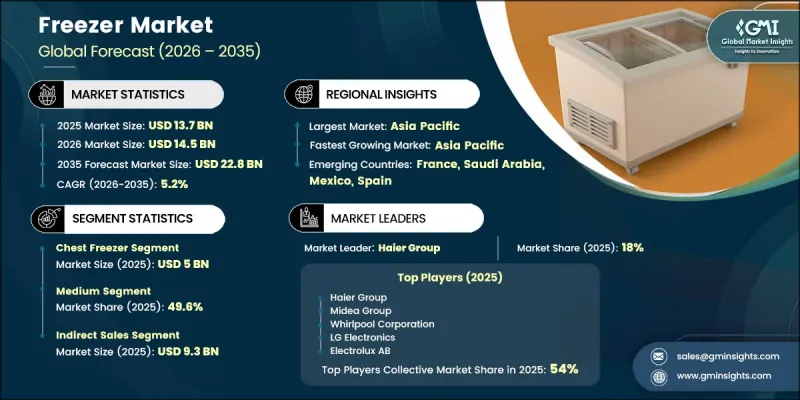
The market is witnessing expansion owing to rising demand for frozen and packaged food products, supported by changing consumer lifestyles and evolving dietary preferences. Increasing urbanization and busier work schedules are encouraging consumers to rely more on convenient, ready-to-store food options, which is driving greater adoption of freezer systems for bulk storage and extended preservation. Improvements in food preservation technologies, packaging quality, and freezing methods are further enhancing product safety, taste retention, and accessibility across retail channels. This is also encouraging households to invest in larger and more advanced freezer units while food producers and distributors expand cold storage infrastructure to support growing frozen food consumption. The expansion of food retail and foodservice networks is further reinforcing demand, particularly in commercial applications where large-scale cold storage is essential. Overall, rising dependence on frozen food consumption patterns continues to strengthen long-term demand for freezer solutions across residential and commercial sectors.
| Market Scope | |
|---|---|
| Start Year | 2025 |
| Forecast Year | 2026-2035 |
| Start Value | $13.7 Billion |
| Forecast Value | $22.8 Billion |
| CAGR | 5.2% |
The chest freezer segment generated USD 5 billion in 2025. Demand for this segment remains strong due to its large storage capacity and efficient design, which supports bulk preservation of perishable goods. Chest freezers are widely adopted across both household and commercial environments where long-term storage of food products is required, making them a preferred option for high-volume refrigeration needs.
The indirect sales segment accounted for USD 9.3 billion in 2025, representing the largest share of the freezer market. This distribution channel remains dominant due to its ability to provide manufacturers with extensive market reach through established retail networks. Consumers benefit from easy product access, a wide range of choices, and in-store assistance, which supports stronger purchasing decisions and improves overall product visibility across multiple retail formats.
U.S. Freezer Market held 77.2% share in 2025 and generated USD 2.4 billion. The country maintains a mature freezer market supported by high consumer awareness, strong purchasing power, and widespread adoption of frozen food consumption habits. Demand is further strengthened by well-developed retail and foodservice industries, where large-scale refrigeration and freezing solutions are essential for storage, distribution, and daily operations.
Major companies operating in the global freezer market include Haier Group, Midea Group, Whirlpool Corporation, Electrolux AB, Samsung Electronics, LG Electronics, Panasonic Corporation, Liebherr Group, Metalfrio Solutions S.A., True Manufacturing, Godrej & Boyce Mfg. Co., Mabe S.A. de C.V., Aucma Co., Ltd., Voltas Limited, AHT Cooling Systems GmbH, Epta Group S.p.A., Arneg S.p.A., Zero Zone Inc., Minus Forty Technologies Corp., Beverage-Air Corporation, and Smad Electric Co., Ltd. Companies operating in the freezer market are focusing on strengthening their market position through continuous product innovation and energy-efficient refrigeration technologies. Manufacturers are investing in smart freezer systems equipped with temperature monitoring, digital controls, and improved insulation to enhance performance and reduce energy consumption. Expansion of product portfolios across residential and commercial segments is helping companies address diverse consumer needs. Strategic partnerships with retail chains and foodservice providers are improving distribution reach and market penetration.
Table of Contents
Chapter 1 Methodology and Scope
- 1.1 Market scope and definition
- 1.2 Research design
- 1.2.1 Research approach
- 1.2.2 Data collection methods
- 1.3 Data mining sources
- 1.3.1 Global
- 1.3.2 Regional/Country
- 1.4 Base estimates and calculations
- 1.4.1 Base year calculation
- 1.4.2 Key trends for market estimation
- 1.5 Primary research and validation
- 1.5.1 Primary sources
- 1.6 Forecast model
- 1.7 Research assumptions and limitations
Chapter 2 Executive Summary
- 2.1 Industry 360° synopsis
- 2.2 Key market trends
- 2.2.1 Regional
- 2.2.2 Product type
- 2.2.3 Technology
- 2.2.4 Access configuration
- 2.2.5 Capacity
- 2.2.6 Price
- 2.2.7 Application
- 2.2.8 Distribution channel
Chapter 3 Industry Insights
- 3.1 Industry ecosystem analysis
- 3.1.1 Supplier landscape
- 3.1.2 Profit margin
- 3.1.3 Value addition at each stage
- 3.1.4 Factor affecting the value chain
- 3.2 Industry impact forces
- 3.2.1 Growth drivers
- 3.2.1.1 Increasing demand for frozen & packaged food
- 3.2.1.2 Expansion of food service & retail industry
- 3.2.1.3 Growth of cold chain infrastructure
- 3.2.2 Industry pitfalls & challenges
- 3.2.2.1 High initial investment
- 3.2.2.2 High energy consumption
- 3.2.3 Opportunities
- 3.2.3.1 Smart & connected appliances
- 3.2.3.2 Energy-efficient & sustainable products
- 3.2.1 Growth drivers
- 3.3 Growth potential analysis
- 3.4 Regulatory framework
- 3.4.1 HFC refrigerant phase-down regulations (EU F-GAS regulation, KIGALI amendment)
- 3.4.2 Energy efficiency standards (EU ecodesign directive, U.S. DOE standards, energy star)
- 3.4.3 Food safety compliance requirements (FDA FSMA, EU food hygiene regulations)
- 3.4.4 Pharmaceutical cold chain compliance (WHO PQS, GDP guidelines for ULT storage)
- 3.4.5 Environmental disposal & recycling regulations (WEEE Directive)
- 3.5 Price trends
- 3.5.1 By region
- 3.5.2 By product type
- 3.6 Porter's analysis
- 3.7 PESTEL analysis
- 3.8 Pricing analysis (driven by primary research)
- 3.8.1 Historical price trend analysis (2022-2025)
- 3.8.2 Pricing strategy by player type (premium / value / cost-plus)
- 3.9 Trade data analysis (driven by paid database)
- 3.9.1 Import/export volume & value trends (2022-2025)
- 3.9.2 Key trade corridors & tariff impact (HS Code 8418 - refrigerators & freezers)
- 3.10 Impact of AI & generative AI on the market
- 3.10.1 AI-driven disruption of bearing design, testing & quality control
- 3.10.2 GenAI use cases & adoption roadmap by automation segment
- 3.10.3 Risks, limitations & regulatory considerations for AI in precision manufacturing
- 3.11 Capacity & production landscape (driven by primary research)
- 3.11.1 Installed capacity by region & key producer
- 3.11.2 Capacity utilization rates & expansion pipelines
Chapter 4 Competitive Landscape, 2025
- 4.1 Introduction
- 4.2 Company market share analysis
- 4.2.1 By region
- 4.2.1.1 North America
- 4.2.1.2 Europe
- 4.2.1.3 Asia Pacific
- 4.2.1.4 Latin America
- 4.2.1.5 Middle East and Africa
- 4.2.1 By region
- 4.3 Company matrix analysis
- 4.4 Competitive analysis of major market players
- 4.5 Competitive positioning matrix
- 4.5.1 Price vs. sustainability positioning
- 4.5.2 Product range vs. market penetration
- 4.5.3 Innovation vs. scale matrix
- 4.6 Key developments
- 4.6.1 Mergers & acquisitions
- 4.6.2 Partnerships & collaborations
- 4.6.3 New product launches
- 4.6.4 Expansion plans
Chapter 5 Market Estimates and Forecast, By Product Type, 2022 - 2035 (USD Billion) (Thousand Units)
- 5.1 Key trends
- 5.2 Chest freezer
- 5.3 Upright/vertical freezer
- 5.4 Drawer freezer
- 5.5 Built-in/under-counter freezer
- 5.6 Portable/compact freezer
- 5.7 Walk-in freezer
- 5.8 Display/showcase freezer
- 5.9 Blast freezer
- 5.10 Others (contact/plate freezer, ultra-low temperature (ULT) freezer, etc.)
Chapter 6 Market Estimates and Forecast, By Technology, 2022 - 2035 (USD Billion) (Thousand Units)
- 6.1 Key trends
- 6.2 Direct cool
- 6.3 Frost free
- 6.4 Smart/IoT-connected
- 6.5 Cryogenic
- 6.6 Thermoelectric/absorption
Chapter 7 Market Estimates and Forecast, By Access Configuration, 2022 - 2035 (USD Billion) (Thousand Units)
- 7.1 Key trends
- 7.2 Single door
- 7.3 Double door
- 7.4 Multi-door (3-4 doors)
- 7.5 Top-opening lid (chest & portable types)
- 7.6 Walk-in entry
Chapter 8 Market Estimates and Forecast, By Capacity, 2022 - 2035 (USD Billion) (Thousand Units)
- 8.1 Key trends
- 8.2 Below 200L
- 8.3 200L - 300L
- 8.4 300L - 500L
- 8.5 500L - 700L
- 8.6 Above 700L
Chapter 9 Market Estimates and Forecast, By Price, 2022 - 2035 (USD Billion) (Thousand Units)
- 9.1 Key trends
- 9.2 Low
- 9.3 Medium
- 9.4 High
Chapter 10 Market Estimates and Forecast, By Application, 2022 - 2035 (USD Billion) (Thousand Units)
- 10.1 Key trends
- 10.2 Residential
- 10.3 Commercial
- 10.3.1 Hotels & restaurants
- 10.3.2 Supermarkets & grocery stores
- 10.3.3 Food processing & manufacturing
- 10.3.4 Specialty food stores
- 10.3.5 Convenience stores & others
- 10.4 Industrial
- 10.5 Healthcare & life sciences
Chapter 11 Market Estimates and Forecast, By Distribution Channel, 2022 - 2035 (USD Billion) (Thousand Units)
- 11.1 Key trends
- 11.2 Direct sales
- 11.3 Indirect sales
Chapter 12 Market Estimates and Forecast, By Region, 2022 - 2035 (USD Billion) (Thousand Units)
- 12.1 Key trends
- 12.2 North America
- 12.2.1 U.S.
- 12.2.2 Canada
- 12.3 Europe
- 12.3.1 Germany
- 12.3.2 UK
- 12.3.3 France
- 12.3.4 Italy
- 12.3.5 Spain
- 12.4 Asia Pacific
- 12.4.1 China
- 12.4.2 Japan
- 12.4.3 India
- 12.4.4 Australia
- 12.4.5 South Korea
- 12.5 Latin America
- 12.5.1 Brazil
- 12.5.2 Mexico
- 12.5.3 Argentina
- 12.6 Middle East and Africa
- 12.6.1 South Africa
- 12.6.2 Saudi Arabia
- 12.6.3 UAE
Chapter 13 Company Profiles
- 13.1 Global players
- 13.1.1 Haier Group
- 13.1.2 Midea Group
- 13.1.3 Whirlpool Corporation
- 13.1.4 Electrolux AB
- 13.1.5 Samsung Electronics
- 13.1.6 LG Electronics
- 13.1.7 Panasonic Corporation
- 13.2 Regional players
- 13.2.1 Liebherr Group
- 13.2.2 Metalfrio Solutions S.A.
- 13.2.3 True Manufacturing
- 13.2.4 Godrej & Boyce Mfg. Co.
- 13.2.5 Mabe S.A. de C.V.
- 13.2.6 Aucma Co., Ltd.
- 13.2.7 Voltas Limited
- 13.3 Emerging players
- 13.3.1 AHT Cooling Systems GmbH
- 13.3.2 Epta Group S.p.A.
- 13.3.3 Arneg S.p.A.
- 13.3.4 Zero Zone Inc.
- 13.3.5 Minus Forty Technologies Corp.
- 13.3.6 Beverage-Air Corporation
- 13.3.7 Smad Electric Co., Ltd.

