PUBLISHER: Global Market Insights Inc. | PRODUCT CODE: 2101957

PUBLISHER: Global Market Insights Inc. | PRODUCT CODE: 2101957
OTC Continuous Glucose Monitoring Market Opportunity, Growth Drivers, Industry Trend Analysis, and Forecast 2026 - 2035
The Global OTC Continuous Glucose Monitoring Market was valued at USD 528.2 million in 2025 and is estimated to grow at a CAGR of 17.1% to reach USD 2.5 billion by 2035.
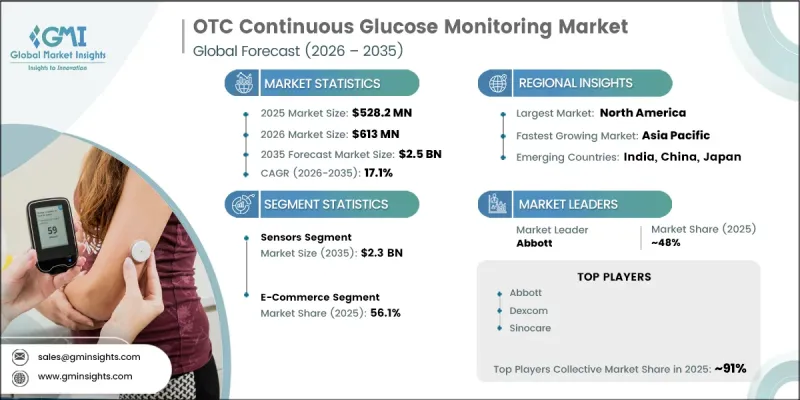
The OTC continuous glucose monitoring market is gaining strong traction as consumers increasingly seek convenient and accessible solutions for tracking metabolic health. OTC CGM systems are wearable glucose monitoring devices that can be purchased and used without a prescription, allowing broader access to continuous glucose tracking. While these technologies have traditionally supported diabetes management, their applications are expanding toward preventive health monitoring among individuals interested in understanding and improving their metabolic wellness. The growing acceptance of proactive healthcare practices, combined with rising consumer awareness, is accelerating adoption among diabetic, prediabetic, and health-focused populations. Technological improvements in sensor accuracy, device miniaturization, longer usage periods, and connectivity with smartphones and wearable platforms are further enhancing the user experience. These advancements are making OTC CGM devices more practical, convenient, and appealing for wider consumer adoption, supporting market expansion over the forecast period.
| Market Scope | |
|---|---|
| Start Year | 2025 |
| Forecast Year | 2026-2035 |
| Start Value | $528.2 Million |
| Forecast Value | $2.5 Billion |
| CAGR | 17.1% |
The sensors segment held 91% share in 2025. The leading position of sensors is supported by increasing demand for compact, wearable, and easy-to-use health monitoring solutions. As consumers prioritize continuous and non-invasive health tracking, advanced sensor technologies have become the central component of OTC CGM systems. Growing preference for lightweight, comfortable, and minimally disruptive monitoring devices is encouraging greater sensor adoption among both individuals managing glucose conditions and users focused on preventive health.
The prediabetic and at-risk individuals segment captured notable share in 2025. Rising cases of prediabetes and impaired glucose regulation worldwide are contributing significantly to the growth of this segment. Increasing concerns related to lifestyle-related health risks are encouraging consumers to adopt early monitoring solutions that help track glucose patterns and support better health decisions. The growing emphasis on preventive healthcare, early intervention, and personalized wellness management is further strengthening demand for OTC CGM devices among individuals with elevated diabetes risk.
North America OTC Continuous Glucose Monitoring Market held 53.9% share in 2025. The region, led by the U.S., represents a major market for OTC continuous glucose monitoring (CGM) devices due to increasing consumer interest in preventive healthcare, metabolic tracking, and personalized wellness solutions. Growing adoption among non-diabetic users, including individuals focused on fitness and proactive health management, is transforming CGMs from traditional medical monitoring tools into broader lifestyle-oriented health devices, thereby expanding the overall market opportunity.
Prominent players operating in the Global OTC continuous glucose monitoring industry include: Veri, Abbott, Levels Health, Dexcom, Zoe, January AI, Nutrisense, Sinocare, Ultrahuman Healthcare, Supersapiens, and Limbo (Vitals in View). Companies operating in the OTC continuous glucose monitoring market are strengthening their market position through product innovation, technology improvements, strategic partnerships, and expansion of consumer-focused health solutions. Leading participants are investing in advanced sensor technologies, improved data analytics platforms, and seamless digital integrations to enhance device performance and user engagement. Companies are also focusing on developing more affordable, accessible, and user-friendly CGM solutions to reach broader consumer groups. Expanding direct-to-consumer strategies, strengthening mobile health ecosystems, and improving personalized insights are becoming important approaches for gaining market share.
Table of Contents
Chapter 1 Research Methodology
- 1.1 Research approach
- 1.2 Quality commitments
- 1.2.1 GMI AI policy & data integrity commitment
- 1.2.1.1 Source consistency protocol
- 1.2.1 GMI AI policy & data integrity commitment
- 1.3 Research trail & confidence scoring
- 1.3.1 Research trail components
- 1.3.2 Scoring components
- 1.4 Data collection
- 1.4.1 Partial list of primary sources
- 1.5 Data mining sources
- 1.5.1 Paid sources
- 1.5.1.1 Sources, by region
- 1.5.1 Paid sources
- 1.6 Base estimates and calculations
- 1.6.1 Base year calculation for any one approach
- 1.7 Forecast model
- 1.7.1 Quantified market impact analysis
- 1.7.1.1 Mathematical impact of growth parameters on forecast
- 1.7.1 Quantified market impact analysis
- 1.8 Research transparency addendum
- 1.8.1 Source attribution framework
- 1.8.2 Quality assurance metrics
- 1.8.3 Our commitment to trust
Chapter 2 Executive Summary
- 2.1 Industry 360° synopsis
- 2.2 Key market trends
- 2.2.1 Regional trends
- 2.2.2 Component trends
- 2.2.3 Consumer type trends
- 2.2.4 Distribution channel trends
- 2.3 CXO perspectives: Strategic imperatives
Chapter 3 Industry Insights
- 3.1 Industry ecosystem analysis
- 3.2 Industry impact forces
- 3.2.1 Growth drivers
- 3.2.1.1 Rising consumer interest in metabolic health and wellness
- 3.2.1.2 Expansion of direct-to-consumer (DTC) and subscription models
- 3.2.1.3 Technological advancements and AI-powered insights
- 3.2.1.4 Shifts in preventive healthcare and longevity trends
- 3.2.2 Industry pitfalls and challenges
- 3.2.2.1 High costs and limited insurance coverage
- 3.2.2.2 Regulatory and data privacy concerns
- 3.2.3 Market opportunities
- 3.2.3.1 Integration with digital health ecosystems and wearable devices
- 3.2.3.2 Expansion into non-diabetic and preventive care markets
- 3.2.1 Growth drivers
- 3.3 Growth potential analysis
- 3.4 Regulatory landscape (Driven by primary research)
- 3.4.1 North America
- 3.4.2 Europe
- 3.4.3 Asia Pacific
- 3.5 Technology landscape
- 3.5.1 Current technological trends
- 3.5.2 Emerging technologies
- 3.6 Pricing trend analysis (Driven by primary research)
- 3.7 Future market trends
- 3.8 Porter's analysis
- 3.9 PESTEL analysis
- 3.10 Impact of AI and Generative AI on the market (Driven by primary research)
- 3.11 Value chain analysis (Driven by primary research)
- 3.12 Investment & funding analysis (Driven by primary research)
- 3.13 Consumer insights (Driven by primary research)
- 3.14 Pre- vs. Post-OTC clearance market structure shift
- 3.15 Gap analysis
Chapter 4 Competitive Landscape, 2025
- 4.1 Introduction
- 4.2 Company matrix analysis
- 4.3 Company market share analysis (Driven by primary research)
- 4.3.1 Global
- 4.3.2 North America
- 4.3.3 Europe
- 4.3.4 Asia Pacific
- 4.4 Competitive positioning matrix
- 4.5 Competitive analysis of major market players
- 4.6 Key developments
- 4.6.1 Mergers & acquisitions
- 4.6.2 Partnerships & collaborations
- 4.6.3 New product launches
- 4.6.4 Expansion plans
Chapter 5 Market Estimates and Forecast, By Component, 2022 - 2035 ($ Mn)
- 5.1 Key trends
- 5.2 Sensors
- 5.3 Platforms/Apps
Chapter 6 Market Estimates and Forecast, By Consumer Type, 2022 - 2035 ($ Mn)
- 6.1 Key trends
- 6.2 Non-diabetic health enthusiasts
- 6.3 Pre-diabetic and at-risk individuals
- 6.4 Other consumer types
Chapter 7 Market Estimates and Forecast, By Distribution Channel, 2022 - 2035 ($ Mn)
- 7.1 Key trends
- 7.2 Hospital pharmacies
- 7.3 Retail pharmacies
- 7.4 E-commerce
Chapter 8 Market Estimates and Forecast, By Region, 2022 - 2035 ($ Mn)
- 8.1 Key trends
- 8.2 North America
- 8.2.1 U.S.
- 8.2.2 Canada
- 8.3 Europe
- 8.3.1 Germany
- 8.3.2 UK
- 8.3.3 France
- 8.3.4 Spain
- 8.3.5 Italy
- 8.3.6 Netherlands
- 8.4 Asia Pacific
- 8.4.1 China
- 8.4.2 Japan
- 8.4.3 India
- 8.4.4 Australia
- 8.4.5 South Korea
- 8.5 Rest of World
Chapter 9 Company Profiles
- 9.1 Abbott
- 9.2 Dexcom
- 9.3 January AI
- 9.4 Levels Health
- 9.5 Limbo (Vitals in View)
- 9.6 Nutrisense
- 9.7 Sinocare
- 9.8 Supersapiens
- 9.9 Ultrahuman Healthcare
- 9.10 Veri
- 9.11 Zoe

