PUBLISHER: Global Market Insights Inc. | PRODUCT CODE: 2101958

PUBLISHER: Global Market Insights Inc. | PRODUCT CODE: 2101958
Stiffleg Crane Market Opportunity, Growth Drivers, Industry Trend Analysis, and Forecast 2026 - 2035
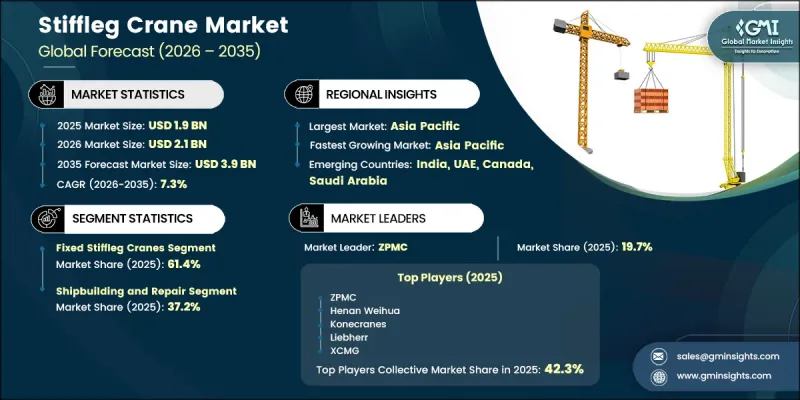
The Global Stiffleg Crane Market was valued at USD 1.9 billion in 2025 and is estimated to grow at a CAGR of 7.3% to reach USD 3.9 billion by 2035.
Market expansion is driven by sustained infrastructure development programs following the post-pandemic recovery phase, rising capital expenditure in bulk cargo handling facilities, and early-stage expansion of offshore renewable energy supply chains. Governments and private terminal operators are increasingly investing in port modernization projects, including berth upgrades, deep-water expansions, and new terminal developments designed to support larger vessels and higher cargo throughput. Growth is particularly strong across emerging economies where new port infrastructure is being developed from the ground up, generating strong demand for permanent heavy lifting systems. Stiffleg cranes are widely preferred in such applications due to their structural strength, high load-handling capability, and long operational lifespan, which aligns with long-term concession-based infrastructure planning. Investment trends indicate a growing preference for fixed heavy-lift systems in terminals handling bulk cargo and multipurpose operations, reinforcing long-term equipment demand across global port infrastructure networks.
| Market Scope | |
|---|---|
| Start Year | 2025 |
| Forecast Year | 2026-2035 |
| Start Value | $1.9 Billion |
| Forecast Value | $3.9 Billion |
| CAGR | 7.3% |
The fixed stiffleg crane segment accounted for 61.4% share in 2025, generating USD 1.16 billion, and is projected to reach USD 2.53 billion by 2035, expanding at a CAGR of 7.9%. This segment continues to lead due to its strong structural stability, high load capacity, and suitability for continuous heavy-duty lifting operations in permanent industrial environments. Fixed installations are increasingly favored in port and shipyard facilities where operational layouts remain unchanged over long periods, eliminating the need for mobility while improving lifting efficiency and structural reliability in repetitive handling applications.
The shipbuilding and repair application segment held 37.2% share in 2025, valued at USD 706.3 million, and is expected to grow at a CAGR of 8% through 2035, reaching USD 1.54 billion. This segment remains the largest contributor to application-based revenue due to strong demand from ship production facilities and maintenance yards. Growth is supported by increasing vessel production activity and the expansion of offshore energy-related manufacturing, where high-capacity lifting systems are required for assembling large structural components and handling complex fabrication processes.
North American Stiffleg Crane Market was valued at USD 216 million in 2025 and is projected to grow at a CAGR of 7.4%, reaching USD 446 million by 2035. Regional growth is driven by sustained investment in port infrastructure modernization, expanded maritime trade capacity, and federal funding support for waterway and terminal upgrades. Increasing development of coastal logistics hubs and industrial waterfront facilities is further strengthening demand for heavy-duty crane systems, particularly in large-scale cargo handling and marine construction applications.
Key companies operating in the global stiffleg crane market include Konecranes, Liebherr, ZPMC (Shanghai Zhenhua Heavy Industry Co., Ltd.), Henan Weihua Heavy Machinery Co., Ltd., XCMG, GH Cranes & Components, and Lampson International. Companies operating in the stiffleg crane market are strengthening their market position by focusing on product durability, high-capacity lifting solutions, and customization for large-scale port and industrial applications. Manufacturers are investing in advanced structural engineering and load optimization technologies to improve lifting performance and operational safety in heavy-duty environments. Strategic partnerships with port authorities, shipyards, and infrastructure developers are helping companies secure long-term supply contracts and expand their global footprint. Firms are also enhancing their after-sales service capabilities, including maintenance, retrofitting, and lifecycle support, to improve customer retention.
Table of Contents
Chapter 1 Methodology & Scope
- 1.1 Research approach
- 1.2 Quality Commitments
- 1.2.1 GMI AI policy & data integrity commitment
- 1.2.1.1 Source consistency protocol
- 1.2.1 GMI AI policy & data integrity commitment
- 1.3 Research Trail & Confidence Scoring
- 1.3.1 Research Trail Components
- 1.3.2 Scoring Components
- 1.4 Data Collection
- 1.4.1 Partial list of primary sources
- 1.5 Data mining sources
- 1.5.1 Paid sources
- 1.5.1.1 Sources, by region
- 1.5.1 Paid sources
- 1.6 Base estimates and calculations
- 1.6.1 Base year calculation
- 1.7 Forecast model
- 1.7.1 Quantified market impact analysis
- 1.7.1.1 Mathematical impact of growth parameters on forecast
- 1.7.1 Quantified market impact analysis
- 1.8 Research transparency addendum
- 1.8.1 Source attribution framework
- 1.8.2 Quality assurance metrics
- 1.8.3 Our commitment to trust
Chapter 2 Executive Summary
- 2.1 Industry 360° synopsis
- 2.2 Key market trends
- 2.2.1 Installation Type
- 2.2.2 Load Capacity
- 2.2.3 Propulsion
- 2.2.4 Application
- 2.2.5 End-User
- 2.3 TAM Analysis, 2026-2035
- 2.4 CXO perspectives: Strategic imperatives
Chapter 3 Industry Insights
- 3.1 Industry ecosystem analysis
- 3.1.1 Supplier landscape
- 3.1.2 Cost structure
- 3.1.3 Profit margin
- 3.1.4 Value addition at each stage
- 3.1.5 Vertical integration trends
- 3.1.6 Disruptors
- 3.2 Industry impact forces
- 3.2.1 Growth drivers
- 3.2.1.1 Expansion of Global Port Infrastructure
- 3.2.1.2 Growth in Shipbuilding and Offshore Projects
- 3.2.1.3 Increasing Bulk Commodity Trade
- 3.2.1.4 Rising Demand for Heavy Industrial Lifting
- 3.2.2 Industry pitfalls & challenges
- 3.2.2.1 High Capital and Installation Costs
- 3.2.2.2 Long Equipment Replacement Cycles
- 3.2.2.3 Competition from Alternative Crane Technologies
- 3.2.3 Market opportunities
- 3.2.3.1 Expansion of Port Modernization Projects
- 3.2.3.2 Growth in Offshore Wind Infrastructure
- 3.2.3.3 Digitalization and Smart Crane Technologies
- 3.2.3.4 Rising Industrial Infrastructure Investments
- 3.2.1 Growth drivers
- 3.3 Growth potential analysis
- 3.4 Technology and Innovation landscape
- 3.4.1 Current technologies
- 3.4.2 Emerging technologies
- 3.5 Pricing Analysis (Driven by Primary Research)
- 3.5.1 Historical Price Trend Analysis
- 3.5.2 Pricing Strategy by Player Type (Premium / Value / Cost-plus)
- 3.6 Regulatory landscape
- 3.6.1 North America
- 3.6.1.1 OSHA Crane & Derrick Standards
- 3.6.1.2 ASME B30.5 - Mobile & Locomotive Cranes
- 3.6.1.3 NCCCO Crane Operator Certification
- 3.6.1.4 CSA Z150 - Safety Code on Mobile Cranes
- 3.6.2 Europe
- 3.6.2.1 EU Machinery Regulation
- 3.6.2.2 EU Stage V Emission Standards
- 3.6.2.3 EN 13000 - Crane Safety Standard
- 3.6.2.4 LOLER - Lifting Equipment Regulations
- 3.6.3 Asia-Pacific
- 3.6.3.1 GB/T 14560 -Crane Safety Standard (China)
- 3.6.3.2 CCMA Crane Type Certification (China)
- 3.6.3.3 JCMA Safety Standards (Japan)
- 3.6.3.4 DGFASLI Crane Safety Regulations (India)
- 3.6.3.5 AS 2550.5 - Cranes Safety in Use (Australia)
- 3.6.4 Latin America
- 3.6.4.1 NR-11 & NR-12 Machinery Safety Regulations (Brazil)
- 3.6.4.2 NOM-009-STPS Lifting Equipment Regulations (Mexico)
- 3.6.5 Middle East & Africa
- 3.6.5.1 OSHAD Lifting Operations Code (UAE)
- 3.6.5.2 Saudi Aramco Lifting Equipment Standards
- 3.6.5.3 South Africa Lifting Machinery Regulations (SANS)
- 3.6.1 North America
- 3.7 Porter's analysis
- 3.8 PESTEL analysis
- 3.9 Patent analysis (Driven by Primary Research)
- 3.10 Trade Data Analysis (Driven by paid database)
- 3.10.1 Import/export volume & value trends
- 3.10.2 Key trade corridors & tariff impact
- 3.11 Cost breakdown analysis
- 3.12 Impact of AI & generative AI on the market
- 3.12.1 AI-Driven Disruption of Existing Business Models
- 3.12.2 Automated design optimization
- 3.12.3 Supply chain AI for demand forecasting
- 3.12.4 GenAI use cases & adoption roadmap by segment
- 3.12.5 Risks, Limitations & Regulatory Considerations
- 3.13 Capacity & Production Landscape (Driven by Primary Research)
- 3.13.1 Installed Capacity by Region & Key Producer
- 3.13.2 Capacity Utilization Rates & Expansion Pipelines
- 3.14 Sustainability and environmental aspects
- 3.14.1 Sustainable practices
- 3.14.2 Waste reduction strategies
- 3.14.3 Energy efficiency in production
- 3.14.4 Eco-friendly Initiatives
- 3.14.5 Carbon footprint considerations
- 3.15 Forecast assumptions & scenario analysis (Driven by Primary Research)
- 3.15.1 Base Case - key macro & industry variables driving CAGR
- 3.15.2 Optimistic Scenarios - Favorable Macro and Industry Tailwinds
- 3.15.3 Pessimistic Scenario - Macroeconomic slowdown or industry headwinds
Chapter 4 Competitive Landscape, 2025
- 4.1 Introduction
- 4.2 Company market share analysis
- 4.2.1 North America
- 4.2.2 Europe
- 4.2.3 Asia-Pacific
- 4.2.4 Latin America
- 4.2.5 Middle East & Africa
- 4.3 Competitive positioning matrix
- 4.4 Key developments
- 4.4.1 Mergers & acquisitions
- 4.4.2 Partnerships & collaborations
- 4.4.3 New product launches
- 4.4.4 Expansion plans and funding
- 4.5 Company tier benchmarking
- 4.5.1 Tier classification criteria & qualifying thresholds
- 4.5.2 Tier positioning matrix by revenue, geography & innovation
Chapter 5 Market Estimates & Forecast, By Installation Type, 2022 - 2035 ($Mn, Units)
- 5.1 Key trends
- 5.2 Fixed Stiffleg Cranes
- 5.3 Rail-Mounted / Traveling Stiffleg Cranes
Chapter 6 Market Estimates & Forecast, By Load Capacity, 2022 - 2035 ($Mn, Units)
- 6.1 Key trends
- 6.2 Up to 25 Tons
- 6.3 26 Tons to 50 Tons
- 6.4 51 Tons to 80 Tons
- 6.5 Above 80 Tons
Chapter 7 Market Estimates & Forecast, By Propulsion, 2022 - 2035 ($Mn, Units)
- 7.1 Key trends
- 7.2 Diesel
- 7.3 Electric / Hybrid
Chapter 8 Market Estimates & Forecast, By Application, 2022 - 2035 ($Mn, Units)
- 8.1 Key trends
- 8.2 Cargo Handling
- 8.3 Bulk Material Handling
- 8.4 Shipbuilding & Repair
- 8.5 Heavy Lift Operations
- 8.6 Equipment Maintenance & Installation
- 8.7 Offshore Supply & Logistics Support
Chapter 9 Market Estimates & Forecast, By End-User, 2022 - 2035 ($Mn, Units)
- 9.1 Key trends
- 9.2 Ports & Harbors
- 9.3 Shipyards
- 9.4 Marine & Offshore
- 9.5 Industrial Manufacturing
- 9.6 Mining & Bulk Terminals
- 9.7 Power & Utilities
Chapter 10 Market Estimates & Forecast, By Region, 2022 - 2035 ($Mn, Units)
- 10.1 North America
- 10.1.1 US
- 10.1.2 Canada
- 10.2 Europe
- 10.2.1 UK
- 10.2.2 Germany
- 10.2.3 France
- 10.2.4 Italy
- 10.2.5 Spain
- 10.2.6 Belgium
- 10.2.7 Netherlands
- 10.2.8 Sweden
- 10.2.9 Russia
- 10.3 Asia Pacific
- 10.3.1 China
- 10.3.2 India
- 10.3.3 Japan
- 10.3.4 Australia
- 10.3.5 Singapore
- 10.3.6 South Korea
- 10.3.7 Vietnam
- 10.3.8 Indonesia
- 10.3.9 Thailand
- 10.4 Latin America
- 10.4.1 Brazil
- 10.4.2 Mexico
- 10.4.3 Argentina
- 10.5 MEA
- 10.5.1 South Africa
- 10.5.2 Saudi Arabia
- 10.5.3 UAE
- 10.5.4 Turkey
Chapter 11 Company Profiles
- 11.1 Global Players
- 11.1.1 ZPMC
- 11.1.2 Kobelco
- 11.1.3 Konecranes
- 11.1.4 Liebherr
- 11.1.5 Manitowoc
- 11.1.6 SANY
- 11.1.7 Tadano
- 11.1.8 Terex
- 11.2 Regional Players
- 11.2.1 Henan Weihua
- 11.2.2 GH Cranes & Components
- 11.2.3 Konecranes Gottwald
- 11.2.4 Lampson International
- 11.2.5 Nucleon Crane
- 11.2.6 XCMG
- 11.2.7 Yongmao
- 11.2.8 Zoomlion
- 11.3 Emerging Players / Disruptors
- 11.3.1 PLM Cranes
- 11.3.2 Shenyang Baoquan
- 11.3.3 Somerset Engineering
- 11.3.4 Thunder Cranes

