PUBLISHER: Global Market Insights Inc. | PRODUCT CODE: 2101967

PUBLISHER: Global Market Insights Inc. | PRODUCT CODE: 2101967
Hyperscale Data Center Market Opportunity, Growth Drivers, Industry Trend Analysis, and Forecast 2026 - 2035
The Global Hyperscale Data Center Market was valued at USD 80.9 billion in 2025 and is estimated to grow at a CAGR of 22.2% to reach USD 624.2 billion by 2035.
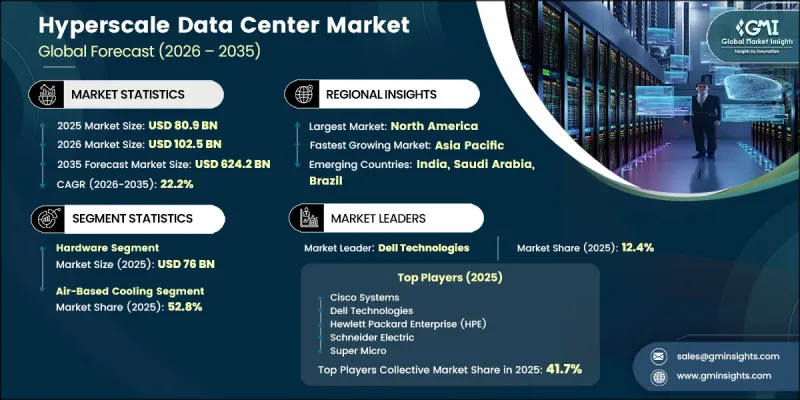
The market expansion is shaped by major changes in computing infrastructure, including the shift toward AI-focused architectures, high-performance computing environments, and increased dependence on cloud-based enterprise platforms. The growing need for advanced processing capacity for artificial intelligence applications is encouraging hyperscale operators to deploy GPU-intensive server environments with significantly higher rack power densities compared with traditional computing systems. AI model development and large-scale data processing require advanced infrastructure capable of supporting high-performance workloads, creating substantial demand for hyperscale facilities. Enterprise digital transformation and the continued movement of business applications to public cloud platforms are further strengthening market growth. In addition, hyperscale companies are increasing investments in renewable energy procurement to support sustainability objectives and meet rising power requirements. The technology sector represented nearly 40% of corporate renewable power purchase agreements in 2025, highlighting the increasing role of hyperscale operators in clean energy adoption. Large-scale renewable energy agreements signed by major technology companies demonstrate a long-term approach toward securing reliable and sustainable energy sources for future data center expansion.
| Market Scope | |
|---|---|
| Start Year | 2025 |
| Forecast Year | 2026-2035 |
| Start Value | $80.9 Billion |
| Forecast Value | $624.2 Billion |
| CAGR | 22.2% |
The hardware segment accounted for USD 76 billion, representing 93.9% share in 2025. This dominance is attributed to the significant capital requirements associated with hyperscale infrastructure development. Servers, storage systems, networking equipment, power management solutions, and cooling technologies collectively account for most of the investment required to establish and expand hyperscale facilities.
Air-based cooling systems segment held a 52.8% share, valued at USD 42.7 billion in 2025, owing to increasing thermal management requirements from AI-driven GPU infrastructure. Direct-to-chip (DTC) liquid cooling has emerged as the most adopted liquid cooling method, as it enables coolant circulation through cold plates attached directly to processors and memory components. This approach provides effective heat removal while allowing integration with existing data center designs without requiring complete infrastructure replacement.
North America Hyperscale Data Center Market held 42.8% share in 2025. The region continues to serve as the foundation of worldwide hyperscale investment, supported by significant infrastructure expansion from leading cloud and technology companies across major data center hubs. Continued capital spending by Amazon Web Services, Microsoft Azure, Google Cloud, Meta Platforms, and Oracle is contributing to the development of advanced hyperscale facilities across key markets, strengthening North America's position in the global industry.
Key players operating in the global hyperscale data center market include Schneider Electric, Vertiv Group, Dell Technologies, Hewlett Packard Enterprise (HPE), Cisco Systems, Huawei Technologies, Super Micro Computer, Arista Networks, Lenovo, Eaton, Legrand, Hitachi, Gigabyte Technology, MiTAC Holdings, Cormant Technologies, Mortenson Construction, DPR Construction, Vast Data, LiquidStack, and GRC. Companies operating in the hyperscale data center market are adopting strategies focused on infrastructure expansion, strategic partnerships, technological innovation, and sustainability initiatives to strengthen their market position. Industry participants are investing in advanced cooling solutions, high-density computing infrastructure, renewable energy integration, and next-generation networking technologies to address increasing AI and cloud workload requirements. Companies are also expanding their global data center footprints through new facility construction, acquisitions, and collaborations with energy providers and technology partners. Developing energy-efficient designs, improving operational reliability, and enhancing data center automation capabilities are key priorities for market participants.
Table of Contents
Chapter 1 Research Methodology
- 1.1 Research approach
- 1.2 Quality Commitments
- 1.2.1 GMI AI policy & data integrity commitment
- 1.3 Research Trail & Confidence Scoring
- 1.3.1 Research Trail Components
- 1.3.2 Scoring Components
- 1.4 Data Collection
- 1.5 Data mining sources
- 1.5.1 Paid sources
- 1.6 Base estimates and calculations
- 1.6.1 Base year calculation
- 1.7 Forecast model
- 1.7.1 Quantified market impact analysis
- 1.8 Research transparency addendum
- 1.8.1 Source attribution framework
- 1.8.2 Quality assurance metrics
- 1.8.3 Our commitment to trust
Chapter 2 Executive Summary
- 2.1 Industry 360° synopsis
- 2.2 Key market trends
- 2.2.1 Regional
- 2.2.2 Component
- 2.2.3 Cooling Technique
- 2.2.4 Power Capacity
- 2.2.5 Industry Vertical
- 2.3 TAM analysis, 2026-2035
- 2.4 CXO perspectives: Strategic imperatives
Chapter 3 Industry Insights
- 3.1 Industry ecosystem analysis
- 3.1.1 Supplier landscape
- 3.1.2 Profit margin
- 3.1.3 Cost structure
- 3.1.4 Value addition at each stage
- 3.1.5 Factor affecting the value chain
- 3.1.6 Disruptions
- 3.2 Industry impact forces
- 3.2.1 Growth drivers
- 3.2.1.1 Surging AI & ML Workload Demand Driving GPU-Dense Cluster Deployments
- 3.2.1.2 Rapid Enterprise Cloud Migration & Public Cloud Adoption Across Verticals
- 3.2.1.3 Exponential Data Growth from IoT, 5G Rollout & Streaming Applications
- 3.2.1.4 Rising Adoption of Cloud Computing Services
- 3.2.2 Industry pitfalls and challenges
- 3.2.2.1 Power Grid Constraints & Interconnection Queue Delays
- 3.2.2.2 Equipment Supply Chain Bottlenecks
- 3.2.3 Market opportunities
- 3.2.3.1 Liquid & Immersion Cooling Adoption Enabling Higher Power Density Deployments
- 3.2.3.2 Greenfield Hyperscale Expansion into Emerging Markets
- 3.2.3.3 On-site Renewable Energy & SMR Integration Reducing Grid Dependency
- 3.2.1 Growth drivers
- 3.3 Technology and innovation landscape
- 3.3.1 Current technological trends
- 3.3.1.1 High-Density GPU/AI-Accelerated Computing Clusters
- 3.3.1.2 Software-Defined Networking (SDN) & Hyperscale Fabric Architectures
- 3.3.1.3 Modular & Prefabricated Data Center Construction
- 3.3.2 Emerging technologies
- 3.3.2.1 Direct-to-Chip Liquid & Immersion Cooling at Scale
- 3.3.2.2 Small Modular Reactors (SMRs) & On-Site Renewable Power Integration
- 3.3.2.3 AI-Driven Data Center Operations (AIOps) & Predictive Infrastructure Management
- 3.3.1 Current technological trends
- 3.4 Growth potential analysis
- 3.5 Regulatory landscape
- 3.5.1 North America
- 3.5.1.1 US - Environmental Protection Agency (EPA)
- 3.5.1.2 US - DOE (Department of Energy)
- 3.5.2 Europe
- 3.5.2.1 EU - European Commission (EC)
- 3.5.2.2 EU - European Data Protection Board (EDPB)
- 3.5.3 Asia Pacific
- 3.5.3.1 China - MIIT (Ministry of Industry and Information Technology)
- 3.5.3.2 India - Ministry of Electronics and Information Technology (MeitY)
- 3.5.4 LATAM
- 3.5.4.1 Mexico - Instituto Federal de Telecomunicaciones (IFT)
- 3.5.4.2 Brazil - ANATEL
- 3.5.5 MEA
- 3.5.5.1 UAE - TRA (Telecommunications and Digital Government Regulatory Authority)
- 3.5.5.2 Saudi Arabia - CST (Communications, Space and Technology Commission)
- 3.5.1 North America
- 3.6 Porter’s analysis
- 3.7 PESTEL analysis
- 3.8 Cost breakdown analysis, 2025
- 3.9 Patent analysis (Driven by Primary Research)
- 3.10 Power Grid Readiness Analysis
- 3.10.1 Grid Capacity & Interconnection Queue Analysis by Region
- 3.10.2 Time-to-Power Gaps & Utility-Hyperscaler Alignment Challenges
- 3.10.3 Power Purchase Agreements (PPAs) & Long-Term Grid Contract Strategies
- 3.11 Data Center Capacity & Infrastructure Landscape
- 3.11.1 Installed capacity (MW) by country , 2025
- 3.11.2 Expansion pipeline, 2026-2030
- 3.11.3 Utilization rates & supply-demand
- 3.12 Sustainability and environmental aspects
- 3.12.1 Sustainable practices
- 3.12.2 Waste reduction strategies
- 3.12.3 Energy efficiency in production
- 3.12.4 Eco-friendly Initiatives
- 3.12.5 Carbon footprint considerations
- 3.13 Impact of AI & generative AI on the market
- 3.13.1 AI-driven disruption of existing business models
- 3.13.2 GenAI use cases & adoption roadmap by segment
- 3.13.3 Risks, limitations & regulatory considerations
- 3.14 Forecast assumptions & scenario analysis (Driven by Primary Research)
- 3.14.1 Base Case- Key Macro & Industry Variables Driving CAGR
- 3.14.2 Optimistic Scenarios- Favorable macro and industry tailwinds
- 3.14.3 Pessimistic Scenario - Macroeconomic slowdown or industry headwinds
Chapter 4 Competitive Landscape, 2025
- 4.1 Introduction
- 4.2 Company market share analysis
- 4.2.1 North America
- 4.2.2 Europe
- 4.2.3 Asia Pacific
- 4.2.4 LATAM
- 4.2.5 MEA
- 4.3 Competitive analysis of major market players
- 4.4 Competitive positioning matrix
- 4.5 Key developments
- 4.5.1 Mergers & acquisitions
- 4.5.2 Partnerships & collaborations
- 4.5.3 New product launches
- 4.5.4 Expansion plans and funding
- 4.6 Company tier benchmarking
- 4.6.1 Tier classification criteria & qualifying thresholds
- 4.6.2 Tier positioning matrix by revenue, geography & innovation
Chapter 5 Market Estimates and Forecast, By Component, 2022 – 2035 ($ Mn, Units)
- 5.1 Key trends
- 5.2 Hardware
- 5.2.1 IT Infrastructure
- 5.2.1.1 Servers
- 5.2.1.1.1 Rack Servers
- 5.2.1.1.2 Blade Servers
- 5.2.1.1.3 GPU/AI Accelerated Servers
- 5.2.1.2 Storage
- 5.2.1.3 Networking Equipment
- 5.2.1.1 Servers
- 5.2.2 Power Infrastructure
- 5.2.3 Cooling Infrastructure
- 5.2.4 Support Infrastructure
- 5.2.1 IT Infrastructure
- 5.3 Software
- 5.3.1 Data Center Infrastructure Management (DCIM) Software
- 5.3.2 Network Management & SDN Software
- 5.3.3 Security, Identity & Compliance Software
- 5.3.4 Analytics Platforms
- 5.3.5 Others
- 5.4 Services
- 5.4.1 Professional Services
- 5.4.1.1 Consulting & Advisory
- 5.4.1.2 Design & Engineering
- 5.4.1.3 Installation & Integration
- 5.4.1.4 Testing & Commissioning
- 5.4.2 Managed Services
- 5.4.1 Professional Services
Chapter 6 Market Estimates and Forecast, By Cooling Technique, 2022 – 2035 ($ Mn)
- 6.1 Key trends
- 6.2 Air-Based Cooling
- 6.3 Liquid Cooling
- 6.4 Immersion Cooling
- 6.5 Hybrid Cooling
Chapter 7 Market Estimates and Forecast, By Power Capacity, 2022 – 2035 ($ Mn, MW )
- 7.1 Key trends
- 7.2 20 MW-50 MW
- 7.3 50 MW-100 MW
- 7.4 100 MW-150 MW
- 7.5 150 MW & Above
Chapter 8 Market Estimates and Forecast, By Industry Vertical, 2022 – 2035 ($ Mn, MW)
- 8.1 Key trends
- 8.2 Cloud Service Providers (CSPs)
- 8.3 IT & Telecommunications
- 8.4 BFSI
- 8.5 Government & Defense
- 8.6 Healthcare & Life Sciences
- 8.7 Retail & E-commerce
- 8.8 Manufacturing
- 8.9 Media & Entertainment
- 8.10 Energy & Utilities
- 8.11 Others
Chapter 9 Market Estimates & Forecast, By Region, 2022 - 2035 ($Mn, MW)
- 9.1 Key trends
- 9.2 North America
- 9.2.1 US
- 9.2.2 Canada
- 9.3 Europe
- 9.3.1 Germany
- 9.3.2 UK
- 9.3.3 France
- 9.3.4 Italy
- 9.3.5 Spain
- 9.3.6 Netherlands
- 9.3.7 Denmark
- 9.3.8 Sweden
- 9.3.9 Norway
- 9.4 Asia Pacific
- 9.4.1 China
- 9.4.2 India
- 9.4.3 Japan
- 9.4.4 South Korea
- 9.4.5 Australia
- 9.4.6 Singapore
- 9.4.7 Thailand
- 9.4.8 Indonesia
- 9.4.9 Malaysia
- 9.5 Latin America
- 9.5.1 Brazil
- 9.5.2 Mexico
- 9.5.3 Argentina
- 9.5.4 Chile
- 9.6 MEA
- 9.6.1 South Africa
- 9.6.2 Saudi Arabia
- 9.6.3 UAE
Chapter 10 Company Profiles
- 10.1 Global players
- 10.1.1 Schneider Electric
- 10.1.2 Vertiv Group
- 10.1.3 Dell Technologies
- 10.1.4 Hewlett Packard Enterprise (HPE)
- 10.1.5 Cisco Systems
- 10.1.6 Huawei Technologies
- 10.1.7 Super Micro
- 10.1.8 Arista Networks
- 10.1.9 Lenovo
- 10.1.10 Eaton
- 10.1.11 Legrand
- 10.1.12 Hitachi
- 10.2 Regional players
- 10.2.1 Gigabyte Technology
- 10.2.2 MiTAC Holdings
- 10.2.3 Cormant Technologies
- 10.2.4 Mortenson Construction
- 10.2.5 DPR Construction
- 10.3 Emerging players
- 10.3.1 Vast Data
- 10.3.2 LiquidStack
- 10.3.3 GRC

