PUBLISHER: Global Market Insights Inc. | PRODUCT CODE: 2101971

PUBLISHER: Global Market Insights Inc. | PRODUCT CODE: 2101971
mRNA Vaccines Market Opportunity, Growth Drivers, Industry Trend Analysis, and Forecast 2026 - 2035
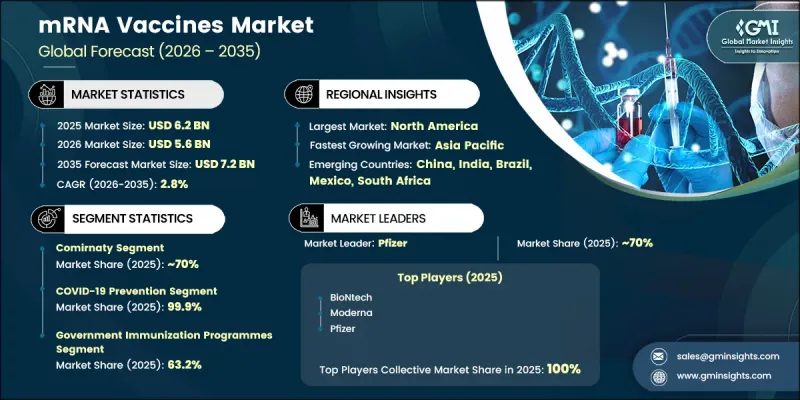
The Global mRNA Vaccines Market was valued at USD 6.2 billion in 2025 and is estimated to grow at a CAGR of 2.8% to reach USD 7.2 billion by 2035.
The market is expected to recover steadily as mRNA technology continues gaining acceptance across a wider range of healthcare applications. Increasing research activity in infectious disease prevention, therapeutic applications, regenerative medicine, and next-generation vaccine development is creating new growth opportunities. Advancements in mRNA delivery systems, lipid nanoparticle (LNP) technologies, and manufacturing capabilities are further improving the scalability and effectiveness of these vaccines. mRNA vaccines work by using messenger RNA molecules to guide cells in producing specific antigens that trigger immune responses against targeted conditions. Their ability to support rapid development, adaptable manufacturing processes, and scalable production has positioned mRNA technology as a significant innovation platform within modern vaccine development. These advantages continue to encourage broader exploration of mRNA-based solutions beyond traditional vaccine applications.
| Market Scope | |
|---|---|
| Start Year | 2025 |
| Forecast Year | 2026-2035 |
| Start Value | $6.2 Billion |
| Forecast Value | $7.2 Billion |
| CAGR | 2.8% |
The comirnaty segment held a 70% share in 2025. Despite the decline in overall COVID-19 vaccine demand, Comirnaty has maintained market leadership due to its established global distribution network, continued regulatory acceptance, and ongoing utilization in vaccination programs. The product benefits from its early market entry, extensive approval history, and availability across major healthcare markets. Continued confidence in its effectiveness, safety profile, and use among priority populations has supported its sustained demand through seasonal vaccination initiatives.
The government immunization programs segment held 63.2% share in 2025 and is projected to reach USD 4.2 billion during 2026-2035. Public health agencies continue to play a critical role in supporting mRNA vaccine adoption through funding, procurement activities, and large-scale distribution programs. Government-led vaccination initiatives remain essential for maintaining coverage among vulnerable groups and supporting seasonal immunization campaigns. International health collaborations and public sector efforts to improve vaccine availability have also strengthened supply networks and supported the continued importance of government immunization programs within the market.
North America mRNA Vaccines Market accounted for 45.3% share in 2025. The region maintains a strong position due to the presence of major biotechnology and pharmaceutical companies involved in mRNA research, development, and commercialization. Continued investments in advanced research infrastructure, clinical development programs, and manufacturing capabilities are supporting the creation of next-generation mRNA vaccines and therapeutic solutions. The region's strong innovation ecosystem and established healthcare infrastructure continue to contribute significantly to market growth.
Prominent players operating in the global mRNA vaccines market include global companies such as Pfizer, BioNTech, and Moderna, along with pipeline-focused companies including Daiichi Sankyo, Ethris, Meiji Seika Pharma, Arcturus Therapeutics, Sanofi, Providence Therapeutics, Strand Therapeutics, and Orna Therapeutics. Companies operating in the mRNA vaccines market are strengthening their market presence through continuous research and development, strategic collaborations, pipeline expansion, and investments in advanced manufacturing capabilities. Key industry participants are focusing on improving mRNA delivery technologies, enhancing vaccine stability, and developing new applications beyond infectious disease prevention. Companies are also expanding clinical trial programs, forming research partnerships, and increasing production capacity to support future demand. Strategic licensing agreements, technology collaborations, and investments in next-generation platforms are helping businesses accelerate innovation and strengthen competitive positioning.
Table of Contents
Chapter 1 Methodology and Scope
- 1.1 Market scope and definition
- 1.2 Research approach
- 1.3 Quality commitments
- 1.3.1 GMI AI policy & data integrity commitment
- 1.3.1.1 Source consistency protocol
- 1.3.1 GMI AI policy & data integrity commitment
- 1.4 Research trail & confidence scoring
- 1.4.1 Research trail components
- 1.4.2 Scoring components
- 1.5 Data collection
- 1.5.1 Partial list of primary sources
- 1.6 Data mining sources
- 1.6.1 Paid sources
- 1.6.1.1 Sources, by region
- 1.6.1 Paid sources
- 1.7 Base estimates and calculations
- 1.7.1 Base year calculation for any one approach
- 1.8 Forecast model
- 1.8.1 Quantified market impact analysis
- 1.8.1.1 Mathematical impact of growth parameters on forecast
- 1.8.1 Quantified market impact analysis
- 1.9 Research transparency addendum
- 1.9.1 Source attribution framework
- 1.9.2 Quality assurance metrics
- 1.9.3 Our commitment to trust
Chapter 2 Executive Summary
- 2.1 Industry 360° synopsis
- 2.2 Key market trends
- 2.2.1 Regional trends
- 2.2.2 Product trends
- 2.2.3 Application trends
- 2.2.4 Patient trends
- 2.2.5 End use trends
- 2.3 CXO perspectives: Strategic imperatives
Chapter 3 Industry Insights
- 3.1 Industry ecosystem analysis
- 3.1.1 Supplier landscape
- 3.1.2 Value addition at each stage
- 3.1.3 Factors affecting the value chain
- 3.2 Industry impact forces
- 3.2.1 Growth drivers
- 3.2.1.1 Growing demand for rapid vaccine development platforms
- 3.2.1.2 Expanding applications beyond COVID-19
- 3.2.1.3 Advancements in Lipid Nanoparticle (LNP) delivery technologies
- 3.2.1.4 Strong commercial success of COVID-19 mRNA vaccines
- 3.2.2 Industry pitfalls and challenges
- 3.2.2.1 High manufacturing and cold-chain logistics costs
- 3.2.2.2 Limited number of commercially approved products
- 3.2.2.3 Declining COVID-19 vaccination demand
- 3.2.3 Market opportunities
- 3.2.3.1 Expansion of personalized cancer vaccines
- 3.2.3.2 Development of combination and multivalent therapies
- 3.2.1 Growth drivers
- 3.3 Growth potential analysis
- 3.4 Technology and innovation landscape
- 3.4.1 Current technological trends
- 3.4.2 Emerging technologies (Driven by Primary Research)
- 3.5 Pricing trend analysis (Driven by Primary Research)
- 3.6 Regulatory landscape (Driven by Primary Research)
- 3.6.1 North America
- 3.6.2 Europe
- 3.6.3 Asia Pacific
- 3.6.4 Latin America
- 3.6.5 MEA
- 3.7 Porter's analysis
- 3.8 PESTEL analysis
- 3.9 Impact of AI and Gen AI on the market
- 3.10 Clinical trial/pipeline analysis (Driven by Primary Research)
- 3.10.1 Vaccine products
- 3.10.2 Non-vaccine products
- 3.11 Future market trends
- 3.12 Future market potential analysis - Global (Pipeline-driven market projection)
- 3.12.1 mRNA vaccines
- 3.12.2 mRNA drugs
- 3.13 Total addressable market - Global
- 3.13.1 mRNA vaccines
- 3.13.2 mRNA drugs
Chapter 4 Competitive Landscape, 2025
- 4.1 Introduction
- 4.2 Company market share analysis
- 4.3 Company matrix analysis
- 4.4 Competitive analysis of major market players
- 4.5 Competitive positioning matrix
- 4.6 Key developments
- 4.6.1 Merger and acquisition
- 4.6.2 Partnership and collaboration
- 4.6.3 New product launches
- 4.6.4 Expansion plans
Chapter 5 Market Estimates and Forecast, By Product, 2022 - 2035 ($ Mn)
- 5.1 Key trends
- 5.2 Comirnaty
- 5.3 Spikevax
- 5.4 mRESVIA
- 5.5 Other products
Chapter 6 Market Estimates and Forecast, By Application, 2022 - 2035 ($ Mn)
- 6.1 Key trends
- 6.2 COVID-19 prevention
- 6.3 Respiratory syncytial virus (RSV) prevention
Chapter 7 Market Estimates and Forecast, By Patient, 2022 - 2035 ($ Mn)
- 7.1 Key trends
- 7.2 Pediatric
- 7.3 Adult
- 7.4 Geriatric
Chapter 8 Market Estimates and Forecast, By End Use, 2022 - 2035 ($ Mn)
- 8.1 Key trends
- 8.2 Hospitals and clinics
- 8.3 Government immunization programmes
- 8.4 Other end users
Chapter 9 Market Estimates and Forecast, By Region, 2022 - 2035 ($ Mn)
- 9.1 Key trends
- 9.2 North America
- 9.2.1 U.S.
- 9.2.2 Canada
- 9.3 Europe
- 9.3.1 Germany
- 9.3.2 UK
- 9.3.3 France
- 9.3.4 Spain
- 9.3.5 Italy
- 9.3.6 Netherlands
- 9.4 Asia Pacific
- 9.4.1 China
- 9.4.2 India
- 9.4.3 Japan
- 9.4.4 Australia
- 9.4.5 South Korea
- 9.5 Latin America
- 9.5.1 Brazil
- 9.5.2 Mexico
- 9.5.3 Argentina
- 9.6 Middle East and Africa
- 9.6.1 South Africa
- 9.6.2 Saudi Arabia
- 9.6.3 UAE
Chapter 10 Company Profiles
- 10.1 Global players
- 10.1.1 Pfizer
- 10.1.2 BioNTech
- 10.1.3 Moderna
- 10.2 Pipeline players
- 10.2.1 Daiichi Sankyo
- 10.2.2 Ethris
- 10.2.3 Meiji Seika Pharma
- 10.2.4 Arcturus Therapeutics
- 10.2.5 Sanofi
- 10.2.6 Providence Therapeutics
- 10.2.7 Strand Therapeutics
- 10.2.8 Orna Therapeutics

