PUBLISHER: Global Market Insights Inc. | PRODUCT CODE: 2101994

PUBLISHER: Global Market Insights Inc. | PRODUCT CODE: 2101994
Current Sensor Market Opportunity, Growth Drivers, Industry Trend Analysis, and Forecast 2026 - 2035
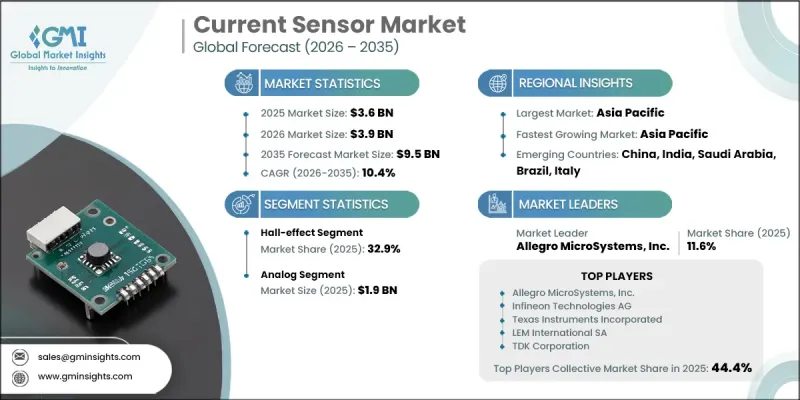
The Global Current Sensor Market was valued at USD 3.6 billion in 2025 and is estimated to grow at a CAGR of 10.4% to reach USD 9.5 billion by 2035.
Market expansion is driven by the rapid electrification of transportation systems, increasing integration of renewable energy infrastructure, growing industrial automation, and the modernization of smart grid networks across global economies. Rising demand for precise power measurement and energy optimization in automotive systems, industrial equipment, and energy platforms is further reinforcing adoption. Governments worldwide are supporting electrification initiatives and renewable energy deployment, which is accelerating the integration of advanced sensing technologies. Utilities are also investing heavily in smart grid upgrades, digital substations, and advanced metering systems to improve grid reliability and accommodate variable renewable energy inputs. The expansion of electric vehicle ecosystems, battery energy storage systems, and high-efficiency power electronics continues to strengthen demand for accurate real-time current monitoring solutions. As industries transition toward smarter, more connected, and energy-efficient operations, current sensors are becoming essential components for ensuring system performance, safety, and energy optimization across multiple applications.
| Market Scope | |
|---|---|
| Start Year | 2025 |
| Forecast Year | 2026-2035 |
| Start Value | $3.6 Billion |
| Forecast Value | $9.5 Billion |
| CAGR | 10.4% |
The hall-effect segment accounted for 32.9% share in 2025, maintaining a leading position due to its widespread use across electric mobility, industrial automation, renewable energy systems, and consumer electronics. Its popularity is driven by advantages such as high measurement accuracy, cost efficiency, non-contact sensing, and electrical isolation, making it suitable for monitoring both AC and DC currents in critical systems such as power conversion units, motor drives, and battery management architectures.
The analog segment reached USD 1.9 billion in 2025. This segment continues to dominate due to its extensive deployment across automotive systems, industrial automation platforms, power supply units, and renewable energy applications. Analog current sensing technology is widely valued for its reliability, fast response, cost-effectiveness, and ability to deliver continuous real-time current measurements. Its straightforward integration into motor control systems, energy storage solutions, and inverter applications supports strong demand across high-volume manufacturing environments.
North America Current Sensor Market held 31.1% share in 2025, driven by rising adoption of electric vehicles, expansion of clean energy projects, and ongoing smart grid modernization initiatives. Increasing demand from battery management systems, EV charging infrastructure, industrial automation, and energy storage applications continues to accelerate regional growth. Continuous investments from both public and private sectors in advanced manufacturing capabilities, grid modernization programs, and semiconductor innovation are further strengthening the region's market position.
Major companies operating in the global current sensor market include Allegro MicroSystems, Inc., Infineon Technologies AG, Texas Instruments Incorporated, LEM International SA, Honeywell International Inc., TE Connectivity, Vishay Intertechnology, Inc., Littelfuse, Inc., Omron Corporation, TDK Corporation, Melexis, Asahi Kasei Microdevices Corporation, Sensitec GmbH, VACUUMSCHMELZE GmbH & Co. KG, TAMURA Corporation, NVE Corporation, Kohshin Electric Corporation, Aceinna, and ROHM Co., Ltd. Companies in the current sensor market are strengthening their competitive positioning through continuous innovation in sensing accuracy, miniaturization, and energy-efficient designs. Manufacturers are heavily investing in research and development to improve sensor precision, temperature stability, and integration capabilities for next-generation electronics. Strategic collaborations with automotive OEMs, renewable energy developers, and industrial automation providers are accelerating product adoption across high-growth applications. Firms are also expanding manufacturing capacity and enhancing supply chain resilience to meet rising global demand.
Table of Contents
Chapter 1 Methodology and Scope
- 1.1 Market scope and definition
- 1.2 Research design
- 1.2.1 Research approach
- 1.2.2 Data collection methods
- 1.3 Data mining sources
- 1.3.1 Global
- 1.3.2 Regional/Country
- 1.4 Base estimates and calculations
- 1.4.1 Base year calculation
- 1.4.2 Key trends for market estimation
- 1.5 Primary research and validation
- 1.5.1 Primary sources
- 1.6 Forecast model
- 1.7 Research assumptions and limitations
Chapter 2 Executive Summary
- 2.1 Industry 360° synopsis, 2022 - 2035
- 2.2 Key market trends
- 2.2.1 Technology trends
- 2.2.2 Loop trends
- 2.2.3 Output trends
- 2.2.4 Application trends
- 2.2.5 End-use industry trends
- 2.3 TAM Analysis, 2026-2035
- 2.4 CXO perspectives: Strategic imperatives
Chapter 3 Industry Insights
- 3.1 Industry ecosystem analysis
- 3.1.1 Supplier Landscape
- 3.1.2 Profit Margin
- 3.1.3 Cost structure
- 3.1.4 Value addition at each stage
- 3.1.5 Factor affecting the value chain
- 3.1.6 Disruptions
- 3.2 Industry impact forces
- 3.2.1 Growth drivers
- 3.2.1.1 Rapid electrification of transportation
- 3.2.1.2 Expansion of renewable energy and energy storage systems
- 3.2.1.3 Growing industrial automation and smart manufacturing
- 3.2.1.4 Modernization of smart grid infrastructure
- 3.2.1.5 Increasing demand for energy-efficient electronic systems
- 3.2.2 Industry pitfalls and challenges
- 3.2.2.1 High cost of advanced current sensing technologies
- 3.2.2.2 Accuracy limitations under harsh operating conditions
- 3.2.3 Market opportunities
- 3.2.3.1 Expansion of electric vehicles and battery energy storage systems
- 3.2.3.2 Growing adoption of smart grids and Industry 4.0
- 3.2.1 Growth drivers
- 3.3 Growth potential analysis
- 3.4 Pricing Analysis (Driven by Primary Research)
- 3.4.1 Historical Price Trend Analysis
- 3.4.2 Pricing Strategy by Player Type (Premium / Value / Cost-plus)
- 3.5 Regulatory landscape
- 3.5.1 North America
- 3.5.2 Europe
- 3.5.3 Asia Pacific
- 3.5.4 Latin America
- 3.5.5 Middle East & Africa
- 3.6 Porter's analysis
- 3.7 PESTEL analysis
- 3.8 Trade Data Analysis (Based on Paid Database)
- 3.8.1 Import/Export Volume & Value Trends
- 3.8.2 Key Trade Corridors & Tariff Impact
- 3.9 Impact of AI & Generative AI on the Market (Driven by Primary Research)
- 3.9.1 AI-Driven Disruption of Existing Business Models
- 3.9.2 GenAI Use Cases & Adoption Roadmap by Segment
- 3.10 Capacity & Production Landscape (Driven by Primary Research)
- 3.10.1 Production Capacity by Key Producer
- 3.10.2 Capacity Utilization Rates & Expansion Pipelines
Chapter 4 Competitive Landscape, 2025
- 4.1 Introduction
- 4.2 Company market share analysis, 2025
- 4.2.1 By Region
- 4.2.1.1 North America
- 4.2.1.2 Europe
- 4.2.1.3 Asia-Pacific
- 4.2.1.4 Latin America
- 4.2.1.5 Middle East and Africa
- 4.2.2 Market Concentration Analysis
- 4.2.1 By Region
- 4.3 Competitive analysis of major market players
- 4.4 Competitive positioning matrix
- 4.5 Key developments
- 4.5.1 Mergers & acquisitions
- 4.5.2 Partnerships & collaborations
- 4.5.3 New product launches
- 4.5.4 Expansion plans and funding
- 4.6 Company tier benchmarking
- 4.6.1 Tier classification criteria & qualifying thresholds
- 4.6.2 Tier positioning matrix by revenue, geography & innovation
Chapter 5 Market Estimates and Forecast, By Technology, 2022 - 2035 (USD Million)
- 5.1 Key trends
- 5.2 Hall-effect
- 5.3 Shunt Resistor
- 5.4 Fluxgate
- 5.5 Magneto-resistive
- 5.6 Rogowski Coil
- 5.7 Others
Chapter 6 Market Estimates and Forecast, By Loop, 2022 - 2035 (USD Million)
- 6.1 Key trends
- 6.2 Open Loop
- 6.3 Closed Loop
Chapter 7 Market Estimates and Forecast, By Output, 2022 - 2035 (USD Million)
- 7.1 Key trends
- 7.2 Analog
- 7.3 Digital
Chapter 8 Market Estimates and Forecast, By Application, 2022 - 2035 (USD Million)
- 8.1 Key trends
- 8.2 Motor Drive & Control
- 8.3 Power Supply & DC-DC Conversion
- 8.4 Inverter Systems
- 8.5 Battery Management System (BMS)
- 8.6 Electric Vehicle Charging Systems
- 8.7 Smart Grid & Power Distribution
- 8.8 Uninterruptible Power Supply (UPS)
- 8.9 Others
Chapter 9 Market Estimates and Forecast, By End-use Industry, 2022 - 2035 (USD Million)
- 9.1 Key trends
- 9.2 Automotive
- 9.3 Telecommunication & Data Centers
- 9.4 Healthcare
- 9.5 Energy & Power Utilities
- 9.6 Consumer Electronics
- 9.7 Others
Chapter 10 Market Estimates and Forecast, By Region, 2022 - 2035 (USD Million)
- 10.1 Key trends
- 10.2 North America
- 10.2.1 U.S.
- 10.2.2 Canada
- 10.3 Europe
- 10.3.1 Germany
- 10.3.2 UK
- 10.3.3 France
- 10.3.4 Spain
- 10.3.5 Italy
- 10.4 Asia Pacific
- 10.4.1 China
- 10.4.2 India
- 10.4.3 Japan
- 10.4.4 Australia
- 10.4.5 South Korea
- 10.5 Latin America
- 10.5.1 Brazil
- 10.5.2 Mexico
- 10.5.3 Argentina
- 10.6 Middle East and Africa
- 10.6.1 South Africa
- 10.6.2 Saudi Arabia
- 10.6.3 UAE
Chapter 11 Company Profiles
- 11.1 Global Key Players
- 11.1.1 Allegro MicroSystems, Inc.
- 11.1.2 Infineon Technologies AG
- 11.1.3 Texas Instruments Incorporated
- 11.1.4 LEM International SA
- 11.1.5 TDK Corporation
- 11.2 Regional key players
- 11.2.1 North America
- 11.2.1.1 Honeywell International Inc.
- 11.2.1.2 Littelfuse, Inc. (U.S.)
- 11.2.1.3 TE Connectivity
- 11.2.1.4 Vishay Intertechnology, Inc
- 11.2.2 Asia Pacific
- 11.2.2.1 Asahi Kasei Microdevices Corporation
- 11.2.2.2 KOHSHIN ELECTRIC CORPORATION
- 11.2.2.3 Omron Corporation
- 11.2.2.4 ROHM Co., Ltd.
- 11.2.2.5 TAMURA Corporation
- 11.2.3 Europe
- 11.2.3.1 Melexis
- 11.2.3.2 Sensitec GmbH
- 11.2.1 North America
- 11.3 Niche Players/Disruptors
- 11.3.1 Aceinna
- 11.3.2 NVE Corporation
- 11.3.3 VACUUMSCHMELZE GmbH & Co. KG

