PUBLISHER: Global Market Insights Inc. | PRODUCT CODE: 2109131

PUBLISHER: Global Market Insights Inc. | PRODUCT CODE: 2109131
Digital Twin in Entertainment Market Opportunity, Growth Drivers, Industry Trend Analysis, and Forecast 2026 - 2035
The Global Digital Twin in Entertainment Market was valued at USD 665.1 million in 2025 and is estimated to grow at a CAGR of 20.4% to reach USD 4.2 billion by 2035.
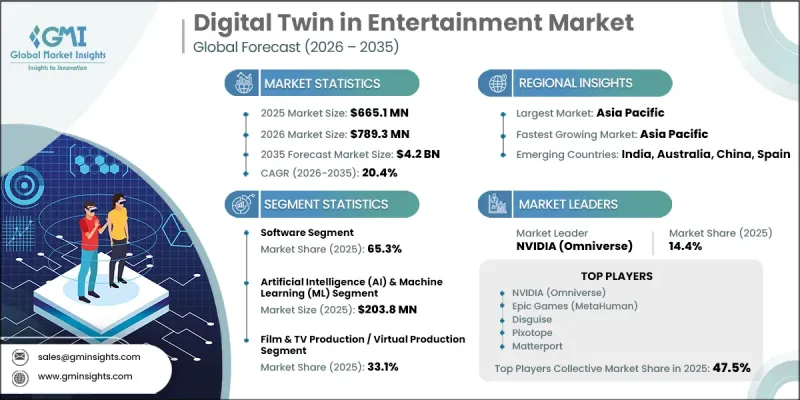
The strong growth of the digital twin in entertainment industry is driven by the accelerating adoption of virtual production technologies, rising demand for immersive AR, VR, and XR experiences, expanding government initiatives supporting creative technology ecosystems, and continuous progress in artificial intelligence, cloud computing, and real-time 3D visualization. These advancements are enabling entertainment companies to transform content creation by improving production efficiency, optimizing workflows, reducing development costs, and delivering highly engaging digital experiences. Growing emphasis on personalized audience engagement and data-driven production strategies is further increasing the adoption of digital twin technologies across multiple entertainment applications. At the same time, the industry is benefiting from greater integration of intelligent digital platforms that enhance collaboration, streamline creative processes, improve asset management, strengthen operational visibility, and support faster production cycles. As organizations continue to invest in advanced digital infrastructure, the digital twin in entertainment market is expected to witness sustained expansion supported by innovation, scalability, and increasing demand for high-quality interactive entertainment experiences.
| Market Scope | |
|---|---|
| Start Year | 2025 |
| Forecast Year | 2026-2035 |
| Start Value | $665.1 Million |
| Forecast Value | $4.2 Billion |
| CAGR | 20.4% |
The entertainment digital twin market continues to gain momentum as virtual production technologies become increasingly integrated into modern content development workflows. The technology enables synchronized digital representations that improve production planning, simplify collaboration, support real-time visualization, and enhance creative decision-making throughout the content development process. Growing public-sector investment in digital innovation and creative technology infrastructure is further accelerating industry adoption. Increasing demand for efficient production environments, improved operational flexibility, and enhanced digital content quality is encouraging entertainment companies to incorporate digital twin solutions into their long-term production strategies while improving resource utilization and overall project efficiency.
The software segment accounted for a 65.3% share in 2025. Its market leadership is supported by the increasing need for real-time visualization, intelligent simulations, digital asset management, and synchronized production environments across the entertainment industry. Rising deployment of cloud-based platforms, advanced production software, and next-generation visualization technologies continues to strengthen demand for software solutions that improve workflow efficiency, reduce production timelines, optimize resource utilization, and enhance the quality of digital entertainment experiences while lowering overall operational costs.
The artificial intelligence (AI) & machine learning (ML) segment reached USD 203.8 million in 2025. Growth within this segment is fueled by the expanding use of intelligent digital twin modeling, automated content generation, predictive analytics, audience behavior analysis, production optimization, and advanced digital modeling capabilities. AI and ML have become foundational technologies supporting smarter production environments by improving automation, accelerating creative workflows, increasing operational efficiency, strengthening predictive capabilities, and enabling more adaptive and data-driven decision-making across digital entertainment production ecosystems.
North America Digital Twin in Entertainment Market captured a 26.5% share in 2025. Regional market expansion is supported by increasing investments in virtual production technologies, greater adoption of artificial intelligence for digital content creation, and growing implementation of digital twin platforms across the entertainment sector. Strong cloud infrastructure, widespread deployment of real-time 3D technologies, and ongoing technological innovation continue to strengthen production capabilities while improving efficiency and digital content quality. In addition, sustained investments in advanced digital infrastructure, artificial intelligence, extended reality technologies, and intelligent entertainment environments are creating favorable conditions for continued market growth across North America.
The leading companies operating in the global digital twin in entertainment market include 3D Digital Venue (3DDV), Beyond Sports, Brainstorm - InfinitySet, Disguise, Epic Games - MetaHuman, Genius Sports, GeniusIQ, Iventis - Virtual Venue, Magnopus - OKO, Matterport, Mo-Sys -VP Pro, NVIDIA - Omniverse, Pixotope, ReSpo.Vision, and VenueTwin by Populous. Companies participating in the digital twin in entertainment industry are strengthening their competitive position by investing in advanced software innovation, artificial intelligence capabilities, cloud-native platforms, and real-time visualization technologies. Many organizations are expanding research and development activities to improve digital twin performance, scalability, and production efficiency while enhancing user experiences. Strategic collaborations, technology partnerships, and ecosystem development initiatives help companies accelerate product innovation and broaden their customer reach. Businesses are also focusing on integrating automation, predictive analytics, and intelligent workflow management to improve operational performance and optimize production processes.
Table of Contents
Chapter 1 Methodology and Scope
- 1.1 Market scope and definition
- 1.2 Research design
- 1.2.1 Research approach
- 1.2.2 Data collection methods
- 1.3 Data mining sources
- 1.3.1 Global
- 1.3.2 Regional/Country
- 1.4 Base estimates and calculations
- 1.4.1 Base year calculation
- 1.4.2 Key trends for market estimation
- 1.5 Primary research and validation
- 1.5.1 Primary sources
- 1.6 Forecast model
- 1.7 Research assumptions and limitations
Chapter 2 Executive Summary
- 2.1 Industry 360° synopsis, 2022 – 2035
- 2.2 Key market trends
- 2.2.1 Offering trends
- 2.2.2 Technology trends
- 2.2.3 Application trends
- 2.2.4 End-user trends
- 2.2.5 Regional trends
- 2.3 TAM Analysis, 2026-2035
- 2.4 CXO perspectives: Strategic imperatives
Chapter 3 Industry Insights
- 3.1 Industry ecosystem analysis
- 3.1.1 Supplier Landscape
- 3.1.2 Profit Margin
- 3.1.3 Cost structure
- 3.1.4 Value addition at each stage
- 3.1.5 Factor affecting the value chain
- 3.1.6 Disruptions
- 3.2 Industry impact forces
- 3.2.1 Growth drivers
- 3.2.1.1 Rising adoption of virtual production technologies
- 3.2.1.2 Growing demand for immersive AR/VR/XR entertainment experiences
- 3.2.1.3 Government support for AVGC-XR and creative technology ecosystems
- 3.2.1.4 Advancements in AI, cloud computing, and real-time 3D visualization
- 3.2.1.5 Increasing focus on personalized audience engagement and streaming platforms
- 3.2.2 Industry pitfalls and challenges
- 3.2.2.1 High implementation and integration costs
- 3.2.2.2 Data security, privacy, and interoperability challenges
- 3.2.3 Market opportunities
- 3.2.3.1 Expansion of metaverse and immersive virtual entertainment
- 3.2.3.2 Growing adoption of AI-powered personalized content and virtual production
- 3.2.1 Growth drivers
- 3.3 Growth potential analysis
- 3.4 Regulatory landscape
- 3.4.1 North America
- 3.4.2 Europe
- 3.4.3 Asia Pacific
- 3.4.4 Latin America
- 3.4.5 Middle East & Africa
- 3.5 Porter’s analysis
- 3.6 PESTEL analysis
- 3.7 Technology and Innovation landscape
- 3.7.1 Current technological trends
- 3.7.2 Emerging technologies
- 3.8 Price trends
- 3.8.1 By region
- 3.8.2 By product
- 3.9 Pricing Strategies
- 3.10 Emerging Business Models
- 3.11 Compliance Requirements
- 3.12 Patent and IP analysis
Chapter 4 Competitive Landscape, 2025
- 4.1 Introduction
- 4.2 Company market share analysis
- 4.2.1 By region
- 4.2.1.1 North America
- 4.2.1.2 Europe
- 4.2.1.3 Asia Pacific
- 4.2.1.4 Latin America
- 4.2.1.5 Middle East & Africa
- 4.2.2 Market concentration analysis
- 4.2.1 By region
- 4.3 Competitive benchmarking of key players
- 4.3.1 Financial performance comparison
- 4.3.1.1 Revenue
- 4.3.1.2 Profit margin
- 4.3.1.3 R&D
- 4.3.2 Product portfolio comparison
- 4.3.2.1 Product range breadth
- 4.3.2.2 Technology
- 4.3.2.3 Innovation
- 4.3.3 Geographic presence comparison
- 4.3.3.1 Global footprint analysis
- 4.3.3.2 Service network coverage
- 4.3.3.3 Market penetration by region
- 4.3.4 Competitive positioning matrix
- 4.3.4.1 Leaders
- 4.3.4.2 Challengers
- 4.3.4.3 Followers
- 4.3.4.4 Niche players
- 4.3.5 Strategic outlook matrix
- 4.3.1 Financial performance comparison
- 4.4 Key developments
- 4.4.1 Mergers and acquisitions
- 4.4.2 Partnerships and collaborations
- 4.4.3 Technological advancements
- 4.4.4 Expansion and investment strategies
- 4.4.5 Digital transformation initiatives
- 4.5 Emerging/ startup competitors landscape
Chapter 5 Market Estimates and Forecast, By Offering, 2022 – 2035 (USD Million)
- 5.1 Key trends
- 5.2 Software
- 5.2.1 Digital twin platforms
- 5.2.2 3D modeling & simulation software
- 5.2.3 Real-time rendering engines
- 5.2.4 Asset visualization software
- 5.2.5 Venue & infrastructure twin solutions
- 5.2.6 Virtual production platforms
- 5.3 Services
- 5.3.1 Consulting services
- 5.3.2 System integration
- 5.3.3 Deployment & implementation
- 5.3.4 Maintenance & support
- 5.3.5 Managed digital twin services
Chapter 6 Market Estimates and Forecast, By Technology, 2022 – 2035 (USD Million)
- 6.1 Key trends
- 6.2 Artificial intelligence (AI) & machine learning (ML)
- 6.3 IoT-enabled monitoring systems
- 6.4 Cloud computing platforms
- 6.5 AR/VR/MR & spatial computing
- 6.6 Real-time data analytics
- 6.7 Others
Chapter 7 Market Estimates and Forecast, By Application, 2022 – 2035 (USD Million)
- 7.1 Key trends
- 7.2 Film & tv production / virtual production
- 7.3 Gaming & esports / immersive experiences
- 7.4 Live events & concerts
- 7.5 Sports & stadium entertainment
- 7.6 Theme parks & attractions
- 7.7 Broadcasting operations
- 7.8 Virtual influencers & digital humans
- 7.9 Others
Chapter 8 Market Estimates and Forecast, By End-User, 2022 – 2035 (USD Million)
- 8.1 Key trends
- 8.2 Film & television studios
- 8.3 Broadcasting companies
- 8.4 Streaming service providers
- 8.5 Gaming companies
- 8.6 Sports organizations
- 8.7 Event organizers
- 8.8 Concert operators
- 8.9 Theme park operators
- 8.10 Entertainment venue owners & operators
Chapter 9 Market Estimates and Forecast, By Region, 2022 – 2035 (USD Million)
- 9.1 Key trends
- 9.2 North America
- 9.2.1 U.S.
- 9.2.2 Canada
- 9.3 Europe
- 9.3.1 Germany
- 9.3.2 UK
- 9.3.3 France
- 9.3.4 Spain
- 9.3.5 Italy
- 9.4 Asia Pacific
- 9.4.1 China
- 9.4.2 India
- 9.4.3 Japan
- 9.4.4 Australia
- 9.4.5 South Korea
- 9.5 Latin America
- 9.5.1 Brazil
- 9.5.2 Mexico
- 9.5.3 Argentina
- 9.6 Middle East and Africa
- 9.6.1 South Africa
- 9.6.2 Saudi Arabia
- 9.6.3 UAE
Chapter 10 Company Profiles
- 10.1 Global Key Players
- 10.1.1 NVIDIA (Omniverse)
- 10.1.2 Epic Games (MetaHuman)
- 10.1.3 Disguise
- 10.1.4 Pixotope
- 10.1.5 Matterport
- 10.2 Regional key players
- 10.2.1 North America
- 10.2.1.1 VenueTwin by Populous
- 10.2.1.2 Magnopus-OKO
- 10.2.2 Europe
- 10.2.2.1 Beyond Sports
- 10.2.2.2 Genius Sports — GeniusIQ
- 10.2.2.3 Brainstorm — InfinitySet
- 10.2.2.4 3D Digital Venue (3DDV)
- 10.2.2.5 Mo-Sys — VP Pro
- 10.2.2.6 Iventis — Virtual Venue
- 10.2.2.7 ReSpo.Vision
- 10.2.1 North America

