PUBLISHER: MarketsandMarkets | PRODUCT CODE: 2092404

PUBLISHER: MarketsandMarkets | PRODUCT CODE: 2092404
Digital Twin in Entertainment Market by Offering (Software, Services), Application (Film & TV Production, Gaming & Esports, Live Events & Concerts, Theme Parks & Attractions, Virtual Influencers & Digital Humans), and Region - Global Forecast to 2032
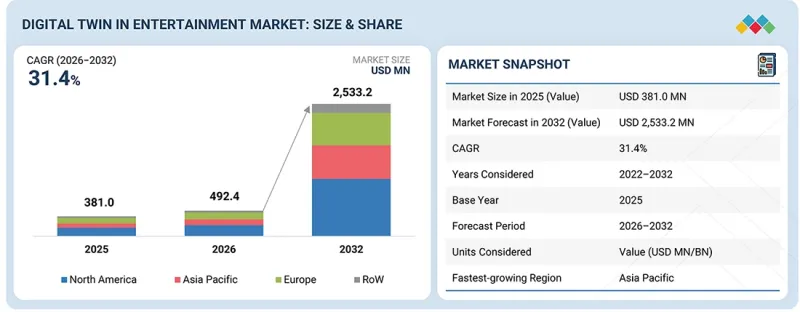
The digital twin in entertainment market is projected to reach USD 2,533.2 million by 2032 from an estimated USD 492.4 million in 2026, registering a CAGR of 31.4% during the forecast period.
| Scope of the Report | |
|---|---|
| Years Considered for the Study | 2021-2032 |
| Base Year | 2025 |
| Forecast Period | 2026-2032 |
| Units Considered | Value (USD Million) |
| Segments | By Offering, Application and Region |
| Regions covered | North America, Europe, APAC, RoW |
"Based on offering, the software segment is expected to witness a higher CAGR than the services segment during the forecast period"
The software segment is expected to witness a higher CAGR than the services segment in the digital twin in entertainment market due to the increasing adoption of AI-powered digital twin platforms, real-time 3D visualization, simulation, and virtual production technologies across the entertainment industry. Entertainment companies are increasingly deploying digital twin software to support content creation, virtual production, digital asset management, immersive audience experiences, and predictive operational analytics. Growing demand for cloud-based collaboration, digital humans, spatial computing, and real-time rendering platforms is further accelerating software adoption. Additionally, continuous advancements in OpenUSD, generative AI, game engines, and XR technologies are enabling scalable, interoperable, and highly realistic digital twin environments, driving the rapid growth of the software segment during the forecast period.
"Based on application, the gaming & esports segment is estimated to account for the second-largest market share during the forecast period"
The gaming & esports segment is estimated to account for the second-largest share of the digital twin in entertainment market during the forecast period, driven by the increasing adoption of real-time 3D engines, AI-powered digital environments, and persistent virtual ecosystems. Game developers and esports organizers are leveraging digital twin technologies to create interactive virtual worlds, optimize game environments, enhance player experiences, and manage large-scale live events. Growing investments in cloud gaming, digital humans, immersive fan engagement, and metaverse-based experiences are further accelerating the adoption of digital twin solutions across the global gaming and esports industry.
"Europe is estimated to hold a significant share of the digital twin in entertainment market"
Europe is estimated to hold a significant share of the digital twin in entertainment market during the forecast period, driven by the strong presence of film studios, gaming companies, live entertainment venues, and technology providers across the region. Increasing investments in virtual production, immersive entertainment, digital heritage preservation, and AI-powered content creation, along with the growing adoption of real-time 3D visualization and digital twin platforms, are accelerating market growth. Additionally, strategic collaborations between entertainment organizations and technology companies, supported by continuous innovation in XR and simulation technologies, are further strengthening the region's market position.
Extensive primary interviews were conducted with key industry experts in the digital twin in entertainment market to determine and verify the market size for various segments and subsegments gathered through secondary research. The study contains insights from various industry experts, from component suppliers to Tier 1 companies and OEMs. The break-up of the primaries is as follows:
- By Company Type - Tier 1 - 40%, Tier 2 - 35%, and Tier 3 - 25%
- By Designation - C-level Executives - 35%, Directors - 40%, and Others - 25%
- By Region - North America - 30%, Europe - 20%, Asia Pacific - 40%, and Rest of the World - 10%
The digital twin in entertainment market is characterized by the presence of several established technology providers, digital twin platform developers, virtual production solution providers, real-time 3D engine developers, and immersive experience companies, including Unity Technologies (US), Epic Games (US), NVIDIA Corporation (US), Sony Group Corporation (Japan), Siemens (Germany), Hitachi Vantara LLC (US), Accenture (Ireland), Preevue (UK), MP Mimic Productions GmbH (Germany), Acceleration Agency (US), d&b audiotechnik GmbH & Co. (Germany), Disguise Group (England), Moment Factory (Canada), Simio (US), and OnePlan (England), among others. These companies compete through continuous product innovation, AI-powered digital twin capabilities, strategic partnerships, virtual production technologies, cloud-based collaboration platforms, and immersive entertainment solutions, enabling them to strengthen their competitive position and expand their presence across the global digital twin in entertainment market.
The study includes an in-depth competitive analysis of these key players in the digital twin in entertainment market, covering their company profiles, recent developments, product innovations, technology advancements, and key market strategies.
Study Coverage:
The report segments the digital twin in entertainment market and forecasts its size by offering (software and services) and application (film & TV production, gaming & esports, live events & concerts, theme parks & attractions, virtual influencers & digital humans). The report also analyses key market drivers, restraints, opportunities, and challenges influencing industry growth. It provides a detailed regional assessment across Asia Pacific, North America, Europe, and the Rest of the World. In addition, the study includes value chain analysis and competitive landscape assessment of leading players operating in the global digital twin in entertainment ecosystem.
Key Benefits of Buying the Report:
- Analysis of key drivers (explosive growth of virtual production & led volume ecosystems, smart stadium & live event digital twin deployment at scale theme park & immersive entertainment demand for operational intelligence, convergence of gaming, metaverse & persistent digital twin world-building), restraints (data security, privacy, and intellectual property risks, lack of standardization and cross-platform interoperability), opportunities (monetization of immersive digital entertainment ecosystems, virtual production & digital content creation at scale), challenges (high complexity of integrating multi-source entertainment data, high computational and infrastructure requirements).
- Product Development/Innovation: Detailed insights on emerging digital twin technologies, advancements in AI-powered simulation, real-time 3D rendering, virtual production, spatial computing, cloud-based collaboration, and digital human technologies, along with ongoing research and development activities, strategic technology innovations, and new product launches in the digital twin in entertainment market.
- Market Development: Comprehensive information about high-growth markets-the report analyzes the digital twin in entertainment market across North America, Europe, Asia Pacific, and the Rest of the World.
- Market Diversification: Exhaustive information about emerging digital twin applications, evolving entertainment use cases, strategic investments, technology partnerships, and expansion opportunities across the digital twin in entertainment market.
- Competitive Assessment: In-depth assessment of the market shares and growth strategies of leading players, such as Unity Technologies (US), Epic Games (US), NVIDIA Corporation (US), Sony Group Corporation (Japan), Siemens (Germany), and Hitachi Vantara LLC (US).
TABLE OF CONTENTS
1 INTRODUCTION
2 RESEARCH METHODOLOGY
3 EXECUTIVE SUMMARY
- 3.1 MARKET SNAPSHOT
- 3.2 KEY INSIGHTS (TECHNOLOGY, DEMAND, INVESTMENT TRENDS)
- 3.3 MARKET SIZE & FORECAST (2024-2030)
- 3.4 KEY GROWTH DRIVERS & RESTRAINTS
- 3.5 WINNING STRATEGIES FOR STAKEHOLDERS
4 MARKET OVERVIEW
- 4.1 EVOLUTION OF DIGITAL TWIN TECHNOLOGY
- 4.2 ROLE OF DIGITAL TWIN IN ENTERTAINMENT ECOSYSTEM
- 4.3 VALUE CHAIN ANALYSIS
- 4.4 ECOSYSTEM MAPPING
- 4.5 MARKET DYNAMICS
- 4.5.1 DRIVERS
- 4.5.2 RESTRAINTS
- 4.5.3 OPPORTUNITIES
- 4.5.4 CHALLENGES
- 4.5.5 USE CASE ANALYSIS
- 4.5.6 FUTURE OUTLOOK & ROADMAP
- 4.5.6.1 Market evolution next 5-10 years
- 4.5.6.2 Role of metaverse & AI
- 4.5.6.3 Emerging business models
5 TECHNOLOGY LANDSCAPE
- 5.1 CORE TECHNOLOGIES
- 5.1.1 AI & MACHINE LEARNING
5.1.2D MODELLING & SIMULATION
- 5.1.3 CLOUD & EDGE COMPUTING
- 5.2 ENABLING PLATFORMS
- 5.2.1 GAME ENGINES (UNITY, UNREAL ENGINE)
- 5.2.2 METAVERSE PLATFORMS
- 5.2.3 DIGITAL CONTENT CREATION TOOLS
- 5.2.3.1 Innovation trends
- 5.2.3.2 Real-time digital humans
- 5.2.3.3 Volumetric capture
- 5.2.3.4 Generative ai integration
6 DIGITAL TWIN IN ENTERTAINMENT MARKET, BY OFFERING
- 6.1 SOFTWARE
- 6.2 SERVICES
7 DIGITAL TWIN IN ENTERTAINMENT MARKET, BY APPLICATION
- 7.1 FILM & TV PRODUCTION
- 7.2 GAMING & ESPORTS
- 7.3 LIVE EVENTS & CONCERTS
- 7.4 THEME PARKS & ATTRACTIONS
- 7.5 VIRTUAL INFLUENCERS & DIGITAL HUMANS
8 DIGITAL TWIN IN ENTERTAINMENT MARKET, BY REGION
- 8.1 NORTH AMERICA
- 8.1.1 US
- 8.1.2 CANADA
- 8.1.3 MEXICO
- 8.2 EUROPE
- 8.2.1 GERMANY
- 8.2.2 UK
- 8.2.3 FRANCE
- 8.2.4 ITALY
- 8.2.5 REST OF EUROPE
- 8.3 ASIA PACIFIC
- 8.3.1 CHINA
- 8.3.2 JAPAN
- 8.3.3 INDIA
- 8.3.4 SOUTH KOREA
- 8.3.5 REST OF ASIA PACIFIC
- 8.4 ROW
- 8.4.1 SOUTH AMERICA
- 8.4.2 MIDDLE EAST
- 8.4.3 AFRICA
9 DIGITAL TWIN IN ENTERTAINMENT MARKET, COMPETITIVE LANDSCAPE
- 9.1 MARKET SHARE ANALYSIS
- 9.2 COMPETITIVE BENCHMARKING
- 9.3 KEY STRATEGIES (PARTNERSHIPS, M&A, PRODUCT LAUNCHES)
- 9.4 INVESTMENT & FUNDING ANALYSIS
- 9.4.1 VENTURE CAPITAL TRENDS
- 9.4.2 STRATEGIC INVESTMENTS
- 9.4.3 STARTUP ECOSYSTEM
10 DIGITAL TWIN IN ENTERTAINMENT MARKET, COMPANY PROFILES
- 10.1 SIMENS
- 10.2 UNITY TECHNOLOGIES
- 10.3 SONY GROUP CORPORATION
- 10.4 HITACHI VANTARA LLC
- 10.5 NVIDIA CORPORATION
- 10.6 NTT DATA GROUP CORPORATION
10.7D DIGITAL VENUE (3DDV)
- 10.8 ACCENTURE
- 10.9 PREEVUE
- 10.10 MP MIMIC PRODUCTIONS GMBH
- 10.11 EPIC GAMES
- 10.12 THE ACCELERATION AGENCY
- 10.13 D&B AUDIOTECHNIK GMBH & CO. KG.
- 10.14 DISGUISE GROUP
- 10.15 MOMENT FACTORY
- 10.16 SIMIO
- 10.17 ONEPLAN
- 10.18 MYND WORKSHOP
- 10.19 WETA FX
- 10.20 NEP GROUP, INC
- 10.21 SP STUDIOS INC.
- 10.22 MINMUD
- 10.23 IVENTIS

