PUBLISHER: Global Market Insights Inc. | PRODUCT CODE: 2109134

PUBLISHER: Global Market Insights Inc. | PRODUCT CODE: 2109134
Prenatal and Reproductive Genetic Testing Market Opportunity, Growth Drivers, Industry Trend Analysis, and Forecast 2026 - 2035
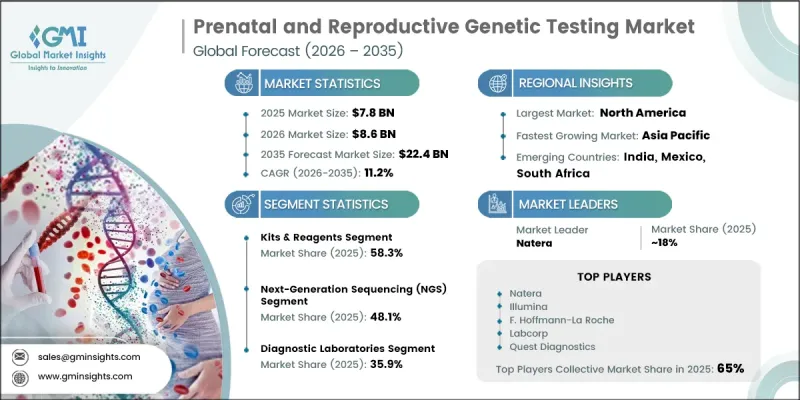
The Global Prenatal and Reproductive Genetic Testing Market was valued at USD 7.8 billion in 2025 and is estimated to grow at a CAGR of 11.2% to reach USD 22.4 billion by 2035.
The market is experiencing substantial growth as demand for advanced genetic screening and diagnostic solutions continues to rise across prenatal care and reproductive health services. Increasing awareness regarding the benefits of early genetic risk assessment, coupled with the growing maternal age population and the rising incidence of inherited genetic conditions, is driving the adoption of genetic testing worldwide. Expanding utilization of assisted reproductive technologies (ART), improvements in molecular diagnostics, and the growing availability of advanced genomic testing platforms are further supporting market expansion. Healthcare providers are increasingly integrating genetic testing into routine prenatal and reproductive care to improve clinical decision-making and support personalized treatment strategies. In addition, technological advancements in genomic analysis, increasing investments in precision medicine, and expanding access to specialized diagnostic services are creating favorable opportunities for industry participants.
| Market Scope | |
|---|---|
| Start Year | 2025 |
| Forecast Year | 2026-2035 |
| Start Value | $7.8 Billion |
| Forecast Value | $22.4 Billion |
| CAGR | 11.2% |
The kits & reagents segment captured a 58.3% share in 2025 and is forecast to grow at a 11% CAGR through 2035. The segment continues to maintain its leading position due to its essential role in supporting genetic screening, molecular diagnostics, and laboratory testing workflows. Consistent demand for kits and reagents across clinical laboratories, diagnostic centers, and healthcare institutions contributes to recurring revenue generation and sustained market growth. Continuous improvements in testing accuracy, workflow efficiency, and assay performance are encouraging broader adoption of advanced genetic testing solutions. Increasing laboratory testing volumes and the growing implementation of genomic diagnostics are expected to further strengthen the segment's leadership throughout the forecast period.
The diagnostic laboratories segment held a 35.9% share in 2025. The growing complexity of prenatal and reproductive genetic testing continues to increase reliance on specialized diagnostic laboratories equipped with advanced molecular diagnostic capabilities. Expanding investments in laboratory automation, high-throughput genomic technologies, and precision diagnostic platforms are enhancing testing efficiency and improving clinical outcomes. As demand for accurate, reliable, and comprehensive genetic analysis continues to increase, specialized diagnostic laboratories remain central to delivering high-quality testing services. Ongoing advancements in laboratory infrastructure and molecular diagnostics are expected to further support growth across this segment during the forecast period.
North America Prenatal and Reproductive Genetic Testing Market recorded a 41.2% share in 2025. The region continues to lead the market due to its advanced healthcare infrastructure, strong adoption of innovative genetic testing technologies, and increasing investment in precision medicine and genomic research. Growing awareness of prenatal genetic screening, expanding access to specialized diagnostic services, and favorable reimbursement environments continue to strengthen regional demand. In addition, continuous technological advancements, increasing healthcare spending, and expanding research activities are expected to reinforce North America's leading position throughout the forecast period while creating significant growth opportunities for market participants.
Major companies operating in the global prenatal and reproductive genetic testing market include Thermo Fisher Scientific, Illumina, Labcorp, Quest Diagnostics, Eurofins Scientific, CooperSurgical, F. Hoffmann-La Roche, Revvity, BGI Genomics, Igenomix, Myriad Genetics, Fulgent Genetics, Genea Biomedx, Sema4, and Natera. Companies operating in the global prenatal and reproductive genetic testing market are focusing on continuous product innovation, expansion of genetic testing portfolios, and investment in advanced genomic technologies to strengthen their competitive position. Manufacturers are increasing research and development efforts to improve testing accuracy, reduce turnaround times, and enhance the clinical utility of genetic screening solutions. Strategic collaborations with healthcare providers, fertility clinics, diagnostic laboratories, and research institutions are helping companies expand their customer base and improve market penetration. Businesses are also strengthening laboratory capabilities, expanding geographic presence, and investing in automation and digital technologies to improve operational efficiency. Continuous emphasis on regulatory compliance, quality assurance, personalized medicine, and advanced molecular diagnostics enables companies to reinforce their market presence, enhance customer confidence, and sustain long-term growth within the global prenatal and reproductive genetic testing market.
Table of Contents
Chapter 1 Methodology and Scope
- 1.1 Research approach
- 1.2 Quality commitments
- 1.2.1 GMI AI policy & data integrity commitment
- 1.2.1.1 Source consistency protocol
- 1.2.1 GMI AI policy & data integrity commitment
- 1.3 Research trail & confidence scoring
- 1.3.1 Research trail components
- 1.3.2 Scoring components
- 1.4 Data collection
- 1.4.1 Partial list of primary sources
- 1.5 Data mining sources
- 1.5.1 Paid sources
- 1.5.1.1 Sources, by region
- 1.5.1 Paid sources
- 1.6 Base estimates and calculations
- 1.6.1 Base year calculation for any one approach
- 1.7 Forecast model
- 1.7.1 Quantified market impact analysis
- 1.7.1.1 Mathematical impact of growth parameters on forecast
- 1.7.1 Quantified market impact analysis
- 1.8 Research transparency addendum
- 1.8.1 Source attribution framework
- 1.8.2 Quality assurance metrics
- 1.8.3 Our commitment to trust
Chapter 2 Executive Summary
- 2.1 Industry 360° synopsis
- 2.2 Key market trends
- 2.2.1 Business trends
- 2.2.2 Products and services trends
- 2.2.3 Test type trends
- 2.2.4 Technology trends
- 2.2.5 Application trends
- 2.2.6 End use trends
- 2.2.7 Regional trends
- 2.3 CXO perspectives: Strategic imperatives
Chapter 3 Industry Insights
- 3.1 Industry ecosystem analysis
- 3.1.1 Supplier landscape
- 3.1.2 Value addition at each stage
- 3.1.3 Factors affecting the value chain
- 3.2 Industry impact forces
- 3.2.1 Growth drivers
- 3.2.1.1 Rising maternal age and high-risk pregnancies
- 3.2.1.2 Growing adoption of IVF and assisted reproductive technologies (ART)
- 3.2.1.3 Increasing prevalence of genetic and inherited disorders
- 3.2.1.4 Advancements in genomic sequencing technologies
- 3.2.2 Industry pitfalls and challenges
- 3.2.2.1 High cost of advanced genetic testing
- 3.2.2.2 Ethical, legal, and regulatory concerns
- 3.2.3 Market opportunities
- 3.2.3.1 Expanding adoption of non-invasive prenatal testing (NIPT)
- 3.2.3.2 Increasing use of preimplantation genetic testing (PGT) in IVF
- 3.2.1 Growth drivers
- 3.3 Growth potential analysis
- 3.4 Technological and innovation landscape
- 3.4.1 Current technological trends
- 3.4.2 Emerging technologies (Driven by Primary Research)
- 3.5 Pricing analysis (Driven by Primary Research)
- 3.5.1 Historic price trend analysis
- 3.5.2 Pricing analysis, by test type
- 3.6 Regulatory landscape (Driven by Primary Research)
- 3.6.1 North America
- 3.6.2 Europe
- 3.6.3 Asia Pacific
- 3.6.4 Latin America
- 3.6.5 MEA
- 3.7 Porter's analysis
- 3.8 PESTEL analysis
- 3.9 Impact of AI and Generative AI on the market (Driven by Primary Research)
- 3.10 Investment and funding landscape (Driven by Primary Research)
- 3.11 Future market trends (Driven by Primary Research)
- 3.12 Reimbursement scenario, by region
Chapter 4 Competitive Landscape, 2025
- 4.1 Introduction
- 4.2 Company market share analysis
- 4.2.1 North America
- 4.2.2 Europe
- 4.2.3 Asia Pacific
- 4.3 Company matrix analysis
- 4.4 Competitive analysis of major market players
- 4.5 Competitive positioning matrix
- 4.6 Key developments
- 4.6.1 Merger and acquisition
- 4.6.2 Partnership and collaboration
- 4.6.3 New product launches
- 4.6.4 Expansion plans
Chapter 5 Market Estimates and Forecast, By Products and Services, 2022 – 2035 ($ Mn)
- 5.1 Key trends
- 5.2 Kits & Reagents
- 5.3 Software & Services
Chapter 6 Market Estimates and Forecast, By Test Type, 2022 – 2035 ($ Mn)
- 6.1 Key trends
- 6.2 Prenatal tests
- 6.2.1 Screening tests
- 6.2.1.1 Non-invasive prenatal testing (NIPT)
- 6.2.1.2 Carrier screening
- 6.2.1.3 Serum screening
- 6.2.1.4 Nuchal translucency ultrasound
- 6.2.2 Diagnostic
- 6.2.2.1 Chorionic villus sampling (CVS)
- 6.2.2.2 Amniocentesis
- 6.2.1 Screening tests
- 6.3 Reproductive genetic tests
- 6.3.1 Carrier screening
- 6.3.2 Preimplantation genetic testing (PGT)
- 6.3.2.1 PGT-A
- 6.3.2.2 PGT-M
- 6.3.2.3 PGT-SR
- 6.3.3 Embryo genetic testing
Chapter 7 Market Estimates and Forecast, By Technology, 2022 – 2035 ($ Mn)
- 7.1 Key trends
- 7.2 Next-generation sequencing (NGS)
- 7.3 Polymerase chain Reaction (PCR)
- 7.4 Chromosomal microarray analysis (CMA)
- 7.5 Fluorescence in-situ hybridization (FISH)
- 7.6 Other technologies
Chapter 8 Market Estimates and Forecast, By Application, 2022 – 2035 ($ Mn)
- 8.1 Key trends
- 8.2 Chromosomal abnormalities
- 8.3 Single gene / monogenic disorders
- 8.4 Carrier status assessment
- 8.5 Embryo screening & selection
- 8.6 Other applications
Chapter 9 Market Estimates and Forecast, By End Use, 2022 – 2035 ($ Mn)
- 9.1 Key trends
- 9.2 Hospitals
- 9.3 Diagnostic laboratories
- 9.4 Fertility clinics / IVF centers
- 9.5 Maternity & specialty clinics
- 9.6 Other end users
Chapter 10 Market Estimates and Forecast, By Region, 2022 – 2035 ($ Mn)
- 10.1 Key trends
- 10.2 North America
- 10.2.1 U.S.
- 10.2.2 Canada
- 10.3 Europe
- 10.3.1 Germany
- 10.3.2 UK
- 10.3.3 France
- 10.3.4 Italy
- 10.3.5 Spain
- 10.3.6 Netherlands
- 10.4 Asia Pacific
- 10.4.1 China
- 10.4.2 Japan
- 10.4.3 India
- 10.4.4 Australia
- 10.4.5 South Korea
- 10.5 Latin America
- 10.5.1 Brazil
- 10.5.2 Mexico
- 10.5.3 Argentina
- 10.6 Middle East and Africa
- 10.6.1 South Africa
- 10.6.2 Saudi Arabia
- 10.6.3 UAE
Chapter 11 Company Profiles
- 11.1 BGI Genomics
- 11.2 CooperSurgical
- 11.3 Eurofins Scientific
- 11.4 F. Hoffmann-La Roche
- 11.5 Fulgent Genetics
- 11.6 Genea Biomedx
- 11.7 Igenomix
- 11.8 Illumina
- 11.9 Labcorp
- 11.10 Myriad Genetics
- 11.11 Natera
- 11.12 Quest Diagnostics
- 11.13 Revvity
- 11.14 Sema4
- 11.15 Thermo Fisher Scientific

