PUBLISHER: Global Market Insights Inc. | PRODUCT CODE: 2109140

PUBLISHER: Global Market Insights Inc. | PRODUCT CODE: 2109140
3D Weaving Market Opportunity, Growth Drivers, Industry Trend Analysis, and Forecast 2026 - 2035
The Global 3D Weaving Market was valued at USD 524 million in 2025 and is estimated to grow at a CAGR of 10.1% to reach USD 1.4 billion by 2035.
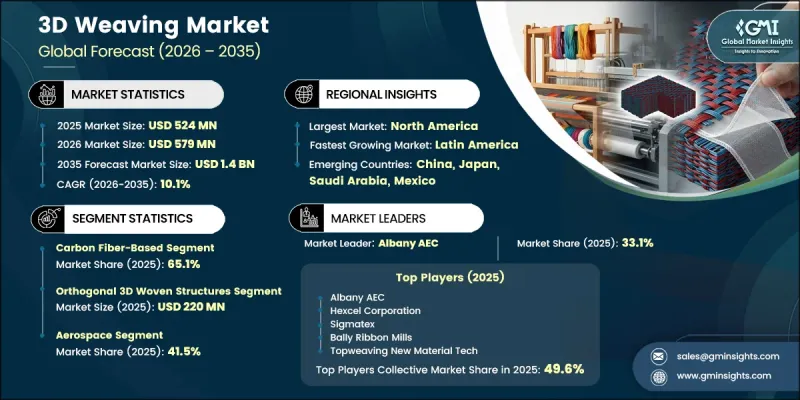
The market continues to gain momentum as industries increasingly prioritize lightweight, high-performance composite materials capable of delivering superior mechanical strength and long-term reliability. Rising demand for advanced manufacturing processes that improve production precision while minimizing material waste is further supporting market expansion. Manufacturers are steadily adopting 3D weaving technologies to produce complex composite structures with enhanced structural integrity, improved impact resistance, and greater dimensional stability. Growing investments in composite material innovation, coupled with the need for durable and efficient engineering solutions, continue to accelerate technology adoption across multiple industrial sectors. In addition, increasing focus on reducing component weight, enhancing operational efficiency, and improving overall product performance is encouraging broader implementation of 3D woven composites. Continuous technological advancements in weaving equipment, material development, and automated production methods are also creating favorable growth opportunities, positioning the 3D weaving market for sustained expansion throughout the forecast period.
| Market Scope | |
|---|---|
| Start Year | 2025 |
| Forecast Year | 2026-2035 |
| Start Value | $524 Million |
| Forecast Value | $1.4 Billion |
| CAGR | 10.1% |
The carbon fiber-based segment captured a 65.1% share in 2025 supported by its exceptional combination of high strength, low weight, outstanding stiffness, superior fatigue resistance, and excellent protection against corrosion. These performance characteristics make carbon fiber an ideal material for manufacturing advanced composite components that require long service life and high structural efficiency. Growing demand for lightweight engineering materials, combined with increasing investments in next-generation transportation and high-performance industrial applications, continues to reinforce the dominance of this segment. Manufacturers also favor carbon fiber because it helps improve product durability while supporting weight reduction and enhanced operational efficiency.
The orthogonal 3D woven structures segment generated USD 220 million in 2025. The segment continues to expand because it offers excellent reinforcement through the thickness of composite materials, improves resistance to layer separation, and delivers superior load distribution capabilities. These structural benefits enable manufacturers to develop highly durable composite components with improved mechanical performance while reducing overall material weight. Increasing demand for advanced structural composites and ongoing innovation in manufacturing technologies are expected to further strengthen the adoption of orthogonal 3D woven structures throughout the forecast period.
North America 3D Weaving Market held a 34.1% share in 2025. Regional growth is being driven by expanding investments in advanced manufacturing capabilities, increasing adoption of lightweight composite materials, and the continued development of high-performance industrial applications. Strong research and development activities, technological innovation, and growing demand for durable composite solutions are encouraging broader implementation of 3D weaving technologies across the region. Supportive industrial infrastructure and continuous investments in next-generation production techniques are also contributing to the region's leadership in the global market.
Prominent companies operating in the Global 3D weaving market include 3D Weaving SA, 3Dwovens Composites, 3TEX Inc., Albany AEC, Bally Ribbon Mills, Biteam AB, Gerster TechTex GmbH, Hexcel Corporation, M. Wright & Sons Ltd., Metyx Composites, Owens Corning, SAERTEX GmbH & Co. KG, SGL Carbon SE, Shikibo Ltd., Sigmatex, T.E.A.M., Inc., Tantra Composite Pvt. Ltd., Tex Tech Industries, Texonic Inc., Textum OpCo LLC, Topweaving New Material Tech Co., Ltd., and Unspun. Leading participants in the 3D Weaving Market are strengthening their competitive position through continuous investment in product innovation, advanced weaving technologies, and high-performance composite material development. Companies are expanding manufacturing capacity to address rising global demand while improving production efficiency through automation and digital manufacturing solutions. Strategic collaborations with material suppliers, technology providers, and industrial manufacturers are enabling faster commercialization of advanced composite products. Many organizations are also increasing research and development spending to enhance material performance, optimize weaving techniques, and introduce customized solutions for diverse industrial requirements. Geographic expansion into emerging markets, long-term supply agreements, and customer-focused product development remain key priorities. In addition, businesses are emphasizing sustainable manufacturing practices, operational efficiency, and quality improvements to strengthen brand value, expand their customer base, and secure a stronger foothold in the evolving global 3D weaving market.
Table of Contents
Chapter 1 Methodology and Scope
- 1.1 Market scope and definition
- 1.2 Research design
- 1.2.1 Research approach
- 1.2.2 Data collection methods
- 1.3 Data mining sources
- 1.3.1 Global
- 1.3.2 Regional/Country
- 1.4 Base estimates and calculations
- 1.4.1 Base year calculation
- 1.4.2 Key trends for market estimation
- 1.5 Primary research and validation
- 1.5.1 Primary sources
- 1.6 Forecast model
- 1.7 Research assumptions and limitations
Chapter 2 Executive Summary
- 2.1 Industry 360° synopsis, 2022 - 2035
- 2.2 Key market trends
- 2.2.1 Fiber material trends
- 2.2.2 Weave Architecture trends
- 2.2.3 End-use industry trends
- 2.2.4 Regional trends
- 2.3 TAM Analysis, 2026-2035
- 2.4 CXO perspectives: Strategic imperatives
Chapter 3 Industry Insights
- 3.1 Industry ecosystem analysis
- 3.1.1 Supplier Landscape
- 3.1.2 Profit Margin
- 3.1.3 Cost structure
- 3.1.4 Value addition at each stage
- 3.1.5 Factor affecting the value chain
- 3.1.6 Disruptions
- 3.2 Industry impact forces
- 3.2.1 Growth drivers
- 3.2.1.1 Increasing demand for lightweight, high-strength composite materials
- 3.2.1.2 Growing adoption in aerospace and defense applications
- 3.2.1.3 Expansion of renewable energy infrastructure
- 3.2.1.4 Increasing focus on advanced manufacturing and near-net-shape production
- 3.2.1.5 Growing investment in composite material research and innovation
- 3.2.2 Industry pitfalls and challenges
- 3.2.2.1 High manufacturing and equipment costs
- 3.2.2.2 Complex production processes and limited scalability
- 3.2.3 Market opportunities
- 3.2.3.1 Growing adoption in aerospace, defense, and space exploration
- 3.2.3.2 Advancements in automated weaving and digital manufacturing technologies
- 3.2.1 Growth drivers
- 3.3 Growth potential analysis
- 3.4 Regulatory landscape
- 3.4.1 North America
- 3.4.2 Europe
- 3.4.3 Asia Pacific
- 3.4.4 Latin America
- 3.4.5 Middle East & Africa
- 3.5 Porter's analysis
- 3.6 PESTEL analysis
- 3.7 Technology and Innovation landscape
- 3.7.1 Current technological trends
- 3.7.2 Emerging technologies
- 3.8 Price trends
- 3.8.1 By region
- 3.8.2 By product
- 3.9 Pricing Strategies
- 3.10 Emerging Business Models
- 3.11 Compliance Requirements
- 3.12 Patent and IP analysis
Chapter 4 Competitive Landscape, 2025
- 4.1 Introduction
- 4.2 Company market share analysis
- 4.2.1 By region
- 4.2.1.1 North America
- 4.2.1.2 Europe
- 4.2.1.3 Asia Pacific
- 4.2.1.4 Latin America
- 4.2.1.5 Middle East & Africa
- 4.2.2 Market concentration analysis
- 4.2.1 By region
- 4.3 Competitive benchmarking of key players
- 4.3.1 Financial performance comparison
- 4.3.1.1 Revenue
- 4.3.1.2 Profit margin
- 4.3.1.3 R&D
- 4.3.2 Product portfolio comparison
- 4.3.2.1 Product range breadth
- 4.3.2.2 Technology
- 4.3.2.3 Innovation
- 4.3.3 Geographic presence comparison
- 4.3.3.1 Global footprint analysis
- 4.3.3.2 Service network coverage
- 4.3.3.3 Market penetration by region
- 4.3.4 Competitive positioning matrix
- 4.3.4.1 Leaders
- 4.3.4.2 Challengers
- 4.3.4.3 Followers
- 4.3.4.4 Niche players
- 4.3.5 Strategic outlook matrix
- 4.3.1 Financial performance comparison
- 4.4 Key developments
- 4.4.1 Mergers and acquisitions
- 4.4.2 Partnerships and collaborations
- 4.4.3 Technological advancements
- 4.4.4 Expansion and investment strategies
- 4.4.5 Digital transformation initiatives
- 4.5 Emerging/ startup competitors landscape
Chapter 5 Market Estimates and Forecast, By Fiber Material, 2022 - 2035 (USD Million)
- 5.1 Key trends
- 5.2 Carbon fiber-based
- 5.3 Glass fiber-based
- 5.4 Aramid fiber-based
- 5.5 Ceramic fiber-based
- 5.6 Natural & basalt fiber-based
- 5.7 Others
Chapter 6 Market Estimates and Forecast, By Weave Architecture, 2022 - 2035 (USD Million)
- 6.1 Key trends
- 6.2 Orthogonal 3D woven structures
- 6.3 Angle-interlock woven structures
- 6.4 Layer-to-layer woven structures
- 6.5 Others
Chapter 7 Market Estimates and Forecast, By End-Use Industry, 2022 - 2035 (USD Million)
- 7.1 Key trends
- 7.2 Aerospace
- 7.3 Defense
- 7.4 Automotive
- 7.5 Wind energy
- 7.6 Marine
- 7.7 Construction & infrastructure
- 7.8 Others
Chapter 8 Market Estimates and Forecast, By Region, 2022 - 2035 (USD Million)
- 8.1 Key trends
- 8.2 North America
- 8.2.1 U.S.
- 8.2.2 Canada
- 8.3 Europe
- 8.3.1 Germany
- 8.3.2 UK
- 8.3.3 France
- 8.3.4 Spain
- 8.3.5 Italy
- 8.3.6 Russia
- 8.4 Asia Pacific
- 8.4.1 China
- 8.4.2 India
- 8.4.3 Japan
- 8.4.4 Australia
- 8.4.5 South Korea
- 8.5 Latin America
- 8.5.1 Brazil
- 8.5.2 Mexico
- 8.5.3 Argentina
- 8.6 Middle East and Africa
- 8.6.1 South Africa
- 8.6.2 Saudi Arabia
- 8.6.3 UAE
Chapter 9 Company Profiles
- 9.1 Global Key Players
- 9.1.1 Albany AEC
- 9.1.2 Bally Ribbon Mills
- 9.1.3 Hexcel Corporation
- 9.1.4 Sigmatex
- 9.1.5 Topweaving New Material Tech
- 9.2 Regional key players
- 9.2.1 North America
- 9.2.1.1 Owens Corning
- 9.2.1.2 Tex Tech Industries
- 9.2.1.3 T.E.A.M., Inc.
- 9.2.1.4 Textum OpCo LLC.
- 9.2.2 Asia Pacific
- 9.2.2.1 Shikibo Ltd.
- 9.2.2.2 Tantra Composite Pvt. Ltd.
- 9.2.2.3 Metyx Composites
- 9.2.3 Europe
- 9.2.3.1 SAERTEX GmbH & Co. KG
- 9.2.3.2 SGL Carbon SE
- 9.2.3.3 Biteam AB
- 9.2.3.4 Gerster TechTex GmbH
- 9.2.3.5 M. Wright & Sons Ltd.
- 9.2.1 North America
- 9.3 Niche Players/Disruptors
- 9.3.1 3TEX Inc.
- 9.3.2 Texonic Inc.
- 9.3.3 3D Weaving SA
- 9.3.4 3Dwovens Composites
- 9.3.5 Unspun

