PUBLISHER: Global Market Insights Inc. | PRODUCT CODE: 2109145

PUBLISHER: Global Market Insights Inc. | PRODUCT CODE: 2109145
Industrial Heat Decarbonization Market Opportunity, Growth Drivers, Industry Trend Analysis, and Forecast 2026 - 2035
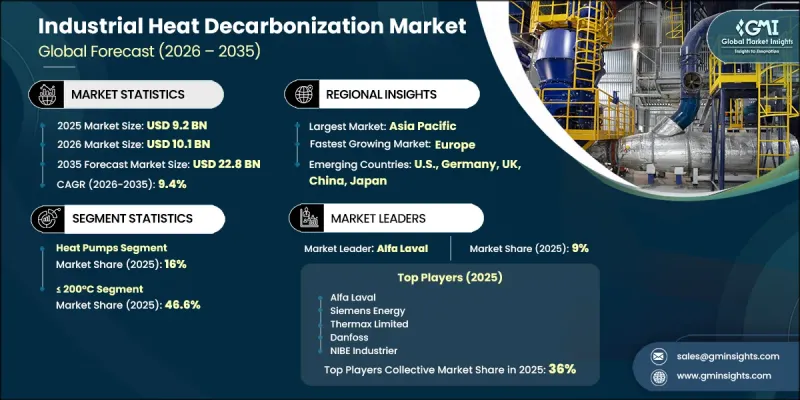
The Global Industrial Heat Decarbonization Market was valued at USD 9.2 billion in 2025 and is estimated to grow at a CAGR of 9.4% to reach USD 22.8 billion by 2035.
The industrial heat decarbonization market is gaining strong momentum as manufacturers increasingly prioritize sustainable operations, energy efficiency, and long-term emissions reduction strategies. Industries are actively adopting cleaner technologies and advanced thermal management approaches to reduce the environmental impact associated with industrial heat generation. The market covers a broad range of solutions focused on minimizing carbon emissions from industrial heating processes through improved efficiency, sustainable energy integration, and modernization of thermal systems. Businesses are increasingly recognizing decarbonization as an essential component of future competitiveness, operational resilience, and regulatory alignment. Growing pressure to reduce industrial carbon footprints is encouraging companies to upgrade heat-intensive processes with more efficient and environmentally responsible alternatives. Manufacturers are investing in technologies that optimize energy consumption, improve resource utilization, and support evolving sustainability targets. The rising emphasis on cleaner production methods, operational reliability, and environmental responsibility is expected to continue driving demand for industrial heat decarbonization solutions across multiple sectors.
| Market Scope | |
|---|---|
| Start Year | 2025 |
| Forecast Year | 2026-2035 |
| Start Value | $9.2 Billion |
| Forecast Value | $22.8 Billion |
| CAGR | 9.4% |
The industrial heat decarbonization market is expanding as industries seek practical solutions to transition away from carbon-intensive thermal operations. Companies are increasingly focusing on technologies that improve heat utilization, lower emissions, and support sustainable manufacturing goals. The growing integration of advanced energy management approaches is helping industrial operators enhance efficiency while reducing environmental impact. Increasing corporate sustainability commitments and stricter emissions reduction objectives are encouraging investments in modern heat systems. Businesses are evaluating innovative solutions that allow them to maintain productivity while improving energy performance and reducing greenhouse gas emissions.
The heat pumps segment accounted for 16% share in 2025. Industrial heat pumps are becoming an increasingly important solution within the decarbonization landscape due to their ability to improve thermal efficiency and support energy recovery processes. These systems help industries optimize heat usage, reduce operating expenses, and decrease emissions associated with conventional heating methods. Growing investments in industrial modernization and sustainable energy infrastructure are accelerating the adoption of heat pumps, supporting long-term segment growth as companies pursue improved thermal efficiency and stricter emission reduction goals.
The <= 200°C industrial heat decarbonization segment held a 46.6% share in 2025 and is expected to reach USD 10 billion by 2035. This temperature category maintains a significant market position because of its widespread application across various industrial processes. Increasing demand for energy-efficient solutions and lower-emission heating technologies is driving adoption within low-temperature industrial applications. The segment is benefiting from rising investments in industrial upgrades, sustainability initiatives, and cleaner production methods. Growing awareness of operational efficiency and the need to reduce industrial emissions will continue supporting market expansion within this temperature range.
United States Industrial Heat Decarbonization Market held a 78% share, generating USD 2 billion in 2025. The U.S. market is advancing due to increasing focus on industrial sustainability, modernization efforts, and investments aimed at reducing emissions. Industrial companies are adopting cleaner production strategies to improve competitiveness while meeting evolving environmental expectations and corporate sustainability commitments. Market growth in the country is being supported by rising investments from both public and private sectors, supportive policy initiatives, and expanding programs focused on industrial decarbonization. These factors are strengthening the adoption of advanced heat management solutions across industrial operations.
Major players operating in the global industrial heat decarbonization market include ABB, Alfa Laval, ANDRITZ, Antora Energy, Atlas Copco, Babcock & Wilcox Enterprises, Bosch Industriekessel GmbH, Coolbrook Oy, Copeland, Danfoss, Electrified Thermal Solutions (ETS), ENGIE, Everllence, Fives Group, GE Vernova, GEA Group, Heaten AS, Honeywell International, Johnson Controls, Mitsubishi Heavy Industries, NIBE Industrier AB, Schneider Electric, Siemens Energy, Spirax Group, Thermax Limited, Topsoe A/S, Veolia, and Yokogawa Electric Corporation. Companies operating in the industrial heat decarbonization market are strengthening their market position by expanding technology portfolios, developing advanced thermal solutions, and increasing investments in sustainable innovation. Market participants are focusing on strategic collaborations, research and development activities, and customized solutions to address the diverse requirements of industrial customers. Businesses are enhancing their capabilities through partnerships, technology integration, and expansion of clean energy offerings. Companies are also prioritizing digital monitoring systems, energy efficiency improvements, and scalable decarbonization solutions to improve competitiveness.
Table of Contents
Chapter 1 Methodology & Scope
- 1.1 Research approach
- 1.2 Quality commitments
- 1.2.1 GMI AI policy & data integrity commitment
- 1.2.1.1 Source consistency protocol
- 1.2.1 GMI AI policy & data integrity commitment
- 1.3 Research trail & confidence scoring
- 1.3.1 Research trail components
- 1.3.2 Scoring components
- 1.4 Data collection
- 1.4.1 Partial list of primary sources
- 1.5 Data mining sources
- 1.5.1 Paid sources
- 1.5.1.1 Sources, by region
- 1.5.1 Paid sources
- 1.6 Base estimates and calculations
- 1.6.1 Base year calculation for any one approach
- 1.7 Market estimates & forecasts parameters
- 1.8 Forecast model
- 1.8.1 Quantified market impact analysis
- 1.8.1.1 Mathematical impact of growth parameters on forecast
- 1.8.1 Quantified market impact analysis
- 1.9 Research transparency addendum
- 1.9.1 Source attribution framework
- 1.9.2 Quality assurance metrics
- 1.9.3 Our commitment to trust
- 1.10 Market definitions
Chapter 2 Executive Summary
- 2.1 Industry synopsis, 2022 - 2035
- 2.1.1 Business trends
- 2.1.2 Technology trends
- 2.1.3 Temperature trends
- 2.1.4 End Use trends
- 2.1.5 Deployment trends
- 2.1.6 Regional trends
Chapter 3 Industry Insights
- 3.1 Industry ecosystem analysis
- 3.1.1 Raw material availability & sourcing analysis
- 3.1.2 Manufacturing capacity assessment
- 3.1.3 Supply chain resilience & risk factors
- 3.1.4 Distribution network analysis
- 3.2 Industry impact forces
- 3.2.1 Growth drivers
- 3.2.2 Industry pitfalls & challenges
- 3.3 Regulatory landscape
- 3.4 Growth potential analysis
- 3.5 Porter's analysis
- 3.5.1 Bargaining power of suppliers
- 3.5.2 Bargaining power of buyers
- 3.5.3 Threat of new entrants
- 3.5.4 Threat of substitutes
- 3.6 PESTEL analysis
- 3.6.1 Political factors
- 3.6.2 Economic factors
- 3.6.3 Social factors
- 3.6.4 Technological factors
- 3.6.5 Legal factors
- 3.6.6 Environmental factors
- 3.7 Cost structure analysis of industrial heat decarbonization
- 3.8 Emerging decarbonization technologies & low-carbon heat solutions
- 3.9 Digitalization, smart energy management & industrial process optimization
- 3.10 Expansion across hard-to-abate industries & high-temperature heat applications
- 3.11 Investment landscape, policy support & future growth outlook
- 3.12 Impact of AI & Generative AI on the market (Driven by Primary Research)
- 3.12.1 AI-Driven production optimization (Driven by Primary Research)
- 3.12.2 Predictive maintenance & fault detection (Driven by Primary Research)
Chapter 4 Competitive Landscape, 2026
- 4.1 Introduction
- 4.2 Company market share analysis, by region, 2025
- 4.2.1 North America
- 4.2.2 Europe
- 4.2.3 Asia Pacific
- 4.2.4 Middle East & Africa
- 4.2.5 Latin America
- 4.3 Competitive analysis of major market players
- 4.4 Competitive positioning matrix
- 4.5 Key developments
- 4.5.1 Mergers & acquisitions
- 4.5.2 Partnerships & collaborations
- 4.5.3 New product launches
- 4.5.4 Expansion plans & funding
- 4.6 Company tier benchmarking
- 4.6.1 Tier classification criteria & qualifying thresholds
- 4.6.2 Tier positioning matrix by revenue, geography & innovation
Chapter 5 Market Size and Forecast, By Technology, 2022 - 2035 (USD Million)
- 5.1 Key trends
- 5.2 Heat pumps
- 5.3 Electric boilers
- 5.4 Electric heating
- 5.5 Hydrogen heating
- 5.6 Biomass heating
- 5.7 Solar thermal
- 5.8 Waste heat recovery
- 5.9 Thermal energy storage
- 5.10 CCUS
- 5.11 Others
Chapter 6 Market Size and Forecast, By Temperature, 2022 - 2035 (USD Million)
- 6.1 Key trends
- 6.2 ≤ 200°C
- 6.3 > 200 – 1,000°C
- 6.4 > 1,000°C
Chapter 7 Market Size and Forecast, By End Use, 2022 - 2035 (USD Million)
- 7.1 Key trends
- 7.2 Chemicals
- 7.3 Iron & steel
- 7.4 Cement
- 7.5 Food & beverage
- 7.6 Pulp & paper
- 7.7 Oil & gas
- 7.8 Glass
- 7.9 Mining & metals
- 7.10 Pharmaceuticals
- 7.11 Others
Chapter 8 Market Size and Forecast, By Deployment, 2022 - 2035 (USD Million)
- 8.1 Key trends
- 8.2 New
- 8.3 Retrofit
Chapter 9 Market Size and Forecast, By Region, 2022 - 2035 (USD Million)
- 9.1 Key trends
- 9.2 North America
- 9.2.1 U.S.
- 9.2.2 Canada
- 9.2.3 Mexico
- 9.3 Europe
- 9.3.1 Germany
- 9.3.2 UK
- 9.3.3 France
- 9.3.4 Italy
- 9.3.5 Spain
- 9.3.6 Netherlands
- 9.3.7 Denmark
- 9.3.8 Finland
- 9.3.9 Austria
- 9.4 Asia Pacific
- 9.4.1 China
- 9.4.2 Japan
- 9.4.3 India
- 9.4.4 South Korea
- 9.4.5 Australia
- 9.4.6 New Zealand
- 9.4.7 Indonesia
- 9.4.8 Thailand
- 9.4.9 Malaysia
- 9.5 Middle East & Africa
- 9.5.1 Saudi Arabia
- 9.5.2 UAE
- 9.5.3 Egypt
- 9.5.4 South Africa
- 9.6 Latin America
- 9.6.1 Brazil
- 9.6.2 Argentina
- 9.6.3 Chile
Chapter 10 Company Profiles
- 10.1 ABB
- 10.2 Alfa Laval
- 10.3 ANDRITZ
- 10.4 Antora Energy
- 10.5 Atlas Copco
- 10.6 Babcock & Wilcox Enterprises
- 10.7 Bosch Industriekessel GmbH
- 10.8 Coolbrook Oy
- 10.9 Copeland
- 10.10 Danfoss
- 10.11 Electrified Thermal Solutions (ETS)
- 10.12 ENGIE
- 10.13 Everllence
- 10.14 Fives Group
- 10.15 GE Vernova
- 10.16 GEA Group
- 10.17 Heaten AS
- 10.18 Honeywell International
- 10.19 Johnson Controls
- 10.20 Mitsubishi Heavy Industries
- 10.21 NIBE Industrier AB
- 10.22 Schneider Electric
- 10.23 Siemens Energy
- 10.24 Spirax Group
- 10.25 Thermax Limited
- 10.26 Topsoe A/S
- 10.27 Veolia
- 10.28 Yokogawa Electric Corporation

