PUBLISHER: Global Market Insights Inc. | PRODUCT CODE: 2109150

PUBLISHER: Global Market Insights Inc. | PRODUCT CODE: 2109150
Electric Vehicle Supply Equipment Market Opportunity, Growth Drivers, Industry Trend Analysis, and Forecast 2026 - 2035
The Global Electric Vehicle Supply Equipment Market was valued at USD 27.7 billion in 2025 and is estimated to grow at a CAGR of 22.6% to reach USD 209.3 billion by 2035.
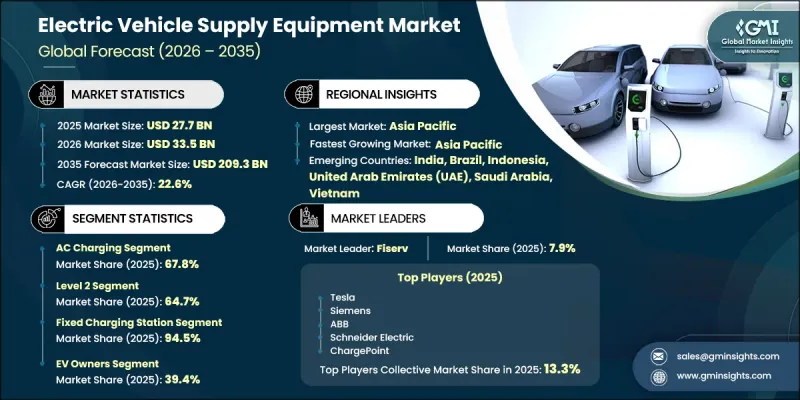
Market growth is accelerated by the increasing adoption of electric vehicles, expanding investments in charging infrastructure, and supportive government initiatives promoting cleaner transportation solutions. The transition toward low-emission mobility, stricter environmental regulations, and rising investments from automotive manufacturers, utilities, and energy providers are creating strong demand for EV charging ecosystems worldwide. Growing electric vehicle penetration is increasing the need for accessible, reliable, and scalable charging networks across residential, commercial, and public locations. In addition, advancements in connected charging technologies, smart energy management, and digital monitoring solutions are enhancing the efficiency and usability of EV charging infrastructure. As countries continue strengthening electrification strategies and expanding clean energy programs, EVSE systems are becoming a critical component of future transportation networks. The rising deployment of charging stations, combined with increasing demand for convenient and intelligent charging solutions, is expected to support significant market expansion through 2035.
| Market Scope | |
|---|---|
| Start Year | 2025 |
| Forecast Year | 2026-2035 |
| Start Value | $27.7 Billion |
| Forecast Value | $209.3 Billion |
| CAGR | 22.6% |
Electric vehicle supply equipment provides the connection between the electrical grid and electric vehicles through integrated hardware and software solutions, including charging units, power management systems, and network platforms. These systems enable vehicle owners and commercial fleet operators to access charging services across multiple environments while improving the overall convenience of electric mobility. Companies are rapidly expanding EV charging infrastructure to address charging accessibility challenges and encourage broader electric vehicle adoption. The growing adoption of connected charging solutions is further transforming the electric vehicle supply equipment market, with operators integrating advanced features such as digital payment systems, remote diagnostics, energy optimization, and automated load management. These capabilities are becoming increasingly important for urban transportation networks, commercial fleets, and businesses seeking to enhance customer experience while improving energy efficiency. The development of intelligent charging networks is positioning EVSE as an essential technology for the future of sustainable transportation.
The AC charging segment held a 67.8% share in 2025. AC charging solutions maintained strong adoption across residential applications and markets focused on cost-effective charging infrastructure due to their affordability, compatibility with existing electrical systems, and ease of installation. These systems are particularly suitable for situations where extended charging periods are acceptable and charging speed is not the primary requirement. However, comparatively slower charging performance limits their application in locations requiring rapid vehicle turnaround.
The Level 2 charging segment held a 64.7% share in 2025. This segment leads due to its balance between charging speed, installation cost, and operational flexibility. Level 2 chargers provide faster charging performance compared with basic charging solutions while remaining more economical and accessible than advanced high-power charging technologies. Their widespread suitability across residential properties, commercial facilities, and public charging locations has strengthened their market penetration. The ability of Level 2 charging systems to support both private and shared charging environments continues to reinforce their dominant market position.
China Electric Vehicle Supply Equipment Market accounted for 74.5% share, generating USD 1.8 billion in 2025. The country maintains its leadership position due to extensive investments in charging infrastructure, strong electric mobility policies, and rapid expansion of charging networks. Large-scale deployment across urban areas and transportation corridors is supporting market growth, while government initiatives focused on vehicle electrification and renewable energy integration continue to encourage infrastructure development. Increasing participation from public and private-sector operators is also contributing to the expansion of advanced charging networks and improving charging accessibility throughout the country.
Key players in the global electric vehicle supply equipment market include Siemens, Tesla, Delta Electronics, BYD Company, ABB, ChargePoint, Schneider Electric, Engie, Huawei Technologies, Eaton. Companies operating in the electric vehicle supply equipment market are strengthening their competitive position through technology innovation, infrastructure expansion, strategic partnerships, and continuous product development. Market participants are investing in advanced charging technologies, including faster charging solutions, connected platforms, and intelligent energy management systems, to address evolving customer requirements. Companies are also expanding their geographic presence by collaborating with automotive manufacturers, utilities, governments, and commercial operators to accelerate charging network deployment. Enhancing software capabilities, improving user experience, and integrating renewable energy management solutions are becoming important strategies for long-term growth. In addition, businesses are focusing on manufacturing scalability, cost optimization, and strategic alliances to strengthen supply chains and maintain competitiveness in the rapidly expanding EVSE market.
Table of Contents
Chapter 1 Research Methodology
- 1.1 Research approach
- 1.2 Quality Commitments
- 1.2.1 GMI AI policy & data integrity commitment
- 1.2.1.1 Source consistency protocol
- 1.2.1 GMI AI policy & data integrity commitment
- 1.3 Research Trail & Confidence Scoring
- 1.3.1 Research Trail Components
- 1.3.2 Scoring Components
- 1.4 Data Collection
- 1.4.1 Partial list of primary sources
- 1.5 Data mining sources
- 1.5.1 Paid sources
- 1.5.1.1 Sources, by region
- 1.5.1 Paid sources
- 1.6 Base estimates and calculations
- 1.6.1 Base year calculation for any one approach
- 1.7 Forecast model
- 1.7.1 Quantified Market impact analysis
- 1.7.1.1 Mathematical impact of growth parameters on forecast
- 1.7.1 Quantified Market impact analysis
- 1.8 Research transparency addendum
- 1.8.1 Source attribution framework
- 1.8.2 Quality assurance metrics
- 1.8.3 Our commitment to trust
Chapter 2 Executive Summary
- 2.1 Industry 360° synopsis, 2022 - 2035
- 2.2 Key Market trends
- 2.2.1 Regional
- 2.2.2 Equipment
- 2.2.3 Charging technology
- 2.2.4 Charging speed
- 2.2.5 Deployment
- 2.2.6 End user
- 2.2.7 Application
- 2.3 TAM Analysis, 2026-2035
- 2.4 CXO perspectives: Strategic imperatives
Chapter 3 Industry Insights
- 3.1 Industry ecosystem analysis
- 3.1.1 Supplier landscape
- 3.1.2 Profit margin analysis
- 3.1.3 Cost structure
- 3.1.4 Value addition at each stage
- 3.1.5 Factor affecting the value chain
- 3.1.6 Disruptions
- 3.2 Industry impact forces
- 3.2.1 Growth drivers
- 3.2.1.1 Rising EV adoption and electrification of transportation
- 3.2.1.2 Government incentives and supportive charging infrastructure policies
- 3.2.1.3 Expansion of public and highway fast-charging networks
- 3.2.1.4 Growth of fleet electrification and commercial EV usage
- 3.2.2 Industry pitfalls and challenges
- 3.2.2.1 High installation and infrastructure development costs
- 3.2.2.2 Grid capacity limitations and power distribution challenges
- 3.2.3 Market opportunities
- 3.2.3.1 Expansion into emerging and developing EV markets
- 3.2.3.2 Integration of renewable energy with charging infrastructure
- 3.2.3.3 Growth of smart cities and connected mobility ecosystems
- 3.2.3.4 Vehicle-to-grid (V2G) and energy storage integration services
- 3.2.1 Growth drivers
- 3.3 Technology and innovation landscape
- 3.3.1 Current technological trends
- 3.3.1.1 Level 1 and Level 2 AC charging systems
- 3.3.1.2 DC fast charging infrastructure
- 3.3.1.3 Cloud-based charging management platforms
- 3.3.1.4 Smart metering and payment integration systems
- 3.3.2 Emerging technologies
- 3.3.2.1 Ultra-fast DC charging technology
- 3.3.2.2 Wireless (inductive) charging systems
- 3.3.2.3 Vehicle-to-grid (V2G) technology
- 3.3.2.4 AI-based smart charging and energy optimization
- 3.3.1 Current technological trends
- 3.4 Growth potential analysis
- 3.5 Pricing Analysis (Driven by primary research)
- 3.5.1 Historical Price Trend Analysis
- 3.5.2 Pricing Strategy by Player Type
- 3.6 Regulatory landscape
- 3.6.1 North America
- 3.6.1.1 National Electrical Code (NEC) - NFPA (Article 625)
- 3.6.1.2 UL Solutions (UL 2202, UL 2594, UL 2231 Standards)
- 3.6.1.3 SAE International (SAE J1772, SAE J3400/NACS Standards)
- 3.6.2 Europe
- 3.6.2.1 Alternative Fuels Infrastructure Regulation (AFIR)
- 3.6.2.2 IEC Standards (IEC 61851 & IEC 62196)
- 3.6.2.3 European Committee for Electrotechnical Standardization (CENELEC)
- 3.6.3 Asia Pacific
- 3.6.3.1 GB/T Standards (China)
- 3.6.3.2 CHAdeMO Association (Japan)
- 3.6.3.3 Bureau of Indian Standards (BIS) & Ministry of Power (India EV Charging Guidelines)
- 3.6.4 Latin America
- 3.6.4.1 ABNT - Brazilian Technical Standards Association (Brazil)
- 3.6.4.2 National Electric Energy Agency (ANEEL) - Brazil
- 3.6.4.3 Mexican Official Standards (NOM) / Secretaria de Energia (SENER)
- 3.6.5 Middle East & Africa
- 3.6.5.1 Emirates Authority for Standardization and Metrology (UAE ESMA) / Ministry of Industry & Advanced Technology (MoIAT)
- 3.6.5.2 Saudi Standards, Metrology and Quality Organization (SASO)
- 3.6.5.3 South African Bureau of Standards (SABS)
- 3.6.1 North America
- 3.7 Porter's analysis
- 3.8 PESTEL analysis
- 3.9 Patent analysis (Driven by primary research)
- 3.10 Cost breakdown analysis
- 3.11 Trade data analysis (Driven by Paid Research)
- 3.11.1 Import/export volume & value trends
- 3.11.2 Key trade corridors & tariff impact
- 3.12 Capacity & production landscape (Driven by Primary Research)
- 3.12.1 Installed capacity by region & key producer
- 3.12.2 Capacity utilization rates & expansion pipelines
- 3.13 Charging infrastructure landscape
- 3.13.1 Public vs Private charging infrastructure
- 3.13.2 Installed charging points by region
- 3.13.3 Fast-charging corridor development
- 3.14 Impact of AI and Generative AI on the Market
- 3.14.1 AI Driven Disruption of Existing Business Models
- 3.14.2 GenAI Use Cases and Adoption Roadmap by Segment
- 3.14.3 Risks Limitations and Regulatory Considerations
- 3.15 Sustainability and environmental aspects
- 3.15.1 Sustainable practices
- 3.15.2 Waste reduction strategies
- 3.15.3 Energy efficiency in production
- 3.15.4 Eco-friendly Initiatives
- 3.15.5 Carbon footprint considerations
- 3.16 Forecast assumptions & scenario analysis (Driven by Primary Research)
- 3.16.1 Base Case- Key Macro & Industry Variables Driving CAGR
- 3.16.2 Optimistic Scenarios- Favorable macro and industry tailwinds
- 3.16.3 Pessimistic Scenario - Macroeconomic slowdown or industry headwinds
Chapter 4 Competitive Landscape, 2025
- 4.1 Introduction
- 4.2 Company Market share analysis (value and volume), 2022-2025
- 4.2.1 North America
- 4.2.2 Europe
- 4.2.3 Asia Pacific
- 4.2.4 LATAM
- 4.2.5 MEA
- 4.3 Top 10 Company production & sales analysis, 2022-2035
- 4.4 Competitive analysis of major market players
- 4.5 Competitive positioning matrix
- 4.6 Key developments
- 4.6.1 Mergers & acquisitions
- 4.6.2 Partnerships & collaborations
- 4.6.3 New Product Launches
- 4.6.4 Expansion Plans and funding
- 4.7 Company tier benchmarking
- 4.7.1 Tier classification criteria & qualifying thresholds
- 4.7.2 Tier positioning matrix by revenue, geography & innovation
Chapter 5 Market Estimates & Forecast, By Equipment, 2022 - 2035 (USD Mn, Units)
- 5.1 Key trends
- 5.2 Charging Cables and Connectors
- 5.3 Power Electronics
- 5.3.1 Rectifiers
- 5.3.2 Inverters
- 5.3.3 Converters
- 5.3.4 Transformers
- 5.4 Charging Controllers
- 5.5 Communication and Networking Equipment
- 5.6 Smart Charging Systems
- 5.7 Others
Chapter 6 Market Estimates & Forecast, By Charging Technology, 2022 - 2035 (USD Mn, Units)
- 6.1 Key trends
- 6.2 AC Charging
- 6.3 DC Fast Charging
- 6.4 Wireless Charging
Chapter 7 Market Estimates & Forecast, By Charging Speed, 2022 - 2035 (USD Mn, Units)
- 7.1 Key trends
- 7.2 Level 1
- 7.3 Level 2
- 7.4 Level 3
Chapter 8 Market Estimates & Forecast, By Deployment, 2022 - 2035 (USD Mn, Units)
- 8.1 Key trends
- 8.2 Fixed Charging Stations
- 8.2.1 Wall Mounted
- 8.2.2 Pedestal
- 8.2.3 Overhead
- 8.3 Portable Charging Equipment
Chapter 9 Market Estimates & Forecast, By End User, 2022 - 2035 (USD Mn, Units)
- 9.1 Key trends
- 9.2 EV Owners
- 9.3 Fleet Operators
- 9.4 Charge Point Operators
- 9.5 Utilities
- 9.6 Government and Municipal Authorities
Chapter 10 Market Estimates & Forecast, By Application, 2022 - 2035 (USD Mn, Units)
- 10.1 Key trends
- 10.2 Residential Charging
- 10.2.1 Single Family Homes
- 10.2.2 Multi Dwelling Units
- 10.3 Commercial Charging
- 10.3.1 Retail and Shopping Centers
- 10.3.2 Workplace and Office Buildings and Campuses
- 10.4 Public Charging Infrastructure
- 10.4.1 Urban Public Charging
- 10.4.2 Highway and Corridor Charging
- 10.4.3 Government and Municipal Charging Networks
- 10.5 Fleet Charging
- 10.5.1 Logistics and Delivery Fleets
- 10.5.2 Corporate and Employee Fleets
- 10.5.3 Ride Hailing and Shared Mobility Fleets
Chapter 11 Market Estimates & Forecast, By Region, 2022 - 2035 (USD Mn, Units)
- 11.1 Key trends
- 11.2 North America
- 11.2.1 US
- 11.2.2 Canada
- 11.3 Europe
- 11.3.1 Germany
- 11.3.2 UK
- 11.3.3 France
- 11.3.4 Italy
- 11.3.5 Spain
- 11.3.6 Russia
- 11.3.7 Norway
- 11.3.8 Netherlands
- 11.3.9 Sweden
- 11.4 Asia Pacific
- 11.4.1 China
- 11.4.2 India
- 11.4.3 Japan
- 11.4.4 Australia
- 11.4.5 South Korea
- 11.4.6 Singapore
- 11.4.7 Thailand
- 11.4.8 Indonesia
- 11.4.9 Vietnam
- 11.5 Latin America
- 11.5.1 Brazil
- 11.5.2 Mexico
- 11.5.3 Argentina
- 11.6 MEA
- 11.6.1 South Africa
- 11.6.2 Saudi Arabia
- 11.6.3 UAE
- 11.6.4 Turkey
Chapter 12 Company Profiles
- 12.1 Global Players
- 12.1.1 ABB E-mobility
- 12.1.2 Siemens eMobility
- 12.1.3 ChargePoint
- 12.1.4 Schneider Electric
- 12.1.5 Delta Electronics
- 12.1.6 Kempower
- 12.1.7 Tesla
- 12.1.8 Tritium
- 12.2 Regional Players
- 12.2.1 Wallbox Chargers
- 12.2.2 Webasto
- 12.2.3 Blink Charging
- 12.2.4 Autel Energy
- 12.2.5 Star Charge
- 12.2.6 TGOOD Global
- 12.2.7 BTC Power
- 12.2.8 Heliox
- 12.3 Emerging Players
- 12.3.1 Fermata Energy
- 12.3.2 Lectron
- 12.3.3 Beam Global
- 12.3.4 Xeal

