PUBLISHER: Global Market Insights Inc. | PRODUCT CODE: 2109162

PUBLISHER: Global Market Insights Inc. | PRODUCT CODE: 2109162
Data Center CPU Market Opportunity, Growth Drivers, Industry Trend Analysis, and Forecast 2026 - 2035
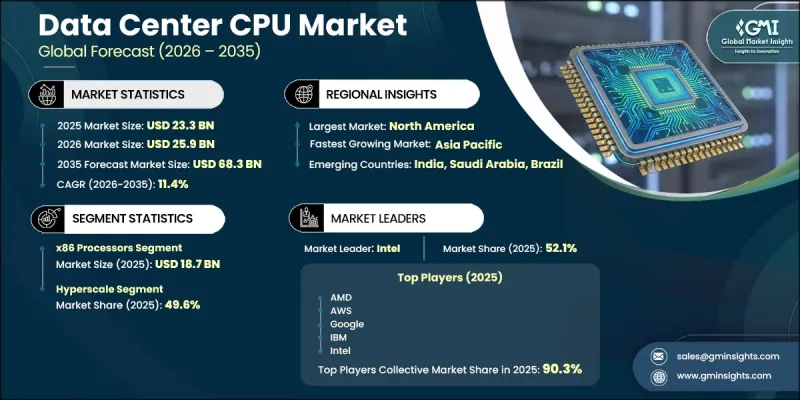
The Global Data Center CPU Market was valued at USD 23.3 billion in 2025 and is estimated to grow at a CAGR of 11.4% to reach USD 68.3 billion by 2035.
Market growth is driven by increasing demand for high-performance computing infrastructure, expanding cloud deployments, and rising investments in artificial intelligence-driven workloads across commercial and government sectors. The growing need for scalable processing capabilities is encouraging organizations to adopt advanced processor architectures designed to support increasingly complex workloads. The market is witnessing a competitive shift as traditional processor platforms continue to maintain a strong position while alternative architectures gain wider acceptance across modern data center environments. Expanding hyperscale infrastructure development across multiple regions is creating new demand opportunities for advanced computing solutions. At the same time, major technology companies are increasingly developing customized processor platforms to optimize performance, improve energy efficiency, and reduce dependence on traditional computing models. These developments are reshaping the competitive landscape of the data center CPU market by expanding processor innovation beyond conventional suppliers and creating new opportunities across cloud computing, enterprise infrastructure, and specialized computing applications.
| Market Scope | |
|---|---|
| Start Year | 2025 |
| Forecast Year | 2026-2035 |
| Start Value | $23.3 Billion |
| Forecast Value | $68.3 Billion |
| CAGR | 11.4% |
The x86 processor segment accounted for an 80.4% share in 2025. The segment continues to maintain its dominant position due to strong software compatibility, extensive ecosystem support, and a large installed base across enterprise and cloud data center environments. Continued demand for reliable and scalable computing infrastructure supports the widespread adoption of x86-based processors, while established processor manufacturers continue enhancing performance capabilities to address evolving workload requirements.
The hyperscale data center segment held a 49.6% share, generating USD 11.5 billion in 2025. The segment's leadership reflects the growing concentration of global computing capacity within large-scale data center operations. Hyperscale facilities require extensive processor deployments to support expanding digital services, cloud platforms, and high-volume computing requirements. The continued expansion of large data center campuses is generating substantial demand for advanced CPUs and creating significant procurement opportunities across the industry.
North America Data Center CPU Market held a 37% share, generating USD 8.6 billion in 2025. Regional dominance is supported by the strong presence of cloud infrastructure providers, continuous enterprise investments in server technologies, and increasing demand for advanced computing capabilities. Growing adoption of artificial intelligence applications and expanding investments in high-performance computing infrastructure are further supporting processor demand across commercial and government sectors throughout the region.
Major companies operating in the global data center CPU market include Intel, AMD, Ampere Computing, Arm Holdings, NVIDIA, IBM, Amazon Web Services, Google, Microsoft, Qualcomm, Alibaba Cloud, Phytium Technology, Loongson Technology, HiSilicon Technology, Hygon Information Technology, SiPearl, Fujitsu, Tenstorrent, Tachyum, and Ainekko. Companies operating in the data center CPU market are strengthening their market position through processor innovation, strategic partnerships, and continuous investments in research and development. Leading players are focusing on improving processing performance, energy efficiency, scalability, and workload optimization to address the growing requirements of cloud computing and artificial intelligence applications. Businesses are also expanding their processor portfolios across different architectures to serve diverse customer needs and emerging computing environments. Strategic collaborations with cloud providers, software developers, and technology partners help companies accelerate ecosystem development and increase adoption.
Table of Contents
Chapter 1 Research Methodology
- 1.1 Research approach
- 1.2 Quality Commitments
- 1.2.1 GMI AI policy & data integrity commitment
- 1.3 Research Trail & Confidence Scoring
- 1.3.1 Research Trail Components
- 1.3.2 Scoring Components
- 1.4 Data Collection
- 1.5 Data mining sources
- 1.5.1 Paid sources
- 1.6 Base estimates and calculations
- 1.6.1 Base year calculation
- 1.7 Forecast model
- 1.7.1 Quantified market impact analysis
- 1.8 Research transparency addendum
- 1.8.1 Source attribution framework
- 1.8.2 Quality assurance metrics
- 1.8.3 Our commitment to trust
Chapter 2 Executive Summary
- 2.1 Industry 360° synopsis
- 2.2 Key market trends
- 2.2.1 Regional
- 2.2.2 Processor Architecture
- 2.2.3 Data Center
- 2.2.4 Core Count
- 2.2.5 Server Form Factor
- 2.2.6 End Use
- 2.3 TAM analysis, 2026-2035
- 2.4 CXO perspectives: Strategic imperatives
Chapter 3 Industry Insights
- 3.1 Industry ecosystem analysis
- 3.1.1 Supplier landscape
- 3.1.2 Profit margin
- 3.1.3 Cost structure
- 3.1.4 Value addition at each stage
- 3.1.5 Factor affecting the value chain
- 3.1.6 Disruptions
- 3.2 Industry impact forces
- 3.2.1 Growth drivers
- 3.2.1.1 Rapid Hyperscale Data Center Expansion Driving CPU Procurement
- 3.2.1.2 AI & Machine Learning Workload Growth Amplifying CPU Demand
- 3.2.1.3 Enterprise Digital Transformation & Server Refresh Accelerating CPU Deployment
- 3.2.1.4 Edge Computing Proliferation Extending CPU Deployment
- 3.2.2 Industry pitfalls and challenges
- 3.2.2.1 GPU & AI Accelerator Displacement Reducing CPU Demand in AI Training
- 3.2.2.2 High Capital Expenditure & Extended Procurement Lead Times Constraining Buyers
- 3.2.3 Market opportunities
- 3.2.3.1 ARM & RISC-V Architecture Disruption Creating New Market Opportunities
- 3.2.3.2 Energy Efficiency Mandates & PUE Regulations Driving CPU Upgrade Cycles
- 3.2.3.3 Emerging Economy Data Center Buildouts Expanding Addressable Market
- 3.2.1 Growth drivers
- 3.3 Technology and innovation landscape
- 3.3.1 Current technological trends
- 3.3.1.1 x86 CPUs
- 3.3.1.2 Chiplet Architecture
- 3.3.2 Emerging technologies
- 3.3.2.1 AI-Optimized CPUs
- 3.3.2.2 3D Chip Stacking & Advanced Packaging
- 3.3.1 Current technological trends
- 3.4 Growth potential analysis
- 3.5 Regulatory landscape
- 3.5.1 North America
- 3.5.1.1 US - Federal Trade Commission (FTC) & Department of Justice (DOJ)
- 3.5.1.2 Canada - Competition Bureau
- 3.5.2 Europe
- 3.5.2.1 EU - European Commission (EC)
- 3.5.2.2 EU - European Data Protection Board (EDPB)
- 3.5.3 Asia Pacific
- 3.5.3.1 China - State Administration for Market Regulation (SAMR)
- 3.5.3.2 Japan - Japan Fair Trade Commission (JFTC)
- 3.5.4 LATAM
- 3.5.4.1 Mexico - Federal Economic Competition Commission (COFECE)
- 3.5.4.2 Brazil - Administrative Council for Economic Defense (CADE)
- 3.5.5 MEA
- 3.5.5.1 Saudi Arabia - General Authority for Competition (GAC)
- 3.5.5.2 South Africa - Competition Commission of South Africa (CCSA)
- 3.5.1 North America
- 3.6 Porter’s analysis
- 3.7 PESTEL analysis
- 3.8 Cost breakdown analysis, 2025
- 3.9 Patent analysis (Driven by Primary Research)
- 3.10 Trade Data Analysis, 2022-2025 (Driven by Paid Database)
- 3.10.1 Import/Export Volume & Value Trends
- 3.10.2 Key Trade Corridors & Tariff Impact
- 3.11 Capacity & Production Landscape (Driven by Primary Research)
- 3.11.1 Installed Capacity by Region & Key Producer, 2025
- 3.11.2 Capacity Utilization Rates & Expansion Pipelines
- 3.12 Power Consumption & Energy Efficiency Benchmarking
- 3.12.1 TDP & Power Envelope Benchmarking Across CPU Architectures
- 3.12.2 Performance-per-Watt Metrics - x86 vs. ARM vs. RISC-V
- 3.12.3 PUE Impact & CPU Power Contribution in Total Data Center Energy Budget
- 3.13 Data Center Capacity & Infrastructure Landscape
- 3.13.1 Installed capacity (MW) by country, 2025 & 2026
- 3.13.2 Expansion pipeline (2026-2030)
- 3.13.3 Utilization rates & supply-demand
- 3.14 Impact of AI & generative AI on the market
- 3.14.1 AI-driven disruption of existing business models
- 3.14.2 GenAI use cases & adoption roadmap by segment
- 3.14.3 Risks, limitations & regulatory considerations
- 3.15 Forecast assumptions & scenario analysis (Driven by Primary Research)
- 3.15.1 Base Case- Key Macro & Industry Variables Driving CAGR
- 3.15.2 Optimistic Scenarios- Favorable macro and industry tailwinds
- 3.15.3 Pessimistic Scenario - Macroeconomic slowdown or industry headwinds
Chapter 4 Competitive Landscape, 2025
- 4.1 Introduction
- 4.2 Company market share analysis (value and volume), 2022-2025
- 4.2.1 North America
- 4.2.2 Europe
- 4.2.3 Asia Pacific
- 4.2.4 LATAM
- 4.2.5 MEA
- 4.3 Top 10 Company production & sales analysis, 2022-2035
- 4.4 Competitive analysis of major market players
- 4.5 Competitive positioning matrix
- 4.6 Key developments
- 4.6.1 Mergers & acquisitions
- 4.6.2 Partnerships & collaborations
- 4.6.3 New product launches
- 4.6.4 Expansion plans and funding
- 4.7 Company tier benchmarking
- 4.7.1 Tier classification criteria & qualifying thresholds
- 4.7.2 Tier positioning matrix by revenue, geography & innovation
Chapter 5 Market Estimates and Forecast, By Processor Architecture, 2022 – 2035 ($ Mn, Units)
- 5.1 Key trends
- 5.2 x86 Processors
- 5.3 ARM-Based Processors
- 5.4 RISC-V Processors
- 5.5 Power/SPARC & Other Proprietary Architectures
Chapter 6 Market Estimates and Forecast, By Data Center, 2022 – 2035 ($ Mn, Units)
- 6.1 Key trends
- 6.2 Hyperscale
- 6.3 Enterprise
- 6.4 Colocation
- 6.5 Edge
Chapter 7 Market Estimates and Forecast, By Core Count, 2022 – 2035 ($ Mn, Units)
- 7.1 Key trends
- 7.2 Low-Core (≤8 Cores)
- 7.3 Medium-Core (9–32 Cores)
- 7.4 High-Core (>32 Cores)
Chapter 8 Market Estimates and Forecast, By Server Form Factor, 2022 – 2035 ($ Mn, Units)
- 8.1 Key trends
- 8.2 Rack Servers (1U/2U/4U)
- 8.3 Blade Servers
- 8.4 Tower Servers
- 8.5 Microservers
Chapter 9 Market Estimates and Forecast, By End Use, 2022 – 2035 ($ Mn, Units)
- 9.1 Key trends
- 9.2 Enterprises
- 9.3 Government & Defense
- 9.4 Research Institutions
Chapter 10 Market Estimates & Forecast, By Region, 2022 - 2035 ($ Mn, Units)
- 10.1 Key trends
- 10.2 North America
- 10.2.1 US
- 10.2.2 Canada
- 10.3 Europe
- 10.3.1 Germany
- 10.3.2 UK
- 10.3.3 France
- 10.3.4 Italy
- 10.3.5 Spain
- 10.3.6 Netherlands
- 10.3.7 Denmark
- 10.3.8 Sweden
- 10.3.9 Norway
- 10.4 Asia Pacific
- 10.4.1 China
- 10.4.2 India
- 10.4.3 Japan
- 10.4.4 South Korea
- 10.4.5 Australia
- 10.4.6 Singapore
- 10.4.7 Thailand
- 10.4.8 Indonesia
- 10.4.9 Malaysia
- 10.5 Latin America
- 10.5.1 Brazil
- 10.5.2 Mexico
- 10.5.3 Argentina
- 10.5.4 Chile
- 10.6 MEA
- 10.6.1 South Africa
- 10.6.2 Saudi Arabia
- 10.6.3 UAE
Chapter 11 Company Profiles
- 11.1 Global players
- 11.1.1 Intel
- 11.1.2 AMD
- 11.1.3 Ampere Computing
- 11.1.4 Arm Holdings
- 11.1.5 NVIDIA
- 11.1.6 IBM
- 11.1.7 Amazon Web Services
- 11.1.8 Google
- 11.1.9 Microsoft
- 11.1.10 Qualcomm
- 11.2 Regional players
- 11.2.1 Alibaba Cloud
- 11.2.2 Phytium Technology
- 11.2.3 Loongson Technology
- 11.2.4 HiSilicon Technology
- 11.2.5 Hygon Information Technology
- 11.2.6 SiPearl
- 11.2.7 Fujitsu
- 11.3 Emerging players
- 11.3.1 Tenstorrent
- 11.3.2 Tachyum
- 11.3.3 Ainekko

