PUBLISHER: Global Market Insights Inc. | PRODUCT CODE: 2109166

PUBLISHER: Global Market Insights Inc. | PRODUCT CODE: 2109166
Asia Pacific Autonomous Forklift Market Opportunity, Growth Drivers, Industry Trend Analysis, and Forecast 2026 - 2035
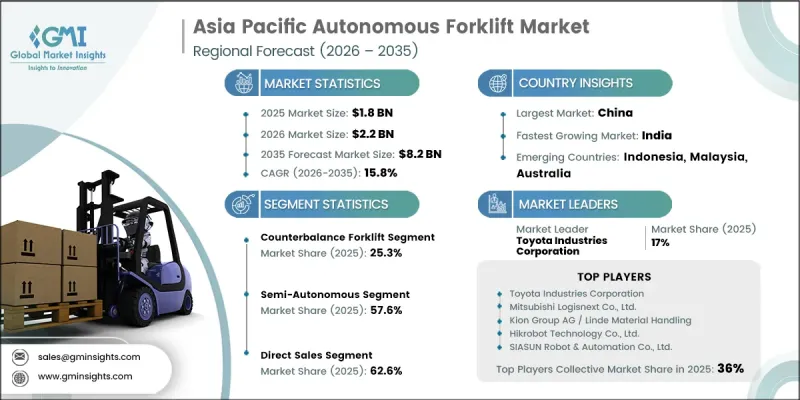
Asia Pacific Autonomous Forklift Market was valued at USD 1.8 billion in 2025 and is estimated to grow at a CAGR of 15.8% to reach USD 8.2 billion by 2035.
The market is experiencing robust growth as businesses across warehousing, manufacturing, and distribution facilities increasingly transition from conventional material handling operations to intelligent autonomous logistics solutions. Rising labor shortages, rapid expansion of e-commerce activities, and growing investments in smart manufacturing initiatives are encouraging organizations to automate warehouse operations and improve productivity. Autonomous forklifts are becoming a critical component of modern intralogistics systems by enhancing operational efficiency, reducing labor dependency, and improving workplace safety. At the same time, software innovation is becoming equally important as hardware advancements in determining overall system performance. AI-powered fleet management platforms capable of optimizing task allocation, coordinating multiple autonomous vehicles, predicting maintenance needs, and integrating seamlessly with warehouse management systems are significantly improving operational efficiency. As organizations continue deploying larger autonomous forklift fleets, intelligent software orchestration is becoming essential for maximizing throughput, minimizing downtime, and supporting highly automated logistics environments, creating long-term growth opportunities for the Asia Pacific autonomous forklift market.
| Market Scope | |
|---|---|
| Start Year | 2025 |
| Forecast Year | 2026-2035 |
| Start Value | $1.8 Billion |
| Forecast Value | $8.2 Billion |
| CAGR | 15.8% |
The counterbalance autonomous forklift segment held a 25.3% share in 2025 and is projected to grow at the fastest CAGR of 16.3% during 2026-2035. The segment maintains its leading position due to its widespread use in high-volume material handling operations across manufacturing facilities, loading areas, and large distribution centers. Autonomous counterbalance forklifts improve productivity by handling repetitive transportation tasks efficiently while supporting continuous operations in demanding industrial environments.
The semi-autonomous segment held a 57.6% share in 2025 and is expected to grow at a CAGR of 15.4% through 2035. This segment continues to dominate as many companies adopt a phased automation strategy that combines autonomous functionality with human supervision for complex operational tasks. Semi-autonomous systems offer greater flexibility by allowing operators to manage specialized activities while automation performs repetitive transportation functions, making them an attractive solution for facilities gradually transitioning toward fully automated operations.
China Autonomous Forklift Market accounted for a 54.4% share in 2025 and is forecast to grow at a CAGR of 16% during 2026-2035. The country's leadership is supported by its extensive robotics manufacturing capabilities, rapidly expanding logistics sector, and strong focus on industrial automation. Increasing investments in advanced manufacturing technologies, warehouse automation, and intelligent logistics infrastructure continue to accelerate the adoption of autonomous forklift solutions throughout the country, reinforcing its dominant position within the regional market.
Key players in the Asia Pacific autonomous forklift market include Toyota Industries Corporation, Mitsubishi Logisnext Co., Ltd., Geekplus Technology Co., Ltd., Hikrobot Technology Co., Ltd., Jungheinrich AG, Kion Group AG / Linde Material Handling, Crown Equipment Corporation, Hangcha Group Co., Ltd., Anhui Heli Co., Ltd., Noblelift Intelligent Equipment Co., Ltd., Quicktron Robotics Technology Co., Ltd., SIASUN Robot & Automation Co., Ltd., EP Equipment Co., Ltd., Yujin Robot Co., Ltd., Addverb Technologies Pvt. Ltd., XSQUARE Technologies Pte. Ltd., Youibot Robotics Co., Ltd., ForwardX Robotics, GreyOrange Inc., Leishen Robot (Leishi Intelligent System), Gridbots Technologies Pvt. Ltd. Companies operating in the Asia Pacific autonomous forklift market are strengthening their market presence through continuous investments in artificial intelligence, robotics, and autonomous navigation technologies. Manufacturers are expanding their product portfolios by introducing advanced forklift models equipped with intelligent fleet management software, enhanced safety systems, and improved warehouse connectivity. Strategic partnerships with logistics providers, manufacturing companies, and warehouse operators are helping accelerate technology adoption while strengthening long-term customer relationships. Businesses are also investing in research and development to improve navigation accuracy, battery performance, and operational efficiency.
Table of Contents
Chapter 1 Methodology and Scope
- 1.1 Market scope & definitions
- 1.2 Research design
- 1.2.1 Research approach
- 1.2.2 Data collection methods
- 1.3 Base estimates and calculations
- 1.3.1 Base year calculation
- 1.3.2 Market estimates & forecasts parameters
- 1.4 Forecast Model
- 1.4.1 Key trends for market estimates
- 1.4.2 Quantified market impact analysis
- 1.4.2.1 Mathematical impact of growth parameters on forecast
- 1.4.3 Scenario analysis framework
- 1.5 Primary research and validation
- 1.5.1 Some of the primary sources (but not limited to)
- 1.6 Data mining sources
- 1.6.1 Paid Sources
- 1.7 Primary research and validation
- 1.7.1 Primary sources
- 1.8 Research Trail & confidence scoring
- 1.8.1 Research trail components
- 1.8.2 Scoring components
- 1.9 Research transparency addendum
- 1.9.1 Source attribution framework
- 1.9.2 Quality assurance metrics
- 1.9.3 Our commitment to trust
Chapter 2 Executive Summary
- 2.1 Industry 360° synopsis
- 2.2 Key market trends
- 2.2.1 Country
- 2.2.2 Forklift type
- 2.2.3 Navigation technology
- 2.2.4 Load capacity
- 2.2.5 Autonomy level
- 2.2.6 Application
- 2.2.7 End use industry
- 2.2.8 Distribution channel
Chapter 3 Industry Insights
- 3.1 Industry ecosystem analysis
- 3.1.1 Supplier landscape
- 3.1.2 Profit margin
- 3.1.3 Value addition at each stage
- 3.1.4 Factor affecting the value chain
- 3.2 Industry impact forces
- 3.2.1 Growth drivers
- 3.2.1.1 Rapid warehouse automation
- 3.2.1.2 Rising labor costs and workforce shortages
- 3.2.1.3 Advancements in autonomous technologies
- 3.2.2 Industry pitfalls & challenges
- 3.2.2.1 High initial investment
- 3.2.2.2 Integration complexity
- 3.2.3 Opportunities
- 3.2.3.1 Greenfield smart warehouse projects
- 3.2.3.2 Cold storage and food logistics
- 3.2.1 Growth drivers
- 3.3 Growth potential analysis
- 3.4 Regulatory framework
- 3.4.1 OSHA powered industrial trucks standard (29 CFR 1910.178)
- 3.4.2 ISO 3691-4:2023 - safety requirements for unmanned industrial trucks
- 3.4.3 Evolving regional safety standards & compliance landscape
- 3.5 Pricing analysis (driven by primary research)
- 3.5.1 Historical price trend analysis (2022-2025)
- 3.5.2 Pricing strategy by player type (premium / value / cost-plus)
- 3.6 Trade data analysis (driven by paid database)
- 3.6.1 Import/export volume & value trends by key country
- 3.6.2 Key trade corridors & tariff impact on autonomous forklift commerce
- 3.7 Impact of AI & generative AI on the market
- 3.7.1 AI-driven disruption of existing business models
- 3.7.2 GenAI use cases & adoption roadmap by segment
- 3.7.3 Risks, limitations & regulatory considerations for AI in pet care
- 3.8 Capacity & production landscape (driven by primary research)
- 3.8.1 Installed manufacturing capacity by region & key producer
- 3.8.2 Capacity utilization rates & expansion pipelines
Chapter 4 Competitive Landscape, 2025
- 4.1 Introduction
- 4.2 Company market share analysis
- 4.2.1 By country
- 4.2.1.1 China
- 4.2.1.2 India
- 4.2.1.3 Japan
- 4.2.1.4 South Korea
- 4.2.1.5 Australia
- 4.2.1.6 Malaysia
- 4.2.1.7 Indonesia
- 4.2.1.8 Vietnam
- 4.2.1 By country
- 4.3 Company matrix analysis
- 4.4 Competitive analysis of major market players
- 4.5 Competitive positioning matrix
- 4.6 Key developments
- 4.6.1 Mergers & acquisitions
- 4.6.2 Partnerships & collaborations
- 4.6.3 New product launches
- 4.6.4 Expansion plans
Chapter 5 Market Estimates and Forecast, By Forklift Type, 2022 - 2035 (USD Billion) (Units)
- 5.1 Key trends
- 5.2 Counterbalance forklift
- 5.3 Reach truck
- 5.4 Pallet mover / pallet truck
- 5.5 Stacker forklift
- 5.6 Order picker
- 5.7 Narrow-aisle / very narrow aisle (VNA) forklift
- 5.8 Tow tractor / tugger
- 5.9 Others (mobile platforms, AGC-based units)
Chapter 6 Market Estimates and Forecast, By Navigation Technology, 2022 - 2035 (USD Billion) (Units)
- 6.1 Key trends
- 6.2 LiDAR / natural feature navigation
- 6.3 Reflector-based laser navigation
- 6.4 Vision (camera / 3D vision)
- 6.5 Slam (simultaneous localization & mapping)
- 6.6 Magnetic
- 6.7 Inductive / wire
- 6.8 QR code / optical navigation
- 6.9 Others (hybrid / multi-modal navigation systems)
Chapter 7 Market Estimates and Forecast, By Load Capacity, 2022 - 2035 (USD Billion) (Units)
- 7.1 Key trends
- 7.2 Below 1.5 tons
- 7.3 1.5 to 3 tons
- 7.4 3 to 5 tons
- 7.5 Above 5 tons
Chapter 8 Market Estimates and Forecast, By Autonomy Level, 2022 - 2035 (USD Billion) (Units)
- 8.1 Key trends
- 8.2 Semi-autonomous
- 8.3 Fully autonomous
Chapter 9 Market Estimates and Forecast, By Application, 2022 - 2035 (USD Billion) (Units)
- 9.1 Key trends
- 9.2 Warehouse automation
- 9.3 Material handling & transportation
- 9.4 Order picking & fulfillment
- 9.5 Production supply & assembly line feeding
- 9.6 Loading & unloading
- 9.7 Cold storage & temperature-controlled operations
- 9.8 Automated shipping & outbound logistics
- 9.9 Others
Chapter 10 Market Estimates and Forecast, By End Use Industry, 2022 - 2035 (USD Billion) (Units)
- 10.1 Key trends
- 10.2 Warehousing & third-party logistics
- 10.3 Manufacturing
- 10.4 E-commerce & retail
- 10.5 Food & beverage
- 10.6 Automotive
- 10.7 Pharmaceutical & healthcare
- 10.8 Paper & pulp
- 10.9 Chemical
- 10.10 Semiconductor & electronics
- 10.11 Aerospace & defense
- 10.12 Others (construction, plastics, consumer goods)
Chapter 11 Market Estimates and Forecast, By Distribution Channel, 2022 - 2035 (USD Billion) (Units)
- 11.1 Key trends
- 11.2 Direct sales
- 11.3 Indirect sales
Chapter 12 Market Estimates and Forecast, By Country, 2022 - 2035 (USD Million) (Million Units)
- 12.1 Key trends
- 12.2 China
- 12.3 India
- 12.4 Japan
- 12.5 South Korea
- 12.6 Australia
- 12.7 Malaysia
- 12.8 Indonesia
- 12.9 Vietnam
Chapter 13 Company Profiles
- 13.1 Global players
- 13.1.1 Toyota Industries Corporation
- 13.1.2 Mitsubishi Logisnext Co., Ltd.
- 13.1.3 Geekplus Technology Co., Ltd.
- 13.1.4 Hikrobot Technology Co., Ltd.
- 13.1.5 Jungheinrich AG
- 13.1.6 Kion Group AG / Linde Material Handling
- 13.1.7 Crown Equipment Corporation
- 13.2 Regional players
- 13.2.1 Hangcha Group Co., Ltd.
- 13.2.2 Anhui Heli Co., Ltd.
- 13.2.3 Noblelift Intelligent Equipment Co., Ltd.
- 13.2.4 Quicktron Robotics Technology Co., Ltd.
- 13.2.5 SIASUN Robot & Automation Co., Ltd.
- 13.2.6 EP Equipment Co., Ltd.
- 13.2.7 Yujin Robot Co., Ltd.
- 13.3 Emerging players
- 13.3.1 Addverb Technologies Pvt. Ltd.
- 13.3.2 XSQUARE Technologies Pte. Ltd.
- 13.3.3 Youibot Robotics Co., Ltd.
- 13.3.4 ForwardX Robotics
- 13.3.5 GreyOrange Inc.
- 13.3.6 Leishen Robot (Leishi Intelligent System)
- 13.3.7 Gridbots Technologies Pvt. Ltd.

