PUBLISHER: Global Market Insights Inc. | PRODUCT CODE: 2109274

PUBLISHER: Global Market Insights Inc. | PRODUCT CODE: 2109274
Autonomous Forklift Market Opportunity, Growth Drivers, Industry Trend Analysis, and Forecast 2026 - 2035
The Global Autonomous Forklift Market was valued at USD 4.6 billion in 2025 and is estimated to grow at a CAGR of 15.1% to reach USD 19.4 billion by 2035.
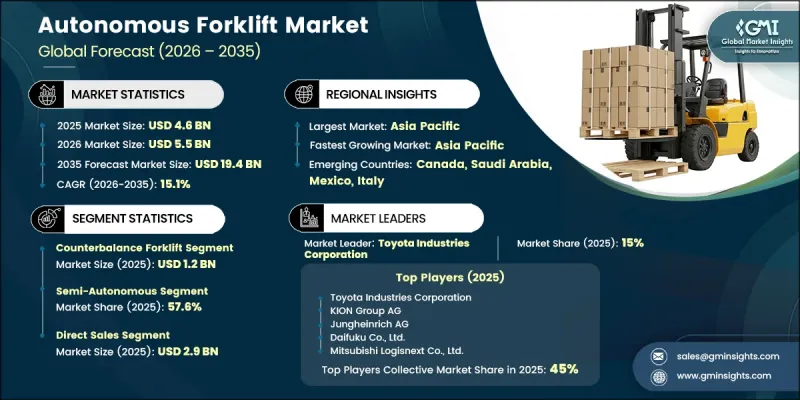
Growth across the autonomous forklift industry is fueled by rising investments in warehouse automation and the increasing need to overcome persistent labor shortages across manufacturing, logistics, and distribution operations. Businesses are accelerating the adoption of intelligent material handling solutions to improve productivity, optimize operational efficiency, and support high-volume warehouse activities. Autonomous forklifts have become an essential component of modern automated facilities by enabling consistent and reliable movement of goods while minimizing manual intervention. Organizations are increasingly viewing autonomous forklift deployment as a long-term strategic investment because these systems help improve throughput, reduce operating costs, enhance workflow accuracy, and increase overall warehouse performance. Continuous advancements in artificial intelligence, autonomous navigation, sensor technologies, and electric-powered vehicle platforms are further expanding the capabilities of autonomous forklifts across a broader range of industrial applications. Ongoing technological innovation, combined with growing investment in smart logistics infrastructure and automated material handling systems, continues to strengthen the long-term growth outlook for the global autonomous forklift market.
| Market Scope | |
|---|---|
| Start Year | 2025 |
| Forecast Year | 2026-2035 |
| Start Value | $4.6 Billion |
| Forecast Value | $19.4 Billion |
| CAGR | 15.1% |
The counterbalance forklift segment generated USD 1.2 billion in 2025. Its leadership is supported by the versatility of counterbalance forklift designs, which can efficiently perform material handling operations across diverse industrial environments without requiring significant modifications to existing facilities. These forklifts are widely preferred because they offer flexible deployment, dependable load handling, and compatibility with a broad range of warehouse and manufacturing applications. Their ability to support efficient material movement while adapting to varying operational requirements continues to sustain strong demand throughout the forecast period.
The semi-autonomous segment accounted for a 57.6% share in 2025, representing the largest share by autonomy level. This segment continues to dominate because it provides an effective balance between automation and operator supervision, allowing businesses to automate repetitive material handling activities while maintaining human oversight for complex operational tasks. Semi-autonomous systems enable organizations to improve productivity, reduce operational inefficiencies, and simplify the transition from conventional forklift operations without requiring extensive infrastructure upgrades. Their practical implementation and lower operational complexity continue to encourage widespread adoption across industrial facilities.
U.S. Autonomous Forklift Market captured a 74.3% share, generating USD 0.9 billion in 2025. Market growth is supported by substantial investment in warehouse automation, expanding logistics infrastructure, and increasing adoption of intelligent material handling technologies. Businesses continue to deploy autonomous forklifts to improve operational efficiency, address workforce shortages, and enhance warehouse productivity. Continued investment in automated distribution facilities and advanced industrial technologies is expected to reinforce the country's leadership throughout the forecast period.
Major companies operating in the global autonomous forklift market include Toyota Industries Corporation, KION Group AG, Jungheinrich AG, Crown Equipment Corporation, Hyster-Yale Materials Handling, Inc., Mitsubishi Logisnext Co., Ltd., Daifuku Co., Ltd., VisionNav Robotics, SEER Robotics, Multiway Robotics, Anhui Heli Co., Ltd., AGVE Group, Hangcha Group Co., Ltd., Agilox Services GmbH, Gideon Brothers, Vecna Robotics, OTTO by Rockwell Automation, Mobile Industrial Robots (MiR), Geek+ (Geekplus Technology), IPLUSMOBOT, and E80 Group. Companies participating in the autonomous forklift market are strengthening their competitive position through continuous investment in artificial intelligence, autonomous navigation technologies, and advanced warehouse automation solutions. Manufacturers are expanding their product portfolios by developing intelligent forklifts with enhanced sensing capabilities, improved navigation accuracy, higher operational efficiency, and greater system reliability. Many organizations are increasing research and development investments, expanding manufacturing capacity, and strengthening regional distribution and service networks to improve customer support and market reach. Strategic partnerships, technology collaborations, and long-term commercial agreements remain key approaches for accelerating innovation and expanding business opportunities.
Table of Contents
Chapter 1 Methodology and Scope
- 1.1 Market scope & definitions
- 1.2 Research design
- 1.2.1 Research approach
- 1.2.2 Data collection methods
- 1.3 Base estimates and calculations
- 1.3.1 Base year calculation
- 1.3.2 Market estimates & forecasts parameters
- 1.4 Forecast Model
- 1.4.1 Key trends for market estimates
- 1.4.2 Quantified market impact analysis
- 1.4.2.1 Mathematical impact of growth parameters on forecast
- 1.4.3 Scenario analysis framework
- 1.5 Primary research and validation
- 1.5.1 Some of the primary sources (but not limited to)
- 1.6 Data mining sources
- 1.6.1 Paid Sources
- 1.7 Primary research
- 1.7.1 Primary sources
- 1.8 Research Trail & confidence scoring
- 1.8.1 Research trail components
- 1.8.2 Scoring components
- 1.9 Research transparency addendum
- 1.9.1 Source attribution framework
- 1.9.2 Quality assurance metrics
- 1.9.3 Our commitment to trust
Chapter 2 Executive Summary
- 2.1 Industry 360° synopsis
- 2.2 Key market trends
- 2.2.1 Regional
- 2.2.2 Forklift type
- 2.2.3 Navigation technology
- 2.2.4 Load capacity
- 2.2.5 Autonomy level
- 2.2.6 Application
- 2.2.7 End use industry
- 2.2.8 Distribution channel
Chapter 3 Industry Insights
- 3.1 Industry ecosystem analysis
- 3.1.1 Supplier landscape
- 3.1.2 Profit margin
- 3.1.3 Value addition at each stage
- 3.1.4 Factor affecting the value chain
- 3.2 Industry impact forces
- 3.2.1 Growth drivers
- 3.2.1.1 Increasing warehouse automation
- 3.2.1.2 Demand for operational efficiency
- 3.2.1.3 Advancements in artificial intelligence and sensors
- 3.2.2 Industry pitfalls & challenges
- 3.2.2.1 High capital investment
- 3.2.2.2 Technical limitations
- 3.2.3 Opportunities
- 3.2.3.1 Smart warehouse development
- 3.2.3.2 Robotics-as-a-Service (RaaS)
- 3.2.1 Growth drivers
- 3.3 Growth potential analysis
- 3.4 Regulatory framework
- 3.4.1 OSHA powered industrial trucks standard (29 CFR 1910.178)
- 3.4.2 ISO 3691-4:2023 - safety requirements for unmanned industrial trucks
- 3.4.3 EU machinery directive & CE marking requirements for automated trucks
- 3.4.4 ANSI/ITSDF B56.5 - safety standard for AGVs (North America)
- 3.4.5 Evolving regional safety standards & compliance landscape
- 3.5 Pricing analysis (driven by primary research)
- 3.5.1 Historical price trend analysis (2022-2025)
- 3.5.2 Pricing strategy by player type (premium / value / cost-plus)
- 3.6 Trade data analysis (driven by paid database)
- 3.6.1 Import/export volume & value trends by key country
- 3.6.2 Key trade corridors & tariff impact on autonomous forklift commerce
- 3.7 Impact of AI & generative AI on the market
- 3.7.1 AI-driven disruption of existing business models
- 3.7.2 GenAI use cases & adoption roadmap by segment
- 3.7.3 Risks, limitations & regulatory considerations for AI in pet care
- 3.8 Capacity & production landscape (driven by primary research)
- 3.8.1 Installed manufacturing capacity by region & key producer
- 3.8.2 Capacity utilization rates & expansion pipelines
Chapter 4 Competitive Landscape, 2025
- 4.1 Introduction
- 4.2 Company market share analysis
- 4.2.1 By region
- 4.2.1.1 North America
- 4.2.1.2 Europe
- 4.2.1.3 Asia Pacific
- 4.2.1.4 Latin America
- 4.2.1.5 Middle East and Africa
- 4.2.1 By region
- 4.3 Company matrix analysis
- 4.4 Competitive analysis of major market players
- 4.5 Competitive positioning matrix
- 4.6 Key developments
- 4.6.1 Mergers & acquisitions
- 4.6.2 Partnerships & collaborations
- 4.6.3 New product launches
- 4.6.4 Expansion plans
Chapter 5 Market Estimates and Forecast, By Forklift Type, 2022 – 2035 (USD Billion) (Units)
- 5.1 Key trends
- 5.2 Counterbalance forklift
- 5.3 Reach truck
- 5.4 Pallet mover / pallet truck
- 5.5 Stacker forklift
- 5.6 Order picker
- 5.7 Narrow-aisle / very narrow aisle (VNA) forklift
- 5.8 Tow tractor / tugger
- 5.9 Others (mobile platforms, AGC-based units)
Chapter 6 Market Estimates and Forecast, By Navigation Technology, 2022 – 2035 (USD Billion) (Units)
- 6.1 Key trends
- 6.2 LiDAR / natural feature navigation
- 6.3 Reflector-based laser navigation
- 6.4 Vision (camera / 3D vision)
- 6.5 Slam (simultaneous localization & mapping)
- 6.6 Magnetic
- 6.7 Inductive / wire
- 6.8 QR code / optical navigation
- 6.9 Others (hybrid / multi-modal navigation systems)
Chapter 7 Market Estimates and Forecast, By Load Capacity, 2022 – 2035 (USD Billion) (Units)
- 7.1 Key trends
- 7.2 Below 1.5 tons
- 7.3 1.5 to 3 tons
- 7.4 3 to 5 tons
- 7.5 Above 5 tons
Chapter 8 Market Estimates and Forecast, By Autonomy Level, 2022 – 2035 (USD Billion) (Units)
- 8.1 Key trends
- 8.2 Semi-autonomous
- 8.3 Fully autonomous
Chapter 9 Market Estimates and Forecast, By Application, 2022 – 2035 (USD Billion) (Units)
- 9.1 Key trends
- 9.2 Warehouse automation
- 9.3 Material handling & transportation
- 9.4 Order picking & fulfillment
- 9.5 Production supply & assembly line feeding
- 9.6 Loading & unloading
- 9.7 Cold storage & temperature-controlled operations
- 9.8 Automated shipping & outbound logistics
- 9.9 Others
Chapter 10 Market Estimates and Forecast, By End Use Industry, 2022 – 2035 (USD Billion) (Units)
- 10.1 Key trends
- 10.2 Warehousing & third-party logistics
- 10.3 Manufacturing
- 10.4 E-commerce & retail
- 10.5 Food & beverage
- 10.6 Automotive
- 10.7 Pharmaceutical & healthcare
- 10.8 Paper & pulp
- 10.9 Chemical
- 10.10 Semiconductor & electronics
- 10.11 Aerospace & defense
- 10.12 Others (construction, plastics, consumer goods)
Chapter 11 Market Estimates and Forecast, By Distribution Channel, 2022 – 2035 (USD Billion) (Units)
- 11.1 Key trends
- 11.2 Direct sales
- 11.3 Indirect sales
Chapter 12 Market Estimates and Forecast, By Region, 2022 – 2035 (USD Billion) (Units)
- 12.1 Key trends
- 12.2 North America
- 12.2.1 U.S.
- 12.2.2 Canada
- 12.3 Europe
- 12.3.1 Germany
- 12.3.2 UK
- 12.3.3 France
- 12.3.4 Italy
- 12.3.5 Spain
- 12.4 Asia Pacific
- 12.4.1 China
- 12.4.2 Japan
- 12.4.3 India
- 12.4.4 Australia
- 12.4.5 South Korea
- 12.5 Latin America
- 12.5.1 Brazil
- 12.5.2 Mexico
- 12.5.3 Argentina
- 12.6 Middle East and Africa
- 12.6.1 South Africa
- 12.6.2 Saudi Arabia
- 12.6.3 UAE
Chapter 13 Company Profiles
- 13.1 Global players
- 13.1.1 Toyota Industries Corporation
- 13.1.2 KION Group AG
- 13.1.3 Jungheinrich AG
- 13.1.4 Crown Equipment Corporation
- 13.1.5 Hyster-Yale Materials Handling, Inc.
- 13.1.6 Mitsubishi Logisnext Co., Ltd.
- 13.1.7 Daifuku Co., Ltd.
- 13.2 Regional players
- 13.2.1 VisionNav Robotics
- 13.2.2 SEER Robotics
- 13.2.3 Multiway Robotics
- 13.2.4 Anhui Heli Co., Ltd.
- 13.2.5 AGVE Group
- 13.2.6 Hangcha Group Co., Ltd.
- 13.2.7 Agilox Services GmbH
- 13.3 Emerging players
- 13.3.1 Gideon Brothers
- 13.3.2 Vecna Robotics
- 13.3.3 OTTO by Rockwell Automation
- 13.3.4 Mobile Industrial Robots (MiR)
- 13.3.5 Geek+ (Geekplus Technology)
- 13.3.6 IPLUSMOBOT
- 13.3.7 E80 Group

