PUBLISHER: Global Market Insights Inc. | PRODUCT CODE: 2109175

PUBLISHER: Global Market Insights Inc. | PRODUCT CODE: 2109175
Utility-Scale Sodium-Ion Energy Storage Systems Market Opportunity, Growth Drivers, Industry Trend Analysis, and Forecast 2026 - 2035
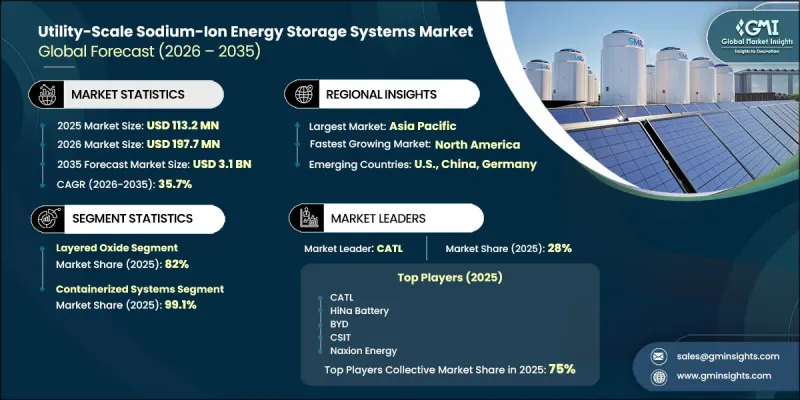
The Global Utility-Scale Sodium-Ion Energy Storage Systems Market was valued at USD 113.2 million in 2025 and is estimated to grow at a CAGR of 35.7% to reach USD 3.1 billion by 2035.
Rapid expansion of renewable power generation and the increasing requirement for reliable grid-scale energy storage solutions are creating strong growth opportunities for the market. Sodium-ion battery technology is moving beyond the demonstration stage and entering commercial deployment as utilities and energy developers seek storage solutions that reduce dependence on critical raw materials while improving operational safety. Chemistry offers a competitive advantage through the elimination of lithium, cobalt, and graphite in most commercial formulations, helping diversify battery supply chains and reduce exposure to raw material price fluctuations. In addition, excellent thermal stability across a broad operating temperature range enhances system reliability in demanding environments. The increasing integration of renewable energy into power grids continues to drive demand for cost-effective, large-scale storage technologies capable of balancing intermittent electricity generation while supporting grid stability, energy security, and long-term decarbonization initiatives.
| Market Scope | |
|---|---|
| Start Year | 2025 |
| Forecast Year | 2026-2035 |
| Start Value | $113.2 Million |
| Forecast Value | $3.1 Billion |
| CAGR | 35.7% |
The utility-scale sodium-ion energy storage systems market is gaining momentum as energy providers and grid operators increase investments in advanced battery technologies designed to improve renewable energy integration and long-duration storage performance. Growing emphasis on strengthening domestic supply chains and reducing dependence on critical minerals is encouraging wider adoption of sodium-ion battery technology across utility-scale projects. Manufacturers are expanding commercial production capacity while improving battery efficiency, energy density, and system reliability to address evolving utility requirements. Continued advancements in manufacturing processes and battery design are also supporting broader commercialization by lowering production costs and improving scalability. As global investments in renewable power generation continue to rise, demand for dependable, safe, and economically competitive sodium-ion storage systems is expected to accelerate throughout the forecast period.
The layered oxide cathode materials segment accounted for 82% share in 2025, and is projected to grow at a CAGR of 32.1% during 2026-2035. This segment maintains its leadership by offering an effective combination of energy density, electrochemical performance, and manufacturing efficiency. Compatibility with production equipment originally developed for lithium-ion battery manufacturing enables manufacturers to optimize capital investments while supporting large-scale commercial production. These advantages continue to strengthen demand for layered oxide cathode materials across utility-scale sodium-ion battery applications.
The containerized systems segment held a 99.1% share in 2025 and is forecast to grow at a CAGR of 33.5% through 2035. Standardized container-based system designs have become the preferred deployment format because they simplify transportation, installation, project development, grid integration, and operational management. The widespread adoption of standardized container configurations enables utilities and developers to deploy sodium-ion energy storage systems within existing grid-scale battery project frameworks while reducing engineering complexity and accelerating project implementation.
North America Utility-Scale Sodium-Ion Energy Storage Systems Market is projected to grow at a CAGR of 92.5% during 2026-2035. Market expansion across the region is supported by increasing investments in grid modernization, favorable energy storage policies, expanding domestic battery manufacturing initiatives, and the growing deployment of renewable energy projects. Rising demand for resilient energy infrastructure and long-duration storage technologies is encouraging utilities and independent power producers to evaluate sodium-ion batteries as a viable alternative for future large-scale energy storage installations.
Key Players in the global utility-scale sodium-ion energy storage systems market include Peak Energy, BenAn Energy, TIAMAT Energy, Naxion Energy, HiNa Battery, Faradion, BYD, Altris AB, Inlyte Energy, CATL, CSIT, Phenogy, Indi Energy, Bihar Batteries. Companies operating in the utility-scale sodium-ion energy storage systems market are focusing on expanding manufacturing capacity, improving battery performance, and accelerating commercialization to strengthen their competitive position. Leading manufacturers are investing heavily in research and development to enhance energy density, cycle life, safety, and overall system efficiency while lowering production costs. Strategic collaborations with utilities, renewable energy developers, and grid operators are helping companies secure large-scale deployment opportunities and strengthen their market presence. Businesses are also emphasizing localized manufacturing, supply chain diversification, and technological innovation to reduce dependence on critical minerals and improve production resilience. In addition, long-term partnerships, product portfolio expansion, pilot project execution, and continuous advancements in battery chemistry remain key strategies supporting sustainable growth and stronger market positioning.
Table of Contents
Chapter 1 Methodology & Scope
- 1.1 Research approach
- 1.2 Quality commitments
- 1.2.1 GMI AI policy & data integrity commitment
- 1.2.1.1 Source consistency protocol
- 1.2.1 GMI AI policy & data integrity commitment
- 1.3 Research trail & confidence scoring
- 1.3.1 Research trail components
- 1.3.2 Scoring components
- 1.4 Data collection
- 1.4.1 Partial list of primary sources
- 1.5 Data mining sources
- 1.5.1 Paid sources
- 1.5.1.1 Sources, by region
- 1.5.1 Paid sources
- 1.6 Base estimates and calculations
- 1.6.1 Base year calculation for any one approach
- 1.7 Market estimates & forecasts parameters
- 1.8 Forecast model
- 1.8.1 Quantified market impact analysis
- 1.8.1.1 Mathematical impact of growth parameters on forecast
- 1.8.1 Quantified market impact analysis
- 1.9 Research transparency addendum
- 1.9.1 Source attribution framework
- 1.9.2 Quality assurance metrics
- 1.9.3 Our commitment to trust
- 1.10 Market definitions
Chapter 2 Executive Summary
- 2.1 Industry synopsis, 2022 - 2035
- 2.1.1 Business trends
- 2.1.2 Chemistry trends
- 2.1.3 Configuration trends
- 2.1.4 Power rating trends
- 2.1.5 Storage duration trends
- 2.1.6 Connectivity trends
- 2.1.7 Application trends
- 2.1.8 End use trends
- 2.1.9 Regional trends
Chapter 3 Industry Insights
- 3.1 Industry ecosystem analysis
- 3.1.1 Raw material suppliers
- 3.1.2 Cell manufacturers & module assemblers
- 3.1.3 System integrators & BESS OEMS
- 3.1.4 EPC contractors, installers & commissioning partner analysis
- 3.1.5 Grid operators, offtakers & end-users
- 3.2 Regulatory landscape
- 3.3 Technology & innovation landscape
- 3.3.1 Sodium-Ion vs. Lithium-Ion (LFP): comparative technical & economic assessment
- 3.3.2 Anode technology evolution
- 3.3.3 Electrolyte developments
- 3.3.4 Battery Management System (BMS) innovations purpose-built for na-ion
- 3.3.5 Thermal management & safety systems for utility-scale deployment
- 3.4 Industry impact forces
- 3.4.1 Growth drivers
- 3.4.2 Industry pitfalls & challenges
- 3.5 Growth potential analysis
- 3.6 Porter's analysis
- 3.6.1 Bargaining power of suppliers
- 3.6.2 Bargaining power of buyers
- 3.6.3 Threat of new entrants
- 3.6.4 Threat of substitutes
- 3.7 PESTEL analysis
- 3.7.1 Political factors
- 3.7.2 Economic factors
- 3.7.3 Social factors
- 3.7.4 Technological factors
- 3.7.5 Legal factors
- 3.7.6 Environmental factors
- 3.8 Investment & funding analysis
- 3.8.1 Venture capital & private equity investment trends
- 3.8.2 Government grants & public funding
- 3.8.3 Project finance, ipp investments & developer equity flows
- 3.9 Impact of AI & Generative AI on the market (Driven by Primary Research)
- 3.9.1 AI-Driven disruption of existing business models
- 3.9.2 GenAI use cases & adoption roadmap
- 3.9.3 Risks, limitations & regulatory considerations
- 3.10 Sustainability initiatives & industry 4.0 integration
- 3.11 Future outlook & strategic opportunities
Chapter 4 Competitive Landscape, 2026
- 4.1 Introduction
- 4.2 Company market share analysis, by region, 2025
- 4.2.1 North America
- 4.2.2 Europe
- 4.2.3 Asia Pacific
- 4.3 Key developments
- 4.3.1 Key partnerships & collaborations
- 4.3.2 Major M&A activities
- 4.3.3 Product innovations & launches
- 4.3.4 Market expansion strategies
- 4.4 Competitive positioning matrix
- 4.4.1 Tier classification criteria & qualifying thresholds
- 4.4.2 Tier positioning matrix by revenue, geography & innovation
Chapter 5 Market Size and Forecast, By Chemistry, 2022 - 2035 (USD Million)
- 5.1 Key trends
- 5.2 Layered Oxide
- 5.3 Prussian Blue Analogues
- 5.4 Polyanionic Compounds
- 5.5 Others
Chapter 6 Market Size and Forecast, By Configuration, 2022 - 2035 (USD Million)
- 6.1 Key trends
- 6.2 Containerized Systems
- 6.3 Rack-Mounted Systems
- 6.4 Integrated Stationary Systems
Chapter 7 Market Size and Forecast, By Power Rating, 2022 - 2035 (USD Million)
- 7.1 Key trends
- 7.2 <10 MW
- 7.3 >10-50 MW
- 7.4 >50-150 MW
- 7.5 >150-500 MW
- 7.6 >500 MW
Chapter 8 Market Size and Forecast, By Storage Duration, 2022 - 2035 (USD Million)
- 8.1 Key trends
- 8.2 Short Duration (1-2h)
- 8.3 Medium Duration (2-4h)
- 8.4 Long Duration (4-8h)
- 8.5 Extra-Long/LDES (>8h)
Chapter 9 Market Size and Forecast, By Connectivity, 2022 - 2035 (USD Million)
- 9.1 Key trends
- 9.2 Transmission-Connected
- 9.3 Distribution-Connected
- 9.4 Others
Chapter 10 Market Size and Forecast, By Application, 2022 - 2035 (USD Million)
- 10.1 Key trends
- 10.2 Renewable Energy Integration
- 10.3 Grid Stabilization
- 10.4 Peak Shaving & Load Shifting
- 10.5 Frequency Regulation
- 10.6 Backup Power
- 10.7 Others
Chapter 11 Market Size and Forecast, By End Use, 2022 - 2035 (USD Million)
- 11.1 Key trends
- 11.2 Distribution System Operators (DSOs)
- 11.3 Independent Power Producers (IPPs)
- 11.4 Renewable Energy Developers
- 11.5 Government Grid Operators & Public Sector Agencies
- 11.6 Others
Chapter 12 Market Size and Forecast, By Region, 2022 - 2035 (USD Million)
- 12.1 Key trends
- 12.2 North America
- 12.2.1 U.S.
- 12.2.2 Canada
- 12.3 Europe
- 12.3.1 Germany
- 12.3.2 UK
- 12.3.3 France
- 12.3.4 Sweden
- 12.4 Asia Pacific
- 12.4.1 China
- 12.4.2 India
- 12.4.3 Japan
- 12.5 Rest of World
Chapter 13 Company Profiles
- 13.1 Altris AB
- 13.2 BYD
- 13.3 BenAn Energy
- 13.4 Bihar Batteries
- 13.5 CATL
- 13.6 CSIT
- 13.7 Faradion
- 13.8 HiNa Battery
- 13.9 Inlyte Energy
- 13.10 Indi Energy
- 13.11 Naxion Energy
- 13.12 Natron Energy
- 13.13 Peak Energy
- 13.14 Phenogy
- 13.15 TIAMAT

