PUBLISHER: Global Market Insights Inc. | PRODUCT CODE: 2109177

PUBLISHER: Global Market Insights Inc. | PRODUCT CODE: 2109177
Asia-Pacific Railcar Unloader Market Opportunity, Growth Drivers, Industry Trend Analysis, and Forecast 2026 - 2035
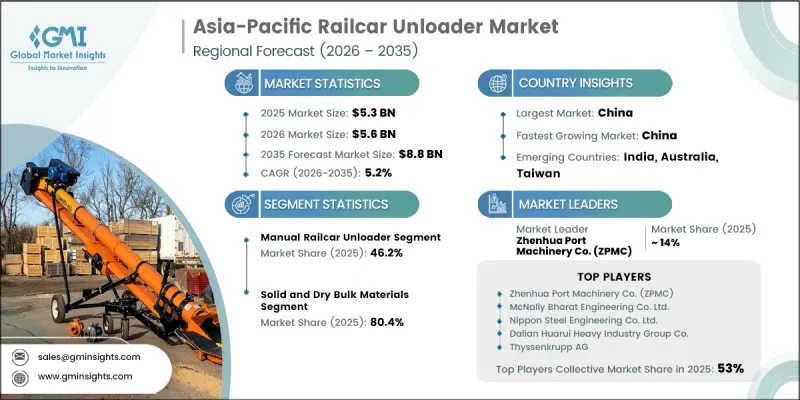
Asia Pacific Railcar Unloader Market was valued at USD 5.3 billion in 2025 and is estimated to grow at a CAGR of 5.2% to reach USD 8.8 billion by 2035.
Market growth is supported by continuous investments in bulk material transportation infrastructure across key industries, including mining, energy, agriculture, construction, and industrial manufacturing. Rising demand for efficient material handling systems at ports, industrial terminals, and processing facilities is increasing the adoption of advanced railcar unloading solutions throughout the region. The expansion of freight rail networks, combined with growing requirements for faster material movement and improved operational efficiency, is encouraging industries to upgrade unloading capabilities. The market is also experiencing a transition toward automated and semi-automated systems as operators focus on reducing unloading time, improving equipment utilization, and minimizing dependence on manual processes. Increasing freight volumes and the need for higher throughput capacity are strengthening demand for advanced unloading technologies. Conveyor-based and pneumatic unloading systems are gaining importance as industries seek reliable solutions that enhance productivity and support large-scale bulk material operations. These trends continue to create favorable growth opportunities for the Asia Pacific railcar unloader market as regional industries modernize their logistics and material handling infrastructure.
| Market Scope | |
|---|---|
| Start Year | 2025 |
| Forecast Year | 2026-2035 |
| Start Value | $5.3 Billion |
| Forecast Value | $8.8 Billion |
| CAGR | 5.2% |
The pneumatic railcar unloader segment accounted for a 23.3% share in 2025. Rising adoption of pneumatic conveying technologies across industrial facilities is supporting segment growth due to their ability to provide efficient and reliable bulk material transfer. Increasing demand for improved handling efficiency, reduced material loss, and optimized unloading operations continues to encourage industries to invest in pneumatic railcar unloading solutions.
The manual railcar unloader segment held a 46.2% share in 2025. Manual systems continue to maintain a strong presence at smaller facilities because of their lower upfront investment requirements and suitability for operations with limited automation needs. Despite this existing demand, increasing focus on operational efficiency, labor optimization, and faster unloading cycles is accelerating the transition toward advanced unloading technologies.
China Railcar Unloader Market held a 31.9% share, generating USD 1.67 billion in 2025, making it the largest and most developed market in the region. Strong demand is supported by the country's extensive freight rail infrastructure and large-scale industrial activities requiring continuous bulk material transportation.
Major companies operating in the Asia Pacific railcar unloader market include BGR Energy Systems Ltd., CITIC Heavy Industries Co., Ltd., Dalian Huarui Heavy Industry Group Co., Ltd., Elecon Engineering Company Ltd., Frigate Teknologies Pvt. Ltd., IHI Corporation, Kawasaki Heavy Industries Ltd., Macmet India Ltd., McNally Bharat Engineering Co. Ltd., Metso Corporation, Mitsubishi Heavy Industries Material Handling & Construction Machinery, Nippon Steel Engineering Co., Ltd., Proman Infrastructure Ltd., Simplex Engineering & Foundry Works Pvt. Ltd., Taiyuan Heavy Industry Co., Ltd., Thyssenkrupp AG, Tidfore Heavy Equipment Group Co., Ltd., TKIL Industries, TRF Limited, and Zhenhua Port Machinery Co. (ZPMC). Companies operating in the Asia Pacific railcar unloader market are focusing on technology advancement, product customization, and strategic expansion to strengthen their market presence. Manufacturers are investing in automated unloading systems, engineering improvements, and energy-efficient solutions to address the evolving requirements of bulk material handling industries. Strategic collaborations with industrial operators, infrastructure developers, and logistics providers are helping companies expand their customer base and improve regional reach. Businesses are also enhancing manufacturing capabilities, strengthening service networks, and offering maintenance support to improve equipment reliability and customer satisfaction.
Table of Contents
Chapter 1 Methodology and Scope
- 1.1 Research approach
- 1.2 Quality Commitments
- 1.2.1 GMI AI policy & data integrity commitment
- 1.2.1.1 Source consistency protocol
- 1.2.1 GMI AI policy & data integrity commitment
- 1.3 Research Trail & Confidence Scoring
- 1.3.1 Research Trail Components
- 1.3.2 Scoring Components
- 1.4 Data Collection
- 1.4.1 Partial list of primary sources
- 1.5 Data mining sources
- 1.5.1 Paid sources
- 1.5.1.1 Sources, by region
- 1.5.1 Paid sources
- 1.6 Base estimates and calculations
- 1.6.1 Base year calculation for any one approach
- 1.7 Forecast model
- 1.7.1 Quantified market impact analysis
- 1.7.1.1 Mathematical impact of growth parameters on forecast
- 1.7.1 Quantified market impact analysis
- 1.8 Research transparency addendum
- 1.8.1 Source attribution framework
- 1.8.2 Quality assurance metrics
- 1.8.3 Our commitment to trust
Chapter 2 Executive Summary
- 2.1 Industry 360° synopsis
- 2.2 Business trends
- 2.2.1 Unloading Mechanism
- 2.2.2 Material Handled
- 2.2.3 Application
- 2.2.4 Automation Level
- 2.2.5 Sales Channel
Chapter 3 Industry Insights
- 3.1 Industry ecosystem analysis
- 3.1.1 Factor affecting the value chain
- 3.1.2 Profit margin analysis
- 3.1.3 Disruptions
- 3.1.4 Future outlook
- 3.1.5 Manufacturers
- 3.1.6 Distributors
- 3.2 Supplier landscape
- 3.3 Key news & initiatives
- 3.4 Technology & Innovation Landscape
- 3.5 Regulatory landscape
- 3.6 Impact on forces
- 3.6.1 Growth drivers
- 3.6.2 Industry pitfalls & challenges
- 3.6.3 Opportunities
- 3.7 Pricing analysis, 2025 (driven by primary research)
- 3.7.1 Historical price trend analysis (2022-2025)
- 3.7.2 Pricing strategy by player type (premium/value/cost-plus)
- 3.7.3 Regional price variation analysis
- 3.8 Growth potential analysis
- 3.9 Porter's analysis
- 3.10 PESTEL analysis
- 3.11 Trade data analysis (driven by paid database)
- 3.11.1 Import/export volume & value trends (Driven by Primary Research)
- 3.11.2 Key trade corridors & tariff impact (Driven by Primary Research)
- 3.12 Impact of AI & generative AI on the market
- 3.12.1 AI-driven disruption of existing business models
- 3.12.2 GenAI use cases & adoption roadmap by segment
- 3.12.3 Risks, limitations & regulatory considerations
- 3.13 Distribution Infrastructure & Channel Penetration Landscape (Driven by Primary Research)
- 3.13.1 Channel Coverage by Region & Format - Modern vs. Traditional Trade (Driven by Primary Research)
- 3.13.2 Last-Mile Infrastructure Gaps & Emerging Channel Shifts (Driven by Primary Research)
Chapter 4 Competitive Landscape, 2025
- 4.1 Introduction
- 4.2 Company market share analysis
- 4.3 Company matrix analysis
- 4.4 Competitive analysis of major market players
- 4.5 Competitive positioning matrix
- 4.6 Key developments
- 4.6.1 Mergers & acquisitions
- 4.6.2 Partnerships & collaborations
- 4.6.3 New product launches
- 4.6.4 Expansion plans
Chapter 5 Market Estimates and Forecast, By Unloading Mechanism, 2022 - 2035 (USD Billion, Units)
- 5.1 Key trends
- 5.2 C-Type Railcar Unloader
- 5.3 Rotary Railcar Unloader
- 5.4 Turnover Railcar Unloader
- 5.5 Conveyor-Based Railcar Unloader
- 5.6 Pneumatic Railcar Unloader
Chapter 6 Market Estimates and Forecast, By Material Handled, 2022 - 2035 (USD Billion, Units)
- 6.1 Key trends
- 6.2 Solid / Dry Bulk Materials
- 6.3 Liquid / Fluid Materials
Chapter 7 Market Estimates and Forecast, By Application, 2022 - 2035 (USD Billion, Units)
- 7.1 Key trends
- 7.2 Mining
- 7.3 Energy
- 7.4 Agriculture
- 7.5 Chemicals & Petrochemicals
- 7.6 Construction
- 7.7 Food & Beverage
- 7.8 Others
Chapter 8 Market Estimates and Forecast, By Automation Level, 2022 - 2035 (USD Billion, Units)
- 8.1 Key trends
- 8.2 Manual Railcar Unloader
- 8.3 Semi-Automated Railcar Unloader
- 8.4 Fully Automated Railcar Unloader
Chapter 9 Market Estimates and Forecast, By Sales Channel, 2022 - 2035 (USD Billion, Units)
- 9.1 Key trends
- 9.2 Direct Sales
- 9.3 Indirect Sales
Chapter 10 Market Estimates and Forecast, By Country, 2022 - 2035 (USD Billion, Units)
- 10.1 Key trends
- 10.2 China
- 10.3 Japan
- 10.4 India
- 10.5 South Korea
- 10.6 Australia
- 10.7 Taiwan
- 10.8 Singapore
- 10.9 Thailand
Chapter 11 Company Profiles
- 11.1 Global/Top PLAYERS
- 11.1.1 Zhenhua Port Machinery Co. (ZPMC)
- 11.1.2 Thyssenkrupp AG
- 11.1.3 Kawasaki Heavy Industries Ltd.
- 11.1.4 Metso Corporation
- 11.1.5 Dalian Huarui Heavy Industry Group Co., Ltd.
- 11.1.6 Nippon Steel Engineering Co., Ltd.
- 11.1.7 IHI Corporation
- 11.2 REGIONAL/NICHE PLAYERS
- 11.2.1 Elecon Engineering Company Ltd.
- 11.2.2 McNally Bharat Engineering Co. Ltd.
- 11.2.3 CITIC Heavy Industries Co., Ltd.
- 11.2.4 Mitsubishi Heavy Industries
- 11.2.5 TRF Limited
- 11.2.6 TKIL Industries
- 11.2.7 Taiyuan Heavy Industry Co., Ltd.
- 11.3 Emerging players
- 11.3.1 Frigate Teknologies Pvt. Ltd.
- 11.3.2 Proman Infrastructure Ltd.
- 11.3.3 Tidfore Heavy Equipment Group Co., Ltd.
- 11.3.4 Macmet India Ltd.
- 11.3.5 BGR Energy Systems Ltd.
- 11.3.6 Simplex Engineering & Foundry Works Pvt. Ltd.

