PUBLISHER: Global Market Insights Inc. | PRODUCT CODE: 2109184

PUBLISHER: Global Market Insights Inc. | PRODUCT CODE: 2109184
Oil Condition Monitoring Market Opportunity, Growth Drivers, Industry Trend Analysis, and Forecast 2026 - 2035
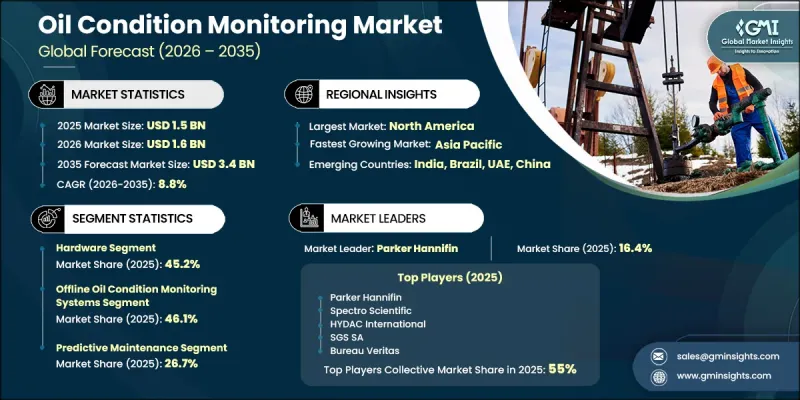
The Global Oil Condition Monitoring Market was valued at USD 1.5 billion in 2025 and is estimated to grow at a CAGR of 8.8% to reach USD 3.4 billion by 2035.
The oil condition monitoring industry is witnessing growth as asset-intensive sectors increasingly prioritize equipment reliability, operational efficiency, and predictive maintenance strategies. Growing industrial automation and expanding deployment of advanced machinery across manufacturing, energy, and process industries are creating significant demand for lubricant monitoring solutions. Organizations are increasingly adopting oil condition monitoring technologies to minimize unexpected equipment failures, lower maintenance expenses, and extend asset operating life. The rising adoption of connected technologies, including smart sensors, digital platforms, and advanced analytics, is transforming traditional maintenance practices by enabling more accurate monitoring of lubricant performance. Data-driven maintenance approaches are allowing industrial operators to identify potential equipment issues earlier and improve overall asset management strategies. The shift toward condition-based maintenance is becoming a key factor supporting market expansion as companies seek greater productivity and reduced operational disruptions. Increasing integration of predictive technologies across industrial applications is expected to continue driving demand for oil condition monitoring solutions worldwide.
| Market Scope | |
|---|---|
| Start Year | 2025 |
| Forecast Year | 2026-2035 |
| Start Value | $1.5 Billion |
| Forecast Value | $3.4 Billion |
| CAGR | 8.8% |
The growth of the oil condition monitoring market is strongly supported by increasing awareness among industrial operators regarding the importance of proactive maintenance practices. Equipment performance issues associated with lubricant deterioration can result in significant operational losses, encouraging companies to invest in monitoring technologies that improve reliability and reduce maintenance risks. The combination of connected monitoring systems, cloud-based analytical tools, and advanced data processing capabilities is enhancing the ability of organizations to manage lubricant conditions more effectively. These technological advancements are accelerating adoption across multiple industries and strengthening the role of oil condition monitoring as an essential component of modern maintenance programs.
The hardware segment held a 45.2% share in 2025. This segment maintains its leading position because hardware components serve as the primary foundation for collecting lubricant performance data. Sensors, monitoring devices, and detection equipment installed within industrial assets enable continuous evaluation of oil quality and equipment conditions. The broad application of hardware solutions across various industrial systems continues to support steady demand. Additionally, recurring requirements related to equipment upgrades, sensor replacement, and calibration activities contribute to sustained revenue generation within this segment as monitoring technologies continue to evolve.
The offline oil condition monitoring systems segment captured a 46.1% share in 2025. This segment continues to gain adoption due to its affordability, straightforward implementation process, and ability to deliver detailed lubricant analysis. Offline monitoring solutions involve collecting oil samples from operating equipment and evaluating them through testing methods to assess lubricant quality and machine health. These systems analyze important oil characteristics, helping operators identify contamination, degradation, and wear-related issues. Their flexibility and cost advantages make them suitable for industries where continuous monitoring solutions may not be necessary or economically practical.
North America Oil Condition Monitoring Market accounted for a 36.3% share in 2025, supported by strong demand from asset-intensive industries and the presence of established maintenance management practices. The United States represents the largest contributor to regional growth due to widespread adoption of advanced monitoring technologies across industrial sectors. Regulatory frameworks and increasing emphasis on equipment reliability are encouraging organizations to integrate oil analysis programs into maintenance strategies. These factors are elevating oil condition monitoring from an optional maintenance approach to an important operational requirement across numerous industrial facilities.
Prominent players operating in the global oil condition monitoring market include Bureau Veritas, eralytics, Eurofins TestOil, ExxonMobil, GasTOPS, HYDAC International, ifm electronic, Intertek Group, Parker Hannifin, Poseidon Systems, Rheonics, SGS SA, Shell, Spectro Scientific, Tan Delta Systems, Veritas Petroleum Services (VPS), and WearCheck International. Companies operating in the oil condition monitoring market are strengthening their market presence by expanding technology portfolios, improving sensor capabilities, and developing advanced analytical solutions for predictive maintenance applications. Market participants are investing in research and development to enhance monitoring accuracy, data processing capabilities, and integration with digital industrial platforms. Strategic partnerships with equipment manufacturers, industrial operators, and technology providers are helping companies expand their customer base and improve solution offerings. Businesses are also focusing on cloud-based monitoring services, automation, and customized solutions to meet evolving industry requirements. Expansion into emerging markets, stronger service networks, and continuous innovation in diagnostics technologies remain key strategies for improving competitiveness, increasing customer adoption, and reinforcing long-term market positioning within the global oil condition monitoring industry.
Table of Contents
Chapter 1 Methodology and Scope
- 1.1 Market scope and definition
- 1.2 Research design
- 1.2.1 Research approach
- 1.2.2 Data collection methods
- 1.3 Data mining sources
- 1.3.1 Global
- 1.3.2 Regional/Country
- 1.4 Base estimates and calculations
- 1.4.1 Base year calculation
- 1.4.2 Key trends for market estimation
- 1.5 Primary research and validation
- 1.5.1 Primary sources
- 1.6 Forecast model
- 1.7 Research assumptions and limitations
Chapter 2 Executive Summary
- 2.1 Industry 360° synopsis, 2022 – 2035
- 2.2 Key market trends
- 2.2.1 Offering trends
- 2.2.2 Product Type trends
- 2.2.3 Equipment Type trends
- 2.2.4 Application trends
- 2.2.5 Regional trends
- 2.3 TAM Analysis, 2026-2035
- 2.4 CXO perspectives: Strategic imperatives
Chapter 3 Industry Insights
- 3.1 Industry ecosystem analysis
- 3.1.1 Supplier Landscape
- 3.1.2 Profit Margin
- 3.1.3 Cost structure
- 3.1.4 Value addition at each stage
- 3.1.5 Factor affecting the value chain
- 3.1.6 Disruptions
- 3.2 Industry impact forces
- 3.2.1 Growth drivers
- 3.2.1.1 Rising Industrial Automation and Machinery Usage
- 3.2.1.2 Increasing Focus on Reducing Equipment Downtime and Maintenance Costs
- 3.2.1.3 Expansion of Oil & Gas, Power Generation, and Manufacturing Operations
- 3.2.1.4 Growing Emphasis on Equipment Life Extension and Reliability
- 3.2.1.5 Stricter Regulatory Compliance and Environmental/Safety Standards
- 3.2.2 Industry pitfalls and challenges
- 3.2.2.1 High Costs of Advanced Monitoring Systems and Lab Testing
- 3.2.2.2 Complexity in Data Integration and Standardization
- 3.2.3 Market opportunities
- 3.2.3.1 Growing Adoption in Emerging Economies and SMEs
- 3.2.3.2 AI-Based Predictive Diagnostics and Cloud Analytics
- 3.2.1 Growth drivers
- 3.3 Growth potential analysis
- 3.4 Pricing Analysis (Driven by Primary Research)
- 3.4.1 Historical Price Trend Analysis
- 3.4.2 Pricing Strategy by Player Type (Premium / Value / Cost-plus)
- 3.5 Regulatory landscape
- 3.5.1 North America
- 3.5.2 Europe
- 3.5.3 Asia Pacific
- 3.5.4 Latin America
- 3.5.5 Middle East & Africa
- 3.6 Porter’s analysis
- 3.7 PESTEL analysis
- 3.8 Trade Data Analysis (Based on Paid Database)
- 3.8.1 Import/Export Volume & Value Trends
- 3.8.2 Key Trade Corridors & Tariff Impact
- 3.9 Impact of AI & Generative AI on the Market (Driven by Primary Research)
- 3.9.1 AI-Driven Disruption of Existing Business Models
- 3.9.2 GenAI Use Cases & Adoption Roadmap by Segment
- 3.10 Capacity & Production Landscape (Driven by Primary Research)
- 3.10.1 Production Capacity by Key Producer
- 3.10.2 Capacity Utilization Rates & Expansion Pipelines
Chapter 4 Competitive Landscape, 2025
- 4.1 Company market share analysis, 2025
- 4.1.1 By Region
- 4.1.1.1 North America
- 4.1.1.2 Europe
- 4.1.1.3 Asia-Pacific
- 4.1.1.4 Latin America
- 4.1.1.5 Middle East and Africa
- 4.1.2 Market Concentration Analysis
- 4.1.1 By Region
- 4.2 Competitive analysis of major market players
- 4.3 Competitive positioning matrix
- 4.4 Key developments
- 4.4.1 Mergers & acquisitions
- 4.4.2 Partnerships & collaborations
- 4.4.3 New product launches
- 4.4.4 Expansion plans and funding
- 4.5 Company tier benchmarking
- 4.5.1 Tier classification criteria & qualifying thresholds
- 4.5.2 Tier positioning matrix by revenue, geography & innovation
Chapter 5 Market Estimates and Forecast, By Offering, 2022 – 2035 (USD Million)
- 5.1 Key trends
- 5.2 Hardware
- 5.3 Software
- 5.4 Services
Chapter 6 Market Estimates and Forecast, By Product Type, 2022 – 2035 (USD Million)
- 6.1 Key trends
- 6.2 Portable Oil Condition Monitoring Systems
- 6.3 Online Oil Condition Monitoring Systems
- 6.4 Off-line Oil Condition Monitoring Systems
Chapter 7 Market Estimates and Forecast, By Equipment Type, 2022 – 2035 (USD Million)
- 7.1 Key trends
- 7.2 Turbines
- 7.3 Compressors
- 7.4 Engines
- 7.5 Gear Systems
- 7.6 Hydraulic Systems
- 7.7 Transformers
- 7.8 Others
Chapter 8 Market Estimates and Forecast, By Application, 2022 – 2035 (USD Million)
- 8.1 Key trends
- 8.2 Predictive Maintenance
- 8.3 Equipment Health Monitoring
- 8.4 Contamination Detection
- 8.5 Lubricant Performance Assessment
- 8.6 Wear Particle Analysis
- 8.7 Fault Detection & Diagnostics
- 8.8 Others
Chapter 9 Market Estimates and Forecast, By End-use Industry, 2022 – 2035 (USD Million)
- 9.1 Key trends
- 9.2 Oil & Gas
- 9.3 Power Generation
- 9.4 Manufacturing
- 9.5 Mining
- 9.6 Marine
- 9.7 Transportation & Railways
- 9.8 Aerospace & Defense
- 9.9 Wind & Renewable Energy
- 9.10 Construction Equipment
- 9.11 Others
Chapter 10 Market Estimates and Forecast, By Region, 2022 – 2035 (USD Million)
- 10.1 Key trends
- 10.2 North America
- 10.2.1 U.S.
- 10.2.2 Canada
- 10.3 Europe
- 10.3.1 Germany
- 10.3.2 UK
- 10.3.3 France
- 10.3.4 Spain
- 10.3.5 Italy
- 10.4 Asia Pacific
- 10.4.1 China
- 10.4.2 India
- 10.4.3 Japan
- 10.4.4 Australia
- 10.4.5 South Korea
- 10.5 Latin America
- 10.5.1 Brazil
- 10.5.2 Mexico
- 10.5.3 Argentina
- 10.6 Middle East and Africa
- 10.6.1 South Africa
- 10.6.2 Saudi Arabia
- 10.6.3 UAE
Chapter 11 Company Profiles
- 11.1 Global Key Players
- 11.1.1 Parker Hannifin Corporation
- 11.1.2 HYDAC International
- 11.1.3 SGS SA
- 11.1.4 Bureau Veritas
- 11.1.5 Intertek Group
- 11.1.6 Shell
- 11.1.7 ExxonMobil
- 11.2 Regional key players
- 11.2.1 North America
- 11.2.1.1 Spectro Scientific
- 11.2.1.2 GasTOPS
- 11.2.1.3 Eurofins TestOil
- 11.2.2 Europe
- 11.2.2.1 Tan Delta Systems
- 11.2.2.2 eralytics
- 11.2.2.3 ifm electronic
- 11.2.2.4 Veritas Petroleum Services (VPS)
- 11.2.1 North America
- 11.3 Niche Players/Disruptors
- 11.3.1 WearCheck International
- 11.3.2 Poseidon Systems
- 11.3.3 Rheonics

