PUBLISHER: Global Market Insights Inc. | PRODUCT CODE: 2109189

PUBLISHER: Global Market Insights Inc. | PRODUCT CODE: 2109189
Remote Monitoring and Control Market Opportunity, Growth Drivers, Industry Trend Analysis, and Forecast 2026 - 2035
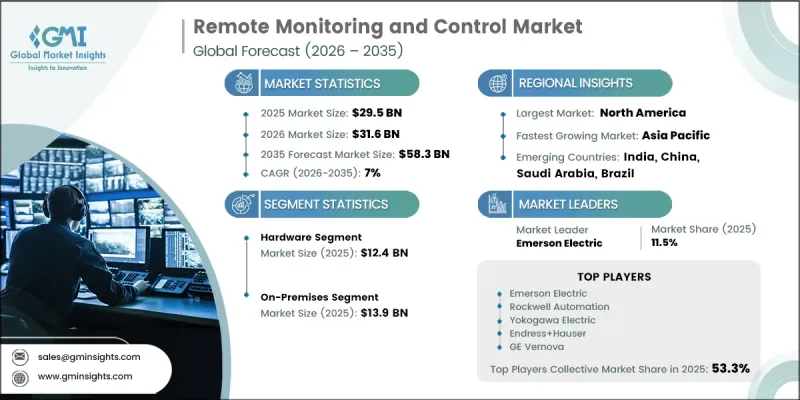
The Global Remote Monitoring and Control Market was estimated at USD 29.5 billion in 2025 and is estimated to grow at a CAGR of 7% to reach USD 58.3 billion by 2035.
The remote monitoring and control industry is experiencing sustained expansion as organizations increasingly adopt advanced digital platforms to improve operational visibility, automate processes, and optimize asset performance. The shift from conventional monitoring architectures toward integrated and cloud-enabled platforms is increasing deployment spending by combining hardware investments with software platforms, cybersecurity solutions, analytics capabilities, and managed services. Growing investments in smart infrastructure, connected industrial environments, and digital transformation initiatives are creating strong long-term demand across multiple industries. The continued adoption of intelligent manufacturing systems featuring connected equipment, automated process management, and data-driven decision-making is further accelerating market expansion. Organizations are increasingly implementing remote monitoring and control technologies to improve productivity, strengthen operational efficiency, enhance system reliability, and support predictive maintenance strategies. Long-term investments in industrial digitalization, infrastructure modernization, and advanced automation technologies continue to reinforce the favorable outlook for the global remote monitoring and control market, creating sustained growth opportunities throughout the forecast period.
| Market Scope | |
|---|---|
| Start Year | 2025 |
| Forecast Year | 2026-2035 |
| Start Value | $29.5 Billion |
| Forecast Value | $58.3 Billion |
| CAGR | 7% |
The hardware segment accounted for USD 12.4 billion in 2025, holding 42% share. The hardware category includes essential components that directly connect monitoring systems with industrial operations, enabling real-time data collection, equipment communication, and process control. Continued investments in automation technologies and connected industrial infrastructure are supporting strong demand for advanced hardware solutions across a wide range of applications.
The on-premises deployment segment reached USD 13.9 billion in 2025. The segment continues to maintain a strong market position due to the extensive installed base of traditional industrial control systems across established production facilities. Many organizations continue to prefer on-premises deployments because they provide greater control over operational data, support compliance with regulatory and cybersecurity requirements, and ensure reliable performance in environments where network connectivity limitations may restrict cloud-based operations.
North America Remote Monitoring and Control Market is expected to reach USD 19.4 billion by 2035. Regional growth is supported by widespread industrial automation, ongoing infrastructure modernization initiatives, and continued investments in advanced digital technologies. Increasing adoption of intelligent monitoring systems and process automation solutions across industrial sectors continues to strengthen regional demand while supporting long-term market expansion.
Leading companies operating in the global remote monitoring and control market include Emerson Electric Co., Rockwell Automation, Yokogawa Electric Corporation, Endress+Hauser, GE Vernova, Siemens AG, and Schneider Electric. Companies participating in the remote monitoring and control market are strengthening their market position by investing in advanced automation technologies, cloud-enabled monitoring platforms, and intelligent analytics solutions that improve operational efficiency and asset performance. Manufacturers are expanding their software capabilities by integrating artificial intelligence, predictive analytics, and enhanced cybersecurity features into their product portfolios. Strategic partnerships, acquisitions, and collaborations with industrial customers and technology providers are helping companies broaden their market reach and accelerate digital transformation initiatives.
Table of Contents
Chapter 1 Methodology & Scope
- 1.1 Research approach
- 1.2 Quality Commitments
- 1.2.1 GMI AI policy & data integrity commitment
- 1.2.1.1 Source consistency protocol
- 1.2.1 GMI AI policy & data integrity commitment
- 1.3 Research Trail & Confidence Scoring
- 1.3.1 Research Trail Components
- 1.3.2 Scoring Components
- 1.4 Data Collection
- 1.4.1 Partial list of primary sources
- 1.5 Data mining sources
- 1.5.1 Paid sources
- 1.5.1.1 Sources, by region
- 1.5.1 Paid sources
- 1.6 Base estimates and calculations
- 1.6.1 Base year calculation
- 1.7 Forecast model
- 1.7.1 Quantified market impact analysis
- 1.7.1.1 Mathematical impact of growth parameters on forecast
- 1.7.1 Quantified market impact analysis
- 1.8 Research transparency addendum
- 1.8.1 Source attribution framework
- 1.8.2 Quality assurance metrics
- 1.8.3 Our commitment to trust
Chapter 2 Executive Summary
- 2.1 Industry 360° synopsis
- 2.2 Key market trends
- 2.2.1 Component
- 2.2.2 Communication Technology
- 2.2.3 Deployment Mode
- 2.2.4 End Use
- 2.2.5 Regional
- 2.3 TAM Analysis, 2026-2035
- 2.4 CXO perspectives: Strategic imperatives
Chapter 3 Industry Insights
- 3.1 Industry ecosystem analysis
- 3.1.1 Supplier landscape
- 3.1.2 Cost structure
- 3.1.3 Profit margin
- 3.1.4 Value addition at each stage
- 3.1.5 Vertical integration trends
- 3.1.6 Disruptors
- 3.2 Industry impact forces
- 3.2.1 Growth drivers
- 3.2.1.1 Rising adoption of industrial automation and Industry 4.0 initiatives
- 3.2.1.2 Expansion of critical infrastructure and utility modernization
- 3.2.1.3 Increasing focus on predictive maintenance and asset reliability
- 3.2.1.4 Growing demand for remote operations and workforce optimization
- 3.2.2 Industry pitfalls & challenges
- 3.2.2.1 Cybersecurity risks associated with connected industrial systems
- 3.2.2.2 High implementation and integration costs
- 3.2.2.3 Interoperability and legacy system compatibility
- 3.2.3 Market opportunities
- 3.2.3.1 Increasing adoption of Industrial IoT (IIoT) and edge computing
- 3.2.3.2 Expansion of cloud-based remote monitoring platforms
- 3.2.3.3 Growing investments in smart infrastructure and digital utilities
- 3.2.3.4 AI-powered predictive analytics and autonomous operations
- 3.2.1 Growth drivers
- 3.3 Growth potential analysis
- 3.4 Technology and Innovation landscape
- 3.4.1 Current technologies
- 3.4.1.1 Industrial IoT (IIoT)-Enabled Remote Monitoring Platforms
- 3.4.1.2 SCADA Systems Integrated with Cloud-Based Monitoring
- 3.4.1.3 Edge Computing for Real-Time Monitoring and Control
- 3.4.2 Emerging technologies
- 3.4.2.1 AI-Driven Predictive Maintenance and Autonomous Operations
- 3.4.2.2 Digital Twin Integration for Remote Asset Monitoring
- 3.4.2.3 Private 5G Networks for Mission-Critical Industrial Connectivity
- 3.4.1 Current technologies
- 3.5 Pricing Analysis (Driven by Primary Research)
- 3.5.1 Historical Price Trend Analysis
- 3.5.2 Pricing Strategy by Player Type (Premium / Value / Cost-plus)
- 3.6 Regulatory landscape
- 3.6.1 North America
- 3.6.1.1 NIST Cybersecurity Framework (US)
- 3.6.1.2 NERC Critical Infrastructure Protection (CIP) Standards (US)
- 3.6.1.3 ISA/IEC 62443 Industrial Cybersecurity Standards (US)
- 3.6.1.4 FCC Equipment Authorization & Radio Frequency Regulations (US)
- 3.6.2 Europe
- 3.6.2.1 NIS2 Directive
- 3.6.2.2 General Data Protection Regulation (GDPR)
- 3.6.2.3 Cyber Resilience Act (CRA)
- 3.6.2.4 IEC 62443 Industrial Communication Networks - IT Security
- 3.6.3 Asia-Pacific
- 3.6.3.1 Cybersecurity Law (China)
- 3.6.3.2 Data Security Law (China)
- 3.6.3.3 Industrial Standardization Act (Japan)
- 3.6.3.4 Digital Personal Data Protection (DPDP) Act (India)
- 3.6.3.5 Security of Critical Infrastructure (SOCI) Act (Australia)
- 3.6.4 Latin America
- 3.6.4.1 Lei Geral de Protecao de Dados (LGPD) (Brazil)
- 3.6.4.2 Federal Law on Protection of Personal Data Held by Private Parties (Mexico)
- 3.6.5 Middle East & Africa
- 3.6.5.1 UAE Information Assurance Standards
- 3.6.5.2 Essential Cybersecurity Controls (ECC) (Saudi Arabia)
- 3.6.5.3 Protection of Personal Information Act (POPIA) (South Africa)
- 3.6.1 North America
- 3.7 Porter's analysis
- 3.8 PESTEL analysis
- 3.9 Patent analysis (Driven by Primary Research)
- 3.10 Cost breakdown analysis
- 3.11 Impact of AI & generative AI on the market
- 3.11.1 AI Driven Disruption of Existing Business Models
- 3.11.2 GenAI Use Cases and Adoption Roadmap by Segment
- 3.11.3 Risks Limitations and Regulatory Considerations
- 3.12 Sustainability and environmental aspects
- 3.12.1 Energy Efficiency through Remote Monitoring & Optimization
- 3.12.2 Asset Life Extension & Predictive Maintenance
- 3.12.3 Remote Operations & Reduced Carbon Emissions
- 3.12.4 Smart Resource Management
- 3.12.5 ESG & Sustainability Compliance
- 3.13 Forecast assumptions & scenario analysis (Driven by Primary Research)
- 3.13.1 Base Case key macro & industry variables driving CAGR
- 3.13.2 Optimistic Scenarios Favorable Macro and Industry Tailwinds
- 3.13.3 Pessimistic Scenario Macroeconomic slowdown or industry headwinds
Chapter 4 Competitive Landscape, 2025
- 4.1 Introduction
- 4.2 Company market share analysis
- 4.2.1 North America
- 4.2.2 Europe
- 4.2.3 Asia-Pacific
- 4.2.4 Latin America
- 4.2.5 Middle East & Africa
- 4.3 Competitive positioning matrix
- 4.4 Key developments
- 4.4.1 Mergers & acquisitions
- 4.4.2 Partnerships & collaborations
- 4.4.3 New product launches
- 4.4.4 Expansion plans and funding
- 4.5 Company tier benchmarking
- 4.5.1 Tier classification criteria & qualifying thresholds
- 4.5.2 Tier positioning matrix by revenue, geography & innovation
Chapter 5 Market Estimates & Forecast, By Component, 2022 - 2035 ($Mn)
- 5.1 Key trends
- 5.2 Hardware
- 5.2.1 Sensors
- 5.2.2 Actuators
- 5.2.3 Programmable Logic Controllers (PLCs)
- 5.2.4 Remote Terminal Units (RTUs)
- 5.2.5 Others
- 5.3 Software
- 5.3.1 SCADA Software
- 5.3.2 Asset Performance Management (APM) Software
- 5.3.3 Remote Asset Monitoring Software
- 5.3.4 Others
- 5.4 Services
- 5.4.1 Consulting Services
- 5.4.2 System Integration & Deployment
- 5.4.3 Maintenance & Support Services
- 5.4.4 Managed Services
Chapter 6 Market Estimates & Forecast, By Communication Technology, 2022 - 2035 ($Mn)
- 6.1 Key trends
- 6.2 Wired
- 6.3 Wireless
Chapter 7 Market Estimates & Forecast, By Deployment Mode, 2022 - 2035 ($Mn)
- 7.1 Key trends
- 7.2 On-Premises
- 7.3 Cloud-Based
- 7.4 Hybrid
Chapter 8 Market Estimates & Forecast, By End Use, 2022 - 2035 ($Mn)
- 8.1 Key trends
- 8.2 Industrial Automation
- 8.3 Utilities
- 8.4 Oil & Gas
- 8.5 Smart Infrastructure
- 8.6 Healthcare
- 8.7 Agriculture
- 8.8 Transportation & Logistics
- 8.9 Others
Chapter 9 Market Estimates & Forecast, By Region, 2022 - 2035 ($Mn)
- 9.1 North America
- 9.1.1 US
- 9.1.2 Canada
- 9.2 Europe
- 9.2.1 UK
- 9.2.2 Germany
- 9.2.3 France
- 9.2.4 Italy
- 9.2.5 Spain
- 9.2.6 Belgium
- 9.2.7 Netherlands
- 9.2.8 Sweden
- 9.2.9 Russia
- 9.3 Asia Pacific
- 9.3.1 China
- 9.3.2 India
- 9.3.3 Japan
- 9.3.4 Australia
- 9.3.5 Singapore
- 9.3.6 South Korea
- 9.3.7 Vietnam
- 9.3.8 Indonesia
- 9.3.9 Thailand
- 9.4 Latin America
- 9.4.1 Brazil
- 9.4.2 Mexico
- 9.4.3 Argentina
- 9.5 MEA
- 9.5.1 South Africa
- 9.5.2 Saudi Arabia
- 9.5.3 UAE
- 9.5.4 Turkey
Chapter 10 Company Profiles
- 10.1 Global Players
- 10.1.1 ABB
- 10.1.2 Cisco
- 10.1.3 Emerson
- 10.1.4 GE Vernova
- 10.1.5 Honeywell
- 10.1.6 Rockwell Automation
- 10.1.7 Schneider Electric
- 10.1.8 Siemens
- 10.2 Regional Champions
- 10.2.1 Advantech
- 10.2.2 Endress+Hauser
- 10.2.3 Fuji Electric
- 10.2.4 Hitachi
- 10.2.5 Mitsubishi Electric
- 10.2.6 Yokogawa Electric
- 10.3 Emerging Players
- 10.3.1 KROHNE
- 10.3.2 Atlas Copco
- 10.3.3 AVEVA
- 10.3.4 Huawei
- 10.3.5 John Wood
- 10.3.6 PTC

