PUBLISHER: Mordor Intelligence | PRODUCT CODE: 2125368

PUBLISHER: Mordor Intelligence | PRODUCT CODE: 2125368
Remote Monitoring And Control - Market Share Analysis, Industry Trends & Statistics, Growth Forecasts (2026 - 2031)
According to Mordor Intelligence, the remote monitoring and control market size is expected to grow from USD 27.13 billion in 2025 to USD 28.55 billion in 2026 and is forecast to reach USD 36.85 billion by 2031 at 5.24% CAGR over 2026-2031.
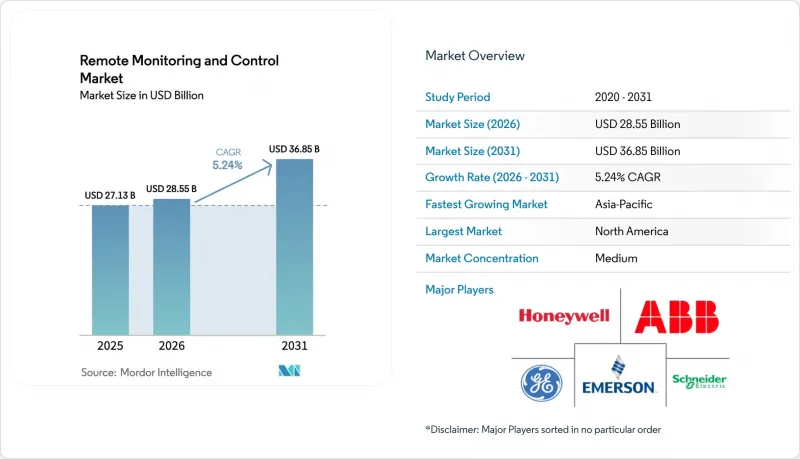
This report is Segmented by Component (Solution and Field Instruments), Deployment Mode (On-Premise and Cloud), Connectivity Technology (Wired and Wireless), End-User Industry (Oil and Gas, Power Generation and Utilities, Chemicals and Petrochemicals, and More) and Geography. The Market Forecasts are Provided in Terms of Value (USD).
Global Remote Monitoring And Control Market Trends and Insights
Rising demand for industrial automation
Manufacturers view automation as a primary lever for offsetting labor shortages and boosting throughput. Private 5G networks built by Rockwell Automation and Nokia support real-time control over Citizens Broadband Radio Service spectrum, enabling autonomous operations in discrete and process plants. Collaborative robots, AI vision, and predictive analytics now run side-by-side on unified platforms, letting operators re-configure production lines with minimal downtime. The result is lower cost per unit and safer work environments. Similar benefits appear in mining and petrochemical facilities where wireless sensors alert technicians before a fault escalates. Companies that delay adoption risk competitive erosion as peers capture savings from faster cycle times and reduced scrap.
Expanding IIoT-enabled predictive maintenance programs
FactoryTalk Analytics Guardian AI uses machine-learning models at the asset layer to catch anomalies early, extending equipment life and shrinking spare-parts inventories. Edge computing allows vibration and temperature data to be processed locally, cutting cloud bandwidth and providing instant feedback for maintenance crews. In harsh mining locations, wireless gateways stream health metrics from haul-truck drivetrains, enabling just-in-time service that maximizes fleet availability. Manufacturers similarly track spindle wear on CNC machines, avoiding costly unplanned shutdowns. Across industries, these programs translate into consistent OEE improvements and measurable ROI within one budget cycle.
High initial CAPEX and complex brown-field integration
Retrofitting decades-old pumps, drives, and valves with modern sensors often requires custom gateways and protocol converters. Engineering teams must stage upgrades carefully to keep plants running, lengthening project timelines and inflating budgets. Water utilities upgrading to advanced SCADA face the added burden of mapping thousands of I/O points while maintaining regulatory reporting. These factors delay decision-makers, particularly in resource-constrained municipalities and SMEs, despite clear long-term savings.
Other drivers and restraints analyzed in the detailed report include:
- Proliferation of edge-AI controllers in hazardous sites
- Stricter carbon-tracking regulations needing real-time data
- Cyber-security vulnerabilities in OT-IT convergence
For complete list of drivers and restraints, kindly check the Table Of Contents.
Segment Analysis
Solutions accounted for 59.70% of remote monitoring and control market share in 2025, affirming the shift toward software-centric architectures. Cloud dashboards, analytics engines, and cybersecurity modules form the digital backbone that binds diverse field devices. Vendors bundle licensing, updates, and support into subscription plans that trim upfront costs and smooth cash flow. Field instruments, while holding a smaller slice, represent the fastest-growing sub-segment at an 7.86% CAGR. Smart sensors embed microcontrollers that run local diagnostics, easing network traffic and ensuring resilience during link outages. Early adopters report fewer site visits and quicker anomaly detection, which feeds back into efficiency gains.
Field instruments' rise also signals a broader move to edge intelligence. Devices now host algorithms that once lived on centralized servers, compressing data before transfer and cutting cellular fees. This evolution widens the remote monitoring and control market as firms attach low-cost nodes to legacy pumps, motors, and conveyors. Software publishers, in turn, enhance their platforms with drag-and-drop configuration, helping non-specialists deploy new sensor packs. The combined momentum of smarter hardware and agile software underpins steady expansion of the remote monitoring and control industry across diverse plants and utilities.
On-premise systems kept 58.05% share of the remote monitoring and control market in 2025, reflecting entrenched investment and regulatory data-residency rules. They remain vital where sub-second control loops govern safety-critical processes. Yet cloud deployments are rising at a 9.12% CAGR as firms favor scalability and lower maintenance overhead. Emerson's DeltaV SaaS SCADA exemplifies this swing by delivering secure browser access and elastic compute for analytics.
Hybrid topologies now blend edge servers for latency-sensitive tasks with cloud layers for long-term optimization. Such designs let operators modernize without discarding sunk-cost assets, accelerating the remote monitoring and control market size expansion. Standardized APIs streamline data export into enterprise resource-planning suites, turning plant metrics into financial dashboards. As 5G coverage broadens, bandwidth constraints ease, making full-cloud control viable even for high-speed production lines.
Complete Report Scope:
- By Component
- Solutions
- Field Instruments
- By Deployment Mode
- On-premise
- Cloud
- By Connectivity Technology
- Wired
- Wireless
- By End-user Industry
- Oil and Gas
- Power Generation and Utilities
- Chemicals and Petrochemicals
- Metals and Mining
- Water and Wastewater
- Food and Beverages
- Pharmaceuticals and Life Sciences
- Pulp and Paper
- Semiconductor and Electronics
- Other End-user Industries
- By Geography
- North America
- United States
- Canada
- Mexico
- South America
- Brazil
- Argentina
- Chile
- Rest of South America
- Europe
- Germany
- United Kingdom
- France
- Italy
- Spain
- Russia
- Rest of Europe
- Asia-Pacific
- China
- India
- Japan
- South Korea
- Malaysia
- Singapore
- Australia
- Rest of Asia-Pacific
- Middle East and Africa
- Middle East
- United Arab Emirates
- Saudi Arabia
- Turkey
- Rest of Middle East
- Africa
- South Africa
- Nigeria
- Rest of Africa
- Middle East
- North America
Geography Analysis
North America led the remote monitoring and control market with 33.85% share in 2025, anchored by the United States' stringent emissions legislation and broad IIoT maturity. Federal infrastructure funds stimulate upgrades in water and wastewater utilities, while shale operators fit methane-detection arrays to comply with the 2025 EPA rule. Canada augments demand through carbon price mechanisms that reward real-time energy analytics. Mexico's automotive clusters digitalize assembly lines to maintain export competitiveness, ensuring steady regional inflows for solution providers.
Asia-Pacific, projected to rise at an 7.95% CAGR, benefits from China's smart-manufacturing subsidies and India's production-linked incentive schemes. Semiconductor fabs in Taiwan and South Korea deploy private 5G to orchestrate mobile robots, while Australian miners automate haulage in remote deserts. ASEAN nations invest in smart-city water grids that rely on cloud SCADA to minimize leakage. This diverse set of projects expands the remote monitoring and control market footprint across developing and advanced economies alike.
Europe records consistent uptake as companies chase Green Deal targets and adopt predictive maintenance to offset high energy costs. German automotive OEMs retrofit legacy lines with edge gateways, whereas UK utilities adopt SaaS SCADA to modernize century-old networks under tight budgets. The Middle East leverages oil revenue to digitize gas processing trains, and South Africa pilots smart-grid telemetry in mining towns. Together, these efforts highlight a global demand curve that is both geographically widespread and use-case specific.
- ABB Ltd.
- Emerson Electric Co.
- Honeywell International Inc.
- Schneider Electric SE
- General Electric Co.
- Rockwell Automation Inc.
- Yokogawa Electric Corp.
- Endress+Hauser AG
- Siemens AG
- Mitsubishi Electric Corp.
- Omron Corp.
- Advantech Co. Ltd.
- Moxa Inc.
- Red Lion Controls Inc.
- ProSoft Technology Inc.
- Inductive Automation LLC
- ICONICS Inc.
- Opto 22
- AVEVA Group plc (Wonderware)
- Kepware Technologies
- HMS Networks AB
- B-Scada Inc.
- Pepperl+Fuchs SE
- Banner Engineering Corp.
- Schneider Citect (AVEVA Plant SCADA)
- Softing AG
Additional Benefits:
- The market estimate (ME) sheet in Excel format
- 3 months of analyst support
TABLE OF CONTENTS
1 INTRODUCTION
- 1.1 Study Assumptions and Market Definition
- 1.2 Scope of the Study
2 RESEARCH METHODOLOGY
3 EXECUTIVE SUMMARY
4 MARKET LANDSCAPE
- 4.1 Market Overview
- 4.2 Market Drivers
- 4.2.1 Rising demand for industrial automation
- 4.2.2 Increasing use of industrial mobility and remote management
- 4.2.3 Expanding IIoT-enabled predictive maintenance programs
- 4.2.4 Proliferation of edge-AI controllers in hazardous sites
- 4.2.5 Stricter carbon-tracking regulations needing real-time data
- 4.2.6 Emerging private-5G networks for ultra-reliable low-latency links
- 4.3 Market Restraints
- 4.3.1 High initial CAPEX and complex brown-field integration
- 4.3.2 Cyber-security vulnerabilities in OT-IT convergence
- 4.3.3 Skilled workforce shortage for multi-vendor platforms
- 4.3.4 Legacy protocol lock-in limiting interoperability
- 4.4 Industry Value Chain Analysis
- 4.5 Regulatory Landscape
- 4.6 Technological Outlook
- 4.7 Industry Attractiveness - Porter's Five Forces Analysis
- 4.7.1 Threat of New Entrants
- 4.7.2 Bargaining Power of Suppliers
- 4.7.3 Bargaining Power of Buyers
- 4.7.4 Threat of Substitutes
- 4.7.5 Intensity of Competitive Rivalry
- 4.8 Impact of Macroeconomic Factors on the Market
5 MARKET SIZE AND GROWTH FORECASTS (VALUES)
- 5.1 By Component
- 5.1.1 Solutions
- 5.1.2 Field Instruments
- 5.2 By Deployment Mode
- 5.2.1 On-premise
- 5.2.2 Cloud
- 5.3 By Connectivity Technology
- 5.3.1 Wired
- 5.3.2 Wireless
- 5.4 By End-user Industry
- 5.4.1 Oil and Gas
- 5.4.2 Power Generation and Utilities
- 5.4.3 Chemicals and Petrochemicals
- 5.4.4 Metals and Mining
- 5.4.5 Water and Wastewater
- 5.4.6 Food and Beverages
- 5.4.7 Pharmaceuticals and Life Sciences
- 5.4.8 Pulp and Paper
- 5.4.9 Semiconductor and Electronics
- 5.4.10 Other End-user Industries
- 5.5 By Geography
- 5.5.1 North America
- 5.5.1.1 United States
- 5.5.1.2 Canada
- 5.5.1.3 Mexico
- 5.5.2 South America
- 5.5.2.1 Brazil
- 5.5.2.2 Argentina
- 5.5.2.3 Chile
- 5.5.2.4 Rest of South America
- 5.5.3 Europe
- 5.5.3.1 Germany
- 5.5.3.2 United Kingdom
- 5.5.3.3 France
- 5.5.3.4 Italy
- 5.5.3.5 Spain
- 5.5.3.6 Russia
- 5.5.3.7 Rest of Europe
- 5.5.4 Asia-Pacific
- 5.5.4.1 China
- 5.5.4.2 India
- 5.5.4.3 Japan
- 5.5.4.4 South Korea
- 5.5.4.5 Malaysia
- 5.5.4.6 Singapore
- 5.5.4.7 Australia
- 5.5.4.8 Rest of Asia-Pacific
- 5.5.5 Middle East and Africa
- 5.5.5.1 Middle East
- 5.5.5.1.1 United Arab Emirates
- 5.5.5.1.2 Saudi Arabia
- 5.5.5.1.3 Turkey
- 5.5.5.1.4 Rest of Middle East
- 5.5.5.2 Africa
- 5.5.5.2.1 South Africa
- 5.5.5.2.2 Nigeria
- 5.5.5.2.3 Rest of Africa
- 5.5.5.1 Middle East
- 5.5.1 North America
6 COMPETITIVE LANDSCAPE
- 6.1 Market Concentration
- 6.2 Strategic Moves
- 6.3 Market Share Analysis
- 6.4 Company Profiles (includes Global level Overview, Market level overview, Core Segments, Financials as available, Strategic Information, Market Rank/Share for key companies, Products and Services, and Recent Developments)
- 6.4.1 ABB Ltd.
- 6.4.2 Emerson Electric Co.
- 6.4.3 Honeywell International Inc.
- 6.4.4 Schneider Electric SE
- 6.4.5 General Electric Co.
- 6.4.6 Rockwell Automation Inc.
- 6.4.7 Yokogawa Electric Corp.
- 6.4.8 Endress+Hauser AG
- 6.4.9 Siemens AG
- 6.4.10 Mitsubishi Electric Corp.
- 6.4.11 Omron Corp.
- 6.4.12 Advantech Co. Ltd.
- 6.4.13 Moxa Inc.
- 6.4.14 Red Lion Controls Inc.
- 6.4.15 ProSoft Technology Inc.
- 6.4.16 Inductive Automation LLC
- 6.4.17 ICONICS Inc.
- 6.4.18 Opto 22
- 6.4.19 AVEVA Group plc (Wonderware)
- 6.4.20 Kepware Technologies
- 6.4.21 HMS Networks AB
- 6.4.22 B-Scada Inc.
- 6.4.23 Pepperl+Fuchs SE
- 6.4.24 Banner Engineering Corp.
- 6.4.25 Schneider Citect (AVEVA Plant SCADA)
- 6.4.26 Softing AG
7 MARKET OPPORTUNITIES AND FUTURE TRENDS
- 7.1 White-Space and Unmet-Need Assessment

