PUBLISHER: Global Market Insights Inc. | PRODUCT CODE: 2109202

PUBLISHER: Global Market Insights Inc. | PRODUCT CODE: 2109202
U.S. Remodeling Market Opportunity, Growth Drivers, Industry Trend Analysis, and Forecast 2026 - 2035
U.S. Remodeling Market was valued at USD 563.2 billion in 2025 and is estimated to grow at a CAGR of 4.9% to reach USD 917.2 billion by 2035.
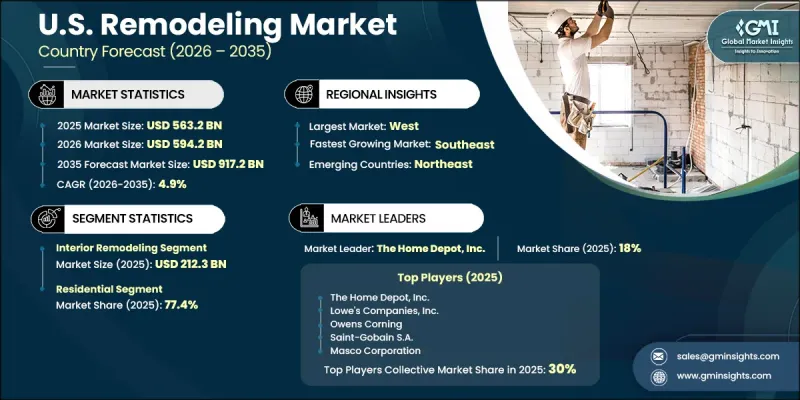
U.S. remodeling industry is experiencing consistent growth as homeowners increasingly invest in improving, upgrading, and maintaining existing residential properties. The aging housing infrastructure across the country continues to create a strong need for renovation projects, as many properties require modernization to maintain functionality, safety, and market value. Remodeling demand is supported by ongoing replacement requirements, evolving homeowner preferences, and increasing interest in improving energy performance and residential comfort. Rising adoption of sustainable building solutions and efficiency-focused upgrades is further transforming the market landscape. Government incentives, tax benefits, and regional energy initiatives are encouraging homeowners to invest in environmentally responsible improvements. At the same time, changing regulations and consumer awareness are accelerating the transition toward modern, energy-efficient home systems. The growing preference for durable materials, enhanced designs, and long-term value improvements is increasing project spending across the remodeling ecosystem. These factors are expected to support steady expansion of the U.S. remodeling market as homeowners continue prioritizing upgrades that improve property performance, aesthetics, and sustainability.
| Market Scope | |
|---|---|
| Start Year | 2025 |
| Forecast Year | 2026-2035 |
| Start Value | $563.2 Billion |
| Forecast Value | $917.2 Billion |
| CAGR | 4.9% |
The U.S. remodeling market is benefiting from several structural factors, including the continued aging of residential properties and increasing demand for home improvement solutions. Many existing homes require upgrades to maintain operational efficiency and meet updated housing standards. As renovation projects become more focused on performance improvements, homeowners are increasingly considering solutions that enhance durability, energy efficiency, and long-term property value. Financial incentives and evolving energy policies are also influencing remodeling decisions by making efficiency-oriented upgrades more accessible. These trends are encouraging broader adoption of modern renovation practices and supporting continued market development.
In 2025, the interior remodeling segment accounted for USD 212.3 billion. Interior renovation activities remain highly preferred among homeowners due to their ability to improve functionality, visual appeal, and overall living experience. Projects focused on improving indoor spaces continue to attract investment because they provide measurable benefits in daily household use and contribute to property value enhancement. Interior remodeling also provides greater flexibility, allowing homeowners to complete projects according to available budgets, changing lifestyle requirements, and individual priorities.
Major players operating in the U.S. remodeling industry include The Home Depot, Inc., Lowe's Companies, Inc., Masco Corporation, Kohler Co., Saint-Gobain S.A., Owens Corning, CRH plc, Pella Corporation, Andersen Corporation, James Hardie Industries plc, MasterBrand, Inc., Marvin Windows and Doors, JELD-WEN Holding, Inc., Fortune Brands Innovations, Inc., DreamMaker Bath & Kitchen, Kitchen Tune-Up, Re-Bath, Bath Planet, Five Star Bath Solutions, Kitchen Solvers, and Renewal by Andersen. Companies operating in the U.S. remodeling market are strengthening their market position by expanding service capabilities, enhancing product portfolios, and developing solutions that align with changing homeowner expectations. Industry participants are investing in digital platforms, customer engagement strategies, and improved project delivery models to increase market reach. Businesses are also focusing on sustainable materials, energy-efficient products, and customized renovation solutions to capture growing demand for modern home improvements. Strategic partnerships, acquisitions, franchise expansion, and stronger distribution networks are helping companies improve competitiveness. Leading players are prioritizing innovation, brand development, and customer-focused services to build long-term relationships with homeowners.
Table of Contents
Chapter 1 Methodology and Scope
- 1.1 Research approach
- 1.2 Quality Commitments
- 1.2.1 GMI AI policy & data integrity commitment
- 1.2.1.1 Source consistency protocol
- 1.2.1 GMI AI policy & data integrity commitment
- 1.3 Research Trail & Confidence Scoring
- 1.3.1 Research Trail Components
- 1.3.2 Scoring Components
- 1.4 Data Collection
- 1.4.1 Partial list of primary sources
- 1.5 Data mining sources
- 1.5.1 Paid sources
- 1.5.1.1 Sources, by region
- 1.5.1 Paid sources
- 1.6 Base estimates and calculations
- 1.6.1 Base year calculation for any one approach
- 1.7 Forecast model
- 1.7.1 Quantified market impact analysis
- 1.7.1.1 Mathematical impact of growth parameters on forecast
- 1.7.1 Quantified market impact analysis
- 1.8 Research transparency addendum
- 1.8.1 Source attribution framework
- 1.8.2 Quality assurance metrics
- 1.8.3 Our commitment to trust
Chapter 2 Executive Summary
- 2.1 Industry 360° synopsis
- 2.2 Key market trends
- 2.2.1 Regional
- 2.2.2 Project type
- 2.2.3 Property type
- 2.2.4 Service delivery model
Chapter 3 Industry Insights
- 3.1 Industry ecosystem analysis
- 3.1.1 Raw material suppliers
- 3.1.2 Manufacturers & distributors
- 3.1.3 Contractors & service providers
- 3.1.4 Retailers & e-commerce platforms
- 3.1.5 End customers
- 3.1.6 Factors affecting the value chain
- 3.1.7 Profit margin analysis by value chain stage
- 3.1.8 Supply chain disruptions & mitigation strategies
- 3.2 Industry impact forces
- 3.2.1 Growth drivers
- 3.2.2 Industry pitfalls & challenges
- 3.2.3 Opportunities
- 3.3 Growth potential analysis
- 3.4 Future market trends
- 3.5 Technology and innovation landscape
- 3.5.1 Smart home integration technologies
- 3.5.2 Sustainable & green building materials
- 3.5.3 Prefabrication & modular remodeling solutions
- 3.5.4 Digital design & visualization tools (AR/VR)
- 3.5.5 Project management software & automation
- 3.6 Consumer buying behavior analysis
- 3.6.1 Demographic trends
- 3.6.2 Factors affecting buying decision
- 3.6.3 Consumer product adoption
- 3.6.4 Preferred distribution channel
- 3.6.5 Preferred price range
- 3.7 Regulatory Framework
- 3.7.1 Federal regulations (EPA, OSHA, FTC)
- 3.7.2 State-level licensing & permitting requirements
- 3.7.3 Building codes & compliance standards
- 3.7.4 Energy efficiency mandates & incentive programs
- 3.7.5 Lead paint & asbestos regulations
- 3.8 Pricing analysis (driven by primary research)
- 3.8.1 Historical price trend analysis (driven by primary research)
- 3.8.2 Pricing strategy by player type (premium / value / cost-plus) (driven by primary research)
- 3.8.3 Regional pricing variations (driven by primary research)
- 3.8.4 Material cost impact on project pricing (driven by primary research)
- 3.9 Porter’s analysis
- 3.10 PESTEL analysis
- 3.11 Trade data analysis (driven by paid database)
- 3.11.1 Import/export volume & value trends for remodeling materials
- 3.11.2 Key trade corridors & tariff impact
- 3.12 Impact of AI & generative AI on the market
- 3.12.1 AI-driven disruption of existing business models
- 3.12.2 GenAI use cases & adoption roadmap by segment
- 3.12.3 AI-powered design & visualization
- 3.12.4 Automated cost estimation & bidding
- 3.12.5 Predictive maintenance & project management
- 3.12.6 Risks, limitations & regulatory considerations
- 3.13 Service delivery capacity & provider infrastructure (driven by primary research)
- 3.13.1 Provider network density & coverage by region
- 3.13.2 Capacity gaps & addressable demand mismatch
Chapter 4 Competitive Landscape, 2025
- 4.1 Introduction
- 4.2 Company market share analysis
- 4.3 Competitive analysis of major market players
- 4.4 Competitive positioning matrix
- 4.5 Key developments
- 4.5.1 Mergers & acquisitions
- 4.5.2 Partnerships & collaborations
- 4.5.3 New product launches
- 4.5.4 Expansion plans
Chapter 5 Market Estimates and Forecast, By Project Type, 2022 – 2035 (USD Billion) (Thousand Units)
- 5.1 Key trends
- 5.2 Interior remodeling
- 5.2.1 Kitchen remodeling
- 5.2.2 Bathroom remodeling
- 5.2.3 Living areas
- 5.2.4 Basement finishing
- 5.3 Exterior remodeling
- 5.3.1 Roofing
- 5.3.2 Siding
- 5.3.3 Windows & doors
- 5.3.4 Landscaping & outdoor living
- 5.4 Structural & systems remodeling
- 5.4.1 Structural changes
- 5.4.2 Energy efficiency upgrades
- 5.4.3 System & equipment
Chapter 6 Market Estimates and Forecast, By Property Type, 2022 – 2035 (USD Billion) (Thousand Units)
- 6.1 Key trends
- 6.2 Residential
- 6.2.1 Single-family homes
- 6.2.2 Multifamily buildings
- 6.2.3 Manufactured & mobile homes
- 6.3 Commercial
- 6.3.1 Office buildings
- 6.3.2 Retail & restaurant spaces
- 6.3.3 Hospitality (hotels, resorts)
- 6.4 Industrial
- 6.4.1 Warehouses & distribution centers
- 6.4.2 Manufacturing facilities
Chapter 7 Market Estimates and Forecast, By Service Delivery Model, 2022 – 2035 (USD Billion) (Thousand Units)
- 7.1 Key trends
- 7.2 Professional/DIFM (Do it for me)
- 7.3 DIY (Do it yourself)
- 7.4 Hybrid (DIY with professional support)
Chapter 8 Market Estimates and Forecast, By Region, 2022 – 2035 (USD Billion) (Thousand Units)
- 8.1 Key trends
- 8.2 Southeast
- 8.3 Southwest
- 8.4 West
- 8.5 Northeast
- 8.6 Midwest
Chapter 9 Company Profiles
- 9.1 Top Global Players
- 9.1.1 The Home Depot, Inc.
- 9.1.2 Lowe’s Companies, Inc.
- 9.1.3 Masco Corporation
- 9.1.4 Kohler Co.
- 9.1.5 Saint-Gobain S.A.
- 9.1.6 Owens Corning
- 9.1.7 CRH plc
- 9.2 Regional Champions
- 9.2.1 Pella Corporation
- 9.2.2 Andersen Corporation
- 9.2.3 James Hardie Industries plc
- 9.2.4 MasterBrand, Inc.
- 9.2.5 Marvin Windows and Doors
- 9.2.6 JELD-WEN Holding, Inc.
- 9.2.7 Fortune Brands Innovations, Inc.
- 9.3 Emerging / Franchise Leaders
- 9.3.1 DreamMaker Bath & Kitchen
- 9.3.2 Kitchen Tune-Up
- 9.3.3 Re-Bath
- 9.3.4 Bath Planet
- 9.3.5 Five Star Bath Solutions
- 9.3.6 Kitchen Solvers
- 9.3.7 Renewal by Andersen

