PUBLISHER: Global Market Insights Inc. | PRODUCT CODE: 2109220

PUBLISHER: Global Market Insights Inc. | PRODUCT CODE: 2109220
5G IoT Market Opportunity, Growth Drivers, Industry Trend Analysis, and Forecast 2026 - 2035
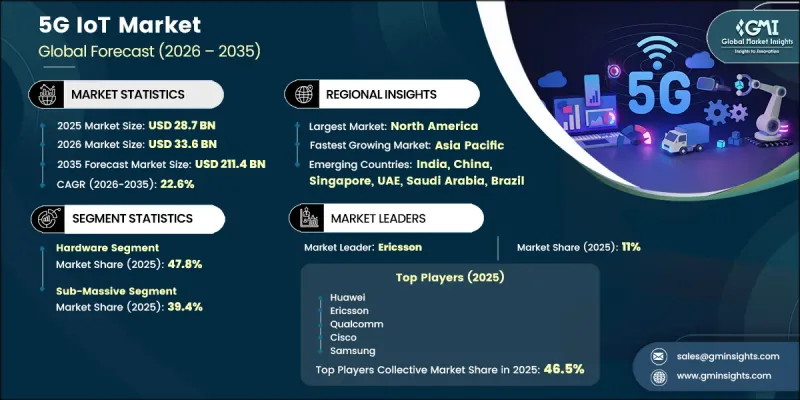
The Global 5G IoT market was valued at USD 28.7 billion in 2025 and is estimated to grow at a CAGR of 22.6% to reach USD 211.4 billion by 2035.
Rapid digital transformation, increasing deployment of next-generation communication networks, and the growing integration of intelligent connected devices are creating strong growth opportunities for the market. Enterprises across multiple industries are investing in advanced connectivity solutions to improve operational efficiency, enable real-time data exchange, and enhance decision-making capabilities. The increasing adoption of industrial automation, edge computing, artificial intelligence, and cloud-enabled platforms is further accelerating the deployment of 5G IoT technologies. Rising demand for secure, low-latency, and high-speed communication networks is encouraging organizations to modernize their digital infrastructure and expand connected ecosystems. Continuous advancements in network architecture, expanding investments in smart infrastructure, and the growing need for seamless machine-to-machine communication are expected to sustain long-term market growth.
| Market Scope | |
|---|---|
| Start Year | 2025 |
| Forecast Year | 2026-2035 |
| Start Value | $28.7 Billion |
| Forecast Value | $211.4 Billion |
| CAGR | 22.6% |
The hardware segment recorded a 47.8% share in 2025. The segment continues to maintain its leading position due to rising demand for advanced 5G-enabled devices, communication modules, gateways, antennas, processors, and network equipment designed to support high-speed connectivity and reliable data transmission. Continuous improvements in device performance, increasing deployment of connected infrastructure, and growing investments in advanced networking equipment are further supporting segment growth. The expanding need for reliable hardware capable of enabling efficient communication, faster processing, and enhanced connectivity across enterprise environments is expected to drive sustained demand throughout the forecast period.
The sub-massive segment held a 39.4% share in 2025. The segment continues to expand because it supports large-scale connected deployments that require reliable connectivity, extended battery performance, broad network coverage, and cost-efficient communication capabilities. Increasing adoption of scalable IoT networks, expanding digital infrastructure, and growing demand for efficient device connectivity are strengthening the segment's market position. Ongoing improvements in low-power communication technologies, enhanced network efficiency, and wider deployment of intelligent connected systems are expected to further accelerate growth while supporting the increasing number of connected endpoints across commercial and industrial environments.
U.S. 5G IoT Market captured USD 8.4 billion in 2025. The country's leadership is supported by rapid deployment of advanced 5G infrastructure, growing enterprise investment in digital transformation, and increasing adoption of connected technologies across multiple industries. Rising demand for secure, high-speed communication networks, expanding investments in intelligent infrastructure, and continuous innovation in wireless connectivity solutions continue to strengthen market growth. In addition, increasing implementation of advanced IoT platforms, modernization of enterprise communication systems, and ongoing expansion of next-generation network infrastructure are expected to create favorable opportunities for sustained market development across the U.S. over the forecast period.
Major companies operating in the global 5G IoT market include Ericsson, Nokia, Huawei, Cisco, Qualcomm, Quectel, Verizon Business, Vodafone IoT, Deutsche Telekom, and Accenture. Companies operating in the 5G IoT market are strengthening their competitive position by expanding their technology portfolios, investing heavily in research and development, and accelerating innovation across connected communication solutions. Industry participants are introducing advanced 5G-enabled hardware, intelligent software platforms, and integrated connectivity solutions that improve network performance, scalability, and security. Strategic collaborations with telecom operators, cloud service providers, and enterprise customers are helping companies expand their customer base and strengthen long-term market presence. Businesses are also investing in artificial intelligence, edge computing, cybersecurity, and cloud-native technologies to enhance the efficiency and reliability of IoT deployments. In addition, companies are expanding global distribution networks, increasing regional investments, enhancing managed services, and developing industry-specific solutions to strengthen their market foothold, improve customer engagement, and capitalize on the growing demand for advanced global 5G IoT market solutions.
Table of Contents
Chapter 1 Methodology
- 1.1 Research approach
- 1.2 Quality Commitments
- 1.2.1 GMI AI policy & data integrity commitment
- 1.2.1.1 Source consistency protocol
- 1.2.1 GMI AI policy & data integrity commitment
- 1.3 Research Trail & Confidence Scoring
- 1.3.1 Research Trail Components
- 1.3.2 Scoring Components
- 1.4 Data Collection
- 1.4.1 Partial list of primary sources
- 1.5 Data mining sources
- 1.5.1 Paid sources
- 1.5.1.1 Sources, by region
- 1.5.1 Paid sources
- 1.6 Base estimates and calculations
- 1.6.1 Base year calculation
- 1.7 Forecast
- 1.7.1 Quantified market impact analysis
- 1.7.1.1 Mathematical impact of growth parameters on forecast
- 1.7.1 Quantified market impact analysis
- 1.8 Research transparency addendum
- 1.8.1 Source attribution framework
- 1.8.2 Quality assurance metrics
- 1.8.3 Our commitment to trust
Chapter 2 Executive Summary
- 2.1 Industry 360° synopsis, 2022 – 2035
- 2.2 Key market trends
- 2.2.1 Regional
- 2.2.2 Component
- 2.2.3 Connectivity Type
- 2.2.4 Deployment Mode
- 2.2.5 Organization Size
- 2.2.6 End-Use Industry
- 2.3 TAM Analysis, 2026-2035
- 2.4 CXO perspectives: Strategic imperatives
Chapter 3 Industry Insights
- 3.1 Industry ecosystem analysis
- 3.1.1 Supplier landscape
- 3.1.1.1 5G Network Operators
- 3.1.1.2 Chipset & Module Providers
- 3.1.1.3 Device & Hardware Manufacturers
- 3.1.1.4 IoT Platform & Software Providers
- 3.1.1.5 Edge Computing Providers
- 3.1.1.6 System Integrators & Managed Service Providers
- 3.1.1.7 Enterprise & Industrial End Users
- 3.1.2 Profit margin analysis
- 3.1.3 Cost structure
- 3.1.4 Value addition at each stage
- 3.1.5 Factor affecting the value chain
- 3.1.6 Disruptions
- 3.1.1 Supplier landscape
- 3.2 Industry impact forces
- 3.2.1 Growth drivers
- 3.2.1.1 Growth of private 5G networks
- 3.2.1.2 Adoption of 5G RedCap technology
- 3.2.1.3 Integration of AI and edge computing
- 3.2.1.4 Expansion of industrial IoT applications
- 3.2.2 Industry pitfalls and challenges
- 3.2.2.1 High deployment costs
- 3.2.2.2 Security and interoperability concerns
- 3.2.3 Market opportunities
- 3.2.3.1 Expansion of private 5G deployments
- 3.2.3.2 Growth of smart manufacturing
- 3.2.3.3 Development of edge AI applications
- 3.2.3.4 Increasing connected vehicle adoption
- 3.2.1 Growth drivers
- 3.3 Growth potential analysis
- 3.4 Technology and Innovation landscape
- 3.4.1 Current technological trends
- 3.4.1.1 5G Massive IoT and NB-IoT Integration
- 3.4.1.2 Edge Computing and Multi-access Edge Computing (MEC)
- 3.4.1.3 Private 5G Networks for Industrial IoT
- 3.4.2 Emerging technologies
- 3.4.2.1 5G-Advanced (5G-A) for Next-Generation IoT
- 3.4.2.2 AI-Native 5G IoT and Intelligent Network Automation
- 3.4.2.3 5G RedCap (Reduced Capability) for Cost-Optimized IoT Devices
- 3.4.1 Current technological trends
- 3.5 Pricing Analysis (Driven by Primary Research)
- 3.5.1 Historical Price Trend Analysis, 2022-2025
- 3.5.2 Pricing Strategy by Player Type (Premium / Value / Cost-plus)
- 3.6 Regulatory guideline
- 3.6.1 North America
- 3.6.1.1 FCC 5G Spectrum Rules (U.S.)
- 3.6.1.2 NIST Cybersecurity Framework (U.S.)
- 3.6.1.3 ISED Spectrum Framework (Canada)
- 3.6.1.4 PIPEDA (Canada)
- 3.6.2 Europe
- 3.6.2.1 General Data Protection Regulation (GDPR)
- 3.6.2.2 European Electronic Communications Code (EECC)
- 3.6.2.3 NIS2 Directive
- 3.6.3 Asia Pacific
- 3.6.3.1 Personal Information Protection Law (PIPL) (China)
- 3.6.3.2 Cybersecurity Law (China)
- 3.6.3.3 Digital Personal Data Protection (DPDP) Act (India)
- 3.6.3.4 Telecommunications Act 2023 (India)
- 3.6.3.5 Act on the Protection of Personal Information (APPI) (Japan)
- 3.6.3.6 Radio Act (Japan)
- 3.6.4 Latin America
- 3.6.4.1 Lei Geral de Protecao de Dados (LGPD) (Brazil)
- 3.6.4.2 ANATEL 5G Spectrum Regulations (Brazil)
- 3.6.4.3 Federal Telecommunications and Broadcasting Law (Mexico)
- 3.6.4.4 Federal Law on Protection of Personal Data (LFPDPPP) (Mexico)
- 3.6.5 Middle East & Africa (MEA)
- 3.6.5.1 Personal Data Protection Law (PDPL) (UAE)
- 3.6.5.2 TDRA 5G Regulations (UAE)
- 3.6.5.3 Personal Data Protection Law (PDPL) (Saudi Arabia)
- 3.6.5.4 CST 5G Framework (Saudi Arabia)
- 3.6.5.5 Protection of Personal Information Act (POPIA) (South Africa)
- 3.6.1 North America
- 3.7 Porter’s analysis
- 3.8 PESTEL analysis
- 3.9 Patent Landscape (Driven by Primary Research)
- 3.10 Use Cases
- 3.10.1 High-Potential Use Cases by Industry
- 3.10.2 Use-Case Adoption & Deployment Status
- 3.10.3 Use-Case Attractiveness Matrix
- 3.10.4 ROI & Business Value Analysis by Use Case
- 3.11 Trade Data Analysis (Driven by Primary Research)
- 3.11.1 Import/Export Volume & Value Trends (Hardware Components)
- 3.11.2 Key Trade Corridors & Tariff Impact
- 3.12 5G IoT Market Readiness Index
- 3.12.1 5G Network Coverage & Availability
- 3.12.2 Spectrum Availability
- 3.12.3 Enterprise 5G Adoption
- 3.12.4 IoT Device Penetration
- 3.12.5 Regulatory Readiness
- 3.12.6 Digital Infrastructure Readiness
- 3.12.7 Regional Market Readiness Ranking
- 3.13 Impact of AI & Generative AI on the Market (Driven by Primary Research)
- 3.13.1 AI-Driven Disruption of Existing Business Models
- 3.13.2 GenAI Use Cases & Adoption Roadmap by Segment
- 3.13.3 Risks, Limitations & Regulatory Considerations
- 3.14 Forecast assumptions & scenario analysis (Driven by Primary Research)
- 3.14.1 Base Case - Key Macro & Industry Variables Driving CAGR
- 3.14.2 Optimistic Scenarios - Favourable macro and industry tailwinds
- 3.14.3 Pessimistic Scenario - Macroeconomic slowdown or industry headwinds
Chapter 4 Competitive Landscape, 2025
- 4.1 Introduction
- 4.2 Company market share analysis, 2022-2025
- 4.2.1 North America
- 4.2.2 Europe
- 4.2.3 Asia Pacific
- 4.2.4 Latin America
- 4.2.5 MEA
- 4.3 Competitive analysis of major market players
- 4.4 Competitive positioning matrix
- 4.5 Key developments
- 4.5.1 Mergers & acquisitions
- 4.5.2 Partnerships & collaborations
- 4.5.3 New Product Launches
- 4.5.4 Expansion Plans and funding
- 4.6 Company Tier Benchmarking
- 4.6.1 Tier Classification Criteria & Qualifying Thresholds
- 4.6.2 Tier Positioning Matrix by Revenue, Geography & Innovation
Chapter 5 Market Estimates & Forecast, By Component, 2022 - 2035 ($Bn, Units)
- 5.1 Key trends
- 5.2 Hardware
- 5.2.1 IoT Modules & Chipsets
- 5.2.2 Gateways & Routers
- 5.2.3 5G SIM Cards & eSIMs
- 5.2.4 Edge Compute Nodes & Customer Premises Equipment
- 5.3 Software
- 5.3.1 Device Management Platforms
- 5.3.2 Data Analytics & AI/ML Platforms
- 5.3.3 IoT Orchestration & Middleware
- 5.3.4 Digital Twin Platforms
- 5.4 Services
- 5.4.1 Professional Services
- 5.4.2 Managed Services
Chapter 6 Market Estimates & Forecast, By Connectivity Type, 2022 - 2035 ($Bn)
- 6.1 Key trends
- 6.2 Sub-Massive IoT
- 6.3 Broadband IoT
- 6.4 Critical IoT
- 6.5 Industrial Automation IoT
Chapter 7 Market Estimates & Forecast, By Deployment Mode, 2022 - 2035 ($Bn)
- 7.1 Key trends
- 7.2 Public 5G Network
- 7.3 Private 5G Network
- 7.4 Hybrid 5G Network
Chapter 8 Market Estimates & Forecast, By Organization Size, 2022 – 2035 ($Bn)
- 8.1 Key trends
- 8.2 Large Enterprises
- 8.3 Small & Medium Enterprises (SMEs)
Chapter 9 Market Estimates & Forecast, By End-Use Industry, 2022 – 2035 ($Bn)
- 9.1 Key trends
- 9.2 Manufacturing
- 9.3 Healthcare
- 9.4 Energy & Utilities
- 9.5 Automotive & Transportation
- 9.6 Supply Chain & Logistics
- 9.7 Government & Public Safety
- 9.8 Agriculture
- 9.9 Others
Chapter 10 Market Estimates & Forecast, By Region, 2022 - 2035 ($Bn)
- 10.1 Key trends
- 10.2 North America
- 10.2.1 US
- 10.2.2 Canada
- 10.3 Europe
- 10.3.1 UK
- 10.3.2 Germany
- 10.3.3 France
- 10.3.4 Italy
- 10.3.5 Spain
- 10.3.6 Belgium
- 10.3.7 Netherlands
- 10.3.8 Sweden
- 10.3.9 Russia
- 10.4 Asia Pacific
- 10.4.1 China
- 10.4.2 India
- 10.4.3 Japan
- 10.4.4 Australia
- 10.4.5 Singapore
- 10.4.6 South Korea
- 10.4.7 Vietnam
- 10.4.8 Indonesia
- 10.4.9 Thailand
- 10.5 Latin America
- 10.5.1 Brazil
- 10.5.2 Mexico
- 10.5.3 Argentina
- 10.6 MEA
- 10.6.1 South Africa
- 10.6.2 Saudi Arabia
- 10.6.3 UAE
Chapter 11 Company Profiles
- 11.1 Global Players
- 11.1.1 Ericsson
- 11.1.2 Nokia
- 11.1.3 Huawei
- 11.1.4 Cisco
- 11.1.5 Qualcomm
- 11.1.6 Quectel
- 11.1.7 Verizon Business
- 11.1.8 Vodafone IoT
- 11.1.9 Deutsche Telekom
- 11.1.10 Accenture
- 11.2 Regional Players
- 11.2.1 Fibocom
- 11.2.2 MeiG Smart
- 11.2.3 SK Telecom
- 11.2.4 Bharti Airtel
- 11.2.5 Cavli Wireless
- 11.2.6 Teltonika Networks
- 11.2.7 Nordic Semiconductor
- 11.2.8 Robustel
- 11.2.9 Tech Mahindra
- 11.2.10 Celona

