PUBLISHER: Global Market Insights Inc. | PRODUCT CODE: 2109223

PUBLISHER: Global Market Insights Inc. | PRODUCT CODE: 2109223
Krill Meal Co-Product from Krill Oil Production Market Opportunity, Growth Drivers, Industry Trend Analysis, and Forecast 2026 - 2035
The Global Krill Meal Co-Product from Krill Oil Production Market was valued at USD 148 million in 2025 and is estimated to grow at a CAGR of 7% to reach USD 291 million by 2035.
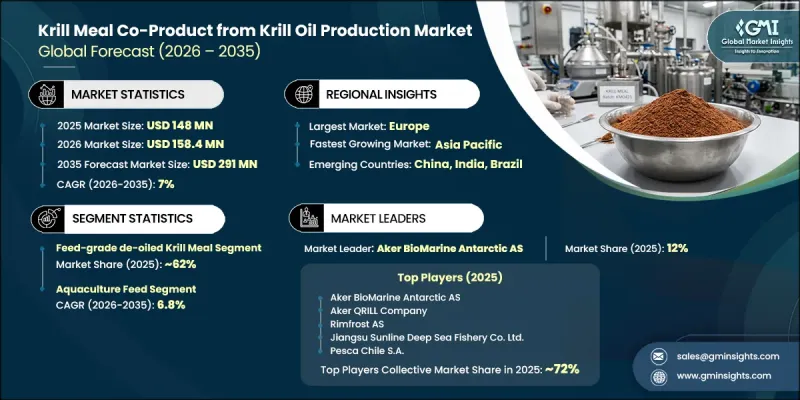
The market continues to gain momentum as de-oiled krill meal evolves from a by-product of krill oil manufacturing into a significant revenue-generating component across the Antarctic krill processing industry. Rising quality expectations among feed manufacturers are increasing the commercial value of specialized krill meal products, particularly certified, low-fluoride variants used in aquaculture nutrition. Ongoing investments in Antarctic harvesting capacity are supporting higher production volumes while reshaping global supply dynamics and expanding availability across international markets. At the same time, the growing preference for premium ingredients in companion animal nutrition is opening additional opportunities for high-quality krill meal. Regulatory oversight and sustainability certification remain key factors influencing production and supply conditions. As demand for value-added marine ingredients continues to rise, the krill oil production co-product krill meal market is becoming an increasingly important contributor to industry revenue, supported by product quality improvements, stronger commercial demand, and expanding processing capabilities.
| Market Scope | |
|---|---|
| Start Year | 2025 |
| Forecast Year | 2026-2035 |
| Start Value | $148 Million |
| Forecast Value | $291 Million |
| CAGR | 7% |
The feed-grade de-oiled krill meal segment held a 62% share in 2025 and is projected to grow at a 6.2% CAGR during 2026-2035. This category, which includes both conventional protein products and enhanced low-fluoride grades accounting for nearly 20% of the segment, remained the leading contributor to overall market volume. Strong demand from aquaculture feed manufacturers continues to support segment growth, as feed-grade krill meal is widely recognized for enhancing feed attractiveness while providing valuable marine-derived nutrients. Rather than functioning as the primary protein component, these products are increasingly incorporated to improve feed performance, nutritional quality, and overall formulation efficiency. Growing demand for certified, higher-specification ingredients is also encouraging producers to expand premium feed-grade offerings, further strengthening the commercial position of this segment throughout the forecast period.
The aquaculture feed application captured a 58% share in 2025 and is forecast to grow at a 6.8% CAGR from 2026 to 2035. This application continues to dominate overall consumption because krill meal delivers multiple nutritional and functional advantages within aquaculture feed formulations. Its ability to improve feed acceptance, provide marine phospholipids, supply naturally occurring astaxanthin, and contribute highly digestible protein makes it a preferred ingredient for modern aquatic nutrition. Increasing emphasis on feed efficiency, animal health, and product quality is encouraging broader adoption of krill meal across commercial aquaculture operations. As producers seek ingredients that support sustainable production while improving nutritional performance, demand within the aquaculture feed segment is expected to remain the largest contributor to overall market growth.
North America Krill Meal Co-Product from Krill Oil Production Market accounted for a 16% share in 2025 and is anticipated to grow at 6.8% CAGR through 2035. Regional growth is primarily supported by rising demand from premium pet nutrition and dietary supplement applications rather than aquaculture feed. Manufacturers are increasingly incorporating certified, low-fluoride krill meal into premium companion animal formulations that emphasize functional nutrition and ingredient transparency. In addition, continued consumer interest in marine-based nutritional products is supporting greater adoption of krill-derived protein and bioactive ingredients within the dietary supplement industry. These trends are strengthening regional demand while encouraging suppliers to expand their presence across value-added nutrition markets.
Major companies operating in the global krill meal co-product from krill oil production market include Aker BioMarine Antarctic AS, Aker QRILL Company, Rimfrost AS, Liaoning Pelagic Fisheries / Liaoyu Antarctic Krill Tech, Jiangsu Sunline Deep Sea Fishery Co., Ltd., Pesca Chile S.A., Neptune Technologies & Bioressources Inc., Hestia (Shandong) Biotech Co., Ltd., Bioextraction Technology LLC / Best Krill, Shandong Hailongyuan Bio-Tech Co., Ltd., Qingdao Kangjing Marine Biotechnology Co., Ltd., Zhongguan Biotechnology (Hunchun) Co., Ltd., Guangzhou Beyond Fishery Co., Ltd., Jeong-Il Corporation, and Kitin AS. Leading participants in the krill meal co-product from krill oil production market are strengthening their competitive position by expanding production capacity, improving processing technologies, and developing premium-grade de-oiled krill meal with enhanced quality specifications. Companies are investing in sustainable harvesting practices, certification programs, and traceable supply chains to address growing customer demand for responsibly sourced marine ingredients. Many manufacturers are broadening their product portfolios to serve aquaculture, pet food, and nutritional applications while increasing investments in research and product innovation to enhance functional performance. Strategic collaborations with feed manufacturers, long-term supply agreements, and geographic expansion into high-growth regional markets are also supporting stronger market penetration.
Table of Contents
Chapter 1 Methodology & Scope
- 1.1 Market scope and definition
- 1.2 Research design
- 1.2.1 Research approach
- 1.2.2 Data collection methods
- 1.3 Data mining sources
- 1.3.1 Global
- 1.3.2 Regional/Country
- 1.4 Base estimates and calculations
- 1.4.1 Base year calculation
- 1.4.2 Key trends for market estimation
- 1.5 Primary research and validation
- 1.5.1 Primary sources
- 1.6 Forecast model
- 1.7 Research assumptions and limitations
Chapter 2 Executive Summary
- 2.1 Industry 360° synopsis
- 2.2 Key market trends
- 2.2.1 Product Grade
- 2.2.2 Application
- 2.2.3 Regional
- 2.3 TAM Analysis, 2026-2035
- 2.4 CXO perspectives: Strategic imperatives
- 2.5 Future outlook and strategic recommendations
Chapter 3 Industry Insights
- 3.1 Industry ecosystem analysis
- 3.1.1 Supplier landscape
- 3.1.2 Profit margin
- 3.1.3 Value addition at each stage
- 3.1.4 Factor affecting the value chain
- 3.1.5 Disruptions
- 3.2 Industry impact forces
- 3.2.1 Growth drivers
- 3.2.2 Industry pitfalls and challenges
- 3.2.3 Market opportunities
- 3.3 Growth potential analysis
- 3.4 Regulatory landscape
- 3.4.1 North America
- 3.4.2 Europe
- 3.4.3 Asia Pacific
- 3.4.4 Latin America
- 3.4.5 Middle East & Africa
- 3.5 Porter’s analysis
- 3.6 PESTEL analysis
- 3.7 Technology and innovation landscape
- 3.7.1 Current technological trends
- 3.7.2 Emerging technologies
- 3.8 Price trends
- 3.8.1 By region
- 3.8.2 By Product grade
- 3.9 Future market trends
- 3.10 Patent landscape
- 3.11 Trade statistics (HS code)
- 3.11.1 Major importing countries
- 3.11.2 Major exporting countries
- 3.12 Sustainability and environmental aspects
- 3.12.1 Sustainable practices
- 3.12.2 Waste reduction strategies
- 3.12.3 Energy efficiency in production
- 3.12.4 Eco-friendly initiatives
Chapter 4 Competitive Landscape, 2025
- 4.1 Introduction
- 4.2 Company market share analysis
- 4.2.1 By region
- 4.2.1.1 North America
- 4.2.1.2 Europe
- 4.2.1.3 Asia Pacific
- 4.2.1.4 LATAM
- 4.2.1.5 MEA
- 4.2.1 By region
- 4.3 Company matrix analysis
- 4.4 Competitive analysis of major market players
- 4.5 Competitive positioning matrix
- 4.6 Key developments
- 4.6.1 Mergers & acquisitions
- 4.6.2 Partnerships & collaborations
- 4.6.3 New product launches
- 4.6.4 Expansion plans
Chapter 5 Market Estimates and Forecast, By Product Grade, 2022–2035 (USD Million) (Kilo Tons)
- 5.1 Key trends
- 5.2 Feed-Grade De-oiled Krill Meal
- 5.2.1 Standard Protein
- 5.2.2 Enhanced-Specification Low-Fluoride
- 5.3 High-Protein De-oiled Krill Meal
- 5.3.1 Salmon & Salmonid-Optimized
- 5.3.2 Shrimp & Shellfish-Optimized
- 5.4 Nutraceutical-Grade De-oiled Krill Meal
- 5.4.1 Human Protein Supplement Base
- 5.4.2 Astaxanthin-Enriched Functional Grade
Chapter 6 Market Estimates and Forecast, By Product Form, 2022–2035 (USD Million) (Kilo Tons)
- 6.1 Key trends
- 6.2 Solvent Extraction
- 6.3 Supercritical CO2 Extraction
- 6.4 Aqueous/Water-Based Extraction
- 6.5 Enzymatic Extraction
- 6.6 Chromatography-Based Separation & Purification
- 6.7 Others
Chapter 7 Market Estimates and Forecast, By Application, 2022–2035 (USD Million) (Kilo Tons)
- 7.1 Key trends
- 7.2 Aquaculture Feed
- 7.2.1 Finfish Feed
- 7.2.2 Shrimp & Shellfish Feed
- 7.2.3 Other Species
- 7.3 Pet Food
- 7.3.1 Dog Food
- 7.3.2 Cat Food
- 7.3.3 Others
- 7.4 Livestock & Poultry Feed
- 7.4.1 Swine Feed
- 7.4.2 Poultry Feed
- 7.4.3 Other Livestock
- 7.5 Nutraceuticals & Dietary Supplements
- 7.5.1 Human Protein Powder
- 7.5.2 Functional Food & Beverage
- 7.5.3 Astaxanthin & Bioactive Extraction
- 7.6 Agricultural Fertilizers
- 7.6.1 Organic Soil Amendment
- 7.6.2 Slow-Release Nitrogen
- 7.7 Others
Chapter 8 Market Estimates and Forecast, By Region, 2022–2035 (USD Million) (Kilo Tons)
- 8.1 Key trends
- 8.2 North America
- 8.2.1 U.S.
- 8.2.2 Canada
- 8.3 Europe
- 8.3.1 Germany
- 8.3.2 UK
- 8.3.3 France
- 8.3.4 Spain
- 8.3.5 Italy
- 8.3.6 Rest of Europe
- 8.4 Asia Pacific
- 8.4.1 China
- 8.4.2 India
- 8.4.3 Japan
- 8.4.4 Australia
- 8.4.5 South Korea
- 8.4.6 Rest of Asia Pacific
- 8.5 Latin America
- 8.5.1 Brazil
- 8.5.2 Mexico
- 8.5.3 Argentina
- 8.5.4 Rest of Latin America
- 8.6 Middle East and Africa
- 8.6.1 Saudi Arabia
- 8.6.2 South Africa
- 8.6.3 UAE
- 8.6.4 Rest of Middle East and Africa
Chapter 9 Company Profiles
- 9.1 Aker BioMarine Antarctic AS
- 9.2 Aker QRILL Company
- 9.3 Rimfrost AS
- 9.4 Liaoning Pelagic Fisheries / Liaoyu Antarctic Krill Tech
- 9.5 Jiangsu Sunline Deep Sea Fishery Co., Ltd.
- 9.6 Pesca Chile S.A.
- 9.7 Neptune Technologies & Bioressources Inc.
- 9.8 Hestia (Shandong) Biotech Co., Ltd.
- 9.9 Bioextraction Technology LLC / Best Krill
- 9.10 Shandong Hailongyuan Bio-Tech Co., Ltd.
- 9.11 Qingdao Kangjing Marine Biotechnology Co., Ltd.
- 9.12 Zhongguan Biotechnology (Hunchun) Co., Ltd.
- 9.13 Guangzhou Beyond Fishery Co., Ltd.
- 9.14 Jeong-Il Corporation
- 9.15 Kitin AS

