PUBLISHER: Mordor Intelligence | PRODUCT CODE: 2113554

PUBLISHER: Mordor Intelligence | PRODUCT CODE: 2113554
Krill Oil - Market Share Analysis, Industry Trends & Statistics, Growth Forecasts (2026 - 2031)
According to Mordor Intelligence, the krill oil market size is expected to grow from USD 0.80 billion in 2025 to USD 0.87 billion in 2026 and is forecast to reach USD 1.37 billion by 2031 at 9.51% CAGR over 2026-2031.
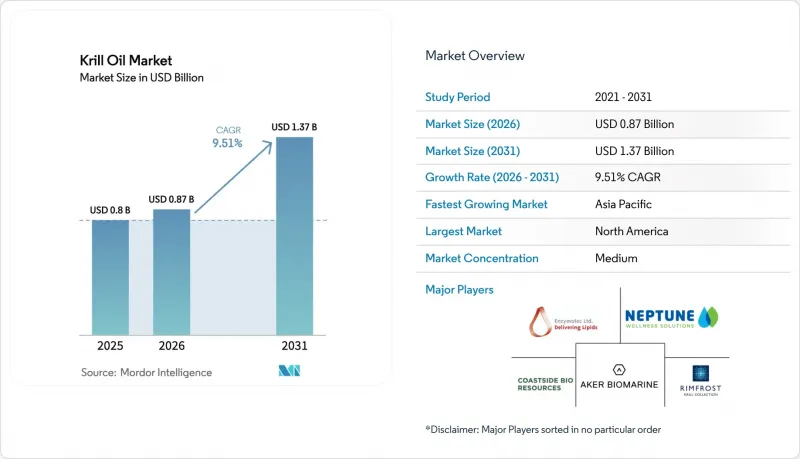
This report is Segmented by Nature (Organic and Conventional), Application (Dietary Supplements, Pharmaceuticals pet Food and Animal Food, and Functional Food and Beverages), and Geography (North America, Europe, Asia-Pacific, South America, and Middle East and Africa). The Market Forecasts are Provided in Terms of Value (USD) and Volume (Liters).
Global Krill Oil Market Trends and Insights
Growing awareness of omega-3 health benefits for heart and brain wellness
Cardiovascular disease continues to be the leading cause of mortality worldwide, with omega-3 fatty acids playing a significant role in preventive cardiology protocols. In 2024, the American Heart Association updated its guidelines to recommend a daily intake of 1,000 milligrams of combined eicosapentaenoic acid (EPA) and docosahexaenoic acid (DHA) for individuals with coronary artery disease. Krill oil supplements meet this requirement through their concentrated phospholipid formulations. Clinical trials published in 2025 demonstrated that krill oil supplementation reduced triglyceride levels by 18% and improved markers of endothelial function within 12 weeks. These outcomes were comparable to those of prescription omega-3 ethyl esters but without associated gastrointestinal side effects. Cognitive health applications are also gaining prominence. A 2025 meta-analysis involving 3,200 participants found that phospholipid-bound docosahexaenoic acid (DHA) improved memory recall scores by 11% in adults over the age of 55. This finding aligns with the needs of aging populations, particularly in countries like Japan and Germany. The dual benefits for cardiovascular and cognitive health distinguish krill oil from fish oil, which lacks the phospholipid carrier necessary for effective blood-brain barrier penetration. Regulatory endorsements further strengthen market confidence. In 2024, the European Food Safety Authority reaffirmed health claims for omega-3 fatty acids related to heart and brain function, enabling manufacturers to use compliant marketing language across all 27 member states.
Shift toward preventive healthcare and regular supplement use
Healthcare cost inflation is encouraging consumers and payers to focus on preventive measures that help delay or avoid chronic disease treatments. According to data from the United States Centers for Disease Control and Prevention, 57.6% of adults consumed dietary supplements in 2024, with omega-3 products ranking third after multivitamins and vitamin D. This trend reflects a growing understanding that supplement regimens are far more affordable than pharmaceutical therapies while providing measurable improvements in health biomarkers. In India, preventive healthcare spending increased at an annual rate of 22% from 2023 to 2025, driven by higher disposable incomes and government-led initiatives promoting wellness over reactive treatments. Krill oil has gained from this trend due to its phospholipid structure, which allows for lower dosages compared to fish oil to achieve similar blood omega-3 levels, making it more convenient and improving adherence. Employers are also playing a role in this shift, as corporate wellness programs in North America and Europe increasingly subsidize omega-3 supplements as part of preventive care packages. This has opened up a business-to-business (B2B) channel that avoids traditional retail challenges. Furthermore, subscription models have become more popular, with direct-to-consumer brands reporting a 68% repeat-purchase rate for krill oil compared to 42% for fish oil. This indicates that the bioavailability advantages of krill oil contribute to stronger customer loyalty.
Environmental concerns regarding impacts on the Antarctic ecosystem
Antarctic krill plays a critical role in the Southern Ocean food web, supporting species such as whales, seals, penguins, and seabirds. While harvest activities are regulated, they often occur in the same foraging zones used by predators, raising concerns about localized depletion and competitive exclusion. A study published in 2025 highlighted a 12 percent decline in Adelie penguin colonies near areas of high-intensity fishing, which was linked to reduced krill availability during critical breeding periods. Climate change adds to these pressures, as warming waters are shifting krill distribution southward, concentrating their biomass into narrower zones that overlap with fishing grounds and predator habitats. In August 2025, the Commission for the Conservation of Antarctic Marine Living Resources (CCAMLR) closed Subarea 48.2 after acoustic surveys detected krill densities below the 75-gram-per-square-meter trigger threshold. This precautionary measure reduced the available fishing area by 18 percent . Environmental advocacy groups have called for expanding marine protected areas to cover 30 percent of the Southern Ocean by 2030, a proposal that would further restrict harvest zones and increase raw material costs. Consumer sentiment is also shifting, as a 2025 survey revealed that 29 percent of European omega-3 buyers expressed concerns about the impact on the Antarctic ecosystem, compared to 14 percent in 2023. This trend indicates that reputational risks could negatively affect market growth if the industry does not demonstrate ecological responsibility.
Other drivers and restraints analyzed in the detailed report include:
- Product innovation in high-concentration and condition-specific formulas
- Expansion of krill oil into functional foods and beverages
- Challenges posed by complex and evolving international fishery regulations
For complete list of drivers and restraints, kindly check the Table Of Contents.
Segment Analysis
Conventional krill oil accounted for 76.81% of the market share in 2025, supported by established supply chains, lower price points, and widespread retail availability. The organic segment, while smaller, is projected to grow at a compound annual growth rate (CAGR) of 10.54% through 2031. This growth is driven by consumers willing to pay 30 to 40% premiums for products certified as free from synthetic additives and sourced from fisheries adhering to organic aquaculture standards. However, organic certification for wild-caught krill remains a contentious issue. Traditional organic frameworks were developed for terrestrial agriculture and aquaculture, not for open-ocean fisheries.
The European Union's organic regulation allows wild-caught fish to carry organic labels only if they are harvested from certified sustainable fisheries and processed without prohibited substances. Currently, fewer than 5% of krill oil producers meet this standard. In the United States, the Department of Agriculture (USDA) National Organic Program has not issued formal guidance on wild-caught marine ingredients, leaving organic krill oil claims in a regulatory gray area, which poses enforcement risks for brands. Despite these challenges, demand for organic options persists. A 2025 consumer survey revealed that 41 percent of North American organic food buyers sought organic omega-3 supplements, and 18% indicated they would switch from conventional krill oil if certified organic alternatives became available.
Complete Report Scope:
- By Nature
- Organic
- Conventional
- By Application
- Dietary Supplements
- Pharmaceuticals
- Pet Food and Animal Food
- Functional Food and Beverages
- By Geography
- North America
- United States
- Canada
- Mexico
- Rest of North America
- Europe
- Germany
- United Kingdom
- Italy
- France
- Spain
- Netherlands
- Rest of Europe
- Asia-Pacific
- China
- India
- Japan
- Australia
- Rest of Asia-Pacific
- South America
- Brazil
- Argentina
- Rest of South America
- Middle East and Africa
- South Africa
- Saudi Arabia
- United Arab Emirates
- Rest of Middle East and Africa
- North America
Geography Analysis
In 2025, North America held a 33.43% share of the market, led by the United States' well-developed dietary supplement infrastructure, a favorable regulatory environment under the Food and Drug Administration's (FDA) Generally Recognized as Safe (GRAS) status, and strong consumer awareness of omega-3 health benefits. The region benefits from extensive distribution networks, including mass retail, specialty health stores, and e-commerce platforms, ensuring broad product availability and competitive pricing. In Canada, the Natural and Non-prescription Health Products Directorate has simplified the licensing process for krill oil products, reducing time-to-market for new formulations and encouraging innovation in delivery formats such as gummies and liquid emulsions. Meanwhile, Mexico's growing middle class and increasing health consciousness are driving the adoption of omega-3 supplements, with krill oil positioned as a premium alternative to fish oil in urban markets. However, growth in North America is slowing due to market saturation and heightened price sensitivity among consumers during economic uncertainty.
The Asia-Pacific region is the fastest-growing market, with a compound annual growth rate of 10.01% expected through 2031. This growth is largely driven by China's 31.4% annual increase in omega-3 supplement sales and regulatory reforms introduced in 2024 that accelerated the registration process for dietary supplements. These developments have created significant opportunities for manufacturers in the region.
Other regions, including South America and the Middle East and Africa, remain smaller markets but are showing early signs of growth. In South America, Brazil's dietary supplement market expanded by 18% in 2024, supported by urbanization and rising health awareness. However, the penetration of krill oil in the region remains limited due to price sensitivity and a preference for locally sourced fish oil. In Europe, the market is shaped by strict regulatory frameworks under the European Food Safety Authority (EFSA) and the European Commission's Novel Food regulation, which require comprehensive safety and efficacy documentation for new omega-3 formulations. Germany, the United Kingdom, France, Italy, and Spain are the largest markets in the region. Germany leads in functional food innovation, while the United Kingdom shows strong demand for sustainably certified supplements. The European Union's 2024 reaffirmation of omega-3 health claims for cardiovascular and cognitive function has provided manufacturers with standardized marketing language across its 27 member states, reducing regulatory fragmentation. Sustainability certifications are particularly important in Europe, where 64% of omega-3 buyers actively seek eco-labels, and 38% would switch brands if sustainability claims were questioned.
- Aker BioMarine AS
- Rimfrost AS
- Neptune Wellness Solutions Inc.
- Enzymotec Ltd.
- Coastside Bio Resources
- NutriGold Inc.
- NWC Naturals Inc.
- Qingdao Kangjing Marine Biotechnology Co., Ltd.
- RB LLC
- Olympic Seafood AS
- Tharos Ltd.
- Viva Labs
- Nutraceutical Corporation
- DSM Firmenich
- Valensa International
- Nordic Naturals
- GC Rieber Oils
- Beijing Gingko Group
- Daeduck FRD Inc.
- Superba Boost (Brand)
Additional Benefits:
- The market estimate (ME) sheet in Excel format
- 3 months of analyst support
TABLE OF CONTENTS
1 INTRODUCTION
- 1.1 Study Assumptions and Market Definition
- 1.2 Scope of the Study
2 RESEARCH METHODOLOGY
3 EXECUTIVE SUMMARY
4 MARKET LANDSCAPE
- 4.1 Market Overview
- 4.2 Market Drivers
- 4.2.1 Growing awareness of omega-3 health benefits for heart and brain wellness
- 4.2.2 Shift toward preventive healthcare and regular supplement use
- 4.2.3 Product innovation in high-concentration and condition-specific formulas
- 4.2.4 Expansion of krill oil into functional foods and beverages
- 4.2.5 Increasing use in infant nutrition and maternal health products
- 4.2.6 Sustainability certifications and eco-labels building brand trust
- 4.3 Market Restraints
- 4.3.1 Environmental concerns regarding impacts on the Antarctic ecosystem
- 4.3.2 Challenges posed by complex and evolving international fishery regulations
- 4.3.3 Public criticism of sustainability certifications and governance practices
- 4.3.4 Supply chain concentration among a few large harvesters
- 4.4 Supply Chain Analysis
- 4.5 Regulatory Outlook
- 4.6 Porter's Five Forces
- 4.6.1 Threat of New Entrants
- 4.6.2 Bargaining Power of Buyers/Consumers
- 4.6.3 Bargaining Power of Suppliers
- 4.6.4 Threat of Substitute Products
- 4.6.5 Intensity of Competitive Rivalry
5 MARKET SIZE AND GROWTH FORECASTS (VALUE AND VOLUME)
- 5.1 By Nature
- 5.1.1 Organic
- 5.1.2 Conventional
- 5.2 By Application
- 5.2.1 Dietary Supplements
- 5.2.2 Pharmaceuticals
- 5.2.3 Pet Food and Animal Food
- 5.2.4 Functional Food and Beverages
- 5.3 By Geography
- 5.3.1 North America
- 5.3.1.1 United States
- 5.3.1.2 Canada
- 5.3.1.3 Mexico
- 5.3.1.4 Rest of North America
- 5.3.2 Europe
- 5.3.2.1 Germany
- 5.3.2.2 United Kingdom
- 5.3.2.3 Italy
- 5.3.2.4 France
- 5.3.2.5 Spain
- 5.3.2.6 Netherlands
- 5.3.2.7 Rest of Europe
- 5.3.3 Asia-Pacific
- 5.3.3.1 China
- 5.3.3.2 India
- 5.3.3.3 Japan
- 5.3.3.4 Australia
- 5.3.3.5 Rest of Asia-Pacific
- 5.3.4 South America
- 5.3.4.1 Brazil
- 5.3.4.2 Argentina
- 5.3.4.3 Rest of South America
- 5.3.5 Middle East and Africa
- 5.3.5.1 South Africa
- 5.3.5.2 Saudi Arabia
- 5.3.5.3 United Arab Emirates
- 5.3.5.4 Rest of Middle East and Africa
- 5.3.1 North America
6 COMPETITIVE LANDSCAPE
- 6.1 Market Concentration
- 6.2 Strategic Moves
- 6.3 Market Ranking Analysis
- 6.4 Company Profiles (includes Global-level Overview, Market-level Overview, Core Segments, Financials (if available), Strategic Information, Market Rank/Share, Products and Services, Recent Developments)
- 6.4.1 Aker BioMarine AS
- 6.4.2 Rimfrost AS
- 6.4.3 Neptune Wellness Solutions Inc.
- 6.4.4 Enzymotec Ltd.
- 6.4.5 Coastside Bio Resources
- 6.4.6 NutriGold Inc.
- 6.4.7 NWC Naturals Inc.
- 6.4.8 Qingdao Kangjing Marine Biotechnology Co., Ltd.
- 6.4.9 RB LLC
- 6.4.10 Olympic Seafood AS
- 6.4.11 Tharos Ltd.
- 6.4.12 Viva Labs
- 6.4.13 Nutraceutical Corporation
- 6.4.14 DSM Firmenich
- 6.4.15 Valensa International
- 6.4.16 Nordic Naturals
- 6.4.17 GC Rieber Oils
- 6.4.18 Beijing Gingko Group
- 6.4.19 Daeduck FRD Inc.
- 6.4.20 Superba Boost (Brand)
7 MARKET OPPORTUNITIES AND FUTURE OUTLOOK

