PUBLISHER: Global Market Insights Inc. | PRODUCT CODE: 2109247

PUBLISHER: Global Market Insights Inc. | PRODUCT CODE: 2109247
Manual Bottle Opener Market Opportunity, Growth Drivers, Industry Trend Analysis, and Forecast 2026 - 2035
The Global Manual Bottle Opener Market was valued at USD 1.3 billion in 2025 and is estimated to grow at a CAGR of 5.3% to reach USD 2.2 billion by 2035.
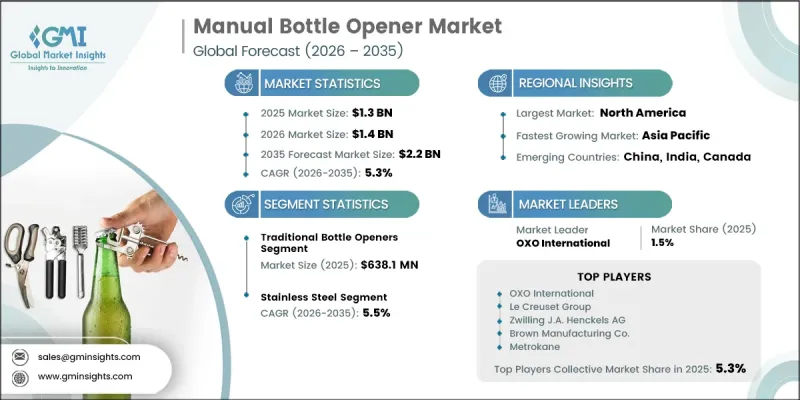
Growth in the manual bottle opener market is driven by rising consumer interest in home meal preparation and beverage consumption, which continues to boost demand for practical and durable kitchen accessories. Manual bottle openers remain an essential household tool for opening a wide variety of bottled beverages, making them a staple in modern kitchens. Increasing interest in home entertaining, social gatherings, and recreational cooking is further supporting product adoption across residential settings. Consumers are also seeking ergonomic, durable, and multifunctional bottle openers that offer greater comfort, convenience, and long-term reliability. In addition, expanding product availability through supermarkets, specialty retail stores, and online sales channels is improving accessibility across global markets. Growing household expenditure on kitchen essentials is contributing to steady market expansion. The hospitality industry is also creating strong commercial demand, as restaurants, hotels, cafes, bars, catering businesses, and entertainment venues rely on dependable bottle openers to improve beverage service efficiency. Continued growth in tourism and foodservice activities is increasing demand for durable products designed to withstand frequent commercial use.
| Market Scope | |
|---|---|
| Start Year | 2025 |
| Forecast Year | 2026-2035 |
| Start Value | $1.3 Billion |
| Forecast Value | $2.2 Billion |
| CAGR | 5.3% |
The traditional bottle openers segment accounted for USD 638.1 million in 2025. This segment continues to lead due to its simple construction, cost-effectiveness, and widespread use across residential, commercial, and hospitality environments. Traditional bottle openers are highly valued for their durability, ease of operation, and minimal maintenance requirements. Their compact design and portability make them a preferred choice for both household and professional applications where reliable bottle-opening tools are essential.
The stainless steel segment held a 56.9% share in 2025 and is projected to grow at a CAGR of 5.5% between 2026 and 2035. Stainless steel remains the preferred material because of its excellent durability, corrosion resistance, and extended product lifespan. These bottle openers maintain their performance even under frequent use, making them well suited for both residential and commercial environments. Their hygienic surface and ease of cleaning further contribute to widespread adoption across hospitality and foodservice establishments.
U.S. Manual Bottle Opener Market reached USD 452.1 million in 2025 and is anticipated to grow at a CAGR of 4.6% from 2026 to 2035. Strong consumption of bottled beverages and continued demand for reliable kitchen accessories continue to support market growth across the country. Households and commercial establishments consistently utilize manual bottle openers because of their affordability, durability, and user-friendly design. Consumer preference is increasingly shifting toward ergonomic products made from stainless steel and multifunctional designs that deliver enhanced convenience and longer service life.
Major companies operating in the manual bottle opener market include OXO International, Le Creuset Group, Joseph Joseph Ltd., Oster, Kuhn Rikon AG, Zwilling J.A. Henckels AG, Metrokane, BarCraft, Boker (Heinr. Boker Baumwerk GmbH), Metallurgica Motta S.R.L., Westmark GmbH, Pulltex S.L., Alessi S.p.A., Cuisinart, True Fabrications (True Brands), Victorinox AG, Farfalli S.R.L., Chef Craft Corporation, Brown Manufacturing Co., Kikkerland Design Inc., and Rosle GmbH & Co. KG. Companies operating in the manual bottle opener market are strengthening their competitive position by investing in product innovation, ergonomic designs, and durable materials that improve functionality and customer satisfaction. Manufacturers are expanding product portfolios with multifunctional designs while focusing on premium finishes and enhanced usability to meet evolving consumer preferences. Many companies are strengthening distribution networks through retail partnerships and online sales channels to increase global market reach. Strategic brand positioning, attractive product packaging, and continuous quality improvements are also helping companies differentiate their offerings.
Table of Contents
Chapter 1 Research Methodology
- 1.1 Research approach
- 1.2 Quality Commitments
- 1.2.1 GMI AI policy & data integrity commitment
- 1.2.1.1 Source consistency protocol
- 1.2.1 GMI AI policy & data integrity commitment
- 1.3 Research Trail & Confidence Scoring
- 1.3.1 Research Trail Components
- 1.3.2 Scoring Components
- 1.4 Data Collection
- 1.4.1 Partial list of primary sources
- 1.5 Data mining sources
- 1.5.1 Paid sources
- 1.5.1.1 Sources, by region
- 1.5.1 Paid sources
- 1.6 Base estimates and calculations
- 1.6.1 Base year calculation for any one approach
- 1.7 Forecast model
- 1.7.1 Quantified market impact analysis
- 1.7.1.1 Mathematical impact of growth parameters on forecast
- 1.7.1 Quantified market impact analysis
- 1.8 Research transparency addendum
- 1.8.1 Source attribution framework
- 1.8.2 Quality assurance metrics
- 1.8.3 Our commitment to trust
Chapter 2 Executive Summary
- 2.1 Industry 360° synopsis, 2022 – 2035
- 2.2 Key market trends
- 2.2.1 Regional
- 2.2.2 Product type
- 2.2.3 Material
- 2.2.4 Price range
- 2.2.5 End use
- 2.2.6 Distribution channel
Chapter 3 Industry Insights
- 3.1 Industry ecosystem analysis
- 3.1.1 Factor affecting the value chain
- 3.1.2 Profit margin analysis
- 3.1.3 Disruptions
- 3.1.4 Future outlook
- 3.1.5 Manufacturers
- 3.1.6 Distributors
- 3.2 Supplier landscape
- 3.3 Key news & initiatives
- 3.4 Technology & innovation landscape
- 3.5 Regulatory landscape
- 3.6 Impact on forces
- 3.6.1 Growth drivers
- 3.6.1.1 Rising home cooking trends increase bottle opener product demand.
- 3.6.1.2 Expanding hospitality sector boosts commercial bottle opener usage.
- 3.6.1.3 Affordable pricing supports widespread manual opener consumer adoption.
- 3.6.2 Industry pitfalls & challenges
- 3.6.2.1 Availability of automatic openers limits manual product demand.
- 3.6.2.2 Low product differentiation intensifies market competition among manufacturers.
- 3.6.3 Opportunities
- 3.6.3.1 Eco-friendly materials create sustainable opener product opportunities.
- 3.6.3.2 Personalized designs attract premium gift-oriented consumer segments.
- 3.6.1 Growth drivers
- 3.7 Porter’s analysis
- 3.8 PESTEL analysis
- 3.9 Pricing analysis (driven by primary research)
- 3.9.1 Historical price trend analysis (driven by primary research)
- 3.9.2 Pricing strategy by player type (premium / value / cost-plus) (driven by primary research)
- 3.10 Trade data analysis (driven by paid database)
- 3.10.1 Import/export volume & value trends by region (driven by paid database)
- 3.10.2 Key trade corridors & tariff impact (driven by paid database)
- 3.11 Impact of AI & generative AI on the market
- 3.11.1 AI-driven disruption of existing business models (demand forecasting, inventory optimization)
- 3.11.2 GenAI use cases & adoption roadmap by segment (personalized design, smart retail)
- 3.11.3 Risks, limitations & regulatory considerations
- 3.12 Distribution infrastructure & channel penetration landscape (driven by primary research)
- 3.12.1 Channel coverage by region & format (modern vs. traditional trade) (driven by primary research)
- 3.12.2 Last-mile infrastructure gaps & emerging channel shifts (driven by primary research)
Chapter 4 Competitive Landscape, 2025
- 4.1 Introduction
- 4.2 Company market share analysis
- 4.3 Competitive positioning matrix
- 4.4 Strategic outlook matrix
- 4.5 Competitive analysis of major market players
- 4.6 Key developments
- 4.6.1 Mergers & acquisitions
- 4.6.2 Partnerships & collaborations
- 4.6.3 New product launches
- 4.6.4 Expansion plans
Chapter 5 Market Estimates & Forecast, By Product Type, 2022-2035 (USD Billion) (Million Units)
- 5.1 Key trends
- 5.2 Traditional Bottle Openers
- 5.3 Keychain Bottle Openers
- 5.4 Wall-Mounted Bottle Openers
- 5.5 Others
Chapter 6 Market Estimates & Forecast, By Material, 2022-2035 (USD Billion) (Million Units)
- 6.1 Key trends
- 6.2 Stainless Steel
- 6.3 Aluminum
- 6.4 Plastic
- 6.5 Others
Chapter 7 Market Estimates & Forecast, By Price Range, 2022-2035 (USD Billion) (Million Units)
- 7.1 Key trends
- 7.2 Low
- 7.3 Mid-range
- 7.4 High
Chapter 8 Market Estimates & Forecast, By End Use, 2022-2035 (USD Billion) (Million Units)
- 8.1 Key trends
- 8.2 Households
- 8.3 Bars & Restaurants
- 8.4 Outdoor Enthusiasts
- 8.5 Others
Chapter 9 Market Estimates & Forecast, By Distribution Channel, 2022-2035 (USD Billion) (Million Units)
- 9.1 Key trends
- 9.2 Online
- 9.3 Offline
Chapter 10 Market Estimates & Forecast, By Region, 2022 – 2035, (USD Billion) (Million Units)
- 10.1 Key trends
- 10.2 North America
- 10.2.1 U.S.
- 10.2.2 Canada
- 10.3 Europe
- 10.3.1 Germany
- 10.3.2 U.K.
- 10.3.3 France
- 10.3.4 Italy
- 10.3.5 Spain
- 10.4 Asia Pacific
- 10.4.1 China
- 10.4.2 India
- 10.4.3 Japan
- 10.4.4 South Korea
- 10.4.5 Australia
- 10.5 Latin America
- 10.5.1 Brazil
- 10.5.2 Mexico
- 10.5.3 Argentina
- 10.6 MEA
- 10.6.1 UAE
- 10.6.2 Saudi Arabia
- 10.6.3 South Africa
Chapter 11 Company Profiles
- 11.1 Global players
- 11.1.1 OXO International
- 11.1.2 Le Creuset Group
- 11.1.3 Joseph Joseph Ltd.
- 11.1.4 Oster
- 11.1.5 Kuhn Rikon AG
- 11.1.6 Zwilling J.A. Henckels AG
- 11.1.7 Metrokane
- 11.2 Regional players
- 11.2.1 BarCraft
- 11.2.2 Boker (Heinr. Boker Baumwerk GmbH)
- 11.2.3 Metallurgica Motta S.R.L.
- 11.2.4 Westmark GmbH
- 11.2.5 Pulltex S.L.
- 11.2.6 Alessi S.p.A.
- 11.2.7 Cuisinart
- 11.3 Emerging players
- 11.3.1 True Fabrications (True Brands)
- 11.3.2 Victorinox AG
- 11.3.3 Farfalli S.R.L.
- 11.3.4 Chef Craft Corporation
- 11.3.5 Brown Manufacturing Co.
- 11.3.6 Kikkerland Design Inc.
- 11.3.7 Rosle GmbH & Co. KG

