PUBLISHER: Global Market Insights Inc. | PRODUCT CODE: 2109253

PUBLISHER: Global Market Insights Inc. | PRODUCT CODE: 2109253
Memristor Market Opportunity, Growth Drivers, Industry Trend Analysis, and Forecast 2026 - 2035
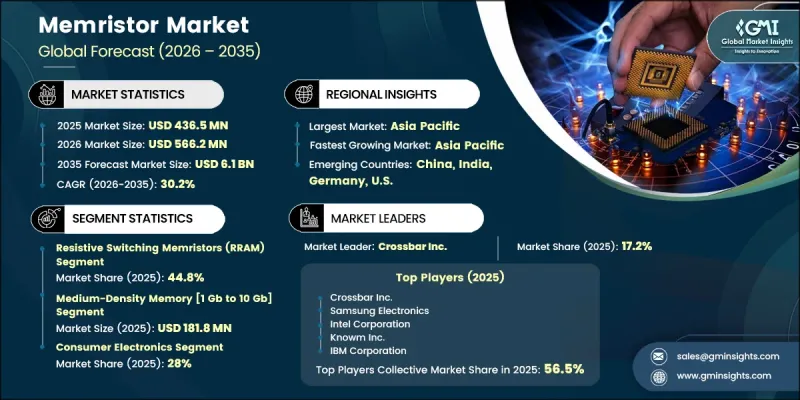
The Global Memristor Market was valued at USD 436.5 million in 2025 and is estimated to grow at a CAGR of 30.2% to reach USD 6.1 billion by 2035.
The market is witnessing strong momentum due to the rising integration of brain-inspired computing architectures designed to enhance processing efficiency and reduce latency in advanced computing systems. Increasing focus on lowering energy consumption in memory-intensive applications is further accelerating adoption across next-generation computing platforms. The rapid proliferation of connected devices that require real-time, edge-based data processing is also reinforcing demand for high-performance, low-power memory technologies. In addition, growing investment in advanced materials research and early-stage commercialization efforts is improving technological readiness and scalability. A notable industry transition toward architectures that reduce frequent data transfer between processing and memory units is reshaping system design approaches and strengthening long-term adoption potential. These combined factors are supporting robust expansion across artificial intelligence, edge computing, and advanced electronics ecosystems, positioning memristors as a key enabling technology for future computing infrastructure.
| Market Scope | |
|---|---|
| Start Year | 2025 |
| Forecast Year | 2026-2035 |
| Start Value | $436.5 Million |
| Forecast Value | $6.1 Billion |
| CAGR | 30.2% |
The phase change memristors (PCM) segment is projected to grow at a CAGR of 31.8% through 2035, driven by its strong endurance capabilities and support for multiple resistance states. This technology is increasingly favored for its reliable performance and analog-like behavior, making it suitable for neuromorphic systems and AI-driven acceleration platforms. Rising interest in brain-inspired computing models and next-generation processing architectures is further strengthening demand for this segment across advanced computing applications.
The medium-density memory segment, ranging from 1 Gb to 10 Gb reached USD 181.8 million in 2025. This segment is widely preferred due to its balanced combination of storage capacity, performance efficiency, and manufacturing practicality. It is commonly used in embedded systems, edge computing devices, and early-stage AI hardware where moderate data handling and fast response times are essential. Its cost-effectiveness, high production yield, and compatibility with existing fabrication technologies continue to support widespread adoption.
North America Memristor Market accounted for 35.8% share in 2025, supported by a strong ecosystem of advanced computing research and semiconductor innovation. The region benefits from a high concentration of national research institutions, defense technology programs, and artificial intelligence development centers that actively explore next-generation memory solutions. Increasing government and private sector investments aimed at strengthening domestic semiconductor capabilities and accelerating advanced computing infrastructure are further driving regional growth. The presence of leading technology developers and early adoption of emerging memory architectures continues to reinforce North America's strategic position in the global market.
Key companies operating in the Global Memristor Market include Samsung Electronics Co., Ltd., Intel Corporation, IBM Corporation, Micron Technology, Inc., SK hynix Inc., TSMC, Toshiba Corporation, STMicroelectronics, Western Digital Corporation, Panasonic Corporation, Everspin Technologies Inc., Crossbar Inc., 4DS Memory Limited, Avalanche Technology Inc., Knowm Inc., RAMXEED, Weebit. Companies in the memristor market are prioritizing advanced research and development initiatives improve device reliability, scalability, and energy efficiency. Strategic collaborations with semiconductor manufacturers and research institutions are helping accelerate commercialization and technology validation. Many players are investing in next-generation materials innovation to enhance switching performance and endurance capabilities. Expansion of pilot production lines and fabrication partnerships is enabling a smoother transition from research to large-scale manufacturing. Firms are also strengthening intellectual property portfolios to secure a competitive advantage in emerging memory architectures. Integration of memristor technology into artificial intelligence and neuromorphic computing systems is being actively pursued to capture high-growth application areas.
Table of Contents
Chapter 1 Methodology and Scope
- 1.1 Market scope and definition
- 1.2 Research design
- 1.2.1 Research approach
- 1.2.2 Data collection methods
- 1.3 Data mining sources
- 1.3.1 Global
- 1.3.2 Regional/Country
- 1.4 Base estimates and calculations
- 1.4.1 Base year calculation
- 1.4.2 Key trends for market estimation
- 1.5 Primary research and validation
- 1.5.1 Primary sources
- 1.6 Forecast model
- 1.7 Research assumptions and limitations
Chapter 2 Executive Summary
- 2.1 Industry 360° synopsis, 2022 – 2035
- 2.2 Key market trends
- 2.2.1 Technology trends
- 2.2.2 Memory capacity trends
- 2.2.3 Application trends
- 2.2.4 Form factor trends
- 2.2.5 End-use industry trends
- 2.2.6 Regional trends
- 2.3 TAM Analysis, 2026-2035
- 2.4 CXO perspectives: Strategic imperatives
Chapter 3 Industry Insights
- 3.1 Industry ecosystem analysis
- 3.1.1 Supplier Landscape
- 3.1.2 Profit Margin
- 3.1.3 Cost structure
- 3.1.4 Value addition at each stage
- 3.1.5 Factor affecting the value chain
- 3.1.6 Disruptions
- 3.2 Industry impact forces
- 3.2.1 Growth drivers
- 3.2.1.1 Rising demand for artificial intelligence and neuromorphic computing
- 3.2.1.2 Growing need for low-power and energy-efficient memory solutions
- 3.2.1.3 Expansion of edge computing and iot deployments
- 3.2.1.4 Increased research investment and commercial prototyping
- 3.2.1.5 Accelerating adoption of in-memory computing architectures
- 3.2.2 Industry pitfalls and challenges
- 3.2.2.1 Technology variability and reliability issues
- 3.2.2.2 Limited manufacturing maturity and process scalability
- 3.2.3 Market opportunities
- 3.2.3.1 Emerging use of memristors in adaptive and reconfigurable hardware systems
- 3.2.3.2 Potential adoption in non-volatile memory replacement and hybrid memory layers
- 3.2.1 Growth drivers
- 3.3 Growth potential analysis
- 3.4 Regulatory landscape
- 3.4.1 North America
- 3.4.2 Europe
- 3.4.3 Asia Pacific
- 3.4.4 Latin America
- 3.4.5 Middle East & Africa
- 3.5 Porter’s analysis
- 3.6 PESTEL analysis
- 3.7 Technology and Innovation landscape
- 3.7.1 Current technological trends
- 3.7.2 Emerging technologies
- 3.8 Price trends
- 3.8.1 By region
- 3.8.2 By product
- 3.9 Pricing Strategies
- 3.10 Emerging Business Models
- 3.11 Compliance Requirements
- 3.12 Patent and IP analysis
Chapter 4 Competitive Landscape, 2025
- 4.1 Introduction
- 4.2 Company market share analysis
- 4.2.1 By region
- 4.2.1.1 North America
- 4.2.1.2 Europe
- 4.2.1.3 Asia Pacific
- 4.2.1.4 Latin America
- 4.2.1.5 Middle East & Africa
- 4.2.2 Market concentration analysis
- 4.2.1 By region
- 4.3 Competitive benchmarking of key players
- 4.3.1 Financial performance comparison
- 4.3.1.1 Revenue
- 4.3.1.2 Profit margin
- 4.3.1.3 R&D
- 4.3.2 Product portfolio comparison
- 4.3.2.1 Product range breadth
- 4.3.2.2 Technology
- 4.3.2.3 Innovation
- 4.3.3 Geographic presence comparison
- 4.3.3.1 Global footprint analysis
- 4.3.3.2 Service network coverage
- 4.3.3.3 Market penetration by region
- 4.3.4 Competitive positioning matrix
- 4.3.4.1 Leaders
- 4.3.4.2 Challengers
- 4.3.4.3 Followers
- 4.3.4.4 Niche players
- 4.3.5 Strategic outlook matrix
- 4.3.1 Financial performance comparison
- 4.4 Key developments
- 4.4.1 Mergers and acquisitions
- 4.4.2 Partnerships and collaborations
- 4.4.3 Technological advancements
- 4.4.4 Expansion and investment strategies
- 4.4.5 Digital transformation initiatives
- 4.5 Emerging/ startup competitors landscape
Chapter 5 Market Estimates and Forecast, By Technology, 2022 – 2035 (USD Million)
- 5.1 Key trends
- 5.2 Resistive switching memristors (RRAM)
- 5.3 Spintronic memristors
- 5.4 Phase change memristors (PCM)
- 5.5 Ferroelectric memristors
- 5.6 Others
Chapter 6 Market Estimates and Forecast, By Memory Capacity, 2022 – 2035 (USD Million)
- 6.1 Key trends
- 6.2 Low-density memory [<1 Gb]
- 6.3 Medium-density memory [1 Gb to 10 Gb]
- 6.4 High-density memory [>10 Gb]
Chapter 7 Market Estimates and Forecast, By Application, 2022 – 2035 (USD Million)
- 7.1 Key trends
- 7.2 Non-volatile memory
- 7.3 Neuromorphic & AI computing
- 7.4 Edge computing & IoT acceleration
- 7.5 Reconfigurable logic & analog computing
- 7.6 Security & cryptographic hardware
- 7.7 Others
Chapter 8 Market Estimates and Forecast, By Form Factor, 2022 – 2035 (USD Million)
- 8.1 Key trends
- 8.2 Standalone memory devices
- 8.3 Embedded memory in SoCs
- 8.4 Crossbar array architectures
- 8.5 Neuromorphic chipsets
Chapter 9 Market Estimates and Forecast, By End-use Industry, 2022 – 2035 (USD Million)
- 9.1 Key trends
- 9.2 Consumer electronics
- 9.3 IT & data centers
- 9.4 Automotive
- 9.5 Aerospace & defense
- 9.6 Healthcare
- 9.7 Industrial manufacturing
- 9.8 Others
Chapter 10 Market Estimates and Forecast, By Region, 2022 – 2035 (USD Million)
- 10.1 Key trends
- 10.2 North America
- 10.2.1 U.S.
- 10.2.2 Canada
- 10.3 Europe
- 10.3.1 Germany
- 10.3.2 UK
- 10.3.3 France
- 10.3.4 Spain
- 10.3.5 Italy
- 10.3.6 Russia
- 10.4 Asia Pacific
- 10.4.1 China
- 10.4.2 India
- 10.4.3 Japan
- 10.4.4 Australia
- 10.4.5 South Korea
- 10.5 Latin America
- 10.5.1 Brazil
- 10.5.2 Mexico
- 10.5.3 Argentina
- 10.6 Middle East and Africa
- 10.6.1 South Africa
- 10.6.2 Saudi Arabia
- 10.6.3 UAE
Chapter 11 Company Profiles
- 11.1 Global Key Players
- 11.1.1 Crossbar Inc.
- 11.1.2 Samsung Electronics
- 11.1.3 Intel Corporation
- 11.1.4 Knowm Inc.
- 11.1.5 IBM Corporation
- 11.2 Regional key players
- 11.2.1 North America
- 11.2.1.1 Avalanche Technology Inc.
- 11.2.1.2 Everspin Technologies Inc.
- 11.2.1.3 Micron Technology, Inc.
- 11.2.1.4 Western Digital Corporation
- 11.2.2 Asia Pacific
- 11.2.2.1 Panasonic Corporation
- 11.2.2.2 RAMXEED
- 11.2.2.3 4DS Memory Limited
- 11.2.2.4 SK hynix Inc.
- 11.2.2.5 Toshiba Corporation
- 11.2.2.6 TSMC
- 11.2.3 Europe
- 11.2.3.1 STMicroelectronics
- 11.2.1 North America
- 11.3 Niche Players/Disruptors
- 11.3.1 Weebit

