PUBLISHER: Global Market Insights Inc. | PRODUCT CODE: 2109256

PUBLISHER: Global Market Insights Inc. | PRODUCT CODE: 2109256
Geothermal ORC Market Opportunity, Growth Drivers, Industry Trend Analysis, and Forecast 2026 - 2035
The Global Geothermal ORC Market was valued at USD 15 billion in 2025 and is estimated to grow at a CAGR of 13.7% to reach USD 54.5 billion by 2035.
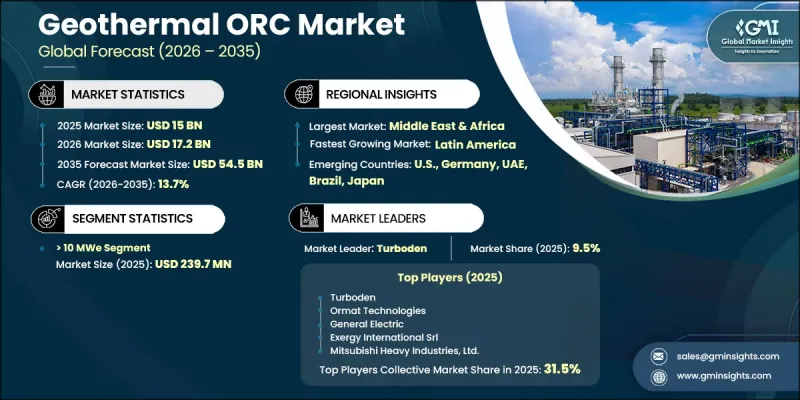
The geothermal ORC market is witnessing strong growth as the global energy sector continues to shift toward cleaner, more reliable, and sustainable power generation solutions. Increasing efforts to reduce carbon emissions and establish dependable renewable energy sources are encouraging governments, utilities, and energy developers to invest in geothermal power technologies. Geothermal ORC systems are gaining importance because they can efficiently convert low- and medium-temperature geothermal heat resources into electricity, making previously less attractive resources commercially viable. The growing need for energy diversification and improved grid stability is further supporting the adoption of ORC-based geothermal systems worldwide. Favorable government policies, renewable energy incentives, and supportive investment frameworks are creating new opportunities for geothermal project development. At the same time, technological improvements in turbine performance, working fluid optimization, and modular ORC system designs are enhancing efficiency, lowering operating expenses, and improving reliability. The expanding use of decentralized geothermal power systems, integration with hybrid energy projects, and application in waste heat recovery are further strengthening the market outlook.
| Market Scope | |
|---|---|
| Start Year | 2025 |
| Forecast Year | 2026-2035 |
| Start Value | $15 Billion |
| Forecast Value | $54.5 Billion |
| CAGR | 13.7% |
Based on power output, the >10 MWe segment was valued at USD 239.7 million in 2025. ORC technology provides significant flexibility compared with conventional thermal energy conversion methods because it can operate efficiently across a wide range of power capacities. The technology supports electricity generation from both large-scale geothermal facilities and smaller thermal resources with lower output levels. Its ability to provide efficient, reliable, and cost-effective conversion of heat energy into mechanical and electrical power has increased its adoption across higher-capacity installations. The combination of strong operational performance, adaptability, and improved efficiency has contributed to the increasing deployment of ORC systems in facilities exceeding 10 megawatts electric (>10 MWe).
The U.S. geothermal ORC market is projected to reach USD 12.2 billion by 2035. The country's growing utilization of geothermal resources is supporting the expansion of ORC technology, especially for applications involving low- and medium-temperature heat sources. Rising attention toward grid resilience, clean energy transition goals, and reliable renewable electricity generation is encouraging utilities and developers to adopt geothermal ORC solutions. Advancements in system efficiency and the conversion of previously unused geothermal heat sources into productive energy assets are further contributing to market expansion. The increasing exploration of geothermal opportunities from existing industrial resources is also supporting the wider deployment of ORC-based power generation systems.
Key players operating in the global geothermal ORC industry include Exergy International Srl, ABB, Turboden S.p.A, General Electric, Ormat Technologies, Mitsubishi Heavy Industries, Ltd., ENOGIA, Atlas Copco AB, ALFA LAVAL, ORCAN ENERGY AG, Calnetix Technologies, LLC, Triogen, Kaishan USA, Enertime, INTEC GMK, and Elvosolar, a.s. Companies operating in the geothermal ORC market are implementing strategies focused on technological innovation, strategic partnerships, and expansion of product capabilities to strengthen their market position. Key participants are investing in research and development activities to improve ORC system efficiency, optimize turbine designs, and enhance operational reliability. Companies are also developing modular and scalable solutions to address the requirements of different geothermal applications and power capacities. Strategic collaborations with energy developers, utilities, and technology providers are helping businesses expand their global presence and accelerate project deployment. Market participants are focusing on cost reduction, advanced working fluid technologies, and integrated energy solutions to improve competitiveness.
Table of Contents
Chapter 1 Methodology & Scope
- 1.1 Research approach
- 1.2 Quality commitments
- 1.2.1 GMI AI policy & data integrity commitment
- 1.2.1.1 Source consistency protocol
- 1.2.1 GMI AI policy & data integrity commitment
- 1.3 Research trail & confidence scoring
- 1.3.1 Research trail components
- 1.3.2 Scoring components
- 1.4 Data collection
- 1.4.1 Partial list of primary sources
- 1.5 Data mining sources
- 1.5.1 Paid sources
- 1.5.1.1 Sources, by region
- 1.5.1 Paid sources
- 1.6 Base estimates and calculations
- 1.6.1 Base year calculation for any one approach
- 1.7 Market estimates & forecasts parameters
- 1.8 Forecast model
- 1.8.1 Quantified market impact analysis
- 1.8.1.1 Mathematical impact of growth parameters on forecast
- 1.8.1 Quantified market impact analysis
- 1.9 Research transparency addendum
- 1.9.1 Source attribution framework
- 1.9.2 Quality assurance metrics
- 1.9.3 Our commitment to trust
- 1.10 Market definitions
Chapter 2 Executive Summary
- 2.1 Industry synopsis, 2022 - 2035
- 2.1.1 Business trends
- 2.1.2 Power output trends
- 2.1.3 Regional trends
Chapter 3 Industry Insights
- 3.1 Industry ecosystem analysis
- 3.1.1 Raw material availability & sourcing analysis
- 3.1.2 Manufacturing capacity assessment
- 3.1.3 Supply chain resilience & risk factors
- 3.1.4 Distribution network analysis
- 3.2 Regulatory landscape
- 3.3 Industry impact forces
- 3.3.1 Growth drivers
- 3.3.2 Industry pitfalls & challenges
- 3.4 Growth potential analysis
- 3.5 Porter's analysis
- 3.5.1 Bargaining power of suppliers
- 3.5.2 Bargaining power of buyers
- 3.5.3 Threat of new entrants
- 3.5.4 Threat of substitutes
- 3.6 PESTEL analysis
- 3.6.1 Political factors
- 3.6.2 Economic factors
- 3.6.3 Social factors
- 3.6.4 Technological factors
- 3.6.5 Legal factors
- 3.6.6 Environmental factors
- 3.7 Price trend analysis (USD/MW)
- 3.7.1 By Capacity
- 3.7.2 By Region
- 3.8 Capacity & production landscape (Driven by Primary Research)
- 3.8.1 Capacity by key producer (Driven by Primary Research)
- 3.8.2 Capacity utilization rates & expansion pipelines (Driven by Primary Research)
- 3.9 Impact of AI & Generative AI on the market (Core Solution)
- 3.9.1 AI-Driven production optimization (Core Solution)
- 3.9.2 Predictive maintenance & fault detection (Core Solution)
- 3.10 Emerging opportunities & trends
- 3.11 Investment analysis & future prospects
- 3.12 Sustainability initiatives & industry 4.0 integration
Chapter 4 Competitive Landscape, 2026
- 4.1 Introduction
- 4.2 Company market share analysis, by region, 2025
- 4.2.1 North America
- 4.2.2 Europe
- 4.2.3 Asia Pacific
- 4.2.4 Middle East & Africa
- 4.2.5 Latin America
- 4.3 Key developments
- 4.3.1 Key partnerships & collaborations
- 4.3.2 Major M&A activities
- 4.3.3 Product innovations & launches
- 4.3.4 Market expansion strategies
- 4.4 Competitive positioning matrix
Chapter 5 Market Size and Forecast, By Power Output, 2022 - 2035 (MW & USD Million)
- 5.1 Key trends
- 5.2 <= 1 MWe
- 5.3 > 1 - 5 MWe
- 5.4 > 5 - 10 MWe
- 5.5 > 10 MWe
Chapter 6 Market Size and Forecast, By Region, 2022 - 2035 (MW & USD Million)
- 6.1 Key trends
- 6.2 North America
- 6.2.1 U.S.
- 6.2.2 Canada
- 6.2.3 Mexico
- 6.3 Europe
- 6.3.1 Germany
- 6.3.2 UK
- 6.3.3 Italy
- 6.3.4 France
- 6.3.5 Belgium
- 6.3.6 Spain
- 6.3.7 Russia
- 6.4 Asia Pacific
- 6.4.1 China
- 6.4.2 Australia
- 6.4.3 India
- 6.4.4 Japan
- 6.4.5 South Korea
- 6.4.6 Philippines
- 6.4.7 Thailand
- 6.4.8 Vietnam
- 6.5 Middle East & Africa
- 6.5.1 UAE
- 6.5.2 Saudi Arabia
- 6.5.3 South Africa
- 6.6 Latin America
- 6.6.1 Brazil
- 6.6.2 Argentina
Chapter 7 Company Profiles
- 7.1 ABB
- 7.2 ALFA LAVAL
- 7.3 Atlas Copco AB
- 7.4 Calnetix Technologies, LLC
- 7.5 Elvosolar, a.s.
- 7.6 Enertime
- 7.7 ENOGIA
- 7.8 Exergy International Srl
- 7.9 General Electric
- 7.10 INTEC GMK
- 7.11 Kaishan USA
- 7.12 Mitsubishi Heavy Industries, Ltd.
- 7.13 ORCAN ENERGY AG
- 7.14 Ormat Technologies
- 7.15 Triogen
- 7.16 Turboden S.p.A

