PUBLISHER: Global Market Insights Inc. | PRODUCT CODE: 2109257

PUBLISHER: Global Market Insights Inc. | PRODUCT CODE: 2109257
Photonic IC Market Opportunity, Growth Drivers, Industry Trend Analysis, and Forecast 2026 - 2035
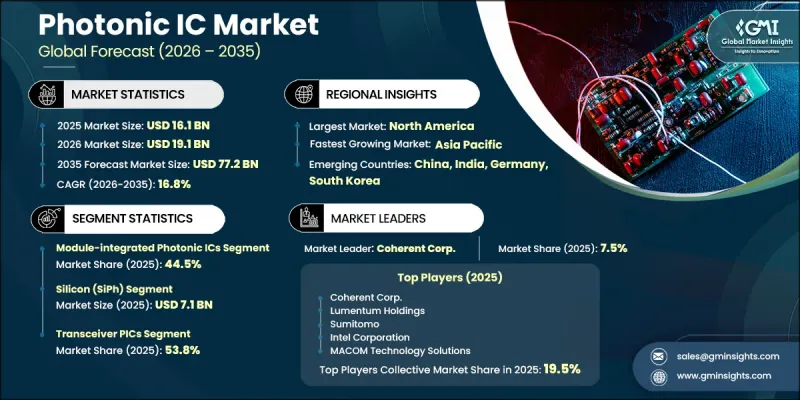
The Global Photonic IC Market was valued at USD 16.1 billion in 2025 and is estimated to grow at a CAGR of 16.8% to reach USD 77.2 billion in 2035.
The expansion of the photonic IC market is supported by rising demand for faster and more power-efficient optical communication solutions, increasing deployment of AI-powered data centers and cloud infrastructure, and ongoing progress in CMOS-compatible silicon photonics technologies. Growing utilization of photonic integrated circuits across communication networks, sensing applications, LiDAR systems, and quantum technologies is further strengthening market growth. In addition, increasing investments from governments and private organizations toward integrated photonics research and advanced semiconductor development are creating new opportunities for market participants. The growing need for next-generation computing infrastructure, higher data transfer capacity, and energy-efficient connectivity solutions continues to accelerate adoption of photonic IC technologies across multiple industries.
| Market Scope | |
|---|---|
| Start Year | 2025 |
| Forecast Year | 2026-2035 |
| Start Value | $16.1 Billion |
| Forecast Value | $77.2 Billion |
| CAGR | 16.8% |
The photonic IC market is gaining momentum as industries increasingly require optical interconnect solutions that deliver higher bandwidth while consuming less power. The limitations associated with conventional electrical connections, particularly regarding data transmission capacity and energy requirements, are encouraging organizations to transition toward photonic integrated circuits. Advancements in silicon photonics production methods, increased semiconductor research funding, and the adoption of scalable manufacturing approaches are further supporting market development. The use of CMOS-compatible fabrication techniques, advanced integration methods, and programmable photonics platforms is improving production efficiency while reducing manufacturing costs. These developments are expanding the application scope of photonic ICs across telecommunications, sensing, quantum computing, and defense-related technologies.
The module-integrated photonic IC segment accounted for 44.5% share in 2025. This segment continues to gain traction because of its ability to combine optimized photonic components into compact modules that support high-speed optical transmission, data center connectivity, and communication infrastructure. Module-integrated photonic IC solutions provide improved performance, simplified manufacturing processes, enhanced scalability, and greater compatibility with evolving network requirements. Their commercial advantages, including easier upgrades and flexible deployment capabilities, are encouraging wider adoption among cloud service providers and telecommunications operators.
The silicon photonics (SiPh) segment reached USD 7.1 billion in 2025. The strong position of silicon photonics is attributed to its increasing implementation in optical communication systems, data center networks, and AI infrastructure. Silicon photonics technology supports compatibility with established CMOS manufacturing processes, enabling cost-effective large-scale production and easier integration with electronic circuits. Its ability to provide high bandwidth, reduced power consumption, and efficient manufacturing capabilities has positioned silicon photonics as a preferred material platform for photonic IC development, including optical transceivers, co-packaged optics, and future cloud infrastructure solutions.
North America Photonic IC Market accounted for a 37.8% share in 2025. The regional market is expanding due to rising investments in AI infrastructure, large-scale cloud computing facilities, and advanced optical communication networks. Increased focus on silicon photonics, co-packaged optics, and next-generation semiconductor technologies is driving demand for photonic integrated circuits across telecommunications, high-performance computing, and defense applications. Strong research capabilities, technology development initiatives, and increasing commercialization of advanced photonics solutions continue to support regional market growth.
Key players operating in the global photonic IC industry include 3SP Technologies, Accelink Technologies, Applied Optoelectronics (AAOI), Broadcom Inc., Coherent Corp., DenseLight Semiconductors, EMCORE Corporation, Global Communication Semiconductors (GCS), GlobalFoundries, HyperLight, Intel Corporation, Ligentec, LioniX International, Lumentum Holdings, MACOM Technology Solutions, NTT Innovative Devices, SilTerra Malaysia, SMART Photonics, STMicroelectronics, Sumitomo, Tower Semiconductor, TSMC, and X-FAB. Companies operating in the photonic IC market are adopting strategies focused on technological innovation, strategic collaborations, product development, and expansion of manufacturing capabilities to strengthen their market position. Industry participants are investing in advanced photonics platforms, improving fabrication processes, and developing energy-efficient solutions to address growing demand for high-speed optical connectivity. Companies are also focusing on partnerships with semiconductor manufacturers, research organizations, and technology providers to accelerate product commercialization.
Table of Contents
Chapter 1 Methodology and Scope
- 1.1 Market scope and definition
- 1.2 Research design
- 1.2.1 Research approach
- 1.2.2 Data collection methods
- 1.3 Data mining sources
- 1.3.1 Global
- 1.3.2 Regional/Country
- 1.4 Base estimates and calculations
- 1.4.1 Base year calculation
- 1.4.2 Key trends for market estimation
- 1.5 Primary research and validation
- 1.5.1 Primary sources
- 1.6 Forecast model
- 1.7 Research assumptions and limitations
Chapter 2 Executive Summary
- 2.1 Industry 360° synopsis, 2022 – 2035
- 2.2 Key market trends
- 2.2.1 Integration type trends
- 2.2.2 Material trends
- 2.2.3 Product Type trends
- 2.2.4 Application trends
- 2.2.5 Regional trends
- 2.3 TAM Analysis, 2026-2035
- 2.4 CXO perspectives: Strategic imperatives
Chapter 3 Industry Insights
- 3.1 Industry ecosystem analysis
- 3.1.1 Supplier Landscape
- 3.1.2 Profit Margin
- 3.1.3 Cost structure
- 3.1.4 Value addition at each stage
- 3.1.5 Factor affecting the value chain
- 3.1.6 Disruptions
- 3.2 Industry impact forces
- 3.2.1 Growth drivers
- 3.2.1.1 Rising demand for AI-driven data centers and high-speed optical interconnects
- 3.2.1.2 Increasing adoption of energy-efficient optical communication technologies
- 3.2.1.3 Advancements in CMOS-compatible silicon photonics manufacturing
- 3.2.1.4 Expanding adoption of PICs in sensing, LiDAR, biomedical, and quantum technologies
- 3.2.1.5 Growing government investment in integrated photonics and semiconductor innovation
- 3.2.2 Industry pitfalls and challenges
- 3.2.2.1 High fabrication and packaging costs of photonic integrated circuits
- 3.2.2.2 Complex integration and design standardization challenges
- 3.2.3 Market opportunities
- 3.2.3.1 Expansion of co-packaged optics and optical interconnects for AI infrastructure
- 3.2.3.2 Growing adoption of photonic ICs in quantum computing, LiDAR, and advanced sensing
- 3.2.1 Growth drivers
- 3.3 Growth potential analysis
- 3.4 Regulatory landscape
- 3.4.1 North America
- 3.4.2 Europe
- 3.4.3 Asia Pacific
- 3.4.4 Latin America
- 3.4.5 Middle East & Africa
- 3.5 Porter’s analysis
- 3.6 PESTEL analysis
- 3.7 Technology and Innovation landscape
- 3.7.1 Current technological trends
- 3.7.2 Emerging technologies
- 3.8 Price trends
- 3.8.1 By region
- 3.8.2 By product
- 3.9 Pricing Strategies
- 3.10 Emerging Business Models
- 3.11 Compliance Requirements
- 3.12 Patent and IP analysis
Chapter 4 Competitive Landscape, 2025
- 4.1 Introduction
- 4.2 Company market share analysis
- 4.2.1 By region
- 4.2.1.1 North America
- 4.2.1.2 Europe
- 4.2.1.3 Asia Pacific
- 4.2.1.4 Latin America
- 4.2.1.5 Middle East & Africa
- 4.2.2 Market concentration analysis
- 4.2.1 By region
- 4.3 Competitive benchmarking of key players
- 4.3.1 Financial performance comparison
- 4.3.1.1 Revenue
- 4.3.1.2 Profit margin
- 4.3.1.3 R&D
- 4.3.2 Product portfolio comparison
- 4.3.2.1 Product range breadth
- 4.3.2.2 Technology
- 4.3.2.3 Innovation
- 4.3.3 Geographic presence comparison
- 4.3.3.1 Global footprint analysis
- 4.3.3.2 Service network coverage
- 4.3.3.3 Market penetration by region
- 4.3.4 Competitive positioning matrix
- 4.3.4.1 Leaders
- 4.3.4.2 Challengers
- 4.3.4.3 Followers
- 4.3.4.4 Niche players
- 4.3.5 Strategic outlook matrix
- 4.3.1 Financial performance comparison
- 4.4 Key developments
- 4.4.1 Mergers and acquisitions
- 4.4.2 Partnerships and collaborations
- 4.4.3 Technological advancements
- 4.4.4 Expansion and investment strategies
- 4.4.5 Digital transformation initiatives
- 4.5 Emerging/ startup competitors landscape
Chapter 5 Market Estimates and Forecast, By Integration Type, 2022 – 2035 (USD Million)
- 5.1 Key trends
- 5.2 Monolithic photonic ICs
- 5.3 Hybrid photonic ICs
- 5.4 Module-integrated photonic ICs
Chapter 6 Market Estimates and Forecast, By Material, 2022 – 2035 (USD Million)
- 6.1 Key trends
- 6.2 Silicon (SiPh)
- 6.3 Indium phosphide (InP)
- 6.4 Gallium arsenide (GaAs)
- 6.5 Lithium niobate (LiNbO₃)
- 6.6 Silicon nitride (Si₃N₄)
- 6.7 Silica-on-silicon
- 6.8 Others
Chapter 7 Market Estimates and Forecast, By Product Type, 2022 – 2035 (USD Million)
- 7.1 Key trends
- 7.2 Transmitter PICs
- 7.3 Receiver PICs
- 7.4 Transceiver PICs
- 7.5 Optical switching PICs
- 7.6 Sensor PICs
- 7.7 Others
Chapter 8 Market Estimates and Forecast, By Application, 2022 – 2035 (USD Million)
- 8.1 Key trends
- 8.2 Optical communications
- 8.3 Data center & ai infrastructure
- 8.4 Healthcare & life sciences
- 8.5 Industrial & manufacturing
- 8.6 Aerospace & defense
- 8.7 Quantum technologies
- 8.8 Automotive & transportation
- 8.9 Consumer electronics
- 8.10 Others
Chapter 9 Market Estimates and Forecast, By Region, 2022 – 2035 (USD Million)
- 9.1 Key trends
- 9.2 North America
- 9.2.1 U.S.
- 9.2.2 Canada
- 9.3 Europe
- 9.3.1 Germany
- 9.3.2 UK
- 9.3.3 France
- 9.3.4 Spain
- 9.3.5 Italy
- 9.4 Asia Pacific
- 9.4.1 China
- 9.4.2 India
- 9.4.3 Japan
- 9.4.4 Australia
- 9.4.5 South Korea
- 9.5 Latin America
- 9.5.1 Brazil
- 9.5.2 Mexico
- 9.5.3 Argentina
- 9.6 Middle East and Africa
- 9.6.1 South Africa
- 9.6.2 Saudi Arabia
- 9.6.3 UAE
Chapter 10 Company Profiles
- 10.1 Global Key Players
- 10.1.1 Coherent Corp.
- 10.1.2 Lumentum Holdings
- 10.1.3 Sumitomo
- 10.1.4 Intel Corporation
- 10.1.5 MACOM Technology Solutions
- 10.2 Regional key players
- 10.2.1 North America
- 10.2.1.1 Broadcom Inc.
- 10.2.1.2 EMCORE Corporation
- 10.2.1.3 Applied Optoelectronics (AAOI)
- 10.2.2 Asia Pacific
- 10.2.2.1 NTT Innovative Devices
- 10.2.2.2 Accelink Technologies
- 10.2.2.3 DenseLight Semiconductors
- 10.2.2.4 SilTerra Malaysia
- 10.2.2.5 TSMC
- 10.2.2.6 Global Communication Semiconductors (GCS)
- 10.2.3 Europe
- 10.2.3.1 SMART Photonics
- 10.2.3.2 Ligentec
- 10.2.3.3 LioniX International
- 10.2.3.4 Tower Semiconductor
- 10.2.3.5 X-FAB
- 10.2.3.6 STMicroelectronics
- 10.2.1 North America
- 10.3 Niche Players/Disruptors
- 10.3.1 3SP Technologies
- 10.3.2 HyperLight
- 10.3.3 GlobalFoundries

