PUBLISHER: Global Market Insights Inc. | PRODUCT CODE: 2109268

PUBLISHER: Global Market Insights Inc. | PRODUCT CODE: 2109268
Metal Hydrogen Generation Market Opportunity, Growth Drivers, Industry Trend Analysis, and Forecast 2026 - 2035
The Global Metal Hydrogen Generation Market was valued at USD 9.4 billion in 2025 and is estimated to grow at a CAGR of 8% to reach USD 20 billion by 2035.
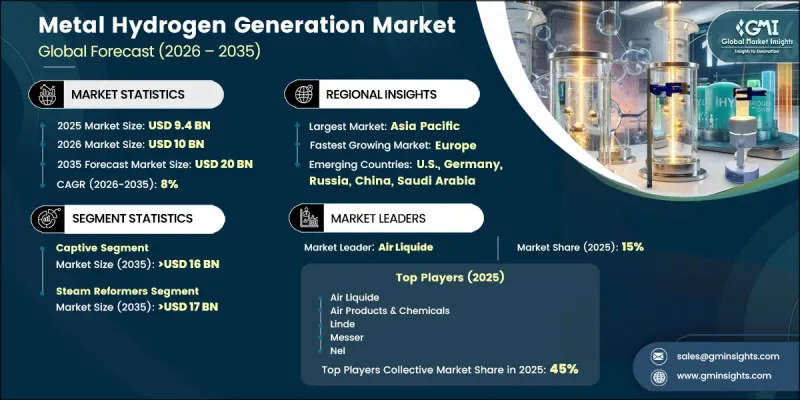
The metal hydrogen generation industry is witnessing sustained expansion as organizations increasingly prioritize dependable, adaptable, and environmentally responsible hydrogen production technologies. Metal-based hydrogen generation systems provide a practical approach to producing hydrogen through controlled chemical processes, minimizing reliance on conventional production techniques while ensuring a consistent supply whenever required. Their ability to deliver hydrogen at the point of use makes these systems well suited for applications where storage and transportation can be less efficient. Growing investments in hydrogen infrastructure and clean energy development continue to create favorable opportunities for market growth. Manufacturers are concentrating on improving reaction performance, enhancing material efficiency, and designing compact systems that address a wide range of operational needs. Increasing hydrogen demand across multiple industries is further supporting market expansion, as these systems offer operational flexibility and seamless integration into existing production environments. Continuous technological advancements in materials, reaction optimization, digital monitoring, and intelligent control systems are improving efficiency, simplifying maintenance, enhancing safety, and supporting the long-term development of the global metal hydrogen generation market.
| Market Scope | |
|---|---|
| Start Year | 2025 |
| Forecast Year | 2026-2035 |
| Start Value | $9.4 Billion |
| Forecast Value | $20 Billion |
| CAGR | 8% |
The captive segment is expected to reach USD 16 billion by 2035. Rising investments in upgrading existing production facilities and deploying advanced, high-efficiency hydrogen generation systems are supporting increasing hydrogen consumption across industrial operations. Companies are integrating automation technologies, advanced monitoring capabilities, and optimized production processes to improve operational efficiency, increase productivity, and lower operating expenses. At the same time, ongoing investments in production capacity expansion and technology modernization are strengthening supply reliability while ensuring uninterrupted manufacturing operations.
The steam reformers segment is anticipated to capture USD 17 billion by 2035. Strong demand for large-scale hydrogen production and the availability of established production infrastructure continue to support the deployment of advanced steam reforming technologies. Industry participants are modernizing existing production assets with higher-efficiency systems and enhanced process controls to maximize output while reducing operational costs. Rising hydrogen demand across various end-use industries is also encouraging capacity expansion and investments in new production projects. In addition, companies are strengthening feedstock availability and upgrading production infrastructure to ensure a dependable hydrogen supply over the long term.
U.S. Metal Hydrogen Generation Market is projected to reach USD 1.4 billion by 2035. Market growth is being supported by expanding industrial activities and the increasing adoption of hydrogen across clean energy, power generation, transportation, and industrial processing applications. Companies are implementing metal-based hydrogen generation technologies to produce hydrogen on demand, improve energy reliability, reduce dependence on traditional fuel sources, and enhance overall operational efficiency. Continuous investments in technology improvements are also helping manufacturers increase hydrogen output while lowering production costs and improving system performance.
Major companies operating in the global metal hydrogen generation market include AFC Energy, Air Liquide, Air Products and Chemicals, American Elements, China Baowu Steel Group, Enapter, GRZ Technologies, H Bank Technologies Inc., Hazer Group, Heraeus Precious Metals, Hydrogenera, JSW Group, Linde, McPhy Energy S.A., Messer Group, Nel Hydrogen, Plug Power, Reliance Industries, Shell, and SSAB. Companies operating in the metal hydrogen generation market are strengthening their market position through continuous investments in technology innovation, production capacity expansion, and advanced material development. Manufacturers are focusing on improving hydrogen generation efficiency, enhancing system reliability, and developing compact solutions that meet evolving industrial requirements. Many companies are expanding strategic partnerships, strengthening regional distribution networks, and increasing research and development activities to accelerate product commercialization. Businesses are also integrating digital monitoring, automation, and intelligent control technologies to improve operational performance and reduce maintenance requirements. Capacity modernization, manufacturing optimization, and investments in sustainable production processes are helping companies improve cost competitiveness while supporting long-term growth.
Table of Contents
Chapter 1 Methodology & Scope
- 1.1 Research design
- 1.2 Quality commitment
- 1.2.1 GMI AI policy & data integrity commitment
- 1.2.1.1 Source consistency protocol
- 1.2.1 GMI AI policy & data integrity commitment
- 1.3 Research trail & confidence scoring
- 1.3.1 Research trail components
- 1.3.2 Scoring components
- 1.4 Data collection
- 1.4.1 Partial list of primary sources
- 1.5 Data mining sources
- 1.5.1 Paid sources
- 1.5.1.1 Sources, by region
- 1.5.1 Paid sources
- 1.6 Base estimates and calculations
- 1.6.1 Base year calculation for any one approach
- 1.7 Forecast model
- 1.8 Research transparency addendum
- 1.8.1 Source attribution framework
- 1.8.2 Quality assurance metrics
- 1.8.3 Our commitment to trust
- 1.9 Market definitions
Chapter 2 Executive Summary
- 2.1 Industry synopsis, 2022 – 2035
- 2.2 Business trends
- 2.3 Delivery mode trends
- 2.4 Process trends
- 2.5 Regional trends
Chapter 3 Industry Insights
- 3.1 Industry ecosystem
- 3.1.1 Raw material availability & sourcing analysis
- 3.1.2 Manufacturing capacity assessment
- 3.1.3 Supply chain resilience & risk factors
- 3.1.4 Distribution network analysis
- 3.2 Regulatory landscape
- 3.2.1 North America
- 3.2.2 Europe
- 3.2.3 Asia Pacific
- 3.2.4 Middle East & Africa
- 3.2.5 Latin America
- 3.3 Industry impact forces
- 3.3.1 Growth drivers
- 3.3.2 Industry pitfalls & challenges
- 3.4 Growth potential analysis
- 3.5 Porter's analysis
- 3.5.1 Bargaining power of suppliers
- 3.5.2 Bargaining power of buyers
- 3.5.3 Threat of new entrants
- 3.5.4 Threat of substitutes
- 3.6 PESTEL analysis
- 3.6.1 Political factors
- 3.6.2 Economic factors
- 3.6.3 Social factors
- 3.6.4 Technological factors
- 3.6.5 Legal factors
- 3.6.6 Environmental factors
- 3.7 Emerging opportunities & trends
- 3.8 Digitalization & IoT integration
- 3.9 Investment analysis and future outlook
Chapter 4 Competitive landscape, 2026
- 4.1 Introduction
- 4.2 Company market share analysis, by region, 2025
- 4.2.1 North America
- 4.2.2 Europe
- 4.2.3 Asia Pacific
- 4.2.4 Middle East & Africa
- 4.2.5 Latin America
- 4.3 Competitive analysis of major market players
- 4.4 Competitive positioning matrix
- 4.5 Key developments
- 4.5.1 Mergers & acquisitions
- 4.5.2 Partnerships & collaborations
- 4.5.3 New product launches
- 4.5.4 Expansion plans & funding
- 4.6 Company tier benchmarking
- 4.6.1 Tier classification criteria & qualifying thresholds
- 4.6.2 Tier positioning matrix by revenue, geography & innovation
Chapter 5 Market Size and Forecast, By Delivery Mode, 2022 – 2035 (USD Billion)
- 5.1 Key trends
- 5.2 Captive
- 5.3 Merchant
Chapter 6 Market Size and Forecast, By Process, 2022 – 2035 (USD Billion)
- 6.1 Key trends
- 6.2 Steam Reformer
- 6.3 Electrolysis
- 6.4 Others
Chapter 7 Market Size and Forecast, By Region, 2022 – 2035 (USD Billion)
- 7.1 Key trends
- 7.2 North America
- 7.2.1 U.S.
- 7.2.2 Canada
- 7.2.3 Mexico
- 7.3 Europe
- 7.3.1 Germany
- 7.3.2 Italy
- 7.3.3 Netherlands
- 7.3.4 Russia
- 7.4 Asia Pacific
- 7.4.1 China
- 7.4.2 India
- 7.4.3 Japan
- 7.5 Middle East & Africa
- 7.5.1 Saudi Arabia
- 7.5.2 Iran
- 7.5.3 UAE
- 7.5.4 South Africa
- 7.6 Latin America
- 7.6.1 Brazil
- 7.6.2 Argentina
- 7.6.3 Chile
Chapter 8 Company Profiles
- 8.1 AFC Energy plc
- 8.2 Air Liquide
- 8.3 Air Products and Chemicals
- 8.4 American Elements
- 8.5 China Baowu Steel Group
- 8.6 Enapter
- 8.7 GRZ Technologies
- 8.8 H Bank Technologies Inc.
- 8.9 Hazer Group
- 8.10 Heraeus Precious Metals
- 8.11 Hydrogenera
- 8.12 JSW Group
- 8.13 Linde
- 8.14 McPhy Energy S.A.
- 8.15 Messer Group
- 8.16 Nel Hydrogen
- 8.17 Plug Power
- 8.18 Reliance Industries
- 8.19 Shell
- 8.20 SSAB

