PUBLISHER: Global Market Insights Inc. | PRODUCT CODE: 2109271

PUBLISHER: Global Market Insights Inc. | PRODUCT CODE: 2109271
Pumpjacks Market Opportunity, Growth Drivers, Industry Trend Analysis, and Forecast 2026 - 2035
The Global Pumpjacks Market was valued at USD 3.7 billion in 2025 and is estimated to grow at a CAGR of 5.3% to reach USD 6.3 billion by 2035.
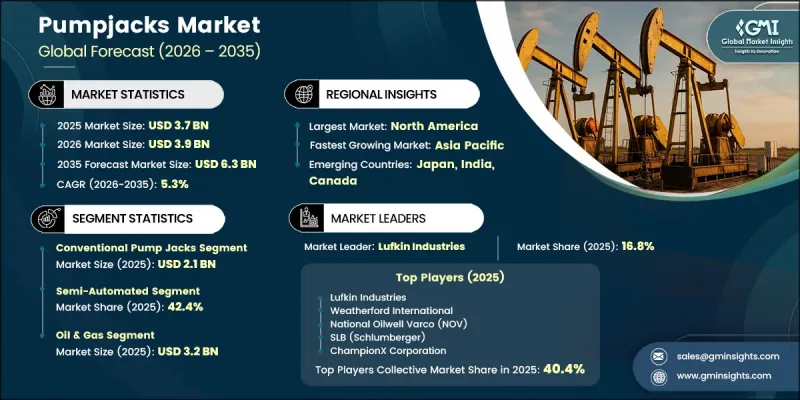
Market growth is driven by continued investment in artificial lift infrastructure as oil and gas producers focus on maintaining production from mature onshore wells. As reservoir pressure declines over time, operators increasingly rely on dependable mechanical lifting systems to sustain commercially viable production rates and maximize the operational life of existing assets. Pumpjacks remain one of the most widely adopted artificial lift technologies for low- and medium-production wells because they offer reliable performance, cost efficiency, and long service life. Ongoing investments in equipment modernization and replacement programs are further supporting market expansion as companies seek to improve production efficiency while controlling operating expenses. Growing activity across mature oilfields continues to generate steady demand for advanced lifting equipment, reinforcing stable procurement trends throughout the industry. In addition, technological improvements that enhance equipment durability, operational efficiency, and monitoring capabilities are encouraging broader adoption of modern pumpjack systems, strengthening the long-term outlook for the Pumpjacks Market.
| Market Scope | |
|---|---|
| Start Year | 2025 |
| Forecast Year | 2026-2035 |
| Start Value | $3.7 Billion |
| Forecast Value | $6.3 Billion |
| CAGR | 5.3% |
The conventional pump jack segment generated USD 2.1 billion in 2025. Its strong market presence is supported by an extensive installed base across onshore oil-producing regions and a well-developed service and maintenance ecosystem. Conventional beam pump systems continue to be widely adopted because of their straightforward mechanical design, dependable operation, and ability to perform efficiently under a broad range of well conditions. Their ease of maintenance and reliable performance make them particularly suitable for locations where operational simplicity and equipment durability are critical.
The semi-automated segment accounted for 42.4% share in 2025, generating USD 1.6 billion. This segment continues to lead the market as operators increasingly adopt partial automation technologies that improve production monitoring and optimize well performance without requiring complete replacement of existing equipment. Semi-automated systems provide a cost-effective solution for enhancing operational efficiency while extending the usefulness of installed pumpjack fleets, supporting continued investment across mature oilfields.
United States Pumpjacks Market accounted for 88.16% share in 2025, generating USD 1.41 billion, and is expected to grow at a CAGR of 4.7% between 2026 and 2035. The country's market leadership is supported by its extensive onshore oil production infrastructure and substantial installed base of artificial lift systems. Continuous investment in maintaining production from existing wells, along with ongoing upgrades to artificial lift equipment, continues to support stable market demand and reinforces the country's leading position within the regional industry.
Key companies operating in the global pumpjacks market include Lufkin Industries, Weatherford International, National Oilwell Varco (NOV), SLB (Schlumberger), Baker Hughes, Liberty Lift Solutions, Unico, Inc., Shengli Oilfield Highland Petroleum Equipment Co., Ltd., Sanjack Petro, Puyang Zhongshi Group Co., Ltd., SEACO Oilfield Equipment Co., Ltd., Redhead Artificial Lift, United Lift Technologies (ULT), BCP Group Artificial Lift, Inc., IJACK Technologies Inc., SSi Artificial Lift, Reynolds Lift Technologies, Encline Artificial Lift Technologies LLC, Air Lift Technology LLC, JCPump LLC, and Paradigm Hydraulics. Companies operating in the global pumpjacks market are strengthening their competitive position by investing in product innovation, expanding artificial lift portfolios, and improving equipment reliability and operational efficiency. Manufacturers are focusing on research and development to enhance system durability, reduce maintenance requirements, and improve production performance across mature oilfields. Strategic partnerships with oil and gas operators, distributors, and service providers are helping companies expand their customer base and strengthen regional market presence. Businesses are also increasing investments in manufacturing capabilities, aftermarket services, and technical support to improve customer satisfaction and long-term retention.
Table of Contents
Chapter 1 Research Methodology
- 1.1 Research approach
- 1.2 Quality Commitments
- 1.2.1 GMI AI policy & data integrity commitment
- 1.2.1.1 Source consistency protocol
- 1.2.1 GMI AI policy & data integrity commitment
- 1.3 Research Trail & Confidence Scoring
- 1.3.1 Research Trail Components
- 1.3.2 Scoring Components
- 1.4 Data Collection
- 1.4.1 Partial list of primary sources
- 1.5 Data mining sources
- 1.5.1 Paid sources
- 1.5.1.1 Sources, by region
- 1.5.1 Paid sources
- 1.6 Base estimates and calculations
- 1.6.1 Base year calculation for any one approach
- 1.7 Forecast model
- 1.7.1 Quantified market impact analysis
- 1.7.1.1 Mathematical impact of growth parameters on forecast
- 1.7.1 Quantified market impact analysis
- 1.8 Research transparency addendum
- 1.8.1 Source attribution framework
- 1.8.2 Quality assurance metrics
- 1.8.3 Our commitment to trust
Chapter 2 Executive Summary
- 2.1 Industry 360° synopsis, 2022 – 2035
- 2.2 Key market trends
- 2.2.1 Regional
- 2.2.2 Pump Type
- 2.2.3 Operations
- 2.2.4 Capacity
- 2.2.5 Application
- 2.2.6 Distribution Channel
Chapter 3 Industry Insights
- 3.1 Industry ecosystem analysis
- 3.1.1 Factor affecting the value chain
- 3.1.2 Profit margin analysis
- 3.1.3 Disruptions
- 3.1.4 Future outlook
- 3.1.5 Manufacturers
- 3.1.6 Distributors
- 3.2 Supplier landscape
- 3.3 Key news & initiatives
- 3.4 Technology & innovation landscape
- 3.5 Regulatory landscape
- 3.6 Impact on forces
- 3.6.1 Growth drivers
- 3.6.1.1 Rising oil production increases pumpjack equipment demand
- 3.6.1.2 Growing mature well operations support pumpjack adoption
- 3.6.1.3 Increasing energy demand boosts upstream oil investments
- 3.6.2 Industry pitfalls & challenges
- 3.6.2.1 Volatile crude oil prices affect equipment investments
- 3.6.2.2 High maintenance costs increase operating expenses
- 3.6.3 Opportunities
- 3.6.3.1 Digital monitoring improves pumpjack operational performance
- 3.6.3.2 Automation technologies strengthen intelligent pumpjack operations
- 3.6.1 Growth drivers
- 3.7 Porter’s analysis
- 3.8 PESTEL analysis
- 3.9 Pricing analysis (driven by primary research)
- 3.9.1 Historical price trend analysis (2019–2024) (driven by primary research)
- 3.9.2 Pricing strategy by player type (premium / value / cost-plus) (driven by primary research)
- 3.9.3 Price sensitivity by end-use segment & well type
- 3.10 Trade data analysis (driven by paid database)
- 3.10.1 Import/export volume & value trends for pumpjack equipment (HS code 8413) (driven by paid database)
- 3.10.2 Key trade corridors (U.S.–Middle East, China–Latin America, Europe–CIS) & tariff impact (driven by paid database)
- 3.11 Impact of AI & generative AI on the pumpjacks market
- 3.11.1 AI-driven disruption of conventional pumpjack operations & maintenance models
- 3.11.2 GenAI use cases & adoption roadmap by segment (predictive maintenance, dynagraph interpretation, well optimization)
- 3.11.3 Risks, limitations & regulatory considerations for AI in oilfield surface equipment
- 3.12 Capacity & production landscape (driven by primary research)
- 3.12.1 Installed pumpjack base by region & key producer (North America, Middle East, Asia Pacific) (driven by primary research)
- 3.12.2 Manufacturing capacity utilization rates & expansion pipelines among OEMs (driven by primary research)
Chapter 4 Competitive Landscape, 2025
- 4.1 Introduction
- 4.2 Company market share analysis
- 4.3 Competitive positioning matrix
- 4.4 Strategic outlook matrix
- 4.5 Competitive analysis of major market players
- 4.6 Key developments
- 4.6.1 Mergers & acquisitions
- 4.6.2 Partnerships & collaborations
- 4.6.3 New product launches
- 4.6.4 Expansion plans
Chapter 5 Market Estimates & Forecast, By Pump Type, 2022-2035 (USD Billion) (Million Units)
- 5.1 Key trends
- 5.2 Conventional pump jacks
- 5.3 Hydraulic pump jacks
- 5.4 Electric pump jacks
- 5.5 Others
Chapter 6 Market Estimates & Forecast, By Operations, 2022-2035 (USD Billion) (Million Units)
- 6.1 Key trends
- 6.2 Manual
- 6.3 Semi-Automatic
- 6.4 Automated
Chapter 7 Market Estimates & Forecast, By Capacity, 2022-2035 (USD Billion) (Million Units)
- 7.1 Key trends
- 7.2 Up to 100 bpd
- 7.3 100–500 bpd
- 7.4 500–1,000 bpd
- 7.5 Above 1,000 bpd
Chapter 8 Market Estimates & Forecast, By Application, 2022-2035 (USD Billion) (Million Units)
- 8.1 Key trends
- 8.2 Oil & gas
- 8.3 Mining
- 8.4 Agriculture
- 8.5 Others
Chapter 9 Market Estimates & Forecast, By Distribution Channel, 2022-2035 (USD Billion) (Million Units)
- 9.1 Key trends
- 9.2 Direct sales
- 9.3 Indirect sales
Chapter 10 Market Estimates & Forecast, By Region, 2022 – 2035, (USD Billion) (Million Units)
- 10.1 Key trends
- 10.2 North America
- 10.2.1 U.S.
- 10.2.2 Canada
- 10.3 Europe
- 10.3.1 Germany
- 10.3.2 U.K.
- 10.3.3 France
- 10.3.4 Italy
- 10.3.5 Spain
- 10.4 Asia Pacific
- 10.4.1 China
- 10.4.2 India
- 10.4.3 Japan
- 10.4.4 South Korea
- 10.4.5 Australia
- 10.5 Latin America
- 10.5.1 Brazil
- 10.5.2 Mexico
- 10.5.3 Argentina
- 10.6 MEA
- 10.6.1 UAE
- 10.6.2 Saudi Arabia
- 10.6.3 South Africa
Chapter 11 Company Profiles
- 11.1 Global players
- 11.1.1 Lufkin Industries
- 11.1.2 Weatherford International
- 11.1.3 National Oilwell Varco (NOV)
- 11.1.4 SLB (Schlumberger)
- 11.1.5 Baker Hughes
- 11.1.6 Liberty Lift Solutions
- 11.1.7 Unico, Inc.
- 11.2 Regional players
- 11.2.1 Shengli Oilfield Highland Petroleum Equipment Co., Ltd.
- 11.2.2 Sanjack Petro
- 11.2.3 Puyang Zhongshi Group Co., Ltd.
- 11.2.4 SEACO Oilfield Equipment Co., Ltd.
- 11.2.5 Redhead Artificial Lift
- 11.2.6 United Lift Technologies (ULT)
- 11.2.7 BCP Group Artificial Lift, Inc.
- 11.3 Emerging players
- 11.3.1 IJACK Technologies Inc.
- 11.3.2 SSi Artificial Lift
- 11.3.3 Reynolds Lift Technologies
- 11.3.4 Encline Artificial Lift Technologies LLC
- 11.3.5 Air Lift Technology LLC
- 11.3.6 JCPump LLC
- 11.3.7 Paradigm Hydraulics

