PUBLISHER: Global Market Insights Inc. | PRODUCT CODE: 2109277

PUBLISHER: Global Market Insights Inc. | PRODUCT CODE: 2109277
Neuromorphic Chip Market Opportunity, Growth Drivers, Industry Trend Analysis, and Forecast 2026 - 2035
The Global Neuromorphic Chip Market was valued at USD 54 million in 2025 and is estimated to grow at a CAGR of 33.5% to reach USD 1 billion by 2035.
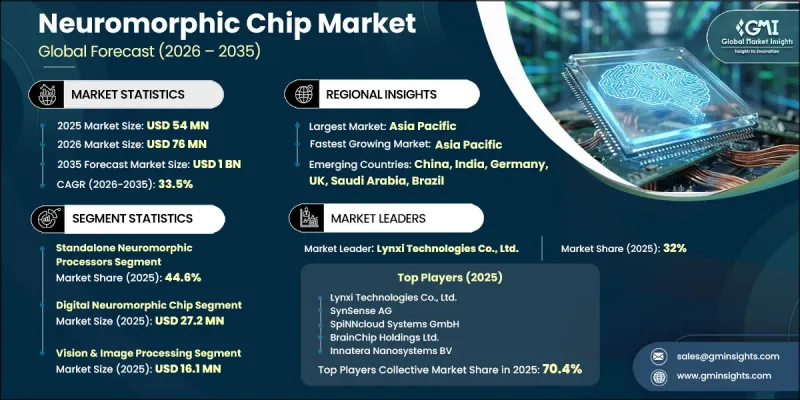
Market growth is fueled by rising demand for highly energy-efficient artificial intelligence hardware, expanding deployment of edge AI technologies, and increasing investments in advanced semiconductor development. Growing adoption of autonomous intelligent systems and continued progress in spiking neural network (SNN) processors are also accelerating commercialization of neuromorphic computing technologies. Unlike conventional AI accelerators, neuromorphic chips integrate memory and computing functions within the same architecture, enabling real-time learning while significantly reducing power consumption and data movement. Increasing investment in next-generation computing technologies and brain-inspired processor architectures is further supporting innovation across the semiconductor industry. As organizations seek faster, low-power, and highly efficient computing solutions capable of handling increasingly complex AI workloads, neuromorphic chips are emerging as an important technology for future intelligent systems. Continued research activities, expanding commercialization efforts, and increasing adoption across advanced AI applications are expected to drive sustained growth in the global neuromorphic chip market throughout the forecast period.
| Market Scope | |
|---|---|
| Start Year | 2025 |
| Forecast Year | 2026-2035 |
| Start Value | $54 Million |
| Forecast Value | $1 Billion |
| CAGR | 33.5% |
The neuromorphic chip market continues to benefit from increasing demand for low-power computing platforms capable of supporting complex neural network processing with greater efficiency than traditional computing architectures. By integrating memory and processing capabilities into a unified structure, these chips minimize data transfer requirements while improving processing speed and energy efficiency. Growing investment in advanced computing research and brain-inspired semiconductor technologies is further accelerating innovation, with increasing support for next-generation artificial intelligence hardware contributing to long-term market expansion.
The standalone neuromorphic processors segment accounted for a 44.6% share in 2025, making it the leading product category. The segment maintains a strong market position because of its flexibility, low-power inference capabilities, and compatibility with spiking neural networks designed for advanced AI applications. Continued adoption across commercial and research environments is expected to support sustained demand as organizations expand deployment of brain-inspired computing technologies.
The vision and image processing segment generated USD 16.1 million in 2025. Rising adoption of event-driven vision technologies and neuromorphic image processing solutions continues to strengthen demand for these processors in intelligent visual computing applications. Their ability to deliver fast, energy-efficient processing for complex visual data makes them increasingly valuable for advanced AI-enabled imaging systems.
North America Neuromorphic Chip Market accounted for a 34.5% share in 2025. The regional market continues to grow as investments in artificial intelligence, advanced semiconductor technologies, and edge AI commercialization accelerate. Strong support for next-generation computing research, combined with ongoing collaboration between research institutions, public organizations, and technology developers, is driving innovation in brain-inspired processor architectures. Increasing deployment of neuromorphic chips across industrial automation, healthcare, robotics, autonomous systems, and other AI-driven applications continues to reinforce regional market growth.
Key players operating in the global neuromorphic chip market include BrainChip Holdings Ltd., General Vision Inc., IBM Corporation, Innatera Nanosystems BV, Intel Corporation, Lynxi Technologies Co., Ltd., Nepes Corporation, Polyn Technology, Prophesee SA, Qualcomm Technologies Inc., Samsung Electronics Co., Ltd., Sony Semiconductor Solutions, SpiNNcloud Systems GmbH, and SynSense AG. Companies participating in the neuromorphic chip market are strengthening their competitive position by investing in advanced processor architectures, expanding research and development activities, and improving energy-efficient AI computing capabilities. Manufacturers are focusing on enhancing spiking neural network performance, reducing power consumption, and increasing scalability to support next-generation artificial intelligence applications. Strategic partnerships with semiconductor companies, research organizations, and AI technology developers help accelerate commercialization and broaden application opportunities.
Table of Contents
Chapter 1 Methodology and Scope
- 1.1 Market scope and definition
- 1.2 Research design
- 1.2.1 Research approach
- 1.2.2 Data collection methods
- 1.3 Data mining sources
- 1.3.1 Global
- 1.3.2 Regional/Country
- 1.4 Base estimates and calculations
- 1.4.1 Base year calculation
- 1.4.2 Key trends for market estimation
- 1.5 Primary research and validation
- 1.5.1 Primary sources
- 1.6 Forecast model
- 1.7 Research assumptions and limitations
Chapter 2 Executive Summary
- 2.1 Industry 360° synopsis, 2022 – 2035
- 2.2 Key market trends
- 2.2.1 Product type trends
- 2.2.2 Chip type trends
- 2.2.3 Application trends
- 2.2.4 Deployment trends
- 2.2.5 End-user industry trends
- 2.2.6 Regional trends
- 2.3 TAM Analysis, 2026-2035
- 2.4 CXO perspectives: Strategic imperatives
Chapter 3 Industry Insights
- 3.1 Industry ecosystem analysis
- 3.1.1 Supplier Landscape
- 3.1.2 Profit Margin
- 3.1.3 Cost structure
- 3.1.4 Value addition at each stage
- 3.1.5 Factor affecting the value chain
- 3.1.6 Disruptions
- 3.2 Industry impact forces
- 3.2.1 Growth drivers
- 3.2.1.1 Growing demand for energy-efficient AI computing
- 3.2.1.2 Increasing adoption of edge AI and real-time inference
- 3.2.1.3 Government investments in neuromorphic computing and semiconductor R&D
- 3.2.1.4 Expanding deployment in autonomous systems, robotics, and defense
- 3.2.1.5 Commercialization of spiking neural networks (SNNs) and neuromorphic hardware platforms
- 3.2.2 Industry pitfalls and challenges
- 3.2.2.1 High development and commercialization costs
- 3.2.2.2 Limited software ecosystem and standardization
- 3.2.3 Market opportunities
- 3.2.3.1 Expansion of edge AI and intelligent IoT applications
- 3.2.3.2 Growing adoption in healthcare, robotics, and autonomous mobility
- 3.2.1 Growth drivers
- 3.3 Growth potential analysis
- 3.4 Pricing Analysis (Driven by Primary Research)
- 3.4.1 Historical Price Trend Analysis
- 3.4.2 Pricing Strategy by Player Type (Premium / Value / Cost-plus)
- 3.5 Regulatory landscape
- 3.5.1 North America
- 3.5.2 Europe
- 3.5.3 Asia Pacific
- 3.5.4 Latin America
- 3.5.5 Middle East & Africa
- 3.6 Porter’s analysis
- 3.7 PESTEL analysis
- 3.8 Trade Data Analysis (Based on Paid Database)
- 3.8.1 Import/Export Volume & Value Trends
- 3.8.2 Key Trade Corridors & Tariff Impact
- 3.9 Impact of AI & Generative AI on the Market (Driven by Primary Research)
- 3.9.1 AI-Driven Disruption of Existing Business Models
- 3.9.2 GenAI Use Cases & Adoption Roadmap by Segment
- 3.10 Capacity & Production Landscape (Driven by Primary Research)
- 3.10.1 Production Capacity by Key Producer
- 3.10.2 Capacity Utilization Rates & Expansion Pipelines
Chapter 4 Competitive Landscape, 2025
- 4.1 Company market share analysis, 2025
- 4.1.1 By Region
- 4.1.1.1 North America
- 4.1.1.2 Europe
- 4.1.1.3 Asia-Pacific
- 4.1.1.4 Latin America
- 4.1.1.5 Middle East and Africa
- 4.1.2 Market Concentration Analysis
- 4.1.1 By Region
- 4.2 Competitive analysis of major market players
- 4.3 Competitive positioning matrix
- 4.4 Key developments
- 4.4.1 Mergers & acquisitions
- 4.4.2 Partnerships & collaborations
- 4.4.3 New product launches
- 4.4.4 Expansion plans and funding
- 4.5 Company tier benchmarking
- 4.5.1 Tier classification criteria & qualifying thresholds
- 4.5.2 Tier positioning matrix by revenue, geography & innovation
Chapter 5 Market Estimates and Forecast, By Product Type, 2022 – 2035 (USD Million)
- 5.1 Key trends
- 5.2 Standalone neuromorphic processors
- 5.3 Neuromorphic ai accelerator chips
- 5.4 Neuromorphic system-on-chip (soc)
Chapter 6 Market Estimates and Forecast, By Chip Type, 2022 – 2035 (USD Million)
- 6.1 Key trends
- 6.2 Digital neuromorphic chips
- 6.3 Analog neuromorphic chips
- 6.4 Mixed-signal neuromorphic chips
Chapter 7 Market Estimates and Forecast, By Application, 2022 – 2035 (USD Million)
- 7.1 Key trends
- 7.2 Vision & image processing
- 7.3 Audio & speech processing
- 7.4 Sensor data processing
- 7.5 Pattern recognition & analytics
- 7.6 Autonomous control & decision making
- 7.7 Others
Chapter 8 Market Estimates and Forecast, By Deployment Mode, 2022 – 2035 (USD Million)
- 8.1 Key trends
- 8.2 Edge & embedded devices
- 8.3 Data center & high-performance computing (HPC)
Chapter 9 Market Estimates and Forecast, By End-User Industry, 2022 – 2035 (USD Million)
- 9.1 Key trends
- 9.2 Consumer electronics
- 9.3 Automotive & transportation
- 9.4 Healthcare & life sciences
- 9.5 Aerospace & defense
- 9.6 Industrial & manufacturing
- 9.7 It & telecommunications
- 9.8 Others
Chapter 10 Market Estimates and Forecast, By Region, 2022 – 2035 (USD Million)
- 10.1 Key trends
- 10.2 North America
- 10.2.1 U.S.
- 10.2.2 Canada
- 10.3 Europe
- 10.3.1 Germany
- 10.3.2 UK
- 10.3.3 France
- 10.3.4 Spain
- 10.3.5 Italy
- 10.4 Asia Pacific
- 10.4.1 China
- 10.4.2 India
- 10.4.3 Japan
- 10.4.4 Australia
- 10.4.5 South Korea
- 10.5 Latin America
- 10.5.1 Brazil
- 10.5.2 Mexico
- 10.5.3 Argentina
- 10.6 Middle East and Africa
- 10.6.1 South Africa
- 10.6.2 Saudi Arabia
- 10.6.3 UAE
Chapter 11 Company Profiles
- 11.1 Global Key Players
- 11.1.1 Lynxi Technologies Co., Ltd.
- 11.1.2 SynSense AG
- 11.1.3 SpiNNcloud Systems GmbH
- 11.1.4 BrainChip Holdings Ltd.
- 11.1.5 Innatera Nanosystems BV
- 11.2 Regional key players
- 11.2.1 North America
- 11.2.1.1 Intel Corporation
- 11.2.1.2 IBM Corporation
- 11.2.1.3 Qualcomm Technologies Inc.
- 11.2.1.4 General Vision Inc.
- 11.2.2 Asia Pacific
- 11.2.2.1 Samsung Electronics Co., Ltd.
- 11.2.2.2 Sony Semiconductor Solutions
- 11.2.3 Europe
- 11.2.3.1 Prophesee SA
- 11.2.3.2 Polyn Technology
- 11.2.1 North America
- 11.3 Niche Players/Disruptors
- 11.3.1 Nepes Corporation

