PUBLISHER: Global Market Insights Inc. | PRODUCT CODE: 2109285

PUBLISHER: Global Market Insights Inc. | PRODUCT CODE: 2109285
Automotive Data Management Market Opportunity, Growth Drivers, Industry Trend Analysis, and Forecast 2026 - 2035
The Global Automotive Data Management Market was valued at USD 2.6 billion in 2025 and is estimated to grow at a CAGR of 17.8% to reach USD 13.6 billion by 2035.
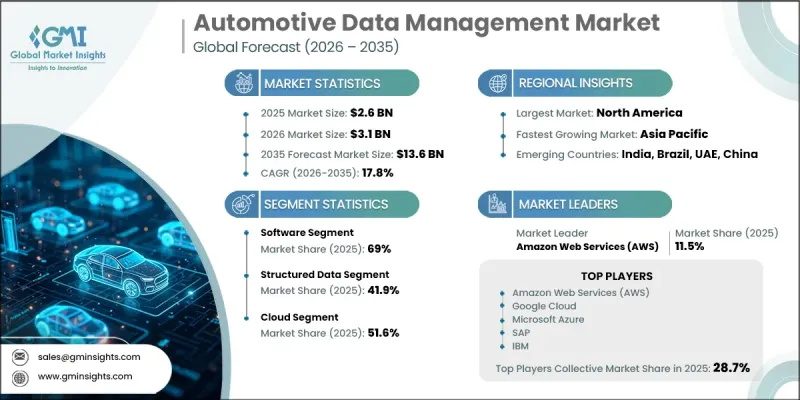
The automotive data management market is expanding rapidly as vehicles become increasingly connected, intelligent, and dependent on data-driven operations. Modern vehicles generate extensive volumes of information through embedded systems that monitor vehicle performance, energy systems, safety features, driver assistance functions, interior conditions, and location-based services. The growing complexity and volume of automotive data are creating demand for advanced data management solutions that can collect, organize, analyze, and secure information in real time. The industry is transitioning from traditional vehicle diagnostics toward continuous monitoring and predictive intelligence, requiring advanced cloud-based platforms and specialized automotive data architectures. Vehicle information is generated through multiple communication systems and requires efficient processing, standardization, and contextual analysis before being used for operational insights. Increasing adoption of connected vehicles, software-defined vehicle platforms, autonomous driving technologies, and predictive maintenance solutions is strengthening market growth. Fleet operators and automotive companies are increasingly utilizing advanced analytics to improve vehicle reliability, optimize performance, reduce maintenance costs, and enhance overall mobility experiences.
| Market Scope | |
|---|---|
| Start Year | 2025 |
| Forecast Year | 2026-2035 |
| Start Value | $2.6 Billion |
| Forecast Value | $13.6 Billion |
| CAGR | 17.8% |
Software solutions accounted for a 69% share in 2025 and is expected to grow at a CAGR of 18.7% from 2026 to 2035. Software platforms serve as the core infrastructure for managing automotive data by supporting information collection, processing, storage, analysis, and governance throughout the vehicle lifecycle. These solutions include data integration platforms for vehicle communication networks, cloud-based data storage systems, artificial intelligence and machine learning analytics tools, and security frameworks designed to maintain controlled access and compliance. Increasing adoption of connected vehicles, software-defined vehicle architectures, over-the-air updates, and advanced analytics technologies is generating consistent demand for automotive data management software.
The cloud segment held a 51.6% share in 2025. Cloud-based deployment has become the preferred approach for automotive data management as vehicle manufacturers, mobility providers, and fleet operators require scalable platforms to manage continuously increasing data volumes. Cloud solutions provide flexible infrastructure for handling large-scale vehicle information while reducing operational complexity and improving deployment efficiency. Leading technology platforms offer automotive-focused capabilities that support telemetry processing, digital vehicle models, remote software updates, artificial intelligence-based analytics, and secure information exchange. The scalability, cost efficiency, and integration capabilities of cloud infrastructure continue to encourage its adoption across the automotive ecosystem.
China Automotive Data Management Market held a 55% share, generating USD 378.8 million in 2025. The country has emerged as the largest and fastest-expanding automotive data management market in the region due to rapid growth in electric vehicles, connected mobility solutions, and intelligent transportation technologies. Automotive manufacturers and technology companies are developing advanced data platforms to support the growing connected vehicle environment and improve digital mobility services.
Key players operating in the global automotive data management industry include Databricks, IBM, S&P Global Mobility, Microsoft Azure, SAP, Amazon Web Services (AWS), Snowflake, Solera, Google Cloud, and Palantir Technologies. Companies operating in the automotive data management market are strengthening their market position through technology innovation, strategic partnerships, and expansion of advanced data solutions. Key players are investing in artificial intelligence, cloud computing, machine learning, and secure data platforms to improve vehicle data processing capabilities. Companies are focusing on developing scalable solutions that support connected vehicles, predictive maintenance, autonomous technologies, and software-defined vehicle ecosystems. Strategic collaborations with automotive manufacturers, cloud providers, and mobility companies are helping businesses expand their technology reach and improve service capabilities. Market participants are also prioritizing cybersecurity, real-time analytics, and flexible data architectures to address evolving automotive requirements. Continuous product enhancement, global expansion, and investment in next-generation data management platforms remain important strategies for maintaining competitiveness and strengthening long-term market presence.
Table of Contents
Chapter 1 Research Methodology
- 1.1 Research approach
- 1.2 Quality Commitments
- 1.2.1 GMI AI policy & data integrity commitment
- 1.2.1.1 Source consistency protocol
- 1.2.1 GMI AI policy & data integrity commitment
- 1.3 Research Trail & Confidence Scoring
- 1.3.1 Research Trail Components
- 1.3.2 Scoring Components
- 1.4 Data Collection
- 1.4.1 Partial list of primary sources
- 1.5 Data mining sources
- 1.5.1 Paid sources
- 1.5.1.1 Sources, by region
- 1.5.1 Paid sources
- 1.6 Base estimates and calculations
- 1.6.1 Base year calculation for any one approach
- 1.7 Forecast model
- 1.7.1 Quantified market impact analysis
- 1.7.1.1 Mathematical impact of growth parameters on forecast
- 1.7.1 Quantified market impact analysis
- 1.8 Research transparency addendum
- 1.8.1 Source attribution framework
- 1.8.2 Quality assurance metrics
- 1.8.3 Our commitment to trust
Chapter 2 Executive Summary
- 2.1 Industry 360° synopsis, 2022 – 2035
- 2.2 Key market trends
- 2.2.1 Regional
- 2.2.2 Solution
- 2.2.3 Data Type
- 2.2.4 Deployment Type
- 2.2.5 Vehicle Type
- 2.2.6 Application
- 2.3 TAM Analysis, 2026-2035
- 2.4 CXO perspectives: Strategic imperatives
Chapter 3 Industry Insights
- 3.1 Industry ecosystem analysis
- 3.1.1 Supplier landscape
- 3.1.2 Profit margin analysis
- 3.1.3 Cost structure
- 3.1.4 Value addition at each stage
- 3.1.5 Factor affecting the value chain
- 3.1.6 Disruptions
- 3.2 Industry impact forces
- 3.2.1 Growth drivers
- 3.2.1.1 Proliferation of Connected Vehicles & Exponential IoT Sensor Data Generation
- 3.2.1.2 Stringent Regulatory Mandates Driving Automotive Data Governance Adoption (GDPR, UNECE R155)
- 3.2.1.3 Rising Demand for Predictive Maintenance & Proactive Vehicle Health Monitoring
- 3.2.1.4 OEM Data Monetization Initiatives & Emergence of New Revenue Streams
- 3.2.2 Industry pitfalls and challenges
- 3.2.2.1 Data Privacy & Cybersecurity Vulnerabilities in Connected Vehicle Ecosystems
- 3.2.2.2 High Implementation Costs & Shortage of Skilled Automotive Data Professionals
- 3.2.2.3 Interoperability Challenges Across Heterogeneous Automotive Systems & Platforms
- 3.2.3 Market opportunities
- 3.2.3.1 Autonomous Vehicle Data Infrastructure — High-Volume, Real-Time Workload Expansion
- 3.2.3.2 Usage-Based Insurance (UBI) Data Ecosystems & Telematics Platform Growth
- 3.2.3.3 Edge Computing Integration for Latency-Sensitive In-Vehicle Data Processing
- 3.2.3.4 Automotive Data Marketplace Platforms for Anonymized Data Monetization
- 3.2.1 Growth drivers
- 3.3 Growth potential analysis
- 3.4 Technology and innovation landscape
- 3.4.1 Current technological trends
- 3.4.1.1 Cloud-Native Automotive Data Platforms & Data Lakehouses
- 3.4.1.2 Edge Computing for Real-Time Vehicle Data Processing
- 3.4.1.3 AI & Machine Learning-Based Data Analytics and Predictive Insights
- 3.4.2 Emerging technologies
- 3.4.2.1 Software-Defined Vehicles (SDVs) & Centralized Vehicle Data Architectures
- 3.4.2.2 Generative AI for Automotive Data Management, Governance & Automation
- 3.4.2.3 Digital Twin Platforms for Vehicle Lifecycle Data Management
- 3.4.1 Current technological trends
- 3.5 Pricing Analysis (Driven by primary research)
- 3.5.1 Historical Price Trend Analysis
- 3.5.2 Pricing Strategy by Player Type
- 3.6 Regulatory landscape
- 3.6.1 North America
- 3.6.1.1 National Highway Traffic Safety Administration (NHTSA) Standing General Order (SGO) for Automated Driving Systems Crash Reporting
- 3.6.1.2 California Consumer Privacy Act (CCPA) / California Privacy Rights Act (CPRA)
- 3.6.1.3 Federal Motor Carrier Safety Administration (FMCSA) Electronic Logging Device (ELD) Mandate
- 3.6.1.4 United States–Mexico–Canada Agreement (USMCA) Automotive Rules of Origin & Supply Chain Traceability Requirements
- 3.6.2 Europe
- 3.6.2.1 General Data Protection Regulation (GDPR)
- 3.6.2.2 UNECE WP.29 Cybersecurity Regulation (UN R155)
- 3.6.2.3 UNECE WP.29 Software Update Regulation (UN R156)
- 3.6.2.4 European Union Data Act
- 3.6.3 Asia Pacific
- 3.6.3.1 China Regulations on the Security Management of Automobile Data
- 3.6.3.2 China Personal Information Protection Law (PIPL)
- 3.6.3.3 GB/T 32960 New Energy Vehicle Remote Service and Management System Technical Specification
- 3.6.3.4 India Digital Personal Data Protection (DPDP) Act, 2023
- 3.6.4 Latin America
- 3.6.4.1 Brazil General Data Protection Law (LGPD)
- 3.6.4.2 Mexico Federal Law on Protection of Personal Data Held by Private Parties (LFPDPPP)
- 3.6.4.3 Brazil National IoT Plan
- 3.6.4.4 Chile Framework Law on Cybersecurity and Critical Information Infrastructure (Law No. 21,663)
- 3.6.5 Middle East & Africa
- 3.6.5.1 UAE Personal Data Protection Law (PDPL)
- 3.6.5.2 Dubai Autonomous Vehicle Law (Law No. 9 of 2023) and RTA Autonomous Vehicle Regulations
- 3.6.5.3 Saudi Personal Data Protection Law (PDPL)
- 3.6.5.4 Saudi Essential Cybersecurity Controls (ECC)
- 3.6.5.5 South Africa Protection of Personal Information Act (POPIA)
- 3.6.1 North America
- 3.7 Porter’s analysis
- 3.8 PESTEL analysis
- 3.9 Patent analysis (Driven by primary research)
- 3.10 Cost breakdown analysis
- 3.11 Impact of AI and Generative AI on the Market
- 3.11.1 AI Driven Disruption of Existing Business Models
- 3.11.2 GenAI Use Cases and Adoption Roadmap by Segment
- 3.11.3 Risks Limitations and Regulatory Considerations
- 3.12 Automotive Data Ownership Landscape
- 3.13 Forecast assumptions & scenario analysis (Driven by Primary Research)
- 3.13.1 Base Case- Key Macro & Industry Variables Driving CAGR
- 3.13.2 Optimistic Scenarios- Favorable macro and industry tailwinds
- 3.13.3 Pessimistic Scenario - Macroeconomic slowdown or industry headwinds
Chapter 4 Competitive Landscape, 2025
- 4.1 Introduction
- 4.2 Company market share analysis
- 4.2.1 North America
- 4.2.2 Europe
- 4.2.3 Asia Pacific
- 4.2.4 LATAM
- 4.2.5 MEA
- 4.3 Competitive analysis of major market players
- 4.4 Competitive positioning matrix
- 4.5 Key developments
- 4.5.1 Mergers & acquisitions
- 4.5.2 Partnerships & collaborations
- 4.5.3 New Product Launches
- 4.5.4 Expansion Plans and funding
- 4.6 Company tier benchmarking
- 4.6.1 Tier classification criteria & qualifying thresholds
- 4.6.2 Tier positioning matrix by revenue, geography & innovation
Chapter 5 Market Estimates & Forecast, By Solution, 2022 - 2035 (USD Bn)
- 5.1 Key trends
- 5.2 Software
- 5.2.1 Data Integration Software
- 5.2.2 Data Analytics Platforms
- 5.2.3 Data Storage Solutions
- 5.2.4 Data Security & Compliance Software
- 5.2.5 Fleet Management Software
- 5.3 Services
- 5.3.1 Professional Services
- 5.3.2 Managed Services
Chapter 6 Market Estimates & Forecast, By Data Type, 2022 - 2035 (USD Bn)
- 6.1 Key trends
- 6.2 Structured Data
- 6.3 Semi-Structured Data
- 6.4 Unstructured Data
Chapter 7 Market Estimates & Forecast, By Deployment Mode, 2022 - 2035 (USD Bn)
- 7.1 Key trends
- 7.2 Cloud
- 7.3 On-Premise
- 7.4 Hybrid
Chapter 8 Market Estimates & Forecast, By Vehicle Type, 2022 - 2035 (USD Bn)
- 8.1 Key trends
- 8.2 Autonomous Vehicles
- 8.3 Non-Autonomous Vehicles
Chapter 9 Market Estimates & Forecast, By Application, 2022 - 2035 (USD Bn)
- 9.1 Key trends
- 9.2 Predictive Maintenance
- 9.3 Safety & Security Management
- 9.4 Driver & User Behavior Analysis
- 9.5 Warranty Analytics
- 9.6 Dealer Performance Analysis
- 9.7 Fleet Management
- 9.8 Product Development & Design Improvement
- 9.9 Supply Chain Optimization
- 9.10 Others
Chapter 10 Market Estimates & Forecast, By Region, 2022 - 2035 (USD Bn)
- 10.1 Key trends
- 10.2 North America
- 10.2.1 US
- 10.2.2 Canada
- 10.3 Europe
- 10.3.1 Germany
- 10.3.2 UK
- 10.3.3 France
- 10.3.4 Italy
- 10.3.5 Spain
- 10.3.6 Russia
- 10.3.7 Norway
- 10.3.8 Netherlands
- 10.3.9 Sweden
- 10.4 Asia Pacific
- 10.4.1 China
- 10.4.2 India
- 10.4.3 Japan
- 10.4.4 Australia
- 10.4.5 South Korea
- 10.4.6 Singapore
- 10.4.7 Thailand
- 10.4.8 Indonesia
- 10.4.9 Vietnam
- 10.5 Latin America
- 10.5.1 Brazil
- 10.5.2 Mexico
- 10.5.3 Argentina
- 10.6 MEA
- 10.6.1 South Africa
- 10.6.2 Saudi Arabia
- 10.6.3 UAE
- 10.6.4 Turkey
Chapter 11 Company Profiles
- 11.1 Global Players
- 11.1.1 Amazon Web Services (AWS)
- 11.1.2 Google Cloud
- 11.1.3 Microsoft Azure
- 11.1.4 Snowflake
- 11.1.5 Databricks
- 11.1.6 SAP
- 11.1.7 IBM
- 11.1.8 Palantir Technologies
- 11.1.9 Accenture
- 11.1.10 Solera
- 11.1.11 Continental
- 11.1.12 Robert Bosch
- 11.1.13 Aptiv
- 11.1.14 Harman International (Samsung)
- 11.1.15 Geotab
- 11.1.16 Samsara
- 11.1.17 Verizon Connect
- 11.2 Regional Players
- 11.2.1 S&P Global Mobility
- 11.2.2 Mobilisights Connect (Stellantis)
- 11.2.3 Toyota Connected

