PUBLISHER: Mordor Intelligence | PRODUCT CODE: 2124711

PUBLISHER: Mordor Intelligence | PRODUCT CODE: 2124711
Automotive Data Monetization - Market Share Analysis, Industry Trends & Statistics, Growth Forecasts (2026 - 2031)
According to Mordor Intelligence, the automotive data monetization market size was valued at USD 0.55 billion in 2025 and estimated to grow from USD 0.69 billion in 2026 to reach USD 2.18 billion by 2031, at a CAGR of 25.86% during the forecast period (2026-2031).
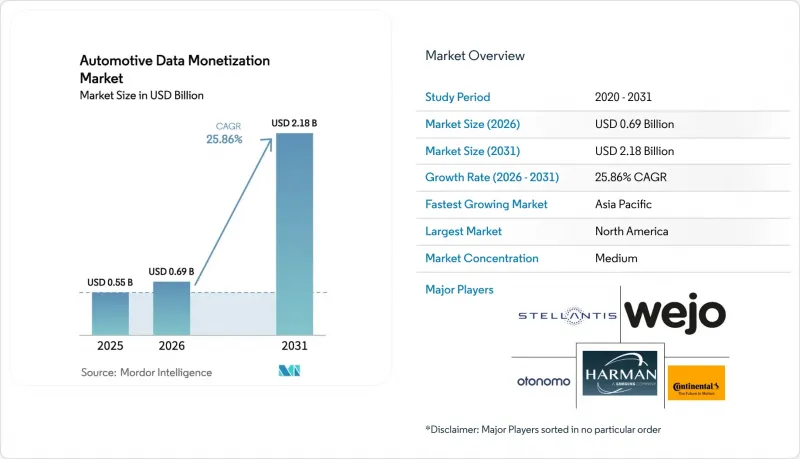
This report is Segmented by Monetization Model (Direct Data Licensing, Subscription-Based Data Services, and More), Application (Usage-Based Insurance, Predictive Maintenance, and More), End User (Automotive OEMs, Tier-1 Suppliers, Insurance Companies, and More), Data Type (Telematics and Vehicle Health Data, and More), and Geography. The Market Forecasts are Provided in Terms of Value (USD).
Global Automotive Data Monetization Market Trends and Insights
Proliferation of Connected Vehicles and V2X Infrastructure
Half of 2024 model-year vehicles shipped with embedded connectivity and penetration is on track to reach 90% by 2030. Bidirectional vehicle-to-everything links funnel 3-40 GB of data each day from more than 200 onboard sensors, effectively turning the car into a rolling data center. Fifth-generation networks supply sub-millisecond latency that unlocks safety-critical use cases such as cooperative awareness messaging and enables real-time analytics services. As data volumes soar, the automotive data monetization market benefits from traffic optimization, predictive-maintenance subscriptions, and location-based offerings that derive value from these continuous feeds. OEMs and municipalities already pilot 5G road-side units that push real-time hazard alerts to drivers and, in return, harvest anonymized telemetry for congestion management.
Expansion of Usage-Based Insurance Programs
Telematics-driven insurance shifted from pilot stage to mainstream, with major carriers rolling out pay-how-you-drive and pay-as-you-drive products across North America and Europe. Granular metrics covering speed, acceleration, cornering, and environmental context feed AI models that calculate individual risk scores, moving underwriting away from demographic averages toward behavior-based pricing. Safe drivers earn premium discounts, insurers reduce claims costs, and data suppliers secure recurring revenue from high-frequency streams. Embedded telematics modules factory-installed by OEMs accelerate this adoption, eliminating aftermarket device costs and ensuring data quality. Early studies show double-digit declines in loss ratios where predictive models trigger pre-emptive driver coaching.
Heightened Cybersecurity and Privacy Concerns
Vehicles now collect extensive personal information and serve as potential gateways to safety-critical functions, making them prime cyber targets. High-profile breaches and stricter legislation such as the General Data Protection Regulation and the California Consumer Privacy Act impose stringent consent, encryption, and minimization requirements. Automakers must invest in secure boot chains, over-the-air patch management, and continuous threat monitoring, inflating operating costs and slowing new data-sharing agreements. Privacy anxieties also affect consumer willingness to opt-in, curbing data supply to the automotive data monetization market and forcing stakeholders to adopt privacy-preserving analytics such as differential privacy and on-device processing.
Other drivers and restraints analyzed in the detailed report include:
- OEM Shift Toward Software-Defined Vehicles and Subscriptions
- Accelerating Digital Transformation Across the Automotive Value Chain
- Lack of Standardized Data Taxonomy Across OEMs
For complete list of drivers and restraints, kindly check the Table Of Contents.
Segment Analysis
Direct licensing held a 36.78% share of the automotive data monetization market in 2025 and remains the preferred path for OEMs that wish to safeguard customer relationships and pricing leverage. Contractual datasets covering location, diagnostics, and usage metrics are sold to insurers, fleets, and analytics vendors, yielding immediate cash flows. Over the forecast period, direct licensing still expands in absolute terms, yet its relative dominance erodes as revenue-sharing marketplaces accelerate. These platform operators bundle anonymized feeds from multiple brands, manage consent, and abstract technical complexities. As a result, revenue-sharing models are forecast to post a 26.62% CAGR, the fastest among all categories, reflecting rising buyer preference for aggregated, standardized, and compliant data access.
In parallel, subscription APIs monetize live streams on a recurring basis, enabling developers to embed real-time insights into mobility apps, navigation, and fleet dashboards. Advertising-driven schemes remain nascent but could unlock new value once in-cabin interfaces support contextually relevant content. Regulatory pushes for open access, notably the European Union Data Act, create tailwinds for marketplace approaches by limiting exclusive control. The automotive data monetization industry therefore transitions toward hybrid strategies where OEMs license premium datasets directly while simultaneously participating in shared-revenue exchanges for broader reach.
Usage-based insurance commanded 41.64% of 2025 revenue, reflecting insurers' rapid shift toward behavior-based underwriting. High-frequency telemetry enables fine-grained risk segmentation, which in turn reduces claims ratios and empowers tailored rewards for safer driving. Predictive maintenance followed as the second-largest field, drawing on vehicle-health signals to schedule service proactively and minimize downtime. Smart-city and infrastructure planning, though smaller today, exhibits the strongest growth at 27.68% CAGR, backed by government initiatives to alleviate congestion, curb emissions, and optimize public transport.
Fleet-management platforms integrate routing, driver scoring, and fuel-efficiency analytics, leveraging the same data streams to lower operating costs for commercial operators. In-vehicle commerce and advertising enter the picture as software-defined vehicles deliver personalized promotions based on location, trip context, and occupant preferences. Battery-health and vehicle-to-grid services emerge alongside the electrification trend, providing fresh datasets that diversify the revenue mix inside the automotive data monetization market.
Complete Report Scope:
- Monetization Model
- Direct Data Licensing
- Subscription-Based Data Services
- Revenue-Sharing Marketplaces
- Advertising-Based Models
- Application
- Usage-Based Insurance
- Predictive Maintenance
- Fleet Management and Optimization
- In-Vehicle Advertising and Commerce
- Smart City and Infrastructure Planning
- End User
- Automotive OEMs
- Tier-1 Suppliers
- Insurance Companies
- Fleet Operators and Mobility Providers
- Government and Infrastructure Agencies
- Data Type
- Telematics and Vehicle Health Data
- Infotainment and In-Cabin Interaction Data
- Powertrain and Battery Performance Data
- ADAS and Autonomous Driving Sensor Data
- Geography
- North America
- United States
- Canada
- Mexico
- South America
- Brazil
- Argentina
- Rest of South America
- Europe
- Germany
- France
- United Kingdom
- Italy
- Spain
- Russia
- Rest of Europe
- Asia Pacific
- China
- Japan
- India
- South Korea
- Australia and New Zealand
- Southeast Asia
- Rest of Asia Pacific
- Middle East
- Saudi Arabia
- United Arab Emirates
- Turkey
- Rest of Middle East
- Africa
- South Africa
- Egypt
- Rest of Africa
- North America
Geography Analysis
North America remained the single largest region in 2025, with the automotive data monetization market size benefiting from widespread telematics installations, early usage-based insurance adoption, and pro-innovation data policies. State-level pilots in Michigan and California demonstrate real-time congestion-pricing models that rely on anonymized vehicle telemetry. OEM-insurer collaborations further entrench the region's leadership by embedding consent mechanisms at vehicle purchase, which expedites data activation.
Europe sustained second position. The forthcoming EU Data Act mandates standardized APIs and defines B2B data-sharing obligations, creating predictable guardrails that may reduce fragmentation costs. German premium brands are already offering optional driving-data subscriptions compliant with the Act's consent provisions. Public agencies tap aggregated datasets to refine low-emission zones and adjust traffic signals dynamically, signaling a shift from one-off research access toward recurring data services.
Asia Pacific's fast growth stems from multiple national policies. China's MIIT requires connected-vehicle data submissions to local servers, enabling city governments to procure traffic analytics. Japan's Society 5.0 roadmap accelerates cross-industry data fusion, integrating mobility, energy, and commerce streams into citizen-centric platforms. India introduces mandatory AIS-140 telematics in commercial fleets, unlocking a new supply of standardized data. The rising supply aligns with a burgeoning developer ecosystem, collectively propelling the automotive data monetization market to its highest regional CAGR.
- Otonomo Technologies Ltd.
- Wejo Group Limited
- Continental AG
- Harman International Industries Inc.
- Stellantis N.V. (Mobilisights)
- Xevo Inc. (Lear Corporation)
- Robert Bosch GmbH
- HERE Global B.V.
- TomTom International B.V.
- Amazon Web Services Inc.
- Microsoft Corporation
- Verizon Communications Inc. (Verizon Connect)
- Databricks, Inc.
- Palantir Technologies
- Vinli Inc.
- Caruso GmbH
- Denso Corporation
- Sibros Technologies Inc.
- Tesla Inc.
- Smartcar Inc.
Additional Benefits:
- The market estimate (ME) sheet in Excel format
- 3 months of analyst support
TABLE OF CONTENTS
1 INTRODUCTION
- 1.1 Study Assumptions and Market Definition
- 1.2 Scope of the Study
2 RESEARCH METHODOLOGY
3 EXECUTIVE SUMMARY
4 MARKET LANDSCAPE
- 4.1 Market Overview
- 4.2 Market Drivers
- 4.2.1 Proliferation of Connected Vehicles AND V2X Infrastructure
- 4.2.2 Expansion of Usage-Based Insurance Programs
- 4.2.3 OEM Shift toward Software-Defined Vehicles and Subscriptions
- 4.2.4 Accelerating Digital Transformation across Automotive Value Chain
- 4.2.5 Regulatory Push for Open Data Access and Standardized APIs
- 4.2.6 AI Foundation Models Enabling Synthetic Vehicle Data Products
- 4.3 Market Restraints
- 4.3.1 Heightened Cybersecurity and Privacy Concerns
- 4.3.2 Lack of Standardized Data Taxonomy across OEMs
- 4.3.3 Edge-Computing Shift Limiting Centralized Data Availability
- 4.3.4 Consumer Backlash to In-Cabin Surveillance Data Collection
- 4.4 Industry Ecosystem Analysis
- 4.5 Regulatory Landscape
- 4.6 Technological Outlook
- 4.7 Impact of Macroeconomic Factors
- 4.8 Porter's Five Forces Analysis
- 4.8.1 Bargaining Power of Buyers
- 4.8.2 Bargaining Power of Suppliers
- 4.8.3 Threat of New Entrants
- 4.8.4 Threat of Substitutes
- 4.8.5 Competitive Rivalry
5 MARKET SIZE AND GROWTH FORECASTS (VALUE)
- 5.1 Monetization Model
- 5.1.1 Direct Data Licensing
- 5.1.2 Subscription-Based Data Services
- 5.1.3 Revenue-Sharing Marketplaces
- 5.1.4 Advertising-Based Models
- 5.2 Application
- 5.2.1 Usage-Based Insurance
- 5.2.2 Predictive Maintenance
- 5.2.3 Fleet Management and Optimization
- 5.2.4 In-Vehicle Advertising and Commerce
- 5.2.5 Smart City and Infrastructure Planning
- 5.3 End User
- 5.3.1 Automotive OEMs
- 5.3.2 Tier-1 Suppliers
- 5.3.3 Insurance Companies
- 5.3.4 Fleet Operators and Mobility Providers
- 5.3.5 Government and Infrastructure Agencies
- 5.4 Data Type
- 5.4.1 Telematics and Vehicle Health Data
- 5.4.2 Infotainment and In-Cabin Interaction Data
- 5.4.3 Powertrain and Battery Performance Data
- 5.4.4 ADAS and Autonomous Driving Sensor Data
- 5.5 Geography
- 5.5.1 North America
- 5.5.1.1 United States
- 5.5.1.2 Canada
- 5.5.1.3 Mexico
- 5.5.2 South America
- 5.5.2.1 Brazil
- 5.5.2.2 Argentina
- 5.5.2.3 Rest of South America
- 5.5.3 Europe
- 5.5.3.1 Germany
- 5.5.3.2 France
- 5.5.3.3 United Kingdom
- 5.5.3.4 Italy
- 5.5.3.5 Spain
- 5.5.3.6 Russia
- 5.5.3.7 Rest of Europe
- 5.5.4 Asia Pacific
- 5.5.4.1 China
- 5.5.4.2 Japan
- 5.5.4.3 India
- 5.5.4.4 South Korea
- 5.5.4.5 Australia and New Zealand
- 5.5.4.6 Southeast Asia
- 5.5.4.7 Rest of Asia Pacific
- 5.5.5 Middle East
- 5.5.5.1 Saudi Arabia
- 5.5.5.2 United Arab Emirates
- 5.5.5.3 Turkey
- 5.5.5.4 Rest of Middle East
- 5.5.6 Africa
- 5.5.6.1 South Africa
- 5.5.6.2 Egypt
- 5.5.6.3 Rest of Africa
- 5.5.1 North America
6 COMPETITIVE LANDSCAPE
- 6.1 Market Concentration
- 6.2 Strategic Moves
- 6.3 Market Share Analysis
- 6.4 Company Profiles (includes Global level Overview, Market level overview, Core Segments, Financials as available, Strategic Information, Market Rank/Share for key companies, Products and Services, and Recent Developments)
- 6.4.1 Otonomo Technologies Ltd.
- 6.4.2 Wejo Group Limited
- 6.4.3 Continental AG
- 6.4.4 Harman International Industries Inc.
- 6.4.5 Stellantis N.V. (Mobilisights)
- 6.4.6 Xevo Inc. (Lear Corporation)
- 6.4.7 Robert Bosch GmbH
- 6.4.8 HERE Global B.V.
- 6.4.9 TomTom International B.V.
- 6.4.10 Amazon Web Services Inc.
- 6.4.11 Microsoft Corporation
- 6.4.12 Verizon Communications Inc. (Verizon Connect)
- 6.4.13 Databricks, Inc.
- 6.4.14 Palantir Technologies
- 6.4.15 Vinli Inc.
- 6.4.16 Caruso GmbH
- 6.4.17 Denso Corporation
- 6.4.18 Sibros Technologies Inc.
- 6.4.19 Tesla Inc.
- 6.4.20 Smartcar Inc.
7 MARKET OPPORTUNITIES AND FUTURE OUTLOOK
- 7.1 White-Space and Unmet-Need Assessment

