PUBLISHER: Global Market Insights Inc. | PRODUCT CODE: 2109302

PUBLISHER: Global Market Insights Inc. | PRODUCT CODE: 2109302
Network Emulator Market Opportunity, Growth Drivers, Industry Trend Analysis, and Forecast 2026 - 2035
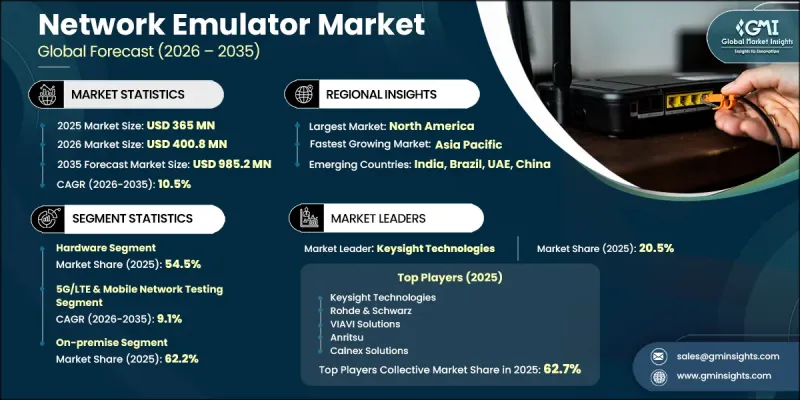
The Global Network Emulator Market was valued at USD 365 million in 2025 and is estimated to grow at a CAGR of 10.5% to reach USD 985.2 million by 2035.
The market is witnessing strong growth as organizations increasingly depend on advanced testing environments to validate complex communication networks before large-scale deployment. Rising adoption of next-generation connectivity technologies, cloud-based networking architectures, and advanced telecom infrastructure is increasing the need for reliable network simulation and performance testing solutions. Network emulators are becoming essential tools for evaluating network behavior, validating system performance, and identifying potential issues under controlled conditions. Growing deployment of modern network architectures is creating demand for testing solutions that can accurately replicate real-world traffic patterns, latency conditions, and connectivity challenges. In addition, increasing emphasis on cybersecurity, network reliability, and regulatory compliance across critical industries is encouraging broader adoption of network emulation technologies. The shift toward software-defined networking, virtualized infrastructure, and cloud-native environments is further transforming the testing landscape. These trends are strengthening the long-term outlook for the network emulation market, positioning advanced testing platforms as a key component in ensuring secure, reliable, and high-performing communication networks.
| Market Scope | |
|---|---|
| Start Year | 2025 |
| Forecast Year | 2026-2035 |
| Start Value | $365 Million |
| Forecast Value | $985.2 Million |
| CAGR | 10.5% |
The network emulator industry is gaining momentum as telecom operators, technology providers, and enterprises increasingly require advanced validation tools for modern communication systems. Network emulators support comprehensive testing of critical network components by allowing organizations to evaluate performance, reliability, and interoperability before deployment. Growing adoption of advanced connectivity solutions, enterprise networking platforms, and cloud-based infrastructure is increasing the demand for simulation environments that replicate real operating conditions. The continued evolution from traditional network functions toward virtualized and cloud-native architectures is further encouraging organizations to adopt sophisticated testing solutions capable of supporting complex network environments.
The hardware segment accounted for a 54.5% share in 2025 and is expected to grow at a CAGR of 7.9% through 2035. Hardware-based network emulators continue to hold a strong market position because they provide dedicated systems capable of delivering consistent and highly accurate testing performance. These solutions are designed to support high-speed traffic simulation, precise network impairment modeling, low-latency testing, and repeatable validation outcomes, making them suitable for demanding network environments. Growing requirements for dependable testing infrastructure across telecommunications, enterprise networking, and mission-critical applications are expected to support continued growth of the hardware segment during the forecast period.
The protocol & signaling testing segment held a 24% share in 2025. Increasing complexity in communication networks is driving demand for advanced testing solutions capable of validating signaling behavior, protocol performance, and interoperability across different network environments. Organizations are increasingly focusing on ensuring seamless connectivity, reliable communication, and optimized network performance, which is strengthening the adoption of protocol and signaling testing solutions.
China Network Emulator Market held a 41% share, generating USD 44.1 million in 2025. The country represents one of the most significant markets for network emulation solutions due to extensive telecommunications infrastructure development and continued investment in advanced connectivity technologies. Expanding network deployments, rising demand for reliable testing frameworks, and ongoing advancements in communication infrastructure are supporting increased adoption of network emulators across the country. The growing complexity of modern telecom networks is further encouraging service providers and technology companies to implement advanced validation and performance testing solutions.
Major companies operating in the global network emulator market include Keysight Technologies, VIAVI Solutions, Calnex Solutions, Apposite Technologies, Rohde & Schwarz, Anritsu, Cisco Systems, Aukua Systems, PacketStorm Communications, and Teledyne LeCroy Xena. Companies operating in the network emulator market are strengthening their competitive position by investing in advanced testing technologies, expanding product capabilities, and developing solutions that support emerging communication architectures. Market participants are focusing on improving network simulation accuracy, enhancing automation capabilities, and integrating advanced analytics to provide more efficient testing environments. Many companies are expanding their offerings to address the growing requirements of telecommunications, cloud networking, enterprise infrastructure, and cybersecurity applications. Strategic partnerships, technology collaborations, and global expansion initiatives are helping businesses increase market reach and strengthen customer relationships.
Table of Contents
Chapter 1 Research Methodology
- 1.1 Research approach
- 1.2 Quality Commitments
- 1.2.1 GMI AI policy & data integrity commitment
- 1.2.1.1 Source consistency protocol
- 1.2.1 GMI AI policy & data integrity commitment
- 1.3 Research Trail & Confidence Scoring
- 1.3.1 Research Trail Components
- 1.3.2 Scoring Components
- 1.4 Data Collection
- 1.4.1 Partial list of primary sources
- 1.5 Data mining sources
- 1.5.1 Paid sources
- 1.5.1.1 Sources, by region
- 1.5.1 Paid sources
- 1.6 Base estimates and calculations
- 1.6.1 Base year calculation for any one approach
- 1.7 Forecast model
- 1.7.1 Quantified market impact analysis
- 1.7.1.1 Mathematical impact of growth parameters on forecast
- 1.7.1 Quantified market impact analysis
- 1.8 Research transparency addendum
- 1.8.1 Source attribution framework
- 1.8.2 Quality assurance metrics
- 1.8.3 Our commitment to trust
Chapter 2 Executive Summary
- 2.1 Industry 360° synopsis, 2022 – 2035
- 2.2 Key market trends
- 2.2.1 Regional
- 2.2.2 Offering
- 2.2.3 Deployment
- 2.2.4 Application
- 2.2.5 Test Type
- 2.2.6 End-User
- 2.3 TAM Analysis, 2026-2035
- 2.4 CXO perspectives: Strategic imperatives
Chapter 3 Industry Insights
- 3.1 Industry ecosystem analysis
- 3.1.1 Supplier landscape
- 3.1.2 Profit margin analysis
- 3.1.3 Cost structure
- 3.1.4 Value addition at each stage
- 3.1.5 Factor affecting the value chain
- 3.1.6 Disruptions
- 3.2 Industry impact forces
- 3.2.1 Growth drivers
- 3.2.1.1 Accelerating 5G Network Rollout & RAN/Core Validation Demand
- 3.2.1.2 Rising Adoption of SD-WAN, SASE & Cloud-Native Networking
- 3.2.1.3 Surge in Network Virtualization & Software-Defined Infrastructure
- 3.2.1.4 Growing Cybersecurity Testing Requirements Across Critical Industries
- 3.2.2 Industry pitfalls and challenges
- 3.2.2.1 High Capital Cost of Hardware-Based Network Emulator Appliances
- 3.2.2.2 Limited Availability of Skilled Network Testing Professionals
- 3.2.3 Market opportunities
- 3.2.3.1 Emergence of Emulation-as-a-Service (EaaS) & Cloud-Native Deployment Models
- 3.2.3.2 LEO Satellite & Non-Terrestrial Network (NTN) Testing Demand
- 3.2.3.3 Expansion of Autonomous Vehicles, V2X & Connected Mobility Testing
- 3.2.3.4 Proliferation of IoT & Edge Computing Driving Distributed Testing Needs
- 3.2.1 Growth drivers
- 3.3 Growth potential analysis
- 3.4 Technology and innovation landscape
- 3.4.1 Current technological trends
- 3.4.1.1 Hardware-Based High-Speed Network Emulation for 5G & Ethernet Validation
- 3.4.1.2 Virtualized Network Emulation for SD-WAN, NFV & Cloud Environments
- 3.4.1.3 AI-Assisted Traffic Generation & Real-Time Network Performance Analytics
- 3.4.2 Emerging technologies
- 3.4.2.1 AI-Driven Autonomous Network Emulation & Self-Optimizing Test Environments
- 3.4.2.2 Digital Twin-Based Network Modeling & End-to-End Infrastructure Simulation
- 3.4.2.3 6G, Non-Terrestrial Networks (NTN) & Edge-Native Network Emulation
- 3.4.1 Current technological trends
- 3.5 Pricing Analysis (Driven by primary research)
- 3.5.1 Historical Price Trend Analysis
- 3.5.2 Pricing Strategy by Player Type
- 3.6 Regulatory landscape
- 3.6.1 North America
- 3.6.1.1 National Institute of Standards and Technology Cybersecurity Framework 2.0
- 3.6.1.2 U.S. Securities and Exchange Commission Cybersecurity Disclosure Rules
- 3.6.1.3 U.S. Department of Defense Cybersecurity Maturity Model Certification
- 3.6.1.4 Health Insurance Portability and Accountability Act Security Rule
- 3.6.2 Europe
- 3.6.2.1 Network and Information Security Directive 2
- 3.6.2.2 General Data Protection Regulation
- 3.6.2.3 Cyber Resilience Act
- 3.6.2.4 Digital Operational Resilience Act
- 3.6.3 Asia Pacific
- 3.6.3.1 China Cybersecurity Law
- 3.6.3.2 China Data Security Law
- 3.6.3.3 Digital Personal Data Protection Act, India
- 3.6.3.4 Singapore Cybersecurity Act
- 3.6.4 Latin America
- 3.6.4.1 Brazil General Data Protection Law
- 3.6.4.2 Brazil National Cybersecurity Strategy
- 3.6.4.3 Federal Law on Protection of Personal Data Held by Private Parties, Mexico
- 3.6.4.4 Chile Cybersecurity Framework Law
- 3.6.5 Middle East & Africa
- 3.6.5.1 Saudi Essential Cybersecurity Controls
- 3.6.5.2 United Arab Emirates Information Assurance Standards
- 3.6.5.3 National Information Assurance Framework
- 3.6.5.4 Protection of Personal Information Act, South Africa
- 3.6.5.5 National Cybersecurity Policy Framework, South Africa
- 3.6.1 North America
- 3.7 Porter’s analysis
- 3.8 PESTEL analysis
- 3.9 Patent analysis (Driven by primary research)
- 3.10 Cost breakdown analysis
- 3.11 Trade Data Analysis (Driven by Primary Research)
- 3.11.1 Import/Export Volume & Value Trends - Network Testing Equipment
- 3.11.2 Key Trade Corridors & Tariff Impact
- 3.12 Cybersecurity & Network Resilience Landscape
- 3.13 Impact of AI and Generative AI on the Market
- 3.13.1 AI Driven Disruption of Existing Business Models
- 3.13.2 GenAI Use Cases and Adoption Roadmap by Segment
- 3.13.3 Risks Limitations and Regulatory Considerations
- 3.14 Forecast assumptions & scenario analysis (Driven by Primary Research)
- 3.14.1 Base Case- Key Macro & Industry Variables Driving CAGR
- 3.14.2 Optimistic Scenarios- Favorable macro and industry tailwinds
- 3.14.3 Pessimistic Scenario - Macroeconomic slowdown or industry headwinds
Chapter 4 Competitive Landscape, 2025
- 4.1 Introduction
- 4.2 Company market share analysis
- 4.2.1 North America
- 4.2.2 Europe
- 4.2.3 Asia Pacific
- 4.2.4 LATAM
- 4.2.5 MEA
- 4.3 Competitive analysis of major market players
- 4.4 Competitive positioning matrix
- 4.5 Key developments
- 4.5.1 Mergers & acquisitions
- 4.5.2 Partnerships & collaborations
- 4.5.3 New Product Launches
- 4.5.4 Expansion Plans and funding
- 4.6 Company tier benchmarking
- 4.6.1 Tier classification criteria & qualifying thresholds
- 4.6.2 Tier positioning matrix by revenue, geography & innovation
Chapter 5 Market Estimates & Forecast, By Offering, 2022 - 2035 (USD Bn)
- 5.1 Key trends
- 5.2 Hardware
- 5.2.1 Rack-Mounted Appliances
- 5.2.2 Portable/Benchtop Emulators
- 5.3 Software
- 5.3.1 Standalone Software Platforms
- 5.3.2 Virtual Appliances & Containerized Solutions
- 5.3.3 Cloud-Native / SaaS-Delivered Software
- 5.4 Services
- 5.4.1 Professional Services
- 5.4.2 Managed Service
Chapter 6 Market Estimates & Forecast, By Deployment, 2022 - 2035 (USD Bn)
- 6.1 Key trends
- 6.2 On-Premise
- 6.3 Cloud-Based
- 6.4 Hybrid
Chapter 7 Market Estimates & Forecast, By Application, 2022 - 2035 (USD Bn)
- 7.1 Key trends
- 7.2 SD-WAN & SASE Testing
- 7.3 Cloud & Data Center Testing
- 7.4 5G/LTE & Mobile Network Testing
- 7.5 IoT Network Testing
- 7.6 WAN & Satellite Link Testing
- 7.7 Wi-Fi & Wireless LAN Testing
- 7.8 Others
Chapter 8 Market Estimates & Forecast, By Test Type, 2022 - 2035 (USD Bn)
- 8.1 Key trends
- 8.2 Performance Testing
- 8.3 Application Testing
- 8.4 Protocol & Signaling Testing
- 8.5 Functional Testing
Chapter 9 Market Estimates & Forecast, By End-User, 2022 - 2035 (USD Bn)
- 9.1 Key trends
- 9.2 Telecommunications Service Providers
- 9.3 Government & Defense
- 9.4 IT & Cloud Service Providers
- 9.5 Banking, Financial Services & Insurance (BFSI)
- 9.6 Automotive & Transportation
- 9.7 Healthcare
- 9.8 Research & Academia
- 9.9 Others
Chapter 10 Market Estimates & Forecast, By Region, 2022 - 2035 (USD Bn)
- 10.1 Key trends
- 10.2 North America
- 10.2.1 US
- 10.2.2 Canada
- 10.3 Europe
- 10.3.1 Germany
- 10.3.2 UK
- 10.3.3 France
- 10.3.4 Italy
- 10.3.5 Spain
- 10.3.6 Russia
- 10.3.7 Norway
- 10.3.8 Netherlands
- 10.3.9 Sweden
- 10.4 Asia Pacific
- 10.4.1 China
- 10.4.2 India
- 10.4.3 Japan
- 10.4.4 Australia
- 10.4.5 South Korea
- 10.4.6 Singapore
- 10.4.7 Thailand
- 10.4.8 Indonesia
- 10.4.9 Vietnam
- 10.5 Latin America
- 10.5.1 Brazil
- 10.5.2 Mexico
- 10.5.3 Argentina
- 10.6 MEA
- 10.6.1 South Africa
- 10.6.2 Saudi Arabia
- 10.6.3 UAE
- 10.6.4 Turkey
Chapter 11 Company Profiles
- 11.1 Global Players
- 11.1.1 Keysight Technologies
- 11.1.2 VIAVI Solutions
- 11.1.3 Rohde & Schwarz
- 11.1.4 Anritsu
- 11.1.5 Cisco Systems
- 11.1.6 Calnex Solutions
- 11.1.7 Teledyne LeCroy Xena
- 11.1.8 EXFO
- 11.2 Regional Players
- 11.2.1 Apposite Technologies
- 11.2.2 Aukua Systems
- 11.2.3 PacketStorm Communications
- 11.2.4 Candela Technologies
- 11.2.5 GL Communications
- 11.2.6 Simnovus
- 11.2.7 TETCOS (NetSim)
- 11.2.8 EVE-NG Pro
- 11.2.9 Valid8
- 11.2.10 East Coast Datacom
- 11.2.11 Polaris Networks
- 11.2.12 InterWorking Labs

