PUBLISHER: Global Market Insights Inc. | PRODUCT CODE: 2109309

PUBLISHER: Global Market Insights Inc. | PRODUCT CODE: 2109309
Learning Management Systems Market Opportunity, Growth Drivers, Industry Trend Analysis, and Forecast 2026 - 2035
The Global Learning Management Systems Market was valued at USD 30.4 billion in 2025 and is estimated to grow at a CAGR of 12.6% to reach USD 97.4 billion by 2035.
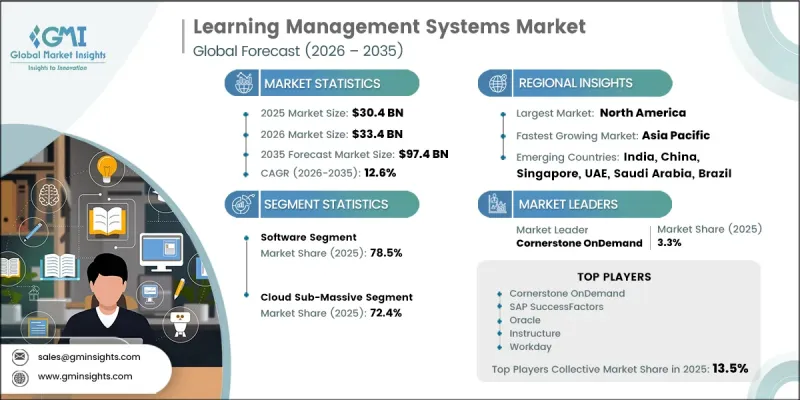
The market is witnessing growth as businesses, educational institutions, and training organizations increasingly adopt digital learning solutions to improve accessibility, reduce training expenses, and enhance learner performance tracking. The transition from conventional learning methods to technology-driven platforms is accelerating demand for flexible and scalable learning management solutions. Cloud-based LMS deployment is gaining significant traction as organizations seek cost-efficient platforms that support expansion without requiring extensive infrastructure investments. Artificial intelligence is further transforming LMS capabilities by enabling more personalized learning experiences, automated evaluations, intelligent recommendations, and data-driven insights into learner behavior. Vendors are continuously enhancing their platforms with advanced AI-powered functionalities that improve content management, learning customization, and training efficiency. The growing adoption of mobile-based learning is also reshaping the market as organizations increasingly prefer flexible, short-duration learning formats that allow users to access training content anytime and anywhere. These developments are strengthening the role of LMS platforms as essential tools for workforce development, academic learning, and continuous skill enhancement across various industries.
| Market Scope | |
|---|---|
| Start Year | 2025 |
| Forecast Year | 2026-2035 |
| Start Value | $30.4 Billion |
| Forecast Value | $97.4 Billion |
| CAGR | 12.6% |
The software segment accounted for a 78.5% share in 2025. The segment maintains its leading position due to increasing demand for centralized digital platforms that support content management, learner administration, assessment processes, and performance evaluation. Organizations across corporate and education sectors are increasingly investing in advanced LMS software solutions to improve training effectiveness, streamline operations, and enhance overall learning outcomes.
The cloud deployment segment held a 72.4% share in 2025. Cloud-based LMS solutions are gaining preference because they provide greater scalability, simplified implementation, reduced operational costs, and convenient access to learning resources. Organizations are increasingly adopting cloud platforms to improve flexibility and allow employees and students to access educational content across different locations and devices.
United States Learning Management Systems Market generated USD 9.9 billion in 2025. The country's strong market position is supported by the presence of leading technology companies, advanced digital infrastructure, and widespread adoption of online learning platforms across enterprises and educational institutions. Increasing investments in AI-enabled LMS solutions are further helping organizations enhance workforce training programs, improve learning engagement, and achieve better educational outcomes.
Key companies operating in the global learning management systems market include Cornerstone OnDemand, SAP SuccessFactors, Oracle Learning Cloud, Docebo, D2L, Instructure, Blackboard, Skillsoft, Microsoft Viva Learning, and Workday Learning. Companies operating in the learning management systems market are strengthening their market position by enhancing platform capabilities, expanding product portfolios, and integrating advanced technologies into their learning solutions. Vendors are focusing on artificial intelligence, automation, analytics, and personalized learning features to improve user engagement and deliver more effective training experiences. Strategic collaborations, acquisitions, and partnerships with enterprises and educational institutions are helping companies expand their customer base and strengthen market penetration. Businesses are also investing in cloud-based solutions, mobile accessibility, and user-friendly interfaces to meet changing customer expectations.
Table of Contents
Chapter 1 Methodology
- 1.1 Research approach
- 1.2 Quality Commitments
- 1.2.1 GMI AI policy & data integrity commitment
- 1.2.1.1 Source consistency protocol
- 1.2.1 GMI AI policy & data integrity commitment
- 1.3 Research Trail & Confidence Scoring
- 1.3.1 Research Trail Components
- 1.3.2 Scoring Components
- 1.4 Data Collection
- 1.4.1 Partial list of primary sources
- 1.5 Data mining sources
- 1.5.1 Paid sources
- 1.5.1.1 Sources, by region
- 1.5.1 Paid sources
- 1.6 Base estimates and calculations
- 1.6.1 Base year calculation
- 1.7 Forecast
- 1.7.1 Quantified market impact analysis
- 1.7.1.1 Mathematical impact of growth parameters on forecast
- 1.7.1 Quantified market impact analysis
- 1.8 Research transparency addendum
- 1.8.1 Source attribution framework
- 1.8.2 Quality assurance metrics
- 1.8.3 Our commitment to trust
Chapter 2 Executive Summary
- 2.1 Industry 360° synopsis, 2022 – 2035
- 2.2 Key market trends
- 2.2.1 Regional
- 2.2.2 Component
- 2.2.3 Deployment Mode
- 2.2.4 Delivery Mode
- 2.2.5 Organization Size
- 2.2.6 End-Use Vertical
- 2.3 TAM Analysis, 2026-2035
- 2.4 CXO perspectives: Strategic imperatives
Chapter 3 Industry Insights
- 3.1 Industry ecosystem analysis
- 3.1.1 Supplier landscape
- 3.1.2 Profit margin analysis
- 3.1.3 Cost structure
- 3.1.4 Value addition at each stage
- 3.1.5 Factor affecting the value chain
- 3.1.6 Disruptions
- 3.2 Industry impact forces
- 3.2.1 Growth drivers
- 3.2.1.1 Rising adoption of digital learning
- 3.2.1.2 Growing workforce upskilling and reskilling initiatives
- 3.2.1.3 Expansion of cloud-based LMS platforms
- 3.2.1.4 Integration of AI and learning analytics
- 3.2.2 Industry pitfalls and challenges
- 3.2.2.1 Data privacy and cybersecurity concerns
- 3.2.2.2 Complex implementation and system integration
- 3.2.3 Market opportunities
- 3.2.3.1 Growing adoption of AI-powered personalized learning
- 3.2.3.2 Rising demand from SMEs
- 3.2.3.3 Expansion of mobile learning and microlearning
- 3.2.3.4 Increasing demand for industry-specific LMS solutions
- 3.2.1 Growth drivers
- 3.3 Growth potential analysis
- 3.4 Technology and Innovation landscape
- 3.4.1 Current technological trends
- 3.4.2 Emerging technologies
- 3.5 Pricing Analysis (Driven by Primary Research)
- 3.5.1 Historical Price Trend Analysis
- 3.5.2 Pricing Strategy by Player Type (Premium / Value / Cost-plus)
- 3.6 Regulatory guideline
- 3.6.1 North America
- 3.6.1.1 Family Educational Rights and Privacy Act (FERPA) (U.S.)
- 3.6.1.2 Children's Online Privacy Protection Act (COPPA) (U.S.)
- 3.6.2 Europe
- 3.6.2.1 General Data Protection Regulation (GDPR)
- 3.6.2.2 Digital Services Act (DSA)
- 3.6.2.3 NIS2 Directive
- 3.6.2.4 European Accessibility Act (EAA)
- 3.6.3 Asia Pacific
- 3.6.3.1 Personal Information Protection Law (PIPL) (China)
- 3.6.3.2 Cybersecurity Law (China)
- 3.6.3.3 Digital Personal Data Protection (DPDP) Act, 2023 (India)
- 3.6.3.4 National Education Policy (NEP) 2020 – Digital Learning Framework (India)
- 3.6.4 Latin America
- 3.6.4.1 Lei Geral de Protecao de Dados (LGPD) (Brazil)
- 3.6.4.2 3.6.4.2. Brazilian Internet Bill of Rights (Marco Civil da Internet) (Brazil)
- 3.6.4.3 3.6.4.3. Federal Law on Protection of Personal Data Held by Private Parties
- 3.6.5 Middle East & Africa (MEA)
- 3.6.5.1 Personal Data Protection Law (PDPL) (UAE)
- 3.6.5.2 UAE Federal Decree-Law No. 45 of 2021 on Personal Data Protection
- 3.6.5.3 Personal Data Protection Law (PDPL) (Saudi Arabia)
- 3.6.1 North America
- 3.7 Porter’s analysis
- 3.8 PESTEL analysis
- 3.9 Patent Landscape (Driven by Primary Research)
- 3.10 Sustainability and environmental aspects
- 3.10.1 Sustainable practices
- 3.10.2 Waste reduction strategies
- 3.10.3 Energy efficiency in production
- 3.10.4 Eco-friendly Initiatives
- 3.10.5 Carbon footprint considerations
- 3.11 Use Cases
- 3.12 Impact of AI & Generative AI on the Market (Driven by Primary Research)
- 3.12.1 AI-Driven Disruption of Existing Business Models
- 3.12.2 GenAI Use Cases & Adoption Roadmap by Segment
- 3.12.3 Risks, Limitations & Regulatory Considerations
- 3.13 Forecast assumptions & scenario analysis (Driven by Primary Research)
- 3.13.1 Base Case - Key Macro & Industry Variables Driving CAGR
- 3.13.2 Optimistic Scenarios - Favourable macro and industry tailwinds
- 3.13.3 Pessimistic Scenario - Macroeconomic slowdown or industry headwinds
Chapter 4 Competitive Landscape, 2025
- 4.1 Introduction
- 4.2 Company market share analysis (value and volume), 2022-2025
- 4.2.1 North America
- 4.2.2 Europe
- 4.2.3 Asia Pacific
- 4.2.4 Latin America
- 4.2.5 MEA
- 4.3 Top 10 Company production & sales analysis, 2022-2035
- 4.4 Competitive analysis of major market players
- 4.5 Competitive positioning matrix
- 4.6 Key developments
- 4.6.1 Mergers & acquisitions
- 4.6.2 Partnerships & collaborations
- 4.6.3 New Product Launches
- 4.6.4 Expansion Plans and funding
- 4.7 Company Tier Benchmarking
- 4.7.1 Tier Classification Criteria & Qualifying Thresholds
- 4.7.2 Tier Positioning Matrix by Revenue, Geography & Innovation
Chapter 5 Market Estimates & Forecast, By Component, 2022 - 2035 ($Bn, Units)
- 5.1 Key trends
- 5.2 Software
- 5.2.1 Content Management & Delivery
- 5.2.2 Assessment, Testing & Certification
- 5.2.3 Reporting, Analytics & Dashboard
- 5.2.4 Administration & User Management
- 5.2.5 Mobile Learning Module
- 5.3 5.3. Services
- 5.3.1 Professional Services
- 5.3.2 Managed Services
Chapter 6 Market Estimates & Forecast, By Deployment Mode, 2022 - 2035 ($Bn)
- 6.1 Key trends
- 6.2 Cloud-Based
- 6.3 On-Premise
Chapter 7 Market Estimates & Forecast, By Delivery Mode, 2022 - 2035 ($Bn)
- 7.1 Key trends
- 7.2 Distance Learning / Self-Paced eLearning
- 7.3 Instructor-Led Training (ILT) & Virtual ILT (vILT)
- 7.4 Blended Learning
- 7.5 Mobile Learning (mLearning) & Microlearning
Chapter 8 Market Estimates & Forecast, By Organization Size, 2022 – 2035 ($Bn)
- 8.1 Key trends
- 8.2 Large Enterprises
- 8.3 Small & Medium Enterprises (SMEs)
Chapter 9 Market Estimates & Forecast, By End-Use Vertical, 2022 – 2035 ($Bn)
- 9.1 Key trends
- 9.2 Academic Institutions
- 9.2.1 K-12 Schools
- 9.2.2 Higher Education (Colleges & Universities)
- 9.3 Corporate
- 9.3.1 BFSI (Banking, Financial Services & Insurance)
- 9.3.2 Healthcare & Life Sciences
- 9.3.3 IT & Telecom
- 9.3.4 Manufacturing
- 9.3.5 Retail & E-Commerce
- 9.3.6 Government & Public Sector
- 9.3.7 Energy & Utilities
- 9.3.8 Hospitality & Travel
- 9.3.9 Media & Entertainment
- 9.3.10 Other
Chapter 10 Market Estimates & Forecast, By Region, 2022 - 2035 ($Bn)
- 10.1 Key trends
- 10.2 North America
- 10.2.1 US
- 10.2.2 Canada
- 10.3 Europe
- 10.3.1 UK
- 10.3.2 Germany
- 10.3.3 France
- 10.3.4 Italy
- 10.3.5 Spain
- 10.3.6 Belgium
- 10.3.7 Netherlands
- 10.3.8 Sweden
- 10.3.9 Russia
- 10.4 Asia Pacific
- 10.4.1 China
- 10.4.2 India
- 10.4.3 Japan
- 10.4.4 Australia
- 10.4.5 Singapore
- 10.4.6 South Korea
- 10.4.7 Vietnam
- 10.4.8 Indonesia
- 10.4.9 Thailand
- 10.5 Latin America
- 10.5.1 Brazil
- 10.5.2 Mexico
- 10.5.3 Argentina
- 10.6 MEA
- 10.6.1 South Africa
- 10.6.2 Saudi Arabia
- 10.6.3 UAE
Chapter 11 Company Profiles
- 11.1 Global Players
- 11.1.1 Cornerstone OnDemand
- 11.1.2 SAP SuccessFactors
- 11.1.3 Oracle Learning Cloud
- 11.1.4 Docebo
- 11.1.5 D2L (Brightspace)
- 11.1.6 Instructure
- 11.1.7 Blackboard
- 11.1.8 Skillsoft
- 11.1.9 Microsoft Viva Learning
- 11.1.10 Workday Learning
- 11.2 Regional Players
- 11.2.1 iSpring Solutions
- 11.2.2 Totara Learning Solutions
- 11.2.3 LearnUpon
- 11.2.4 ELMO Software
- 11.2.5 Growth Engineering
- 11.2.6 Fuse Universal
- 11.2.7 Cegid Talent
- 11.2.8 EduMe
- 11.2.9 Paradiso Solutions
- 11.2.10 Gyrus Systems

