PUBLISHER: Global Market Insights Inc. | PRODUCT CODE: 2109314

PUBLISHER: Global Market Insights Inc. | PRODUCT CODE: 2109314
Highway, Street, and Bridge Construction Market Opportunity, Growth Drivers, Industry Trend Analysis, and Forecast 2026 - 2035
The Global Highway, Street, And Bridge Construction Market was valued at USD 2.21 trillion in 2025 and is estimated to grow at a CAGR of 4.3% to reach USD 3.34 trillion by 2035.
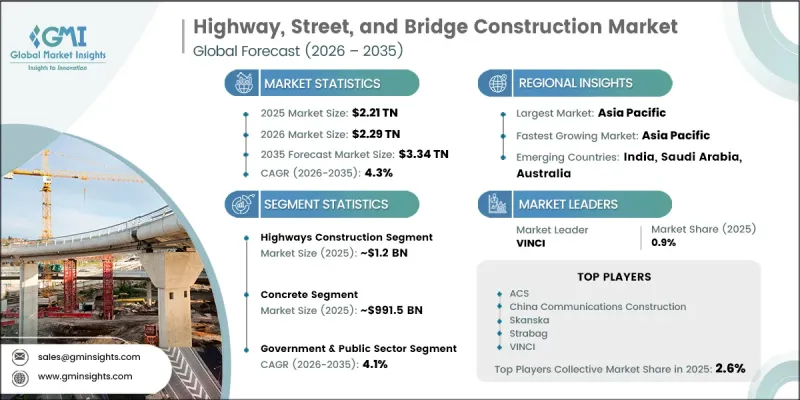
The global highway, street, and bridge construction market is experiencing growth as governments continue to increase investments in transportation infrastructure to improve connectivity, support economic development, and strengthen logistics networks. Both developed and developing economies are prioritizing the construction and modernization of highways, roads, bridges, and related transportation assets to accommodate rising traffic volumes and long-term urban expansion. Infrastructure spending is also extending beyond major transportation corridors, with increasing emphasis on rural road development, rehabilitation projects, and maintenance programs that enhance accessibility and regional mobility. At the same time, sustainability has become an integral part of infrastructure development, with environmental performance and climate resilience now incorporated into project planning and procurement requirements across numerous markets. Contractors are increasingly required to deliver infrastructure capable of withstanding changing environmental conditions while meeting stricter construction standards. Growing investments in resilient transportation networks, modern engineering practices, and durable construction materials continue to create favorable opportunities for market expansion, reinforcing long-term demand across both new infrastructure development and rehabilitation projects worldwide.
| Market Scope | |
|---|---|
| Start Year | 2025 |
| Forecast Year | 2026-2035 |
| Start Value | $2.21 Trillion |
| Forecast Value | $3.34 Trillion |
| CAGR | 4.3% |
The highways construction segment held a 53.5% share in 2025, generating USD 1.2 trillion. The segment maintains its leading position due to increasing investments in highway expansion, expressway development, national road upgrades, urban bypasses, and large-scale transportation corridors. Rising demand for efficient freight movement, improved regional connectivity, and expanding urban infrastructure continues to support significant construction activity. Ongoing investments in high-capacity transportation networks are expected to sustain strong demand for highway construction projects throughout the forecast period.
The new construction segment accounted for 46.9% share in 2025. Strong growth in this segment is driven by increasing contracts for newly developed transportation infrastructure, including highways, bridges, expressways, and integrated mobility corridors. Governments and private sector participants continue to prioritize new infrastructure projects to improve transportation efficiency, stimulate economic growth, strengthen logistics capabilities, and support expanding urban development, creating sustained opportunities for construction companies worldwide.
Asia Pacific Highway, Street, And Bridge Construction Market is expected to grow at a CAGR of 5.6% between 2026 and 2035. The region continues to represent the largest and fastest-growing market due to rapid urbanization, population growth, expanding industrial activity, and rising investments in transportation infrastructure. Continuous development of highways, bridges, and road networks across several countries is supporting long-term market growth. Increasing government spending on large-scale infrastructure modernization and cross-border transportation connectivity is expected to further strengthen regional demand throughout the forecast period.
Major companies operating in the global highway, street, and bridge construction market include VINCI, Bechtel, ACS, Skanska, Balfour Beatty, Bouygues Construction, Larsen & Toubro (L&T), Kiewit Corporation, China Communications Construction, and Strabag. Companies operating in the highway, street, and bridge construction market are strengthening their market position by investing in advanced construction technologies, sustainable engineering practices, and large-scale infrastructure capabilities. Industry participants are expanding their project portfolios through strategic partnerships, joint ventures, and long-term government contracts to secure major transportation infrastructure projects. Businesses are also increasing investments in digital construction management, automation, and advanced project planning tools to improve operational efficiency, reduce project timelines, and optimize resource utilization. In addition, companies are enhancing expertise in resilient infrastructure design, adopting environmentally responsible construction methods, and expanding regional operations to capitalize on growing infrastructure investments.
Table of Contents
Chapter 1 Research Methodology
- 1.1 Research approach
- 1.2 Quality Commitments
- 1.2.1 GMI AI policy & data integrity commitment
- 1.3 Research Trail & Confidence Scoring
- 1.3.1 Research Trail Components
- 1.3.2 Scoring Components
- 1.4 Data Collection
- 1.5 Data mining sources
- 1.5.1 Paid sources
- 1.6 Base estimates and calculations
- 1.6.1 Base year calculation
- 1.7 Forecast model
- 1.7.1 Quantified market impact analysis
- 1.8 Research transparency addendum
- 1.8.1 Source attribution framework
- 1.8.2 Quality assurance metrics
- 1.8.3 Our commitment to trust
Chapter 2 Executive Summary
- 2.1 Industry 360° synopsis
- 2.2 Key market trends
- 2.2.1 Regional
- 2.2.2 Construction
- 2.2.3 Material
- 2.2.4 Project
- 2.2.5 End-Use
- 2.3 TAM analysis, 2026-2035
- 2.4 CXO perspectives: Strategic imperatives
Chapter 3 Industry Insights
- 3.1 Industry ecosystem analysis
- 3.1.1 Supplier landscape
- 3.1.2 Profit margin
- 3.1.3 Cost structure
- 3.1.4 Value addition at each stage
- 3.1.5 Factor affecting the value chain
- 3.1.6 Disruptions
- 3.2 Industry impact forces
- 3.2.1 Growth drivers
- 3.2.1.1 Aging Infrastructure & Structural Replacement Demand
- 3.2.1.2 Government Infrastructure Stimulus & National Investment Programs
- 3.2.1.3 Rapid Urbanization & Rising Demand for Urban Road & Bridge Networks
- 3.2.1.4 Smart City Initiatives Driving Intelligent Road Infrastructure Investment
- 3.2.2 Industry pitfalls and challenges
- 3.2.2.1 Material Cost Escalation & Supply Chain Volatility
- 3.2.2.2 Lengthy Environmental Permitting & Regulatory Approval Cycles
- 3.2.3 Market opportunities
- 3.2.3.1 Climate Resilience & Flood-Adaptive Infrastructure Investment
- 3.2.3.2 Emerging Market Urbanization & Greenfield Road Network Expansion
- 3.2.3.3 Green & Sustainable Infrastructure Certification Requirements
- 3.2.1 Growth drivers
- 3.3 Technology and innovation landscape
- 3.3.1 Current technological trends
- 3.3.1.1 LiDAR Surveying and Mapping
- 3.3.1.2 Ground Penetrating Radar (GPR)
- 3.3.2 Emerging technologies
- 3.3.2.1 AI-Powered Construction Management Platforms
- 3.3.2.2 Digital Twin Technology
- 3.3.2.3 Autonomous Construction Equipment
- 3.3.1 Current technological trends
- 3.4 Growth potential analysis
- 3.5 Pricing Analysis (Driven by Primary Research)
- 3.5.1 Historical Price Trend Analysis, 2022-2025
- 3.5.2 Pricing Strategy by Player Type (Premium / Value / Cost-plus)
- 3.6 Regulatory landscape
- 3.6.1 North America
- 3.6.1.1 US - Federal Highway Administration (FHWA)
- 3.6.1.2 US - American Association of State Highway and Transportation Officials (AASHTO)
- 3.6.1.3 Canada - Departments of Transportation
- 3.6.2 Europe
- 3.6.2.1 EU - Directorate-General for Mobility and Transport (DG MOVE)
- 3.6.2.2 UK - National Highways
- 3.6.3 Asia Pacific
- 3.6.3.1 China - Ministry of Transport (MOT)
- 3.6.3.2 India - Ministry of Road Transport and Highways (MoRTH)
- 3.6.4 LATAM
- 3.6.4.1 Brazil - Agencia Nacional de Transportes Terrestres (ANTT)
- 3.6.4.2 Argentina - Direccion Nacional de Vialidad (DNV)
- 3.6.5 MEA
- 3.6.5.1 Saudi Arabia - Roads General Authority (RGA)
- 3.6.5.2 UAE - Roads and Transport Authority (RTA)
- 3.6.1 North America
- 3.7 Porter’s analysis
- 3.8 PESTEL analysis
- 3.9 Cost breakdown analysis
- 3.9.1 Material Costs
- 3.9.2 Labor Costs
- 3.9.3 Equipment and Machinery Costs
- 3.9.4 Design, Engineering, and Planning Costs
- 3.9.5 Transportation, Logistics, and Site Preparation Costs
- 3.10 Patent analysis (Driven by Primary Research)
- 3.11 Sustainability and environmental aspects
- 3.11.1 Sustainable Practices
- 3.11.2 Waste Reduction Strategies
- 3.11.3 Energy Efficiency in Production
- 3.11.4 Eco-friendly Initiatives
- 3.11.5 Carbon Footprint Considerations
- 3.12 Capital Allocation Trends, 2026-2035
- 3.12.1 Government Budget Allocation & National Infrastructure Spending Priorities
- 3.12.2 Multilateral & Development Bank Financing
- 3.12.3 Private Capital, Municipal Bond & Infrastructure Fund Financing
- 3.13 Impact of AI & generative AI on the market
- 3.13.1 AI-driven disruption of existing business models
- 3.13.2 GenAI use cases & adoption roadmap by segment
- 3.13.3 Risks, limitations & regulatory considerations
- 3.14 Forecast assumptions & scenario analysis (Driven by Primary Research)
- 3.14.1 Base Case- Key Macro & Industry Variables Driving CAGR
- 3.14.2 Optimistic Scenarios- Favorable macro and industry tailwinds
- 3.14.3 Pessimistic Scenario - Macroeconomic slowdown or industry headwinds
Chapter 4 Competitive Landscape, 2025
- 4.1 Introduction
- 4.2 Company market share analysis
- 4.2.1 North America
- 4.2.2 Europe
- 4.2.3 Asia Pacific
- 4.2.4 LATAM
- 4.2.5 MEA
- 4.3 Competitive analysis of major market players
- 4.4 Competitive positioning matrix
- 4.5 Key developments
- 4.5.1 Mergers & acquisitions
- 4.5.2 Partnerships & collaborations
- 4.5.3 New product launches
- 4.5.4 Expansion plans and funding
- 4.6 Company tier benchmarking
- 4.6.1 Tier classification criteria & qualifying thresholds
- 4.6.2 Tier positioning matrix by revenue, geography & innovation
Chapter 5 Market Estimates and Forecast, By Construction, 2022 – 2035 ($ Mn)
- 5.1 Key trends
- 5.2 Highways Construction
- 5.2.1 National Highways & Interstate Corridors
- 5.2.2 Expressways & Freeways
- 5.2.3 Airport Runways & Taxiways
- 5.2.4 Rural & Secondary Roads
- 5.3 Street Construction
- 5.4 Bridge Construction
- 5.4.1 Beam Bridge
- 5.4.2 Truss Bridge
- 5.4.3 Arch Bridge
- 5.4.4 Suspension Bridge
- 5.4.5 Cable-Stayed Bridge
- 5.4.6 Others
Chapter 6 Market Estimates and Forecast, By Material, 2022 – 2035 ($ Mn)
- 6.1 Key trends
- 6.2 Asphalt
- 6.2.1 Hot-Mix Asphalt (HMA)
- 6.2.2 Warm-Mix Asphalt (WMA)
- 6.2.3 Recycled Asphalt Pavement (RAP)
- 6.2.4 Cold Mix & Specialty Asphalt
- 6.3 Steel
- 6.3.1 Carbon Steel
- 6.3.2 Weathering Steel (Corten)
- 6.3.3 High-Strength Low-Alloy (HSLA) Steel
- 6.3.4 Stainless & Specialty Steel
- 6.4 Concrete
- 6.4.1 Reinforced Concrete (RC)
- 6.4.2 Prestressed Concrete (PC)
- 6.4.3 Ultra-High-Performance Concrete (UHPC)
- 6.5 Composite Materials
- 6.5.1 Steel-Concrete Composites
- 6.5.2 Fiber-Reinforced Polymer
- 6.6 Others
Chapter 7 Market Estimates and Forecast, By Project, 2022 – 2035 ($ Mn)
- 7.1 Key trends
- 7.2 New Construction
- 7.3 Reconstruction & Rehabilitation
- 7.4 Repair & Maintenance
- 7.5 Expansion/widening
Chapter 8 Market Estimates and Forecast, By End-Use, 2022 – 2035 ($ Mn)
- 8.1 Key trends
- 8.2 Government & Public Sector
- 8.2.1 Federal / National Agencies
- 8.2.2 State / Provincial Governments
- 8.2.3 Municipal Authorities
- 8.2.4 Defense & Military
- 8.3 Private Sector
- 8.3.1 Private Infrastructure & Toll Road Operators
- 8.3.2 Industrial & Mining Facility Owners
- 8.3.3 Real Estate & Commercial Developers
- 8.4 Others
Chapter 9 Market Estimates & Forecast, By Region, 2022 - 2035 ($Mn)
- 9.1 Key trends
- 9.2 North America
- 9.2.1 US
- 9.2.2 Canada
- 9.3 Europe
- 9.3.1 Germany
- 9.3.2 UK
- 9.3.3 France
- 9.3.4 Italy
- 9.3.5 Spain
- 9.3.6 Russia
- 9.3.7 Poland
- 9.3.8 Sweden
- 9.3.9 Norway
- 9.3.10 Denmark
- 9.4 Asia Pacific
- 9.4.1 China
- 9.4.2 India
- 9.4.3 Japan
- 9.4.4 South Korea
- 9.4.5 Australia
- 9.4.6 Singapore
- 9.4.7 Indonesia
- 9.4.8 Thailand
- 9.4.9 Vietnam
- 9.4.10 Philippines
- 9.5 Latin America
- 9.5.1 Brazil
- 9.5.2 Mexico
- 9.5.3 Argentina
- 9.6 MEA
- 9.6.1 South Africa
- 9.6.2 Saudi Arabia
- 9.6.3 UAE
Chapter 10 Company Profiles
- 10.1 Global players
- 10.1.1 VINCI Construction
- 10.1.2 ACS
- 10.1.3 China Communications Construction
- 10.1.4 China State Construction
- 10.1.5 Bechtel
- 10.1.6 Skanska
- 10.1.7 Bouygues Construction
- 10.1.8 Webuild
- 10.1.9 Ferrovial
- 10.1.10 Balfour Beatty
- 10.1.11 Strabag
- 10.1.12 Fluor
- 10.2 Regional players
- 10.2.1 Kajima
- 10.2.2 Kiewit
- 10.2.3 Larsen & Toubro (L&T)
- 10.2.4 Afcons Infrastructure
- 10.2.5 Flatiron Construction
- 10.3 Emerging players
- 10.3.1 InQuik
- 10.3.2 Advanced Bridge Construction
- 10.3.3 Kalyon

