PUBLISHER: Global Market Insights Inc. | PRODUCT CODE: 2109320

PUBLISHER: Global Market Insights Inc. | PRODUCT CODE: 2109320
Orthopedic Devices Market Opportunity, Growth Drivers, Industry Trend Analysis, and Forecast 2026 - 2035
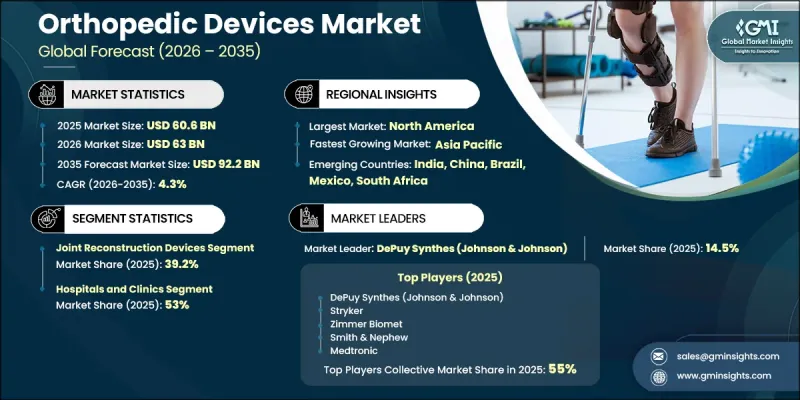
The Global Orthopedic Devices Market was valued at USD 60.6 billion in 2025 and is estimated to grow at a CAGR of 4.3% to reach USD 92.2 billion by 2035.
Market growth is supported by the rising burden of musculoskeletal disorders, continuous advancements in orthopedic technologies, and increasing demand for advanced treatment solutions. Orthopedic devices include a broad range of implants, surgical instruments, and medical systems developed to address bone, joint, and muscle-related conditions. These solutions are designed to restore movement, manage pain, improve physical function, and enhance overall patient well-being. The growing adoption of regenerative approaches, biologics, and innovative implant technologies is reshaping orthopedic care globally. Increasing cases of sports-related injuries, trauma incidents, and age-associated orthopedic conditions are strengthening demand for specialized devices. In addition, improvements in minimally invasive procedures, robotic-assisted surgeries, customized implants produced through advanced manufacturing techniques, and connected orthopedic technologies are improving surgical outcomes. Rising awareness regarding early diagnosis and treatment options, particularly in developing regions, is further accelerating market expansion and increasing access to advanced orthopedic solutions.
| Market Scope | |
|---|---|
| Start Year | 2025 |
| Forecast Year | 2026-2035 |
| Start Value | $60.6 Billion |
| Forecast Value | $92.2 Billion |
| CAGR | 4.3% |
The joint reconstruction devices segment held a 39.2% share in 2025. The segment's dominance is primarily linked to the increasing occurrence of degenerative joint conditions, rising demand for joint replacement procedures, and the expanding elderly population worldwide. Growing cases of osteoarthritis, rheumatoid arthritis, and injuries affecting joint mobility are contributing to increased adoption of reconstruction implants. The need to restore movement and improve quality of life among patients with joint-related disorders continues to support strong growth opportunities within this segment.
The hospitals and clinics segment held 53% share in 2025. Hospitals remain the primary locations for orthopedic procedures due to their access to specialized surgical infrastructure, trained medical professionals, and advanced treatment technologies. These facilities perform a wide range of orthopedic interventions, including complex implant procedures, spinal treatments, and injury-related surgeries. The availability of advanced operating environments, imaging systems, and modern surgical technologies enables hospitals to handle higher procedure volumes while improving patient care outcomes.
North America Orthopedic Devices Market captured a 55.4% share in 2025. The region's leadership is supported by advanced healthcare systems, substantial medical spending, and rapid adoption of innovative orthopedic technologies. A growing aging population and increasing prevalence of conditions such as arthritis, osteoporosis, and other degenerative joint disorders are creating sustained demand for orthopedic procedures. Strong healthcare infrastructure and continued investment in advanced medical solutions further strengthen North America's position in the global orthopedic devices industry.
Major players operating in the global orthopedic devices industry are Stryker, DePuy Synthes (J&J), Zimmer Biomet, Smith & Nephew, Medtronic, Arthrex, B. Braun, Globus Medical, Enovis, ATEC, CONMED, Integra, Medacta, MicroPort Scientific, ConforMIS, TriMed, aap Implantate, and Waldemar. Companies operating in the orthopedic devices market are strengthening their market presence through product innovation, strategic acquisitions, technological advancements, and expansion into emerging markets. Manufacturers are focusing on developing next-generation implants, minimally invasive surgical solutions, and personalized orthopedic products to improve clinical outcomes and meet changing patient needs. Companies are also investing in research and development activities to introduce advanced materials, digital technologies, and improved surgical techniques. Expanding distribution networks, building partnerships with healthcare providers, and enhancing customer support services are helping companies improve market penetration. Strategic collaborations and portfolio diversification are enabling industry participants to address a broader range of orthopedic conditions while maintaining competitive advantages in a rapidly evolving healthcare environment.
Table of Contents
Chapter 1 Methodology and Scope
- 1.1 Research approach
- 1.2 Quality commitments
- 1.2.1 GMI AI policy & data integrity commitment
- 1.2.1.1 Source consistency protocol
- 1.2.1 GMI AI policy & data integrity commitment
- 1.3 Research trail & confidence scoring
- 1.3.1 Research trail components
- 1.3.2 Scoring components
- 1.4 Data collection
- 1.4.1 Partial list of primary sources
- 1.5 Data mining sources
- 1.5.1 Paid sources
- 1.5.1.1 Sources, by region
- 1.5.1 Paid sources
- 1.6 Base estimates and calculations
- 1.6.1 Base year calculation
- 1.7 Forecast model
- 1.7.1 Quantified market impact analysis
- 1.7.1.1 Mathematical impact of growth parameters on forecast
- 1.7.1 Quantified market impact analysis
- 1.8 Research transparency addendum
- 1.8.1 Source attribution framework
- 1.8.2 Quality assurance metrics
- 1.8.3 Our commitment to trust
Chapter 2 Executive Summary
- 2.1 Industry 360° synopsis
- 2.2 Key market trends
- 2.2.1 Regional trends
- 2.2.2 Product trends
- 2.2.3 End use trends
- 2.3 CXO perspectives: Strategic imperatives
Chapter 3 Industry Insights
- 3.1 Industry ecosystem analysis
- 3.2 Industry impact forces
- 3.2.1 Growth drivers
- 3.2.1.1 Innovation in biologics and regenerative solutions
- 3.2.1.2 Augmented incidence of orthopedic diseases
- 3.2.1.3 Technological advancements
- 3.2.1.4 Escalating rate of orthopedic surgeries in developed nations
- 3.2.2 Industry pitfalls and challenges
- 3.2.2.1 Excessive cost of orthopedic devices
- 3.2.2.2 Stringent FDA regulations and biocompatibility issues
- 3.2.3 Market opportunities
- 3.2.3.1 Rising adoption of minimally invasive orthopedic procedures
- 3.2.3.2 Expanding healthcare infrastructure in emerging economies
- 3.2.1 Growth drivers
- 3.3 Growth potential analysis
- 3.4 Regulatory landscape
- 3.4.1 North America
- 3.4.2 Europe
- 3.4.3 Asia Pacific
- 3.5 Technology landscape
- 3.5.1 Current technological trends
- 3.5.1.1 Portable home-based orthopedic devices
- 3.5.1.2 Digital health remote monitoring
- 3.5.1.3 Patient-friendly oscillatory systems
- 3.5.2 Emerging technologies
- 3.5.2.1 AI respiratory predictive analytics
- 3.5.2.2 Wearable connected orthopedic devices
- 3.5.2.3 Smart adaptive therapy devices
- 3.5.1 Current technological trends
- 3.6 Future market trends
- 3.6.1 Integration of IoT systems
- 3.6.2 Personalized orthopedic solutions
- 3.6.3 Robotics-assisted device applications
- 3.7 Pricing analysis
- 3.8 Patent analysis
- 3.9 Reimbursement scenario
- 3.10 Impact of AI & Generative AI on the Market (Driven by Primary Research)
- 3.11 Gap analysis
- 3.12 Porter's analysis
- 3.13 PESTEL analysis
Chapter 4 Competitive Landscape, 2025
- 4.1 Introduction
- 4.2 Company matrix analysis
- 4.3 Company market share analysis
- 4.3.1 Global
- 4.3.2 North America
- 4.3.3 Europe
- 4.3.4 Asia Pacific
- 4.3.5 LAMEA
- 4.4 Competitive positioning matrix
- 4.5 Competitive analysis of major market players
- 4.6 Key developments
- 4.6.1 Mergers & acquisitions
- 4.6.2 Partnerships & collaborations
- 4.6.3 New service type launches
- 4.6.4 Expansion plans
Chapter 5 Market Estimates and Forecast, By Product, 2022 - 2035 ($ Mn)
- 5.1 Key trends
- 5.2 Joint reconstruction devices
- 5.2.1 Knee replacement
- 5.2.2 Hip replacement
- 5.2.3 Shoulder replacement
- 5.2.4 Ankle replacement
- 5.2.5 Other joint reconstruction devices
- 5.3 Spinal devices
- 5.4 Trauma fixation devices
- 5.5 Orthobiologics
- 5.6 Arthroscopic and sports medicine devices
- 5.7 Other products
Chapter 6 Market Estimates and Forecast, By End Use, 2022 - 2035 ($ Mn)
- 6.1 Key trends
- 6.2 Hospitals & clinics
- 6.3 Ambulatory surgical centers
- 6.4 Other end users
Chapter 7 Market Estimates and Forecast, By Region, 2022 - 2035 ($ Mn)
- 7.1 Key trends
- 7.2 North America
- 7.2.1 U.S.
- 7.2.2 Canada
- 7.3 Europe
- 7.3.1 Germany
- 7.3.2 UK
- 7.3.3 France
- 7.3.4 Spain
- 7.3.5 Italy
- 7.3.6 Netherlands
- 7.4 Asia Pacific
- 7.4.1 China
- 7.4.2 Japan
- 7.4.3 India
- 7.4.4 Australia
- 7.4.5 South Korea
- 7.5 Latin America
- 7.5.1 Brazil
- 7.5.2 Mexico
- 7.5.3 Argentina
- 7.6 Middle East and Africa
- 7.6.1 South Africa
- 7.6.2 Saudi Arabia
- 7.6.3 UAE
Chapter 8 Company Profiles
- 8.1 aap Implantate
- 8.2 Arthrex
- 8.3 ATEC
- 8.4 B. Braun
- 8.5 ConforMIS
- 8.6 CONMED
- 8.7 DePuy Synthes (J&J)
- 8.8 Enovis
- 8.9 Globus Medical
- 8.10 Integra
- 8.11 Medacta
- 8.12 Medtronic
- 8.13 MicroPort Scientific
- 8.14 Smith & Nephew
- 8.15 Stryker
- 8.16 TriMed
- 8.17 Waldemar
- 8.18 Zimmer Biomet

