PUBLISHER: Global Market Insights Inc. | PRODUCT CODE: 2109321

PUBLISHER: Global Market Insights Inc. | PRODUCT CODE: 2109321
Point of Care Ultrasound (POCUS) Market Opportunity, Growth Drivers, Industry Trend Analysis, and Forecast 2026 - 2035
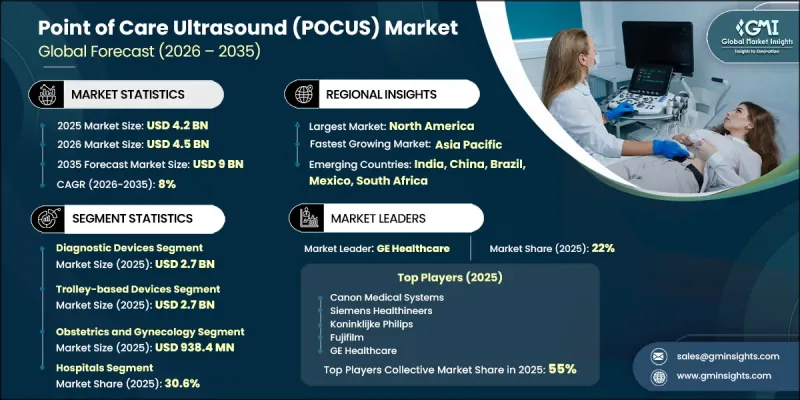
The Global Point of Care Ultrasound (POCUS) Market was valued at USD 4.2 billion in 2025 and is estimated to grow at a CAGR of 8% to reach USD 9 billion by 2035.
Growth across the point of care ultrasound (POCUS) industry is supported by the rising incidence of chronic diseases, rapid technological advancements in portable ultrasound systems, and the expanding global geriatric population. Point-of-care ultrasound refers to the use of compact ultrasound devices that allow healthcare professionals to perform imaging directly at the patient's location, enabling immediate clinical assessment and faster treatment decisions. Unlike conventional imaging systems that require dedicated diagnostic departments, POCUS delivers real-time visualization during patient care, improving workflow efficiency and reducing diagnostic delays. Growing demand for rapid bedside imaging, combined with the increasing prevalence of age-related conditions, is encouraging wider adoption of these systems across healthcare settings. Continuous innovation is also improving device portability, imaging quality, processing speed, and ease of operation, making point-of-care ultrasound increasingly valuable for modern clinical practice. As healthcare providers continue to prioritize faster diagnosis, improved patient outcomes, and greater accessibility to imaging technologies, the global point of care ultrasound (POCUS) market is expected to witness sustained long-term expansion.
| Market Scope | |
|---|---|
| Start Year | 2025 |
| Forecast Year | 2026-2035 |
| Start Value | $4.2 Billion |
| Forecast Value | $9 Billion |
| CAGR | 8% |
The global point of care ultrasound (POCUS) industry continues to evolve through ongoing technological innovation that is enhancing the performance, mobility, and usability of portable ultrasound systems. Improvements in imaging capabilities and device functionality are enabling healthcare professionals to perform rapid diagnostic evaluations while supporting more informed clinical decision-making. The growing emphasis on accessible, real-time imaging solutions is encouraging broader adoption of POCUS technologies across diverse healthcare environments. Continued investment in advanced ultrasound technologies is expected to further strengthen market growth while improving diagnostic efficiency and patient care.
The diagnostic devices segment generated USD 2.7 billion in 2025. Its strong market position is supported by the essential role these systems play in providing immediate diagnostic imaging during patient care. Real-time visualization of internal structures enables healthcare professionals to accelerate diagnosis, support timely clinical interventions, and improve decision-making across a wide range of medical applications. Growing reliance on rapid imaging technologies continues to reinforce demand for advanced diagnostic devices throughout the forecast period.
The hospitals segment held 30.6% share in 2025. Hospitals continue to lead market demand due to the extensive use of bedside ultrasound technologies throughout various clinical departments. The ability to perform immediate imaging during patient evaluation supports faster diagnosis, guides medical procedures, enhances treatment planning, and improves overall patient outcomes. Increasing investment in advanced diagnostic equipment and the growing need for efficient patient management continue to strengthen adoption across hospital settings.
North America Point of Care Ultrasound (POCUS) Market accounted for 42.5% share in 2025. Regional growth is being driven by advanced healthcare infrastructure, continued technological progress, and increasing demand for rapid diagnostic imaging solutions. The rising burden of chronic diseases is encouraging healthcare providers to adopt portable ultrasound systems that improve diagnostic accuracy while supporting timely clinical decision-making. Continued investments in healthcare innovation and advanced medical technologies are expected to further strengthen the region's leadership throughout the forecast period.
Major companies operating in the global point of care ultrasound (POCUS) market include Butterfly Network, Canon Medical Systems, Clarius Mobile Health, Chison Medical Imaging, Esaote SpA, Fujifilm, Fukuda Denshi, BenQ Medical Technology, GE Healthcare, Koninklijke Philips, Shenzhen Mindray, Siemens Healthineers, SAMSUNG Healthcare, Viatom Technology, and Vave Health. Companies operating in the point of care ultrasound (POCUS) industry are strengthening their market position by investing in advanced imaging technologies, artificial intelligence integration, and product innovation to improve diagnostic performance and workflow efficiency. Manufacturers are focusing on developing highly portable, user-friendly systems with enhanced imaging capabilities and digital connectivity to support a broader range of clinical applications. Strategic partnerships with healthcare providers, research organizations, and distribution partners are helping companies expand their market reach and accelerate product adoption. Businesses are also increasing investments in research and development, regulatory compliance, and manufacturing capabilities to improve product quality and scalability.
Table of Contents
Chapter 1 Methodology and Scope
- 1.1 Market scope and definition
- 1.2 Research design
- 1.2.1 Research approach
- 1.2.2 Data collection methods
- 1.3 Data mining sources
- 1.3.1 Global
- 1.3.2 Regional/Country
- 1.4 Base estimates and calculations
- 1.4.1 Base year calculation
- 1.4.2 Key trends for market estimation
- 1.5 Primary research and validation
- 1.5.1 Primary sources
- 1.6 Forecast model
- 1.7 Research assumptions and limitations
Chapter 2 Executive Summary
- 2.1 Industry 360° synopsis
- 2.2 Key market trends
- 2.2.1 Regional trends
- 2.2.2 Type trends
- 2.2.3 Portability trends
- 2.2.4 Application trends
- 2.2.5 End use trends
- 2.3 CXO perspectives: Strategic imperatives
- 2.3.1 Key decision points for industry executives
- 2.3.2 Critical success factors for market players
- 2.4 Future outlook and strategic recommendations
Chapter 3 Industry Insights
- 3.1 Industry ecosystem analysis
- 3.2 Industry impact forces
- 3.2.1 Growth drivers
- 3.2.1.1 Increasing prevalence of chronic diseases
- 3.2.1.2 Rising demand for bedside diagnostics
- 3.2.1.3 Technological advancements in POCUS systems
- 3.2.1.4 Growing geriatric population base
- 3.2.2 Industry pitfalls and challenges
- 3.2.2.1 High cost of POCUS devices
- 3.2.2.2 Stringent regulatory scenario
- 3.2.3 Market opportunities
- 3.2.3.1 Growing healthcare expansion in emerging economies
- 3.2.3.2 Integration of multiplex POC diagnostics into POCUS-led clinical workflows
- 3.2.1 Growth drivers
- 3.3 Growth potential analysis
- 3.4 Regulatory landscape
- 3.4.1 North America
- 3.4.2 Europe
- 3.4.3 Asia Pacific
- 3.4.4 Latin America
- 3.4.5 Middle East and Africa
- 3.5 Technological advancements
- 3.5.1 Current technological trends
- 3.5.2 Emerging technologies
- 3.6 Pricing trend analysis
- 3.7 Future market trends
- 3.8 Porter's analysis
- 3.9 PESTEL analysis
- 3.10 Impact of AI and Generative AI on the market (Driven by primary research)
- 3.11 Value chain analysis (Driven by primary research)
- 3.12 Treatment infrastructure and clinical adoption landscape (Driven by primary research)
Chapter 4 Competitive Landscape, 2025
- 4.1 Introduction
- 4.2 Company matrix analysis
- 4.3 Company market share analysis (Driven by primary research)
- 4.3.1 Global
- 4.3.2 North America
- 4.3.3 Europe
- 4.3.4 Asia Pacific
- 4.4 Competitive positioning matrix
- 4.5 Competitive analysis of major market players
- 4.6 Key developments
- 4.6.1 Mergers & acquisitions
- 4.6.2 Partnerships & collaborations
- 4.6.3 New product launches
- 4.6.4 Expansion plans
Chapter 5 Market Estimates and Forecast, By Type, 2022 - 2035 ($ Mn)
- 5.1 Key trends
- 5.2 Diagnostic devices
- 5.3 Therapeutic devices
Chapter 6 Market Estimates and Forecast, By Portability, 2022 - 2035 ($ Mn)
- 6.1 Key trends
- 6.2 Trolley based devices
- 6.3 Handheld devices
Chapter 7 Market Estimates and Forecast, By Application, 2022 - 2035 ($ Mn)
- 7.1 Key trends
- 7.2 Emergency medicine
- 7.3 Cardiology
- 7.4 Obstetrics and gynecology
- 7.5 Urology
- 7.6 Vascular surgery
- 7.7 Musculoskeletal
- 7.8 Other end users
Chapter 8 Market Estimates and Forecast, By End Use, 2022 - 2035 ($ Mn)
- 8.1 Key trends
- 8.2 Hospitals
- 8.3 Clinics
- 8.4 Maternity centers
- 8.5 Ambulatory surgical centers (ASCs)
- 8.6 Other end users
Chapter 9 Market Estimates and Forecast, By Region, 2022 - 2035 ($ Mn)
- 9.1 Key trends
- 9.2 North America
- 9.2.1 U.S.
- 9.2.2 Canada
- 9.3 Europe
- 9.3.1 Germany
- 9.3.2 UK
- 9.3.3 France
- 9.3.4 Spain
- 9.3.5 Italy
- 9.3.6 Netherlands
- 9.4 Asia Pacific
- 9.4.1 China
- 9.4.2 India
- 9.4.3 Japan
- 9.4.4 Australia
- 9.4.5 South Korea
- 9.5 Latin America
- 9.5.1 Brazil
- 9.5.2 Mexico
- 9.5.3 Argentina
- 9.6 Middle East and Africa
- 9.6.1 Saudi Arabia
- 9.6.2 South Africa
- 9.6.3 UAE
Chapter 10 Company Profiles
- 10.1 Butterfly Network
- 10.2 Canon Medical Systems
- 10.3 Clarius Mobile Health
- 10.4 Chison Medical Imaging
- 10.5 Esaote SpA
- 10.6 Fujifilm
- 10.7 Fukuda Denshi
- 10.8 BenQ Medical Technology
- 10.9 GE Healthcare
- 10.10 Koninklijke Philips
- 10.11 Shenzhen Mindray
- 10.12 Siemens Healthineers
- 10.13 SAMSUNG Healthcare
- 10.14 Viatom Technology
- 10.15 Vave Health

