PUBLISHER: Global Market Insights Inc. | PRODUCT CODE: 2121099

PUBLISHER: Global Market Insights Inc. | PRODUCT CODE: 2121099
Eye-Safe Laser Rangefinder Module Market Opportunity, Growth Drivers, Industry Trend Analysis, and Forecast 2026 - 2035
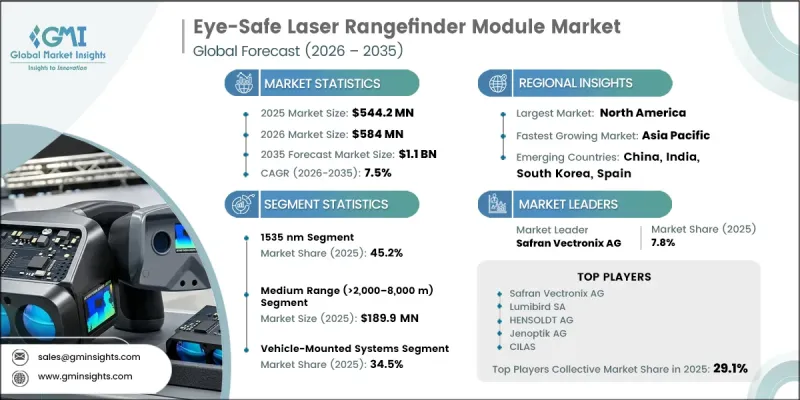
The Global Eye-Safe Laser Rangefinder Module Market was valued at USD 544.2 million in 2025 and is estimated to grow at a CAGR of 7.5% to reach USD 1.1 billion by 2035.
Market growth is being supported by the continued modernization of defense capabilities and the wider adoption of laser safety requirements. Increasing deployment of unmanned and autonomous platforms is also creating demand for compact and reliable distance measurement technologies. At the same time, surveying and industrial applications are generating additional opportunities as organizations seek accurate and dependable distance measurement solutions. Ongoing advances in eye-safe photonics are further improving the performance and practicality of laser rangefinder modules. Manufacturers are focusing on developing solutions that combine high measurement accuracy with compact dimensions, lower weight, and efficient operation. These improvements are expanding the potential use of eye-safe laser rangefinder modules across defense and commercial environments. Growing demand for precision sensing, combined with continued development of advanced electro-optical technologies, is encouraging investment in next-generation rangefinder solutions. As users increasingly prioritize operational safety alongside performance, eye-safe laser technologies are gaining importance in applications requiring accurate distance measurement. These trends are expected to support continued expansion of the eye-safe laser rangefinder module market through 2035.
| Market Scope | |
|---|---|
| Start Year | 2025 |
| Forecast Year | 2026-2035 |
| Start Value | $544.2 Million |
| Forecast Value | $1.1 Billion |
| CAGR | 7.5% |
The medium range (>2,000-8,000 m) segment held USD 189.9 million in 2025. Demand for medium-range modules is supported by their broad integration into defense and security systems requiring dependable distance measurement. These modules provide a practical balance between detection distance, measurement accuracy, compact size, and power requirements. Their performance characteristics make them suitable for standard battlefield requirements as well as security and industrial operations. Medium-range solutions also remain attractive because they can support eye-safe operation using 1535 nm and 1550 nm laser sources. Their comparatively lower complexity and cost compared with long-range alternatives further contribute to their continued demand across defense and commercial applications.
The 1535 nm segment accounted for 45.2% share in 2025. The segment's leading position is supported by the favorable combination of extended-distance performance, strong atmospheric transmission, and Class 1 laser eye-safety characteristics. These properties make 1535 nm technology an attractive option for applications that require reliable range measurement while maintaining stringent safety requirements. Continued adoption of this wavelength is supporting its dominant position within the eye-safe laser rangefinder module industry.
North America Eye-Safe Laser Rangefinder Module Market captured a 32.8% share in 2025. Regional growth is being driven by ongoing defense modernization programs and increasing procurement of advanced electro-optical systems. Rising investment in border surveillance capabilities and precision targeting technologies is also contributing to demand for eye-safe laser rangefinder modules. The continued development of advanced defense and security infrastructure is creating favorable opportunities for manufacturers and technology providers across the region.
Prominent companies operating in the global eye-safe laser rangefinder module market include Lumibird SA, HENSOLDT AG, CILAS, Safran Vectronix AG, Jenoptik AG, Newcon Optik Inc., ERDI Tech Ltd., LumiSpot Tech Co., Ltd., Eyoung Technology Co., Ltd., LaserWorks Co., Ltd., Jinan Farsight Electro-optical Technology Co., Ltd., IADIY Technology Co., Ltd., Jioptic Technology Co., Ltd., Lumimetric Technology Co., Ltd., Newtron Technology Co., Ltd., and Raythink Technology Co., Ltd. Companies in the global eye-safe laser rangefinder module market are focusing on product innovation, photonics technology development, strategic partnerships, and portfolio expansion to strengthen their competitive positions. Manufacturers are investing in research and development to improve range accuracy, detection performance, compactness, weight, and power efficiency. Companies are also developing advanced modules based on eye-safe laser wavelengths to address increasingly stringent operational and safety requirements. Strategic collaborations with defense contractors, electro-optical system providers, and industrial customers are helping participants expand application opportunities and accelerate product development. Manufacturers are broadening their portfolios to serve different distance measurement requirements across defense, security, surveying, and industrial applications. Investment in miniaturization and advanced optical technologies is helping companies develop more portable and efficient solutions. Regional expansion is also supporting market penetration as companies target growing demand for advanced sensing and ranging technologies. These strategies are enabling market participants to improve product differentiation, strengthen customer relationships, and establish a stronger foothold in the global eye-safe laser rangefinder module industry.
Table of Contents
Chapter 1 Methodology and Scope
- 1.1 Market scope and definition
- 1.2 Research design
- 1.2.1 Research approach
- 1.2.2 Data collection methods
- 1.3 Data mining sources
- 1.3.1 Global
- 1.3.2 Regional/Country
- 1.4 Base estimates and calculations
- 1.4.1 Base year calculation
- 1.4.2 Key trends for market estimation
- 1.5 Primary research and validation
- 1.5.1 Primary sources
- 1.6 Forecast model
- 1.7 Research assumptions and limitations
Chapter 2 Executive Summary
- 2.1 Industry 360° synopsis, 2022 – 2035
- 2.2 Key market trends
- 2.2.1 Operating Wavelength trends
- 2.2.2 Measurement Range trends
- 2.2.3 Platform trends
- 2.2.4 Regional trends
- 2.3 TAM Analysis, 2026-2035
- 2.4 CXO perspectives: Strategic imperatives
Chapter 3 Industry Insights
- 3.1 Industry ecosystem analysis
- 3.1.1 Supplier Landscape
- 3.1.2 Profit Margin
- 3.1.3 Cost structure
- 3.1.4 Value addition at each stage
- 3.1.5 Factor affecting the value chain
- 3.1.6 Disruptions
- 3.2 Industry impact forces
- 3.2.1 Growth drivers
- 3.2.1.1 Rising defense modernization and soldier digitization programs
- 3.2.1.2 Stringent laser safety regulations and adoption of eye-safe wavelengths
- 3.2.1.3 Growing deployment of autonomous systems and unmanned platforms
- 3.2.1.4 Expansion of precision surveying, industrial automation, and infrastructure inspection
- 3.2.1.5 Advancements in photonics, fiber lasers, and detector technologies
- 3.2.2 Industry pitfalls and challenges
- 3.2.2.1 High cost of advanced eye-safe laser components
- 3.2.2.2 Performance limitations under adverse environmental conditions
- 3.2.3 Market opportunities
- 3.2.3.1 Expansion of autonomous platforms and next-generation defense systems
- 3.2.3.2 Advancements in photonic integration and solid-state laser technologies
- 3.2.1 Growth drivers
- 3.3 Growth potential analysis
- 3.4 Regulatory landscape
- 3.4.1 North America
- 3.4.2 Europe
- 3.4.3 Asia Pacific
- 3.4.4 Latin America
- 3.4.5 Middle East & Africa
- 3.5 Porter’s analysis
- 3.6 PESTEL analysis
- 3.7 Technology and Innovation landscape
- 3.7.1 Current technological trends
- 3.7.2 Emerging technologies
- 3.8 Price trends
- 3.8.1 By region
- 3.8.2 By product
- 3.9 Pricing Strategies
- 3.10 Emerging Business Models
- 3.11 Compliance Requirements
- 3.12 Patent and IP analysis
Chapter 4 Competitive Landscape, 2025
- 4.1 Introduction
- 4.2 Company market share analysis
- 4.2.1 By region
- 4.2.1.1 North America
- 4.2.1.2 Europe
- 4.2.1.3 Asia Pacific
- 4.2.1.4 Latin America
- 4.2.1.5 Middle East & Africa
- 4.2.2 Market concentration analysis
- 4.2.1 By region
- 4.3 Competitive benchmarking of key players
- 4.3.1 Financial performance comparison
- 4.3.1.1 Revenue
- 4.3.1.2 Profit margin
- 4.3.1.3 R&D
- 4.3.2 Product portfolio comparison
- 4.3.2.1 Product range breadth
- 4.3.2.2 Technology
- 4.3.2.3 Innovation
- 4.3.3 Geographic presence comparison
- 4.3.3.1 Global footprint analysis
- 4.3.3.2 Service network coverage
- 4.3.3.3 Market penetration by region
- 4.3.4 Competitive positioning matrix
- 4.3.4.1 Leaders
- 4.3.4.2 Challengers
- 4.3.4.3 Followers
- 4.3.4.4 Niche players
- 4.3.5 Strategic outlook matrix
- 4.3.1 Financial performance comparison
- 4.4 Key developments
- 4.4.1 Mergers and acquisitions
- 4.4.2 Partnerships and collaborations
- 4.4.3 Technological advancements
- 4.4.4 Expansion and investment strategies
- 4.4.5 Digital transformation initiatives
- 4.5 Emerging/ startup competitors landscape
Chapter 5 Market Estimates and Forecast, By Operating Wavelength, 2022 – 2035 (USD Million)
- 5.1 Key trends
- 5.2 905 nm
- 5.3 1535 nm
- 5.4 1550 nm
- 5.5 1570 nm
Chapter 6 Market Estimates and Forecast, By Measurement Range, 2022 – 2035 (USD Million)
- 6.1 Key trends
- 6.2 Short Range (≤2,000 m)
- 6.3 Medium Range (>2,000–8,000 m)
- 6.4 Long Range (>8,000–20,000 m)
- 6.5 Ultra-Long Range (>20,000 m)
Chapter 7 Market Estimates and Forecast, By Platform, 2022 – 2035 (USD Million)
- 7.1 Key trends
- 7.2 Handheld & man-portable systems
- 7.3 Vehicle-mounted systems
- 7.4 Airborne & UAV/UAS payloads
- 7.5 Naval & maritime systems
- 7.6 Fixed installation systems
- 7.7 Industrial & commercial equipment
Chapter 8 Market Estimates and Forecast, By Region, 2022 – 2035 (USD Million)
- 8.1 Key trends
- 8.2 North America
- 8.2.1 U.S.
- 8.2.2 Canada
- 8.3 Europe
- 8.3.1 Germany
- 8.3.2 UK
- 8.3.3 France
- 8.3.4 Spain
- 8.3.5 Italy
- 8.4 Asia Pacific
- 8.4.1 China
- 8.4.2 India
- 8.4.3 Japan
- 8.4.4 Australia
- 8.4.5 South Korea
- 8.5 Latin America
- 8.5.1 Brazil
- 8.5.2 Mexico
- 8.5.3 Argentina
- 8.6 Middle East and Africa
- 8.6.1 South Africa
- 8.6.2 Saudi Arabia
- 8.6.3 UAE
Chapter 9 Company Profiles
- 9.1 Global Key Players
- 9.1.1 Safran Vectronix AG
- 9.1.2 Lumibird SA
- 9.1.3 HENSOLDT AG
- 9.1.4 Jenoptik AG
- 9.1.5 CILAS
- 9.2 Regional key players
- 9.2.1 North America
- 9.2.1.1 Newcon Optik Inc.
- 9.2.2 Asia Pacific
- 9.2.2.1 ERDI Tech Ltd.
- 9.2.2.2 Jinan Farsight Electro-optical Technology Co., Ltd.
- 9.2.2.3 Lumimetric Technology Co., Ltd.
- 9.2.2.4 IADIY Technology Co., Ltd.
- 9.2.2.5 Raythink Technology Co., Ltd
- 9.2.1 North America
- 9.3 Niche Players/Disruptors
- 9.3.1 LumiSpot Tech Co., Ltd.
- 9.3.2 Jioptic Technology Co., Ltd.
- 9.3.3 LaserWorks Co., Ltd.
- 9.3.4 Newtron Technology Co., Ltd.
- 9.3.5 Eyoung Technology Co., Ltd.

