PUBLISHER: Global Market Insights Inc. | PRODUCT CODE: 2121118

PUBLISHER: Global Market Insights Inc. | PRODUCT CODE: 2121118
Quantum Navigation Market Opportunity, Growth Drivers, Industry Trend Analysis, and Forecast 2026 - 2035
The Global Quantum Navigation Market was valued at USD 1 billion in 2025 and is estimated to grow at a CAGR of 21.6% to reach USD 7.3 billion by 2035.
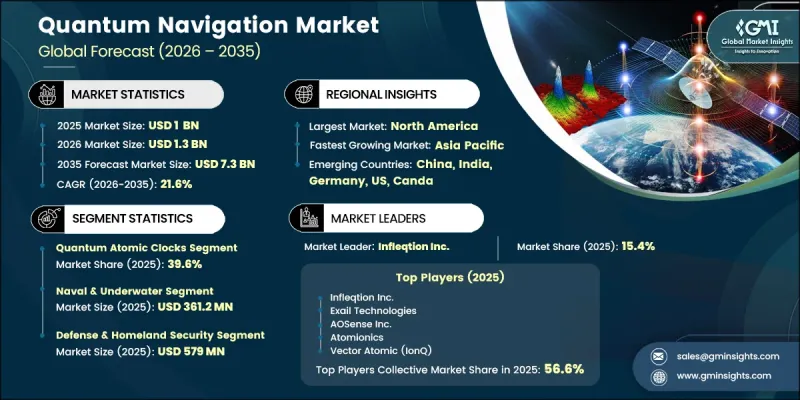
The quantum navigation market is expanding as demand rises for reliable positioning, navigation, and timing (PNT) capabilities that can operate independently of conventional satellite navigation signals. Growing exposure to signal disruption is encouraging defense and other critical sectors to explore resilient navigation technologies. At the same time, increased defense spending on secure PNT systems is creating favorable opportunities for quantum navigation developers. Continued advances in quantum magnetometers and atom-based inertial sensors are improving the capabilities of next-generation navigation platforms and supporting broader commercialization. The technology also offers growing potential across aviation, maritime operations, robotics, and autonomous platforms that require dependable positioning capabilities. Public funding for quantum science and technology programs is further supporting research, development, and deployment efforts in this field. As investments increase and sensor technologies mature, industry participants are working to improve accuracy, reliability, integration, and operational performance. These developments are strengthening the foundation for wider adoption of quantum navigation systems and supporting rapid market growth through the forecast period.
| Market Scope | |
|---|---|
| Start Year | 2025 |
| Forecast Year | 2026-2035 |
| Start Value | $1 Billion |
| Forecast Value | $7.3 Billion |
| CAGR | 21.6% |
The quantum atomic clocks segment held a 39.6% share in 2025. The segment is benefiting from the critical role of highly accurate timing and synchronization in position, navigation, and timing (PNT) services. Quantum atomic clocks can help navigation systems maintain accurate positioning information when GNSS signal availability is limited or compromised. Their ability to provide precise timing is therefore supporting their importance within advanced navigation architectures and contributing to the segment's leading market position.
The naval & underwater segment captured USD 361.2 million in 2025. The segment's strong performance reflects the growing requirement for dependable navigation capabilities in environments where conventional satellite-based positioning may not be available. Robust navigation technologies are particularly important for operations that require consistent positioning and timing performance under challenging conditions. Increasing attention toward reliable navigation capabilities for naval and underwater applications is therefore supporting continued demand within this segment.
North America Quantum Navigation Market accounted for 41.1% share in 2025. The regional market is gaining momentum as defense, aerospace, maritime, and autonomous platforms place greater emphasis on dependable position, navigation, and timing systems. Government agencies and military organizations are increasingly exploring alternative PNT technologies that can maintain operational functionality when GPS signals are unavailable or affected by interference. Continued investment in advanced navigation capabilities and quantum technology development is supporting regional market expansion and reinforcing North America's position within the global quantum navigation industry.
Prominent companies operating in the global quantum navigation market include Exail Technologies, AOSense Inc., Infleqtion Inc., Q.ANT GmbH, Aquark Technologies, Vector Atomic (IonQ), Atomionics, SBQuantum, Delta g Ltd., M Squared Lasers, Dirac Labs, Mesa Quantum, Nomad Atomics, QuBeats, and Shanghai Quantum Sensing. Companies in the global quantum navigation market are pursuing research and development, technology partnerships, product innovation, and strategic expansion to strengthen their competitive positions. Market participants are focusing on improving the accuracy, stability, sensitivity, and reliability of quantum sensors used in navigation systems. Developers are also advancing quantum magnetometers and atom-based inertial sensing technologies to address the growing need for resilient PNT capabilities. Strategic collaborations with technology providers and end users are helping companies accelerate product development and support commercialization. Participants are also working to improve the integration of quantum navigation technologies with existing navigation architectures and autonomous platforms. Expansion into defense, aerospace, maritime, and other high-value applications is helping companies broaden their customer base. Continued investment in miniaturization, system performance, and deployment readiness is enabling market participants to move quantum navigation technologies closer to practical large-scale adoption while strengthening their overall market foothold.
Table of Contents
Chapter 1 Methodology and Scope
- 1.1 Market scope and definition
- 1.2 Research design
- 1.2.1 Research approach
- 1.2.2 Data collection methods
- 1.3 Data mining sources
- 1.3.1 Global
- 1.3.2 Regional/Country
- 1.4 Base estimates and calculations
- 1.4.1 Base year calculation
- 1.4.2 Key trends for market estimation
- 1.5 Primary research and validation
- 1.5.1 Primary sources
- 1.6 Forecast model
- 1.7 Research assumptions and limitations
Chapter 2 Executive Summary
- 2.1 Industry 360° synopsis, 2022 – 2035
- 2.2 Key market trends
- 2.2.1 Technology trends
- 2.2.2 Platform trends
- 2.2.3 End use industry trends
- 2.2.4 Regional trends
- 2.3 TAM Analysis, 2026-2035
- 2.4 CXO perspectives: Strategic imperatives
Chapter 3 Industry Insights
- 3.1 Industry ecosystem analysis
- 3.1.1 Supplier Landscape
- 3.1.2 Profit Margin
- 3.1.3 Cost structure
- 3.1.4 Value addition at each stage
- 3.1.5 Factor affecting the value chain
- 3.1.6 Disruptions
- 3.2 Industry impact forces
- 3.2.1 Growth drivers
- 3.2.1.1 Growing need for GPS/GNSS-independent navigation amid rising jamming and spoofing threats
- 3.2.1.2 Increasing defence investment in resilient quantum-based positioning, navigation and timing (PNT)
- 3.2.1.3 Rapid advancement of quantum magnetometers, atom interferometers and inertial sensors
- 3.2.1.4 Growing adoption potential across aircraft, naval vessels and autonomous platforms
- 3.2.1.5 Expanding government quantum programmes and funding for commercialization
- 3.2.2 Industry pitfalls and challenges
- 3.2.2.1 High cost and complexity of quantum navigation systems
- 3.2.2.2 Challenges in miniaturization, ruggedization and real-world deployment
- 3.2.3 Market opportunities
- 3.2.3.1 Development of compact and integrated quantum sensors for navigation
- 3.2.3.2 Integration of quantum navigation with conventional inertial and GNSS systems
- 3.2.1 Growth drivers
- 3.3 Growth potential analysis
- 3.4 Regulatory landscape
- 3.4.1 North America
- 3.4.2 Europe
- 3.4.3 Asia Pacific
- 3.4.4 Latin America
- 3.4.5 Middle East & Africa
- 3.5 Porter’s analysis
- 3.6 PESTEL analysis
- 3.7 Technology and Innovation landscape
- 3.7.1 Current technological trends
- 3.7.2 Emerging technologies
- 3.8 Price trends
- 3.8.1 By region
- 3.8.2 By product
- 3.9 Pricing Strategies
- 3.10 Emerging Business Models
- 3.11 Compliance Requirements
- 3.12 Patent and IP analysis
Chapter 4 Competitive Landscape, 2025
- 4.1 Introduction
- 4.2 Company market share analysis
- 4.2.1 By region
- 4.2.1.1 North America
- 4.2.1.2 Europe
- 4.2.1.3 Asia Pacific
- 4.2.1.4 Latin America
- 4.2.1.5 Middle East & Africa
- 4.2.2 Market concentration analysis
- 4.2.1 By region
- 4.3 Competitive benchmarking of key players
- 4.3.1 Financial performance comparison
- 4.3.1.1 Revenue
- 4.3.1.2 Profit margin
- 4.3.1.3 R&D
- 4.3.2 Product portfolio comparison
- 4.3.2.1 Product range breadth
- 4.3.2.2 Technology
- 4.3.2.3 Innovation
- 4.3.3 Geographic presence comparison
- 4.3.3.1 Global footprint analysis
- 4.3.3.2 Service network coverage
- 4.3.3.3 Market penetration by region
- 4.3.4 Competitive positioning matrix
- 4.3.4.1 Leaders
- 4.3.4.2 Challengers
- 4.3.4.3 Followers
- 4.3.4.4 Niche players
- 4.3.5 Strategic outlook matrix
- 4.3.1 Financial performance comparison
- 4.4 Key developments
- 4.4.1 Mergers and acquisitions
- 4.4.2 Partnerships and collaborations
- 4.4.3 Technological advancements
- 4.4.4 Expansion and investment strategies
- 4.4.5 Digital transformation initiatives
- 4.5 Emerging/ startup competitors landscape
Chapter 5 Market Estimates and Forecast, By Technology, 2022 – 2035 (USD Million)
- 5.1 Key trends
- 5.2 Cold atom interferometry
- 5.3 Quantum atomic clocks
- 5.4 Nitrogen-vacancy (nv) diamond sensors
- 5.5 Squid-based sensors
- 5.6 Others
Chapter 6 Market Estimates and Forecast, By Platform, 2022 – 2035 (USD Million)
- 6.1 Key trends
- 6.2 Airborne
- 6.3 Naval & underwater
- 6.4 Ground/land-based
- 6.5 Space-based
Chapter 7 Market Estimates and Forecast, By End Use Industry, 2022 – 2035 (USD Million)
- 7.1 Key trends
- 7.2 Defense & homeland security
- 7.3 Aerospace & aviation
- 7.4 Maritime & underwater
- 7.5 Space
- 7.6 Industrial & surveying
- 7.7 Autonomous mobility
- 7.8 Others
Chapter 8 Market Estimates and Forecast, By Region, 2022 – 2035 (USD Million)
- 8.1 Key trends
- 8.2 North America
- 8.2.1 U.S.
- 8.2.2 Canada
- 8.3 Europe
- 8.3.1 Germany
- 8.3.2 UK
- 8.3.3 France
- 8.3.4 Spain
- 8.3.5 Italy
- 8.4 Asia Pacific
- 8.4.1 China
- 8.4.2 India
- 8.4.3 Japan
- 8.4.4 Australia
- 8.4.5 South Korea
- 8.5 Latin America
- 8.5.1 Brazil
- 8.5.2 Mexico
- 8.5.3 Argentina
- 8.6 Middle East and Africa
- 8.6.1 South Africa
- 8.6.2 Saudi Arabia
- 8.6.3 UAE
Chapter 9 Company Profiles
- 9.1 Global Key Players
- 9.1.1 Infleqtion Inc.
- 9.1.2 Exail Technologies
- 9.1.3 AOSense Inc.
- 9.1.4 Atomionics
- 9.1.5 Vector Atomic (IonQ)
- 9.2 Regional key players
- 9.2.1 North America
- 9.2.1.1 QuBeats
- 9.2.1.2 SBQuantum
- 9.2.1.3 Mesa Quantum
- 9.2.2 Asia Pacific
- 9.2.2.1 Nomad Atomics
- 9.2.2.2 Shanghai Quantum Sensing
- 9.2.3 Europe
- 9.2.3.1 M Squared Lasers
- 9.2.3.2 Q.ANT GmbH
- 9.2.3.3 Aquark Technologies
- 9.2.3.4 Delta g Ltd.
- 9.2.1 North America
- 9.3 Niche Players/Disruptors
- 9.3.1 Dirac Labs

