PUBLISHER: Global Market Insights Inc. | PRODUCT CODE: 2121175

PUBLISHER: Global Market Insights Inc. | PRODUCT CODE: 2121175
Handheld Concrete Saws Market Opportunity, Growth Drivers, Industry Trend Analysis, and Forecast 2026 - 2035
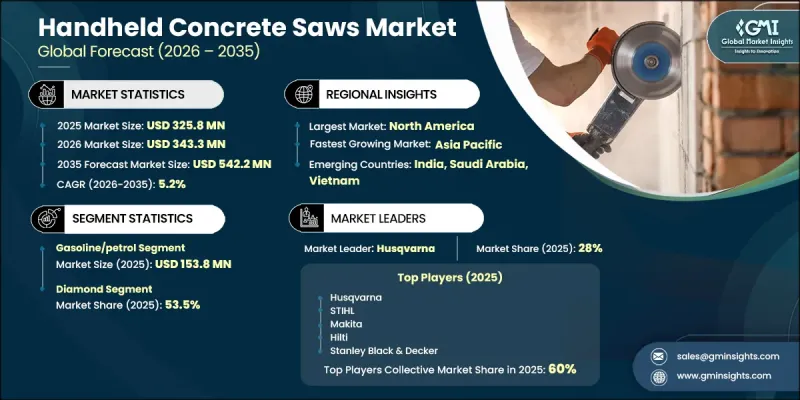
The Global Handheld Concrete Saws Market was valued at USD 325.8 million in 2025 and is estimated to grow at a CAGR of 5.2% to reach USD 542.2 million by 2035.
The market continues to expand as construction and infrastructure activities create sustained demand for efficient, accurate, and dependable concrete cutting equipment. Contractors and construction companies increasingly require tools that can deliver consistent cutting performance while meeting evolving workplace safety and operational requirements. The broad applicability of handheld concrete saws across construction activities gives manufacturers access to a diverse customer base and helps reduce reliance on individual construction segments. Improvements in equipment design, cutting efficiency, portability, dust management, vibration control, and overall operator safety are also supporting product adoption. The market benefits from continued infrastructure development, renovation activity, and demand for professional-grade equipment that can handle demanding cutting operations. Manufacturers are responding to these requirements by developing solutions that improve productivity while addressing increasingly stringent safety expectations. As construction companies continue to prioritize equipment efficiency, reliability, and compliance, demand for handheld concrete saws is expected to maintain steady growth through 2035.
| Market Scope | |
|---|---|
| Start Year | 2025 |
| Forecast Year | 2026-2035 |
| Start Value | $325.8 Million |
| Forecast Value | $542.2 Million |
| CAGR | 5.2% |
The gasoline/petrol-powered handheld concrete saws segment accounted for USD 153.8 million in 2025. These saws continue to maintain strong demand in markets where access to battery-charging facilities or dependable electrical infrastructure remains limited. Their ability to operate independently from fixed electrical sources makes them suitable for locations where continuous access to power cannot be assured. Fuel distribution networks also support the continued use of gasoline-powered equipment across numerous markets. The combination of mobility, operating independence, and suitability for demanding cutting requirements continues to preserve the importance of gasoline/petrol-powered saws within the handheld concrete saws industry.
The diamond segments held a 53.5% share in 2025. The strong position of diamond segment cutting tools reflects the continued preference for cutting solutions that deliver high precision, durability, and consistent performance. Professional users increasingly favor diamond-based cutting technologies because they can support demanding concrete cutting requirements while helping improve operational efficiency and cutting accuracy. Their performance characteristics also allow contractors to address quality and regulatory requirements more effectively. Husqvarna remains an important participant in the diamond segment cutting tools market, with its product portfolio supporting the company's position among manufacturers serving professional users.
U.S. Handheld Concrete Saws Market accounted for an 85.6% share, generating USD 94.2 million in 2025. North America maintains a mature position in the handheld concrete saws industry, supported by an established professional contractor base and strong demand for specialized construction equipment. Contractors across the region place considerable emphasis on equipment ownership, productivity, durability, and operational reliability. Workplace safety requirements under OSHA standards are also influencing equipment selection, encouraging professional users to adopt saws equipped with integrated features designed to improve dust control and reduce vibration.
Key players operating in the global handheld concrete saws industry include Husqvarna AB, Hilti AG, Robert Bosch GmbH, Makita Corporation, Andreas Stihl AG & Co. KG, Milwaukee Tool, Stanley Black & Decker / DeWalt, Koki Holdings Co., Ltd., Wacker Neuson SE, MK Diamond Products, Inc., ECHO Inc., Saint-Gobain Abrasives, Flex-Elektrowerkzeuge GmbH, Evolution Power Tools Ltd., ICS / Oregon Tool, Inc., Diamond Products Co., Tyrolit Group, Golz GmbH, CS Unitec, Inc., iQ Power Tools, and Multiquip Inc. Companies in the handheld concrete saws market are strengthening their positions by expanding product portfolios, improving cutting performance, and developing equipment that addresses changing contractor requirements. Manufacturers are investing in research and development to enhance power efficiency, durability, ergonomics, dust management, vibration reduction, and operator safety. Companies are also broadening their distribution networks to improve product availability across established and emerging construction markets. Strategic partnerships, product launches, technology upgrades, and regional expansion remain important approaches for increasing market reach. Leading participants are focusing on professional-grade solutions that can improve productivity while meeting increasingly demanding workplace requirements. Manufacturers are also strengthening after-sales support, service capabilities, and customer relationships to encourage brand loyalty.
Table of Contents
Chapter 1 Methodology
- 1.1 Research approach
- 1.2 Quality Commitments
- 1.2.1 GMI AI policy & data integrity commitment
- 1.2.1.1 Source consistency protocol
- 1.2.1 GMI AI policy & data integrity commitment
- 1.3 Research Trail & Confidence Scoring
- 1.3.1 Research Trail Components
- 1.3.2 Scoring Components
- 1.4 Data Collection
- 1.4.1 Partial list of primary sources
- 1.5 Data mining sources
- 1.5.1 Paid sources
- 1.5.1.1 Sources, by region
- 1.5.1 Paid sources
- 1.6 Base estimates and calculations
- 1.6.1 Base year calculation for any one approach
- 1.7 Forecast model
- 1.7.1 Quantified market impact analysis
- 1.7.1.1 Mathematical impact of growth parameters on forecast
- 1.7.1 Quantified market impact analysis
- 1.8 Research transparency addendum
- 1.8.1 Source attribution framework
- 1.8.2 Quality assurance metrics
- 1.8.3 Our commitment to trust
Chapter 2 Executive Summary
- 2.1 Industry snapshot
- 2.2 Business trends
- 2.2.1 Power Source trends
- 2.2.2 Blade Type trends
- 2.2.3 End use trends
- 2.2.4 Distribution channel trends
- 2.2.5 Regional trends
Chapter 3 Industry Insights
- 3.1 Industry ecosystem and value chain analysis
- 3.1.1 Raw material & component suppliers (diamond segments, carbide, motor components)
- 3.1.2 Manufacturers & OEMs
- 3.1.3 Distributors, dealers & rental outlets
- 3.1.4 End users
- 3.1.5 Profit margin analysis across the value chain
- 3.2 Industry impact forces
- 3.2.1 Market Driver
- 3.2.1.1 Global Infrastructure Investment Surge
- 3.2.1.2 Battery/Cordless Technology Premium Cycle
- 3.2.1.3 Emerging Market Construction Boom
- 3.2.2 Market challenges/pitfalls
- 3.2.2.1 High Capital Cost and Professional Barrier to Entry
- 3.2.2.2 Foreign Exchange Headwinds on USD-Denominated Market Value
- 3.2.3 Market opportunities
- 3.2.3.1 IoT Connectivity and Smart Tool Integration
- 3.2.3.2 Middle East Vision 2030 and India NIP Mega-Project Pipeline
- 3.2.1 Market Driver
- 3.3 Growth potential analysis
- 3.4 Industry ecosystem analysis
- 3.5 Regulatory framework
- 3.5.1 Occupational health & safety regulations (OSHA, EU machinery directive)
- 3.5.2 Silica dust exposure standards & compliance (NIOSH, HSE UK)
- 3.5.3 Noise & vibration emission standards by region
- 3.5.4 Country-specific import, certification & product compliance requirements
- 3.6 Pricing analysis (driven by primary research)
- 3.6.1 Historical price trend analysis (2022–2024) (driven by primary research)
- 3.6.2 Pricing strategy by player type (premium/value/cost-plus) (driven by primary research)
- 3.7 Technology and innovation landscape
- 3.7.1 Current technology trends
- 3.7.2 Emerging battery & cordless platform technology trends
- 3.7.3 Blade material innovation (diamond segment bonding, carbide grades)
- 3.7.4 Dust suppression & water cooling technology advances
- 3.7.5 Ergonomic design & vibration-reduction technology trends
- 3.8 Porter’s Analysis
- 3.9 PESTEL Analysis
- 3.10 Supply Chain Analysis
- 3.10.1 Key raw materials (diamond segments, steel, carbide, motor components)
- 3.10.2 Supply chain disruption risk assessment
- 3.10.3 Nearshoring & supplier diversification trends
- 3.11 Trade data analysis (driven by paid database)
- 3.11.1 Import/export volume & value trends (HS code: 8464.10)
- 3.11.2 Key trade corridors & tariff impact (US-China, EU-Asia, intra-regional)
- 3.12 Impact of AI and generative AI on the market
- 3.12.1 AI-driven disruption of existing business models (smart tool connectivity, IoT integration)
- 3.12.2 GenAI use cases & adoption roadmap by segment (predictive maintenance, blade life optimization)
- 3.12.3 Risks, limitations & regulatory considerations for AI in power tools
- 3.13 Capacity & production landscape (driven by primary research)
- 3.13.1 Installed production capacity by region & key manufacturer (driven by primary research)
- 3.13.2 Capacity utilization rates & expansion pipelines (driven by primary research)
Chapter 4 Competitive Landscape, 2025
- 4.1 Introduction
- 4.2 Company market share analysis
- 4.2.1 North America
- 4.2.2 Europe
- 4.2.3 APAC
- 4.2.4 LATAM
- 4.2.5 MEA
- 4.3 Company matrix analysis
- 4.4 Competitive analysis of major market players
- 4.5 Competitive positioning matrix
- 4.6 Key developments
- 4.6.1 Mergers & acquisitions
- 4.6.2 Partnerships & collaborations
- 4.6.3 New product launches
- 4.6.4 Expansion plans
Chapter 5 Market Estimates and Forecast, By Power Source, 2022 – 2035 ($ Million) (Thousand Units)
- 5.1 Key trends
- 5.2 Electric
- 5.2.1 Corded Electric
- 5.2.2 Cordless / Battery-Powered
- 5.3 Gasoline / Petrol
- 5.4 Hydraulic
- 5.5 Pneumatic
Chapter 6 Market Estimates and Forecast, By Blade Type, 2022 – 2035 ($ Million) (Thousand Units)
- 6.1 Key trends
- 6.2 Diamond Blades
- 6.3 Abrasive / Aluminum Oxide Blades
- 6.4 Carbide-Tipped Blades
- 6.5 Segmented Plain Steel Blades
Chapter 7 Market Estimates and Forecast, By End Use, 2022 – 2035 ($ Million) (Thousand Units)
- 7.1 Key trends
- 7.2 Residential
- 7.3 Commercial
- 7.4 Industrial
- 7.5 Infrastructure & Civil Construction
Chapter 8 Market Estimates and Forecast, By Distribution Channel, 2022 – 2035 ($ Million) (Thousand Units)
- 8.1 Key trends
- 8.2 Online
- 8.3 Offline
Chapter 9 Market Estimates and Forecast, By Region, 2022 – 2035 ($ Million) (Thousand Units)
- 9.1 Key trends
- 9.2 North America
- 9.2.1 US
- 9.2.2 Canada
- 9.3 Europe
- 9.3.1 Germany
- 9.3.2 UK
- 9.3.3 France
- 9.3.4 Italy
- 9.3.5 Spain
- 9.3.6 Netherlands
- 9.4 Asia Pacific
- 9.4.1 China
- 9.4.2 India
- 9.4.3 Japan
- 9.4.4 Australia
- 9.4.5 South Korea
- 9.5 Latin America
- 9.5.1 Brazil
- 9.5.2 Mexico
- 9.6 Middle East and Africa
- 9.6.1 South Africa
- 9.6.2 Saudi Arabia
- 9.6.3 UAE
Chapter 10 Company Profiles
- 10.1 Global Players
- 10.1.1 Husqvarna AB
- 10.1.2 Hilti AG
- 10.1.3 Robert Bosch GmbH
- 10.1.4 Makita Corporation
- 10.1.5 Andreas Stihl AG & Co. KG
- 10.1.6 Milwaukee Tool
- 10.1.7 Stanley Black & Decker / DeWalt
- 10.2 Regional Players
- 10.2.1 Koki Holdings Co., Ltd.
- 10.2.2 Wacker Neuson SE
- 10.2.3 MK Diamond Products, Inc.
- 10.2.4 ECHO Inc.
- 10.2.5 Saint-Gobain Abrasives
- 10.2.6 Flex-Elektrowerkzeuge GmbH
- 10.2.7 Evolution Power Tools Ltd.
- 10.3 Niche Players
- 10.3.1 ICS / Oregon Tool, Inc.
- 10.3.2 Diamond Products Co.
- 10.3.3 Tyrolit Group
- 10.3.4 Golz GmbH
- 10.3.5 CS Unitec, Inc.
- 10.3.6 iQ Power Tools
- 10.3.7 Multiquip Inc.

