PUBLISHER: Global Market Insights Inc. | PRODUCT CODE: 2121189

PUBLISHER: Global Market Insights Inc. | PRODUCT CODE: 2121189
Sports officiating technologies Market Opportunity, Growth Drivers, Industry Trend Analysis, and Forecast 2026 - 2035
The Global Sports Officiating Technologies Market was valued at USD 3.8 billion in 2025 and is estimated to grow at a CAGR of 21.3% to reach USD 23.4 billion by 2035.
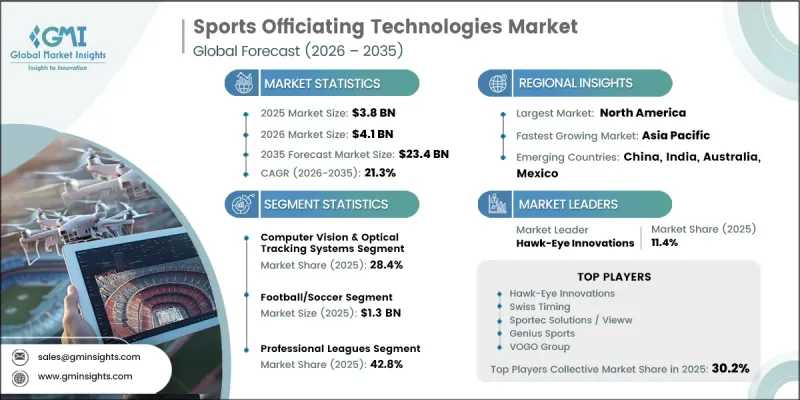
Sports organizations are rapidly adopting digital technologies to improve the speed, consistency, and reliability of officiating decisions. Artificial intelligence, computer vision, video analysis, optical tracking, and sensor-enabled systems are transforming how officials review events and evaluate actions during competitions. The growing development of connected sports venues is creating additional opportunities for technology providers as organizers seek integrated infrastructure that can support real-time decision-making and data management. Sports governing organizations are also placing greater emphasis on fairness, transparency, and consistent rule enforcement, which is encouraging wider investment in advanced officiating systems. Competition organizers increasingly recognize the value of technology in reducing avoidable judgment errors while supporting officials during fast-moving situations. Changes in competition regulations are also creating opportunities for digital officiating platforms as governing bodies establish frameworks that accommodate technology-assisted decision-making. Rising investments in sports technology and the increasing professionalization of competitions are expected to maintain strong demand for advanced officiating solutions throughout the forecast period.
| Market Scope | |
|---|---|
| Start Year | 2025 |
| Forecast Year | 2026-2035 |
| Start Value | $3.8 Billion |
| Forecast Value | $23.4 Billion |
| CAGR | 21.3% |
The sports officiating technologies market is gaining momentum as sports organizations increasingly integrate digital decision-support systems into professional competitions. Advanced video analysis, artificial intelligence, and automated data processing allow officials to review events with greater consistency and make informed decisions during live competitions. Sports governing bodies are also strengthening officiating standards to promote greater fairness, reduce subjective judgment, and encourage consistent enforcement of competition rules. Investment in technologically advanced sports venues is creating another source of demand as organizers develop infrastructure capable of supporting real-time review and decision-making. The international expansion of sporting events is further increasing the need for reliable digital officiating capabilities across different venues and competitions. Governing federations continue to influence technology adoption by updating competition frameworks and supporting systems that improve decision accuracy.
The computer vision and optical tracking systems segment accounted for a 28.4% share in 2025. Professional sports organizations increasingly depend on computer-based visual analysis and optical tracking to capture movements and identify relevant objects with speed and precision. These systems provide continuous data that can help officials evaluate events more accurately while reducing reliance on manual observation alone. The technology supports automated analysis of player movement, object trajectories, positioning, and other competition-related information. Its ability to generate detailed real-time information has made computer vision and optical tracking important components of modern digital officiating infrastructure. Continued improvements in image processing, tracking accuracy, artificial intelligence, and real-time analytics are expanding the functionality of these systems. As sports organizations seek faster and more consistent decision-making, demand for advanced visual tracking technologies is expected to remain strong.
The football and soccer segment generated USD 1.3 billion in 2025. The widespread adoption of digital officiating solutions across professional competitions continues to support the segment's leading position. Football organizations increasingly use technology-assisted systems to improve decision accuracy, strengthen match integrity, and increase transparency during competitions. Digital video review, automated tracking, communication systems, and other technology-enabled tools are becoming increasingly important components of modern football officiating infrastructure. Professional leagues and governing organizations continue to invest in technology to support officials and improve the consistency of match decisions. The scale of football's professional competition network, combined with continued investment in digital officiating infrastructure, is sustaining strong demand for advanced technologies.
North America Sports Officiating Technologies Market accounted for a 37.1% share in 2025. The region continues to benefit from strong technology adoption across professional sports, supported by established sports organizations, advanced digital infrastructure, and significant investment in innovation. Professional competitions across the region are increasingly incorporating artificial intelligence, video review, optical tracking, and other advanced technologies to improve officiating accuracy and operational efficiency. Investments in connected sports venues and digital broadcasting infrastructure are also supporting the deployment of high-performance officiating solutions. Sports organizations, governing bodies, and commercial stakeholders are accelerating their transition toward digitally enabled competition environments, creating opportunities for technology suppliers.
Prominent companies operating in the global sports officiating technologies market include KINEXON Sports, Dartfish, Hawk-Eye Innovations, Evertz Technologies, Genius Sports, Swiss Timing, DVSport, VOGO Group, EVS Broadcast Equipment, Vieww GmbH, Goal Sport Technology, Sportec Solutions, FinishLynx (Lynx System Developers), SLOMO.TV, and V6 Sports. Companies in the sports officiating technologies market are strengthening their market positions through product innovation, strategic partnerships, technology integration, and expansion into new sports and geographic markets. Providers are investing in artificial intelligence, computer vision, automated tracking, video analysis, and real-time data processing to improve the accuracy and speed of officiating solutions. Companies are also developing integrated platforms that combine multiple capabilities, allowing sports organizations to streamline operations and reduce dependence on disconnected technologies. Strategic partnerships with leagues, governing organizations, broadcasters, venue operators, and technology providers help businesses expand their customer base and strengthen market access. Geographic expansion enables suppliers to address growing demand across emerging sports markets, while customization helps them meet the specific requirements of different competitions.
Table of Contents
Chapter 1 Methodology and Scope
- 1.1 Market scope and definition
- 1.2 Research design
- 1.2.1 Research approach
- 1.2.2 Data collection methods
- 1.3 Data mining sources
- 1.3.1 Global
- 1.3.2 Regional/Country
- 1.4 Base estimates and calculations
- 1.4.1 Base year calculation
- 1.4.2 Key trends for market estimation
- 1.5 Primary research and validation
- 1.5.1 Primary sources
- 1.6 Forecast model
- 1.7 Research assumptions and limitations
Chapter 2 Executive Summary
- 2.1 Industry 360° synopsis, 2022 – 2035
- 2.2 Key market trends
- 2.2.1 Technology trends
- 2.2.2 Sport trends
- 2.2.3 End user / buyer type trends
- 2.2.4 Regional trends
- 2.3 TAM Analysis, 2026-2035
- 2.4 CXO perspectives: Strategic imperatives
Chapter 3 Industry Insights
- 3.1 Industry ecosystem analysis
- 3.1.1 Supplier Landscape
- 3.1.2 Profit Margin
- 3.1.3 Cost structure
- 3.1.4 Value addition at each stage
- 3.1.5 Factor affecting the value chain
- 3.1.6 Disruptions
- 3.2 Industry impact forces
- 3.2.1 Growth drivers
- 3.2.1.1 Increasing adoption of video-assisted officiating systems across professional sports
- 3.2.1.2 Growing integration of AI, computer vision, and sensor-based technologies
- 3.2.1.3 Rising investments in smart stadiums and international sporting events
- 3.2.1.4 Growing emphasis on transparency, fairness, and officiating accuracy
- 3.2.1.5 Continuous modernization of sports rules supporting digital officiating
- 3.2.2 Industry pitfalls and challenges
- 3.2.2.1 High implementation and infrastructure costs
- 3.2.2.2 Technology integration, latency, and operational complexity
- 3.2.3 Market opportunities
- 3.2.3.1 Expansion of AI-powered automated officiating and real-time analytics
- 3.2.3.2 Growing adoption across emerging sports, grassroots competitions, and smart stadiums
- 3.2.1 Growth drivers
- 3.3 Growth potential analysis
- 3.4 Regulatory landscape
- 3.4.1 North America
- 3.4.2 Europe
- 3.4.3 Asia Pacific
- 3.4.4 Latin America
- 3.4.5 Middle East & Africa
- 3.5 Porter’s analysis
- 3.6 PESTEL analysis
- 3.7 Technology and Innovation landscape
- 3.7.1 Current technological trends
- 3.7.2 Emerging technologies
- 3.8 Price trends
- 3.8.1 By region
- 3.8.2 By product
- 3.9 Pricing Strategies
- 3.10 Emerging Business Models
- 3.11 Compliance Requirements
- 3.12 Patent and IP analysis
Chapter 4 Competitive Landscape, 2025
- 4.1 Introduction
- 4.2 Company market share analysis
- 4.2.1 By region
- 4.2.1.1 North America
- 4.2.1.2 Europe
- 4.2.1.3 Asia Pacific
- 4.2.1.4 Latin America
- 4.2.1.5 Middle East & Africa
- 4.2.2 Market concentration analysis
- 4.2.1 By region
- 4.3 Competitive benchmarking of key players
- 4.3.1 Financial performance comparison
- 4.3.1.1 Revenue
- 4.3.1.2 Profit margin
- 4.3.1.3 R&D
- 4.3.2 Product portfolio comparison
- 4.3.2.1 Product range breadth
- 4.3.2.2 Technology
- 4.3.2.3 Innovation
- 4.3.3 Geographic presence comparison
- 4.3.3.1 Global footprint analysis
- 4.3.3.2 Service network coverage
- 4.3.3.3 Market penetration by region
- 4.3.4 Competitive positioning matrix
- 4.3.4.1 Leaders
- 4.3.4.2 Challengers
- 4.3.4.3 Followers
- 4.3.4.4 Niche players
- 4.3.5 Strategic outlook matrix
- 4.3.1 Financial performance comparison
- 4.4 Key developments
- 4.4.1 Mergers and acquisitions
- 4.4.2 Partnerships and collaborations
- 4.4.3 Technological advancements
- 4.4.4 Expansion and investment strategies
- 4.4.5 Digital transformation initiatives
- 4.5 Emerging/ startup competitors landscape
Chapter 5 Market Estimates and Forecast, By Technology, 2022 – 2035 (USD Million)
- 5.1 Key trends
- 5.2 Computer vision & optical tracking systems
- 5.2.1 Ball & object trajectory tracking
- 5.2.2 Semi-automated offside technology (SAOT)
- 5.2.3 Electronic line calling systems
- 5.2.4 Optical goal-line & boundary detection
- 5.2.5 Others
- 5.3 Video review & replay infrastructure
- 5.3.1 Video assistant referee (VAR) Systems
- 5.3.2 Decision review system (DRS)
- 5.3.3 Television match official (TMO) & challenge review systems
- 5.3.4 High-speed replay & review servers
- 5.3.5 Others
- 5.4 Sensor-based & embedded detection systems
- 5.4.1 Magnetic/RFID goal-line technology
- 5.4.2 Chip-in-ball & chip-in-puck systems
- 5.4.3 Sensor-based officiating detection systems
- 5.4.4 Contact & boundary detection systems
- 5.4.5 Others
- 5.5 AI-native & automated officiating platforms
- 5.5.1 AI decision flagging & automated infringement detection
- 5.5.2 Markerless AI officiating systems
- 5.5.3 Decision audit & consistency platforms
- 5.5.4 Referee performance analytics platforms
- 5.5.5 Automated scoring platforms
- 5.5.6 Others
- 5.6 Referee communication & official support technology
- 5.6.1 Referee communication systems
- 5.6.2 Official wearables & position tracking
- 5.6.3 Smart whistle & automated signal systems
- 5.6.4 Others
- 5.7 Timing, measurement & competition scoring systems
- 5.7.1 Photo finish technology
- 5.7.2 False start detection systems
- 5.7.3 Match timer & shot clock systems
- 5.7.4 Field event measurement systems
- 5.7.5 Others
- 5.8 Others
Chapter 6 Market Estimates and Forecast, By Sport, 2022 – 2035 (USD Million)
- 6.1 Key trends
- 6.2 Football/soccer
- 6.3 Cricket
- 6.4 Tennis & racket sports
- 6.5 Rugby
- 6.6 Basketball
- 6.7 American football
- 6.8 Baseball
- 6.9 Athletics
- 6.10 Swimming & aquatics
- 6.11 Ice hockey
- 6.12 Other sports
Chapter 7 Market Estimates and Forecast, By End User / Buyer Type, 2022 – 2035 (USD Million)
- 7.1 Key trends
- 7.2 International federations
- 7.3 Professional leagues
- 7.4 Multi-sport event organizers
- 7.5 National governing bodies
- 7.6 Amateur & grassroots organizations
Chapter 8 Market Estimates and Forecast, By Region, 2022 – 2035 (USD Million)
- 8.1 Key trends
- 8.2 North America
- 8.2.1 U.S.
- 8.2.2 Canada
- 8.3 Europe
- 8.3.1 Germany
- 8.3.2 UK
- 8.3.3 France
- 8.3.4 Spain
- 8.3.5 Italy
- 8.4 Asia Pacific
- 8.4.1 China
- 8.4.2 India
- 8.4.3 Japan
- 8.4.4 ANZ
- 8.4.5 South Korea
- 8.5 Latin America
- 8.5.1 Brazil
- 8.5.2 Mexico
- 8.6 Middle East and Africa
- 8.6.1 South Africa
- 8.6.2 Saudi Arabia
- 8.6.3 UAE
Chapter 9 Company Profiles
- 9.1 Global Key Players
- 9.1.1 Hawk-Eye Innovations
- 9.1.2 Swiss Timing
- 9.1.3 Sportec Solutions / Vieww
- 9.1.4 Genius Sports
- 9.1.5 VOGO Group
- 9.2 Regional key players
- 9.2.1 North America
- 9.2.1.1 FinishLynx (Lynx System Developers)
- 9.2.1.2 DVSport
- 9.2.1.3 V6 Sports
- 9.2.1.4 Evertz Technologies
- 9.2.2 Europe
- 9.2.2.1 EVS Broadcast Equipment
- 9.2.2.2 SLOMO.TV
- 9.2.2.3 Dartfish
- 9.2.2.4 Goal Sport Technology
- 9.2.2.5 Vieww GmbH
- 9.2.1 North America
- 9.3 Niche Players/Disruptors
- 9.3.1 KINEXON Sports

