PUBLISHER: Global Market Insights Inc. | PRODUCT CODE: 2121191

PUBLISHER: Global Market Insights Inc. | PRODUCT CODE: 2121191
Hose Pump Market Opportunity, Growth Drivers, Industry Trend Analysis, and Forecast 2026 - 2035
The Global Hose Pump Market was valued at USD 638.4 million in 2025 and is estimated to grow at a CAGR of 5.5% to reach USD 1.1 billion by 2035.
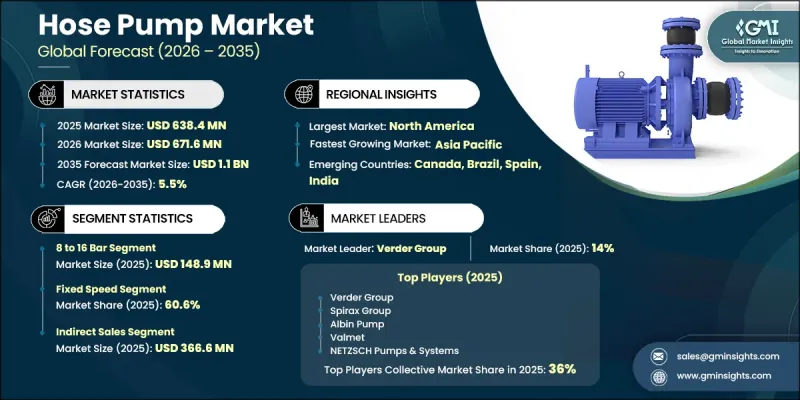
The global hose pump market continues to expand steadily as industries increasingly adopt hose pump technology for applications that require reliable handling of abrasive, viscous, and high-solids-content fluids. Demand remains strong across water and wastewater treatment, mining, mineral processing, food and beverage production, and industrial chemical processing, where the operational benefits of hose pumps support long-term performance and reduced maintenance requirements. The market is also benefiting from ongoing digital transformation, as industrial operators invest in intelligent pumping systems equipped with advanced monitoring, automation, and maintenance capabilities, thereby improving equipment reliability and operational efficiency. Growing adoption of connected technologies and digital control platforms is changing purchasing priorities, encouraging buyers to focus on long-term operating value rather than initial equipment costs. At the same time, stricter environmental regulations, continuous advancements in material engineering, and increasing integration of smart industrial technologies are reshaping equipment specifications across multiple industries. These factors continue to strengthen the outlook for the global hose pump industry, positioning advanced pumping solutions as an essential component of modern fluid handling systems.
| Market Scope | |
|---|---|
| Start Year | 2025 |
| Forecast Year | 2026-2035 |
| Start Value | $638.4 Million |
| Forecast Value | $1.1 Billion |
| CAGR | 5.5% |
The 8 to 16 bar segment generated USD 148.9 million in 2025. This operating range accounts for the largest revenue share because it supports demanding industrial applications involving abrasive materials, high-viscosity fluids, sludge transfer, and challenging pumping environments that require dependable performance under elevated pressure conditions. Hose pumps operating within this pressure range continue to gain preference due to their ability to deliver consistent flow, withstand difficult operating conditions, and efficiently manage fluids containing high levels of solids. Their durability, low maintenance requirements, and reliable operation make them well suited for industries that require uninterrupted pumping performance while minimizing operational downtime.
The fixed-speed segment accounted for 60.6% share in 2025, representing the largest share among drive configurations. Fixed-speed systems continue to maintain their leadership due to widespread installation across municipal water treatment facilities, agricultural operations, and light industrial applications where stable flow requirements and operational simplicity remain key purchasing considerations. Demand is further supported by the large installed equipment base, creating consistent replacement and maintenance opportunities across North America and Europe. Organizations operating within budget-conscious procurement environments continue to favor fixed-speed hose pumps because of their lower upfront investment, dependable performance, straightforward operation, and reduced technical complexity when variable flow control or advanced automation features are not required.
U.S. Hose Pump Market held an 83.9% share, generating USD 168.6 million in 2025. The United States remains the region's largest and most established market, supported by extensive municipal water infrastructure, a highly developed pharmaceutical and biotechnology manufacturing sector, and significant mining activities that continue to drive demand for reliable hose pumping solutions. Market expansion is also supported by a mature industrial distribution network, a well-developed supply chain, and increasing emphasis on evaluating pump systems based on lifecycle performance, energy efficiency, and long-term operating costs in addition to initial capital investment.
Major companies operating in the global hose pump market include Albin Pump, Graco Inc., NETZSCH Pumps & Systems, ProMinent GmbH, Spirax Group, Valmet, Verder Group, Abaque, Boyser Pumps, Crane Process Flow Tech., Hefei Huayun Machinery, PCM Group, Ragazzini S.r.l., Tapflo AB, DAE Pumps, Depamu Pumps Technology Co., Ltd., Gaodetec, Lutz-Jesco GmbH, SeFluid, Wanner Engineering / Vector Pumps, and Zhengzhou Lead Equipment. Companies operating in the hose pump market are strengthening their competitive position by investing in product innovation, expanding intelligent pump technologies, and improving equipment efficiency to meet evolving industrial requirements. Manufacturers continue to develop advanced pumping solutions with enhanced durability, digital monitoring capabilities, and automation features that improve operational reliability while reducing maintenance costs. Strategic collaborations with distributors, industrial solution providers, and regional partners are helping companies expand their geographic presence and strengthen customer relationships.
Table of Contents
Chapter 1 Methodology and Scope
- 1.1 Market scope & definitions
- 1.2 Research design
- 1.2.1 Research approach
- 1.2.2 Data collection methods
- 1.3 Base estimates and calculations
- 1.3.1 Base year calculation
- 1.3.2 Market estimates & forecasts parameters
- 1.4 Forecast Model
- 1.4.1 Key trends for market estimates
- 1.4.2 Quantified market impact analysis
- 1.4.2.1 Mathematical impact of growth parameters on forecast
- 1.4.3 Scenario analysis framework
- 1.5 Primary research and validation
- 1.5.1 Some of the primary sources (but not limited to)
- 1.6 Data mining sources
- 1.6.1 Paid Sources
- 1.7 Primary research and validation
- 1.7.1 Primary sources
- 1.8 Research Trail & confidence scoring
- 1.8.1 Research trail components
- 1.8.2 Scoring components
- 1.9 Research transparency addendum
- 1.9.1 Source attribution framework
- 1.9.2 Quality assurance metrics
- 1.9.3 Our commitment to trust
Chapter 2 Executive Summary
- 2.1 Industry 360° synopsis
- 2.2 Key market trends
- 2.2.1 Regional
- 2.2.2 Pressure rating
- 2.2.3 Hose material
- 2.2.4 Drive type
- 2.2.5 Application
- 2.2.6 Distribution channel
Chapter 3 Industry Insights
- 3.1 Industry ecosystem analysis
- 3.1.1 Supplier landscape
- 3.1.2 Profit margin
- 3.1.3 Value addition at each stage
- 3.1.4 Factor affecting the value chain
- 3.2 Industry impact forces
- 3.2.1 Growth drivers
- 3.2.1.1 Growing water and wastewater treatment activities
- 3.2.1.2 Stringent hygiene requirements
- 3.2.1.3 Rising mining and mineral processing investments
- 3.2.2 Industry pitfalls & challenges
- 3.2.2.1 Hose wear and replacement costs
- 3.2.2.2 Energy efficiency concerns
- 3.2.3 Opportunities
- 3.2.3.1 Smart pumping solutions
- 3.2.3.2 Battery materials and energy transition industries
- 3.2.1 Growth drivers
- 3.3 Growth potential analysis
- 3.4 Regulatory framework
- 3.4.1 Global pump efficiency standards (EU Ecodesign Directive, DOE Pump Rule - USA)
- 3.4.2 Food safety & hygienic standards (FDA 21 CFR, EC 1935/2004, EHEDG)
- 3.4.3 Chemical handling & ATEX/IECEx compliance requirements
- 3.4.4 Water & wastewater treatment discharge regulations (EU WFD, US Clean Water Act)
- 3.4.5 Mining safety & environmental regulations by region
- 3.5 Pricing analysis (driven by primary research)
- 3.5.1 Historical price trend analysis (2022–2025) by pump category
- 3.5.2 Pricing strategy by player type (premium / value / cost-plus)
- 3.5.3 Price variance by hose material & pressure rating
- 3.5.4 Aftermarket pricing dynamics (replacement hose elements vs. New pump sales)
- 3.6 Trade data analysis (driven by paid database)
- 3.6.1 Import/export volume & value trends by region
- 3.6.2 Key trade corridors & tariff impact on hose pump equipment
- 3.7 Impact of AI & generative AI on the market
- 3.7.1 AI-driven disruption of existing business models
- 3.7.2 GenAI use cases & adoption roadmap by segment
- 3.7.3 Risks, limitations & regulatory considerations for AI in hose pump
- 3.8 Capacity & production landscape (driven by primary research)
- 3.8.1 Installed manufacturing capacity by region & key producer
- 3.8.2 Capacity utilization rates & expansion pipelines among leading OEMs
Chapter 4 Competitive Landscape, 2025
- 4.1 Introduction
- 4.2 Company market share analysis
- 4.2.1 By region
- 4.2.1.1 North America
- 4.2.1.2 Europe
- 4.2.1.3 Asia Pacific
- 4.2.1.4 Latin America
- 4.2.1.5 Middle East and Africa
- 4.2.1 By region
- 4.3 Company matrix analysis
- 4.4 Competitive analysis of major market players
- 4.5 Competitive positioning matrix
- 4.6 Key developments
- 4.6.1 Mergers & acquisitions
- 4.6.2 Partnerships & collaborations
- 4.6.3 New product launches
- 4.6.4 Expansion plans
Chapter 5 Market Estimates and Forecast, By Pressure Rating, 2022 – 2035 (USD Million) (Thousand Units)
- 5.1 Key trends
- 5.2 Below 2 bar
- 5.3 2 to 4 bar
- 5.4 4 to 6 bar
- 5.5 6 to 8 bar
- 5.6 8 to 16 bar
- 5.7 16 to 32 bar
- 5.8 Above 32 bar
Chapter 6 Market Estimates and Forecast, By Hose Material, 2022 – 2035 (USD Million) (Thousand Units)
- 6.1 Key trends
- 6.2 Natural rubber
- 6.3 Nitrile rubber (NBR)
- 6.4 Neoprene (CR)
- 6.5 EPDM
- 6.6 PVC
- 6.7 Polyurethane
- 6.8 Others (PTFE, CSM/Hypalon, Fluoropolymer)
Chapter 7 Market Estimates and Forecast, By Drive Type, 2022 – 2035 (USD Million) (Thousand Units)
- 7.1 Key trends
- 7.2 Fixed speed
- 7.3 Variable speed
Chapter 8 Market Estimates and Forecast, By Application, 2022 – 2035 (USD Million) (Thousand Units)
- 8.1 Key trends
- 8.2 Chemical industry
- 8.3 Mining
- 8.4 Wastewater treatment
- 8.5 Food & beverage
- 8.6 Pharmaceutical & bioprocessing
- 8.7 Others (construction, pulp & paper, energy, etc.)
Chapter 9 Market Estimates and Forecast, By Distribution Channel, 2022 – 2035 (USD Million) (Thousand Units)
- 9.1 Key trends
- 9.2 Direct sales
- 9.3 Indirect sales
Chapter 10 Market Estimates and Forecast, By Region, 2022 – 2035 (USD Million) (Thousand Units)
- 10.1 Key trends
- 10.2 North America
- 10.2.1 U.S.
- 10.2.2 Canada
- 10.3 Europe
- 10.3.1 Germany
- 10.3.2 UK
- 10.3.3 France
- 10.3.4 Italy
- 10.3.5 Spain
- 10.4 Asia Pacific
- 10.4.1 China
- 10.4.2 Japan
- 10.4.3 India
- 10.4.4 Australia
- 10.4.5 South Korea
- 10.5 Latin America
- 10.5.1 Brazil
- 10.5.2 Mexico
- 10.5.3 Argentina
- 10.6 Middle East and Africa
- 10.6.1 South Africa
- 10.6.2 Saudi Arabia
- 10.6.3 UAE
Chapter 11 Company Profiles
- 11.1 Global players
- 11.1.1 Albin Pump
- 11.1.2 Graco Inc.
- 11.1.3 NETZSCH Pumps & Systems
- 11.1.4 ProMinent GmbH
- 11.1.5 Spirax Group
- 11.1.6 Valmet
- 11.1.7 Verder Group
- 11.2 Regional players
- 11.2.1 Abaque
- 11.2.2 Boyser Pumps
- 11.2.3 Crane Process Flow Tech.
- 11.2.4 Hefei Huayun Machinery
- 11.2.5 PCM Group
- 11.2.6 Ragazzini S.r.l.
- 11.2.7 Tapflo AB
- 11.3 Emerging players
- 11.3.1 DAE Pumps
- 11.3.2 Depamu Pumps Technology Co., Ltd.
- 11.3.3 Gaodetec
- 11.3.4 Lutz-Jesco GmbH
- 11.3.5 SeFluid
- 11.3.6 Wanner Engineering / Vector Pumps
- 11.3.7 Zhengzhou Lead Equipment

