PUBLISHER: Global Market Insights Inc. | PRODUCT CODE: 2121194

PUBLISHER: Global Market Insights Inc. | PRODUCT CODE: 2121194
Control Valve Market Opportunity, Growth Drivers, Industry Trend Analysis, and Forecast 2026 - 2035
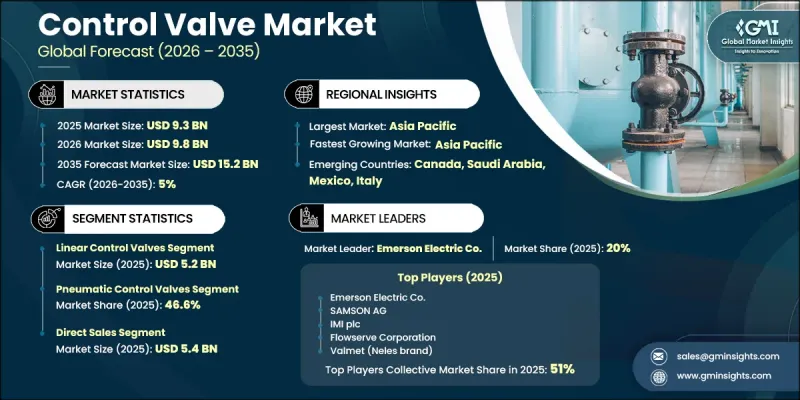
The Global Control Valve Market was valued at USD 9.3 billion in 2025 and is estimated to grow at a CAGR of 5% to reach USD 15.2 billion by 2035.
The market continues to expand as process industries increasingly rely on advanced flow control technologies to improve operational accuracy, production efficiency, and process reliability. Control valves remain an essential component across industrial facilities where precise regulation of fluid flow is critical for maintaining stable operations and optimizing energy consumption. Ongoing modernization of industrial process control systems is encouraging greater adoption of digitally enabled control valves equipped with advanced actuators, intelligent positioners, and real-time monitoring capabilities. These technologies allow operators to improve system performance, reduce maintenance requirements, and enhance process visibility while supporting long-term operational efficiency. At the same time, tightening environmental regulations and growing corporate sustainability initiatives are influencing purchasing decisions, prompting end users to invest in low-emission valve technologies, energy-efficient actuation systems, and smart diagnostic solutions. The transition from conventional valve systems to advanced digital control platforms is accelerating replacement demand while increasing the overall value of installed valve assemblies. These factors continue to support sustained growth across the global Control Valve Market.
| Market Scope | |
|---|---|
| Start Year | 2025 |
| Forecast Year | 2026-2035 |
| Start Value | $9.3 Billion |
| Forecast Value | $15.2 Billion |
| CAGR | 5% |
The linear control valves segment generated USD 5.2 billion in 2025. The segment continues to maintain its leading position because linear control valves provide accurate flow regulation, dependable shut-off performance, and consistent operation across a broad range of industrial process conditions. Their ability to deliver stable process control and support efficient system performance has contributed to widespread adoption across continuous processing environments where operational precision and reliable flow management remain essential.
The pneumatic control valves segment accounted for 46.6% share in 2025. Strong market demand continues to be supported by the widespread availability of pneumatic infrastructure and the proven performance of pneumatic actuation technologies in industrial facilities. Many operators are upgrading existing pneumatic control systems with advanced actuator and positioning technologies to improve process efficiency, enhance control accuracy, extend equipment life, and maintain compatibility with established plant infrastructure while minimizing capital investment.
United States Control Valve Market held a 74.3% share generating USD 2.2 billion in 2025. The country's extensive industrial manufacturing base, combined with continued investments in industrial modernization and process automation, continues to drive demand for advanced control valve technologies. Growing emphasis on improving operational efficiency, increasing production reliability, strengthening environmental compliance, and modernizing industrial facilities further supports the expansion of the Control Valve Market across the United States.
Major companies operating in the Global Control Valve Market include Emerson Electric Co., Flowserve Corporation, Valmet (Neles brand), Baker Hughes (Masoneilan), SAMSON AG, IMI plc, KSB SE & Co. KGaA, CEPAI Group, Bray International, Neway Valve (Suzhou) Co., Kitz Corporation, ARI-Armaturen, CIRCOR International, ARCA Regler GmbH, Burkert Fluid Control Systems, Azbil Corporation, Zhejiang SUPCON Fluid Technology, GEMU Group, Mokveld Valves BV, Curtiss-Wright Corporation, and Velan Inc. Companies participating in the Control Valve Market are strengthening their market positions through continuous investments in product innovation, digital technologies, and advanced process automation solutions. Manufacturers are expanding their portfolios by introducing intelligent control valves with enhanced diagnostics, predictive maintenance capabilities, improved energy efficiency, and seamless integration with digital industrial control systems. Strategic partnerships, mergers, acquisitions, and technology collaborations remain important growth strategies for expanding global presence and strengthening engineering capabilities. Companies are also increasing research and development investments to improve product reliability, operational performance, material durability, and automation compatibility.
Table of Contents
Chapter 1 Methodology & Scope
- 1.1 Research approach
- 1.2 Quality Commitments
- 1.2.1 GMI AI policy & data integrity commitment
- 1.2.1.1 Source consistency protocol
- 1.2.1 GMI AI policy & data integrity commitment
- 1.3 Research Trail & Confidence Scoring
- 1.3.1 Research Trail Components
- 1.3.2 Scoring Components
- 1.4 Data Collection
- 1.4.1 Partial list of primary sources
- 1.5 Data mining sources
- 1.5.1 Paid sources
- 1.5.1.1 Sources, by region
- 1.5.1 Paid sources
- 1.6 Base estimates and calculations
- 1.6.1 Base year calculation for any one approach
- 1.7 Forecast model
- 1.7.1 Quantified market impact analysis
- 1.7.1.1 Mathematical impact of growth parameters on forecast
- 1.7.1 Quantified market impact analysis
- 1.8 Research transparency addendum
- 1.8.1 Source attribution framework
- 1.8.2 Quality assurance metrics
- 1.8.3 Our commitment to trust
Chapter 2 Executive Summary
- 2.1 Industry 360° synopsis
- 2.2 Key market trends
- 2.2.1 Regional
- 2.2.2 Valve type
- 2.2.3 Actuation technology
- 2.2.4 Component
- 2.2.5 Material
- 2.2.6 Size
- 2.2.7 Pressure range
- 2.2.8 Application
- 2.2.9 End user industry
- 2.2.10 Distribution channel
Chapter 3 Industry Insights
- 3.1 Industry ecosystem analysis
- 3.1.1 Supplier landscape
- 3.1.2 Profit margin
- 3.1.3 Value addition at each stage
- 3.1.4 Factor affecting the value chain
- 3.2 Industry impact forces
- 3.2.1 Growth drivers
- 3.2.1.1 Rising industrial automation
- 3.2.1.2 Increasing focus on operational efficiency
- 3.2.1.3 Regulatory and safety requirements
- 3.2.2 Industry pitfalls & challenges
- 3.2.2.1 High installation and maintenance costs
- 3.2.2.2 Supply chain and raw material volatility
- 3.2.3 Opportunities
- 3.2.3.1 Smart control valves
- 3.2.3.2 Water and wastewater sector expansion
- 3.2.1 Growth drivers
- 3.3 Growth potential analysis
- 3.4 Regulatory framework
- 3.4.1 US EPA methane reduction & fugitive emission standards
- 3.4.2 EU industrial emissions directive & ATEX compliance
- 3.4.3 API, ANSI/ISA, IEC standards for control valve design & testing
- 3.4.4 Regional regulatory landscape (APAC, MEA)
- 3.5 Pricing analysis (driven by primary research)
- 3.5.1 Historical price trend analysis (2022-2025)
- 3.5.2 Pricing strategy by player type (premium / value / cost-plus)
- 3.6 Trade data analysis (driven by paid database)
- 3.6.1 Import/export volume & value trends by HS code (8481)
- 3.6.2 Key trade corridors & tariff impact
- 3.7 Impact of AI & generative AI on the market
- 3.7.1 AI-driven disruption of existing business models
- 3.7.2 GenAI use cases & adoption roadmap by segment
- 3.7.3 Risks, limitations & regulatory considerations
- 3.8 Capacity & production landscape (driven by primary research)
- 3.8.1 Installed manufacturing capacity by region & key producer
- 3.8.2 Capacity utilization rates & expansion pipelines
Chapter 4 Competitive Landscape, 2025
- 4.1 Introduction
- 4.2 Company market share analysis
- 4.2.1 By region
- 4.2.1.1 North America
- 4.2.1.2 Europe
- 4.2.1.3 Asia Pacific
- 4.2.1.4 Latin America
- 4.2.1.5 Middle East and Africa
- 4.2.1 By region
- 4.3 Company matrix analysis
- 4.4 Competitive analysis of major market players
- 4.5 Competitive positioning matrix
- 4.6 Key developments
- 4.6.1 Mergers & acquisitions
- 4.6.2 Partnerships & collaborations
- 4.6.3 New product launches
- 4.6.4 Expansion plans
Chapter 5 Market Estimates and Forecast, By Valve Type, 2022 – 2035 (USD Billion) (Units)
- 5.1 Key trends
- 5.2 Linear control valves
- 5.3 Rotary control valves
Chapter 6 Market Estimates and Forecast, By Actuation Technology, 2022 – 2035 (USD Billion) (Units)
- 6.1 Key trends
- 6.2 Pneumatic control valves
- 6.3 Electric control valves
- 6.4 Electro-hydraulic control valves
- 6.5 Hydraulic control valves
- 6.6 Manual control valves
Chapter 7 Market Estimates and Forecast, By Component, 2022 – 2035 (USD Billion) (Units)
- 7.1 Key trends
- 7.2 Valve body
- 7.3 Actuators
- 7.4 Pneumatic actuators
- 7.5 Electric actuators
- 7.6 Hydraulic actuators
- 7.7 Positioners
- 7.8 Pneumatic positioners
- 7.9 Digital/smart positioners
- 7.10 Others (limit switches, solenoid pilots, sealing assemblies, accessories)
Chapter 8 Market Estimates and Forecast, By Material, 2022 – 2035 (USD Billion) (Units)
- 8.1 Key trends
- 8.2 Stainless steel
- 8.3 Cast iron
- 8.4 Carbon steel & chrome-moly alloys
- 8.5 Cryogenic-grade materials
- 8.6 Exotic alloys
- 8.7 Others
Chapter 9 Market Estimates and Forecast, By Size, 2022 – 2035 (USD Billion) (Units)
- 9.1 Key trends
- 9.2 Up to 1"
- 9.3 1" – 6"
- 9.4 6" – 25"
- 9.5 25" – 50"
- 9.6 Above 50"
Chapter 10 Market Estimates and Forecast, By Pressure Range, 2022 – 2035 (USD Billion) (Units)
- 10.1 Key trends
- 10.2 < 50 Bar
- 10.3 50 – 350 Bar
- 10.4 351 – 700 Bar
- 10.5 701 – 1,000 Bar
- 10.6 > 1,000 Bar
Chapter 11 Market Estimates and Forecast, By Application, 2022 – 2035 (USD Billion) (Units)
- 11.1 Key trends
- 11.2 Flow control
- 11.3 Pressure control
- 11.4 Temperature control
- 11.5 Level control
- 11.6 Others
Chapter 12 Market Estimates and Forecast, By End User Industry, 2022 – 2035 (USD Billion) (Units)
- 12.1 Key trends
- 12.2 Oil & gas
- 12.3 Energy & power
- 12.4 Water & wastewater treatment
- 12.5 Chemicals & petrochemicals
- 12.6 Food & beverages
- 12.7 Pharmaceuticals
- 12.8 Metals & mining
- 12.9 Pulp & paper
- 12.10 Building & construction
- 12.11 Others
Chapter 13 Market Estimates and Forecast, By Distribution Channel, 2022 – 2035 (USD Billion) (Units)
- 13.1 Key trends
- 13.2 Direct sales
- 13.3 Indirect sales
Chapter 14 Market Estimates and Forecast, By Region, 2022 – 2035 (USD Billion) (Units)
- 14.1 Key trends
- 14.2 North America
- 14.2.1 U.S.
- 14.2.2 Canada
- 14.3 Europe
- 14.3.1 Germany
- 14.3.2 UK
- 14.3.3 France
- 14.3.4 Italy
- 14.3.5 Spain
- 14.4 Asia Pacific
- 14.4.1 China
- 14.4.2 Japan
- 14.4.3 India
- 14.4.4 Australia
- 14.4.5 South Korea
- 14.5 Latin America
- 14.5.1 Brazil
- 14.5.2 Mexico
- 14.5.3 Argentina
- 14.6 Middle East and Africa
- 14.6.1 South Africa
- 14.6.2 Saudi Arabia
- 14.6.3 UAE
Chapter 15 Company Profiles
- 15.1 Global players
- 15.1.1 Emerson Electric Co.
- 15.1.2 Flowserve Corporation
- 15.1.3 Valmet (Neles brand)
- 15.1.4 Baker Hughes (Masoneilan)
- 15.1.5 SAMSON AG
- 15.1.6 IMI plc
- 15.1.7 KSB SE & Co. KGaA
- 15.2 Regional players
- 15.2.1 CEPAI Group
- 15.2.2 Bray International
- 15.2.3 Neway Valve (Suzhou) Co.
- 15.2.4 Kitz Corporation
- 15.2.5 ARI-Armaturen
- 15.2.6 CIRCOR International
- 15.2.7 ARCA Regler GmbH
- 15.3 Emerging players
- 15.3.1 Burkert Fluid Control Systems
- 15.3.2 Azbil Corporation
- 15.3.3 Zhejiang SUPCON Fluid Technology
- 15.3.4 GEMU Group
- 15.3.5 Mokveld Valves BV
- 15.3.6 Curtiss-Wright Corporation
- 15.3.7 Velan Inc.

