PUBLISHER: Global Market Insights Inc. | PRODUCT CODE: 2121196

PUBLISHER: Global Market Insights Inc. | PRODUCT CODE: 2121196
EV Battery Cooling Market Opportunity, Growth Drivers, Industry Trend Analysis, and Forecast 2026 - 2035
The Global EV Battery Cooling Market was valued at USD 10.3 billion in 2025 and is estimated to grow at a CAGR of 10.6% to reach USD 29.7 billion by 2035.
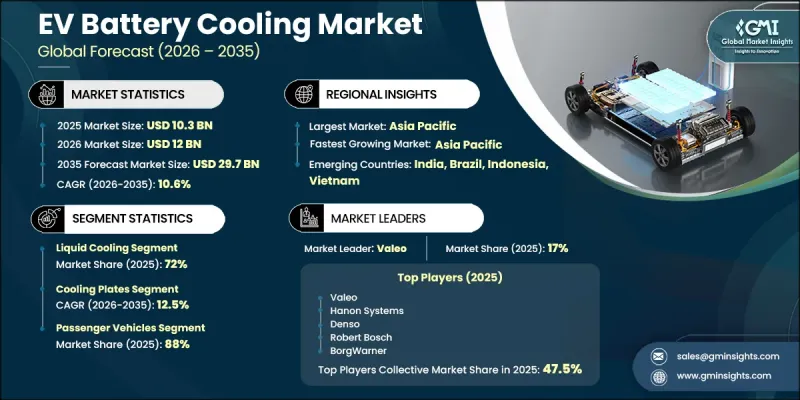
The market is expanding as electric vehicle manufacturers increasingly prioritize advanced thermal management systems to improve battery performance, efficiency, and safety. Modern battery pack designs are integrating sophisticated cooling technologies that deliver more uniform temperature distribution, helping extend battery life while supporting consistent charging and discharging performance. As electric vehicle production continues to accelerate and battery capacities increase, demand for efficient battery cooling solutions is rising across passenger vehicles, commercial vehicles, and electric buses. Continuous advancements in battery technology, high-energy-density battery packs, and fast-charging capabilities are further increasing the importance of effective thermal management systems. In addition, growing investments in electric mobility, battery manufacturing, and next-generation vehicle platforms are creating strong demand for innovative cooling technologies capable of enhancing battery reliability, operational stability, and overall vehicle performance. These factors are expected to reinforce the long-term growth of the EV Battery Cooling Market throughout the forecast period.
| Market Scope | |
|---|---|
| Start Year | 2025 |
| Forecast Year | 2026-2035 |
| Start Value | $10.3 Billion |
| Forecast Value | $29.7 Billion |
| CAGR | 10.6% |
The liquid cooling segment recorded 72% share in 2025 and is forecast to grow at a CAGR of 12.5% from 2026 to 2035. Liquid cooling continues to dominate the market because it offers superior heat dissipation, maintains uniform battery temperatures, and effectively supports high-energy-density battery systems used in modern electric vehicles. The technology enables efficient thermal regulation under demanding operating conditions, helping improve battery performance, durability, and safety. Growing deployment of larger battery packs, increasing adoption of fast-charging technologies, and rising production of passenger vehicles, buses, and commercial electric vehicles are expected to further strengthen demand for liquid cooling systems throughout the forecast period.
The cooling plates segment captured 24% share in 2025 and is forecast to grow at a CAGR of 12.5% through 2035. Cooling plates remain a critical component of liquid-cooled battery systems because they efficiently transfer heat away from battery cells while maintaining optimal operating temperatures. Their ability to improve thermal uniformity and support stable battery operation has made them an essential part of advanced electric vehicle battery architectures. Continuous advancements in cooling plate materials, design optimization, and manufacturing technologies are expected to enhance thermal performance, improve system efficiency, and support increasing adoption across next-generation electric vehicles.
China EV Battery Cooling Market held a 73.7% share, generating USD 4.5 million in 2025 supported by its extensive electric vehicle manufacturing ecosystem, well-established battery production capabilities, and highly integrated supply chain. Continuous investments in electric mobility, expansion of battery manufacturing facilities, and increasing production of advanced electric vehicles continue to drive demand for high-performance battery cooling solutions. In addition, ongoing technological innovation, strong domestic manufacturing capacity, and growing adoption of advanced thermal management systems are expected to reinforce China's dominant position throughout the forecast period.
Major companies operating in the global EV battery cooling market include BorgWarner, Continental, Denso, Hanon Systems, Hitachi Astemo, Johnson Electric (JE), Marelli, Nidec, Robert Bosch, and Valeo. Companies operating in the global EV battery cooling market are strengthening their competitive position by investing in advanced thermal management technologies, innovative cooling solutions, and next-generation battery system components. Leading manufacturers are expanding research and development activities to improve heat dissipation efficiency, reduce system weight, and enhance battery performance for increasingly powerful electric vehicle platforms. Strategic collaborations with automotive manufacturers, battery producers, and electric powertrain developers are enabling companies to accelerate product development and expand market reach. Businesses are also investing in lightweight materials, integrated thermal management systems, automated manufacturing processes, and high-performance cooling technologies to improve product efficiency and reliability. Furthermore, companies are strengthening global production capabilities, expanding regional supply networks, and introducing customized cooling solutions to reinforce their market foothold, improve competitiveness, and capitalize on the growing demand across the global ev battery cooling market.
Table of Contents
Chapter 1 Research Methodology
- 1.1 Research approach
- 1.2 Quality Commitments
- 1.2.1 GMI AI policy & data integrity commitment
- 1.2.1.1 Source consistency protocol
- 1.2.1 GMI AI policy & data integrity commitment
- 1.3 Research Trail & Confidence Scoring
- 1.3.1 Research Trail Components
- 1.3.2 Scoring Components
- 1.4 Data Collection
- 1.4.1 Partial list of primary sources
- 1.5 Data mining sources
- 1.5.1 Paid sources
- 1.5.1.1 Sources, by region
- 1.5.1 Paid sources
- 1.6 Base estimates and calculations
- 1.6.1 Base year calculation
- 1.7 Forecast model
- 1.7.1 Quantified market impact analysis
- 1.7.1.1 Mathematical impact of growth parameters on forecast
- 1.7.1 Quantified market impact analysis
- 1.8 Research transparency addendum
- 1.8.1 Source attribution framework
- 1.8.2 Quality assurance metrics
- 1.8.3 Our commitment to trust
Chapter 2 Executive Summary
- 2.1 Industry 360° synopsis, 2022 – 2035
- 2.2 Key market trends
- 2.2.1 Regional
- 2.2.2 Cooling Technology
- 2.2.3 Component
- 2.2.4 Vehicle
- 2.2.5 Propulsion
- 2.2.6 Battery Chemistry
- 2.2.7 Sales Channel
- 2.3 TAM Analysis, 2026-2035
- 2.4 CXO perspectives: Strategic imperatives
Chapter 3 Industry Insights
- 3.1 Industry ecosystem analysis
- 3.1.1 Supplier landscape
- 3.1.2 Profit margin analysis
- 3.1.3 Cost structure
- 3.1.4 Value addition at each stage
- 3.1.5 Factor affecting the value chain
- 3.1.6 Disruptions
- 3.2 Industry impact forces
- 3.2.1 Growth drivers
- 3.2.1.1 Rising electric vehicle adoption
- 3.2.1.2 Growth of fast charging infrastructure
- 3.2.1.3 Increasing battery energy density
- 3.2.1.4 Government support for vehicle electrification
- 3.2.2 Industry pitfalls and challenges
- 3.2.2.1 High cost of advanced cooling systems
- 3.2.2.2 Design complexity and system integration
- 3.2.3 Market opportunities
- 3.2.3.1 Expansion of fast charging networks
- 3.2.3.2 Development of high energy density batteries
- 3.2.3.3 Growth in commercial electric vehicles
- 3.2.1 Growth drivers
- 3.3 Growth potential analysis
- 3.4 Pricing Analysis (Driven by primary research)
- 3.4.1 Historical Price Trend Analysis, 2022-2025
- 3.4.2 Pricing Strategy by Player Type
- 3.5 Regulatory landscape
- 3.5.1 North America
- 3.5.1.1 US FMVSS Electric Vehicle Safety Standards
- 3.5.1.2 US EPA Greenhouse Gas Emission Standards for Light Duty Vehicles
- 3.5.1.3 SAE J2929 Electric and Hybrid Vehicle Safety Standard
- 3.5.1.4 UL 2580 Battery Safety Standard for Electric Vehicles
- 3.5.1.5 Canada Motor Vehicle Safety Regulations for Electric Vehicles
- 3.5.2 Europe
- 3.5.2.1 UNECE R100 Electric Vehicle Battery Safety Regulation
- 3.5.2.2 EU Battery Regulation 2023/1542
- 3.5.2.3 EU General Safety Regulation 2019/2144
- 3.5.2.4 CE Marking Requirements for Automotive Components
- 3.5.2.5 UNECE R10 Electromagnetic Compatibility Regulation
- 3.5.3 Asia Pacific
- 3.5.3.1 China GB 38031 Electric Vehicle Battery Safety Standard
- 3.5.3.2 China GB T 18384 Electric Vehicle Safety Requirements
- 3.5.3.3 Japan Road Vehicle Safety Standards for Electric Vehicles
- 3.5.3.4 India AIS 156 Battery Safety Standard
- 3.5.3.5 India AIS 038 Rev 2 Electric Vehicle Safety Standard
- 3.5.3.6 South Korea KMVSS Electric Vehicle Safety Regulations
- 3.5.4 Latin America
- 3.5.4.1 Brazil ABNT Electric Vehicle Safety Standards
- 3.5.4.2 Brazil INMETRO Electric Vehicle Certification Requirements
- 3.5.4.3 Mexico NOM Automotive Safety Standards
- 3.5.4.4 Mexico Electric Mobility Technical Regulations
- 3.5.4.5 Regional Electric Vehicle Safety and Certification Regulations
- 3.5.5 Middle East & Africa
- 3.5.5.1 UAE Electric Vehicle Regulatory Framework
- 3.5.5.2 UAE ESMA Vehicle Conformity Requirements
- 3.5.5.3 Saudi SASO Electric Vehicle Technical Regulations
- 3.5.5.4 South Africa National Road Traffic Act for Electric Vehicles
- 3.5.1 North America
- 3.6 Porter’s analysis
- 3.7 PESTEL analysis
- 3.8 Technology and innovation landscape
- 3.8.1 Current technological trends
- 3.8.1.1 Liquid Cooling
- 3.8.1.2 Direct Refrigerant Cooling
- 3.8.1.3 Advanced Cooling Plates & Channels
- 3.8.1.4 Integrated Battery Thermal Management Systems (BTMS)
- 3.8.2 Emerging technologies
- 3.8.2.1 Immersion Cooling
- 3.8.2.2 Two-Phase Cooling
- 3.8.2.3 Phase-Change Material (PCM) Cooling
- 3.8.2.4 AI-Enabled Battery Thermal Management
- 3.8.1 Current technological trends
- 3.9 Cost breakdown analysis, 2025
- 3.10 Patent analysis (Driven by primary research)
- 3.11 Trade Data Analysis (Driven by Paid Database)
- 3.11.1 Battery Import/Export volume & value trends, 2022-2025
- 3.11.2 Key trade corridors & Tariff Impact
- 3.12 Capacity & Production Landscape (Driven by Primary Research)
- 3.12.1 Installed battery capacity by region & key producer, 2025
- 3.12.2 Capacity utilization rates & expansion pipelines
- 3.13 Sustainability and environmental aspects
- 3.13.1 Sustainable practices
- 3.13.2 Waste reduction strategies
- 3.13.3 Energy efficiency in production
- 3.13.4 Eco-friendly Initiatives
- 3.13.5 Carbon footprint considerations
- 3.14 Impact of AI and Generative AI on the Market
- 3.14.1 AI Driven Disruption of Existing Business Models
- 3.14.2 GenAI Use Cases and Adoption Roadmap by Segment
- 3.14.3 Risks Limitations and Regulatory Considerations
- 3.15 Forecast assumptions & scenario analysis (Driven by Primary Research)
- 3.15.1 Base Case- Key Macro & Industry Variables Driving CAGR
- 3.15.2 Optimistic Scenarios- Favorable macro and industry tailwinds
- 3.15.3 Pessimistic Scenario - Macroeconomic slowdown or industry headwinds
Chapter 4 Competitive Landscape, 2025
- 4.1 Introduction
- 4.2 Company market share analysis, (Value and Volume) 2022-2025
- 4.2.1 North America
- 4.2.2 Europe
- 4.2.3 Asia Pacific
- 4.2.4 LATAM
- 4.2.5 MEA
- 4.3 Company production & sales analysis, 2022-2035 (Top 10)
- 4.4 Competitive analysis of major market players
- 4.5 Competitive positioning matrix
- 4.6 Strategic outlook matrix
- 4.7 Key developments
- 4.7.1 Mergers & acquisitions
- 4.7.2 Partnerships & collaborations
- 4.7.3 New Product Launches
- 4.7.4 Expansion Plans and funding
Chapter 5 Market Estimates & Forecast, By Cooling Technology, 2022 - 2035 (USD Million)
- 5.1 Key trends
- 5.2 Air Cooling
- 5.3 Liquid Cooling
- 5.4 Refrigerant Cooling (Direct Cooling)
- 5.5 Phase Change Material (PCM) Cooling
Chapter 6 Market Estimates & Forecast, By Component, 2022 - 2035 (USD Million, Units)
- 6.1 Key trends
- 6.2 Cooling Plates
- 6.3 Coolant Pumps
- 6.4 Compressors
- 6.5 Heat Exchangers
- 6.6 Cooling Fans & Blowers
- 6.7 Valves, Pipes & Hoses
- 6.8 Sensors & Electronic Controllers
- 6.9 Thermal Interface Materials (TIMs)
Chapter 7 Market Estimates & Forecast, By Vehicle, 2022 - 2035 (USD Million, Units)
- 7.1 Key trends
- 7.2 Passenger Vehicles
- 7.2.1 Hatchback
- 7.2.2 Sedan
- 7.2.3 SUV
- 7.3 Commercial Vehicles
- 7.3.1 Light Commercial Vehicle (LCV)
- 7.3.2 Medium Commercial Vehicle (MCV)
- 7.3.3 Heavy Commercial Vehicle (HCV)
Chapter 8 Market Estimates & Forecast, By Propulsion, 2022 - 2035 (USD Million, Units)
- 8.1 Key trends
- 8.2 Battery Electric Vehicle (BEV)
- 8.3 Plug-in Hybrid Electric Vehicle (PHEV)
- 8.4 Hybrid Electric Vehicle (HEV)
- 8.5 Fuel Cell Electric Vehicle (FCEV)
Chapter 9 Market Estimates & Forecast, By Battery Chemistry, 2022 - 2035 (USD Million, Units)
- 9.1 Key trends
- 9.2 Lithium Iron Phosphate (LFP)
- 9.3 Nickel Manganese Cobalt (NMC)
- 9.4 Nickel Cobalt Aluminum (NCA)
- 9.5 Solid-state Batteries
- 9.6 Others
Chapter 10 Market Estimates & Forecast, By Sales Channel, 2022 - 2035 (USD Million, Units)
- 10.1 Key trends
- 10.2 OEM
- 10.3 Aftermarket
Chapter 11 Market Estimates & Forecast, By Region, 2022 - 2035 (USD Million, Units)
- 11.1 Key trends
- 11.2 North America
- 11.2.1 US
- 11.2.2 Canada
- 11.3 Europe
- 11.3.1 Germany
- 11.3.2 UK
- 11.3.3 France
- 11.3.4 Italy
- 11.3.5 Spain
- 11.3.6 Russia
- 11.3.7 Norway
- 11.3.8 Netherlands
- 11.3.9 Sweden
- 11.4 Asia Pacific
- 11.4.1 China
- 11.4.2 India
- 11.4.3 Japan
- 11.4.4 Australia
- 11.4.5 South Korea
- 11.4.6 Singapore
- 11.4.7 Thailand
- 11.4.8 Indonesia
- 11.4.9 Vietnam
- 11.5 Latin America
- 11.5.1 Brazil
- 11.5.2 Mexico
- 11.5.3 Argentina
- 11.6 MEA
- 11.6.1 South Africa
- 11.6.2 Saudi Arabia
- 11.6.3 UAE
- 11.6.4 Turkey
Chapter 12 Company Profiles
- 12.1 Global Players
- 12.1.1 BorgWarner
- 12.1.2 Dana Incorporated
- 12.1.3 Denso
- 12.1.4 Hanon Systems
- 12.1.5 MAHLE
- 12.1.6 Modine Manufacturing Company
- 12.1.7 Robert Bosch
- 12.1.8 Valeo
- 12.2 Regional Players
- 12.2.1 Continental
- 12.2.2 FinDreams Battery
- 12.2.3 Marelli (Highly Marelli)
- 12.2.4 Shanghai Yinlun Automotive Climate Control Technology
- 12.2.5 Tata AutoComp Systems
- 12.2.6 Zhejiang Sanhua Automotive Components
- 12.3 Emerging Players
- 12.3.1 Cadenza Innovation
- 12.3.2 Calogy Solutions
- 12.3.3 Carrar
- 12.3.4 Voltabox
- 12.3.5 Xerotech
- 12.3.6 XING Mobility

