PUBLISHER: Global Market Insights Inc. | PRODUCT CODE: 2121197

PUBLISHER: Global Market Insights Inc. | PRODUCT CODE: 2121197
Airborne SATCOM Market Opportunity, Growth Drivers, Industry Trend Analysis, and Forecast 2026 - 2035
The Global Airborne SATCOM Market was valued at USD 6.2 billion in 2025 and is estimated to grow at a CAGR of 8.2% to reach USD 13.7 billion by 2035.
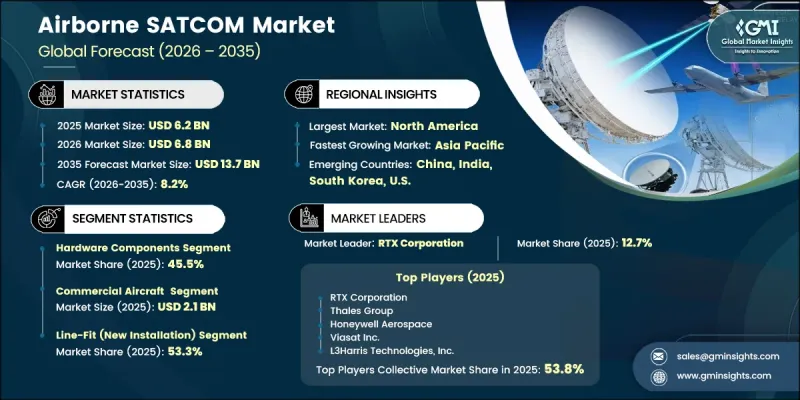
The market is gaining momentum as aviation operators place greater emphasis on reliable, high-speed connectivity and advanced communication capabilities. Increasing demand for uninterrupted broadband services during flights is encouraging airlines and aircraft operators to adopt more sophisticated satellite communication infrastructure. Aircraft modernization programs across commercial and defense aviation are also creating opportunities for next-generation SATCOM technologies. The deployment of Low Earth Orbit (LEO) and High-Throughput Satellite (HTS) networks is further improving the availability, capacity, and performance of airborne connectivity solutions. At the same time, satellite-enabled air traffic management, safety communications, and mission-critical connectivity are becoming increasingly important for aviation operations. The growing requirement for resilient communication systems is supporting adoption across commercial aviation, military aviation, and business aviation. Improvements in aircraft terminals, antennas, networking equipment, modems, and other SATCOM components are also helping operators address evolving connectivity requirements.
| Market Scope | |
|---|---|
| Start Year | 2025 |
| Forecast Year | 2026-2035 |
| Start Value | $6.2 Billion |
| Forecast Value | $13.7 Billion |
| CAGR | 8.2% |
The hardware components segment held a 45.5% share in 2025. The segment benefits from the essential role of physical SATCOM equipment in establishing and maintaining satellite-based communication links. Key hardware components include satellite antennas, radomes, transceivers, modems, aircraft terminals, and onboard networking systems, which collectively support data transmission and connectivity during flight operations. Increasing deployment of advanced communication systems across aircraft fleets is creating sustained demand for upgraded hardware with improved bandwidth, reliability, and operational performance. Aircraft modernization initiatives and the growing need for dependable connectivity are also encouraging operators to replace older equipment with more capable SATCOM hardware. Continued technological development in antennas, terminals, networking equipment, and related components is expected to support the segment's market position throughout the forecast period.
The line-fit (new installation) segment captured 53.3% share in 2025. Increasing integration of factory-installed SATCOM systems into newly manufactured commercial and military aircraft is supporting segment expansion. Aircraft manufacturers are increasingly incorporating communication technologies directly into new platforms to meet rising connectivity and operational requirements. The high volume of new aircraft deliveries also creates a substantial opportunity for line-fit SATCOM installations, as operators increasingly seek aircraft equipped with advanced communication capabilities from the outset. Growing fleet modernization, increasing demand for connected aircraft, and the integration of advanced satellite communication systems into new aircraft platforms are expected to continue supporting the segment through the forecast period.
North America Airborne SATCOM Market recorded 40.5% share in 2025. The regional industry is benefiting from the strength of commercial aviation, increasing demand for in-flight broadband services, and ongoing upgrades to military communication infrastructure. The presence of major aircraft manufacturers, satellite operators, aerospace companies, and defense contractors provides a strong ecosystem for the development and deployment of airborne SATCOM technologies. Rising investment in connected aircraft systems is encouraging aviation operators to adopt more advanced communication platforms capable of supporting higher data volumes and reliable connectivity. The region's continued focus on aircraft modernization and digital aviation infrastructure is also creating additional opportunities for SATCOM providers. Increasing requirements for secure, resilient, and high-performance communication across commercial, business, and defense aviation are expected to support continued expansion of the North American market.
Prominent companies operating in the global airborne satcom market include Thales Group, Viasat Inc., Honeywell Aerospace, Anuvu, RTX Corporation, Elbit Systems, Panasonic Avionics Corp., Gilat Satellite Networks, BAE Systems plc, Eutelsat OneWeb, ASELSAN, Northrop Grumman, Intellian Technologies, General Dynamics Mission Systems, Arabsat, Astronics Corporation, Cobham / CAES, Embraer Defense & Security, Gogo Business Aviation, Israel Aerospace Industries (IAI), Kontron AG, L3Harris Technologies, Leonardo S.p.A., SES S.A., SITA / SITAONAIR, ST Engineering, Teledyne Defense Electronics, ThinKom Solutions, and Yahsat (Al Yah Satellite). Companies in the global airborne satcom market are strengthening their competitive positions through technology development, strategic collaborations, portfolio expansion, and investments in next-generation connectivity solutions. Leading participants are improving antenna systems, aircraft terminals, modems, networking equipment, and satellite communication platforms to deliver higher capacity, reliability, and connectivity performance. Companies are also developing solutions compatible with evolving satellite architectures, including LEO and HTS networks, to address increasing demand for high-speed airborne communications. Partnerships with aircraft manufacturers, airlines, defense organizations, satellite operators, and communication providers are helping businesses expand their customer base and accelerate technology deployment. Market participants are also increasing research and development investments to support smaller, lighter, and more efficient equipment suitable for modern aircraft. Expanding service capabilities, strengthening global distribution networks, upgrading manufacturing capacity, and developing customized solutions for commercial and defense applications are further supporting market expansion. These strategies are enabling companies to broaden their technology portfolios, improve customer engagement, and reinforce their foothold in the global airborne satcom market.
Table of Contents
Chapter 1 Methodology and Scope
- 1.1 Market scope and definition
- 1.2 Research design
- 1.2.1 Research approach
- 1.2.2 Data collection methods
- 1.3 Data mining sources
- 1.3.1 Global
- 1.3.2 Regional/Country
- 1.4 Base estimates and calculations
- 1.4.1 Base year calculation
- 1.4.2 Key trends for market estimation
- 1.5 Primary research and validation
- 1.5.1 Primary sources
- 1.6 Forecast model
- 1.7 Research assumptions and limitations
Chapter 2 Executive Summary
- 2.1 Industry 360° synopsis, 2022 – 2035
- 2.2 Key market trends
- 2.2.1 Component trends
- 2.2.2 Platform trends
- 2.2.3 Frequency band trends
- 2.2.4 Orbit type trends
- 2.2.5 Installation type trends
- 2.2.6 Application trends
- 2.2.7 Regional trends
- 2.3 TAM Analysis, 2026-2035
- 2.4 CXO perspectives: Strategic imperatives
Chapter 3 Industry Insights
- 3.1 Industry ecosystem analysis
- 3.1.1 Supplier Landscape
- 3.1.2 Profit Margin
- 3.1.3 Cost structure
- 3.1.4 Value addition at each stage
- 3.1.5 Factor affecting the value chain
- 3.1.6 Disruptions
- 3.2 Industry impact forces
- 3.2.1 Growth drivers
- 3.2.1.1 Increasing demand for satellite-enabled air traffic management and flight safety
- 3.2.1.2 Growing passenger demand for high-speed in-flight broadband connectivity
- 3.2.1.3 Commercial aircraft fleet expansion and modernization programs
- 3.2.1.4 Deployment of High-Throughput Satellites (HTS) and Low Earth Orbit (LEO) constellations
- 3.2.1.5 Increasing defense investments in secure multi-orbit airborne communications
- 3.2.2 Industry pitfalls and challenges
- 3.2.2.1 High installation and retrofit costs of airborne SATCOM systems
- 3.2.2.2 Spectrum availability and regulatory compliance across regions
- 3.2.3 Market opportunities
- 3.2.3.1 Expansion of Low Earth Orbit (LEO) and High-Throughput Satellite (HTS) networks
- 3.2.3.2 Increasing adoption of multi-orbit and software-defined SATCOM architectures
- 3.2.1 Growth drivers
- 3.3 Growth potential analysis
- 3.4 Regulatory landscape
- 3.4.1 North America
- 3.4.2 Europe
- 3.4.3 Asia Pacific
- 3.4.4 Latin America
- 3.4.5 Middle East & Africa
- 3.5 Porter’s analysis
- 3.6 PESTEL analysis
- 3.7 Technology and Innovation landscape
- 3.7.1 Current technological trends
- 3.7.2 Emerging technologies
- 3.8 Price trends
- 3.8.1 By region
- 3.8.2 By product
- 3.9 Pricing Strategies
- 3.10 Emerging Business Models
- 3.11 Compliance Requirements
- 3.12 Patent and IP analysis
Chapter 4 Competitive Landscape, 2025
- 4.1 Introduction
- 4.2 Company market share analysis
- 4.2.1 By region
- 4.2.1.1 North America
- 4.2.1.2 Europe
- 4.2.1.3 Asia Pacific
- 4.2.1.4 Latin America
- 4.2.1.5 Middle East & Africa
- 4.2.2 Market concentration analysis
- 4.2.1 By region
- 4.3 Competitive benchmarking of key players
- 4.3.1 Financial performance comparison
- 4.3.1.1 Revenue
- 4.3.1.2 Profit margin
- 4.3.1.3 R&D
- 4.3.2 Product portfolio comparison
- 4.3.2.1 Product range breadth
- 4.3.2.2 Technology
- 4.3.2.3 Innovation
- 4.3.3 Geographic presence comparison
- 4.3.3.1 Global footprint analysis
- 4.3.3.2 Service network coverage
- 4.3.3.3 Market penetration by region
- 4.3.4 Competitive positioning matrix
- 4.3.4.1 Leaders
- 4.3.4.2 Challengers
- 4.3.4.3 Followers
- 4.3.4.4 Niche players
- 4.3.5 Strategic outlook matrix
- 4.3.1 Financial performance comparison
- 4.4 Key developments
- 4.4.1 Mergers and acquisitions
- 4.4.2 Partnerships and collaborations
- 4.4.3 Technological advancements
- 4.4.4 Expansion and investment strategies
- 4.4.5 Digital transformation initiatives
- 4.5 Emerging/ startup competitors landscape
Chapter 5 Market Estimates and Forecast, By Component, 2022 – 2035 (USD Million)
- 5.1 Key trends
- 5.2 Hardware components
- 5.2.1 Antennas & satellite terminals
- 5.2.2 Modems & routers
- 5.2.3 Transceivers
- 5.2.4 Radomes
- 5.2.5 Power amplifiers & lnbs
- 5.2.6 Others
- 5.3 Software & network management platforms
- 5.4 Connectivity services
Chapter 6 Market Estimates and Forecast, By Platform, 2022 – 2035 (USD Million)
- 6.1 Key trends
- 6.2 Commercial aircraft
- 6.2.1 Narrowbody aircraft
- 6.2.2 Widebody aircraft
- 6.2.3 Regional aircraft
- 6.3 Military aircraft
- 6.4 Business jets & general aviation
- 6.5 Helicopters
- 6.6 UAVs
Chapter 7 Market Estimates and Forecast, By Frequency Band, 2022 – 2035 (USD Million)
- 7.1 Key trends
- 7.2 L-band
- 7.3 S-band
- 7.4 C-band
- 7.5 X-band
- 7.6 Ku-band
- 7.7 Ka-band
- 7.8 Multi-band
Chapter 8 Market Estimates and Forecast, By Orbit Type, 2022 – 2035 (USD Million)
- 8.1 Key trends
- 8.2 GEO (geostationary earth orbit)
- 8.3 MEO (medium earth orbit)
- 8.4 LEO (low earth orbit)
- 8.5 Multi-orbit
Chapter 9 Market Estimates and Forecast, By Installation Type, 2022 – 2035 (USD Million)
- 9.1 Key trends
- 9.2 Line-fit (new installation)
- 9.3 Retrofit (upgrade/modification)
Chapter 10 Market Estimates and Forecast, By Application, 2022 – 2035 (USD Million)
- 10.1 Key trends
- 10.2 In-flight Connectivity (IFC)
- 10.3 Intelligence, surveillance & reconnaissance (ISR)
- 10.4 Command & control (C2)
- 10.5 Tactical communications & situational awareness
- 10.6 Operational aviation communications (AOC)
- 10.7 Others
Chapter 11 Market Estimates and Forecast, By Region, 2022 – 2035 (USD Million)
- 11.1 Key trends
- 11.2 North America
- 11.2.1 U.S.
- 11.2.2 Canada
- 11.3 Europe
- 11.3.1 Germany
- 11.3.2 UK
- 11.3.3 France
- 11.3.4 Spain
- 11.3.5 Italy
- 11.3.6 Netherlands
- 11.4 Asia Pacific
- 11.4.1 China
- 11.4.2 India
- 11.4.3 Japan
- 11.4.4 Australia
- 11.4.5 South Korea
- 11.5 Latin America
- 11.5.1 Brazil
- 11.5.2 Mexico
- 11.5.3 Argentina
- 11.6 Middle East and Africa
- 11.6.1 South Africa
- 11.6.2 Saudi Arabia
- 11.6.3 UAE
Chapter 12 Company Profiles
- 12.1 Global Key Players
- 12.1.1 RTX Corporation
- 12.1.2 Thales Group
- 12.1.3 Honeywell Aerospace
- 12.1.4 Viasat Inc.
- 12.1.5 L3Harris Technologies, Inc.
- 12.2 Regional key players
- 12.2.1 North America
- 12.2.1.1 Panasonic Avionics Corp.
- 12.2.1.2 Northrop Grumman
- 12.2.1.3 General Dynamics Mission Systems
- 12.2.1.4 Gogo Business Aviation
- 12.2.1.5 Astronics Corporation
- 12.2.1.6 Anuvu
- 12.2.1.7 Yahsat (Al Yah Satellite)
- 12.2.2 Asia Pacific
- 12.2.2.1 ST Engineering
- 12.2.2.2 Arabsat
- 12.2.2.3 Israel Aerospace Industries (IAI)
- 12.2.2.4 ASELSAN
- 12.2.2.5 Gilat Satellite Networks
- 12.2.2.6 Embraer Defense & Security
- 12.2.2.7 Intellian Technologies
- 12.2.3 Europe
- 12.2.3.1 SES S.A.
- 12.2.3.2 Cobham / CAES
- 12.2.3.3 BAE Systems plc
- 12.2.3.4 Leonardo S.p.A.
- 12.2.3.5 SITA / SITAONAIR
- 12.2.3.6 Kontron AG
- 12.2.3.7 Eutelsat OneWeb
- 12.2.1 North America
- 12.3 Niche Players/Disruptors
- 12.3.1 Elbit Systems
- 12.3.2 Teledyne Defense Electronics
- 12.3.3 ThinKom Solutions

