
PUBLISHER: MarketsandMarkets | PRODUCT CODE: 1923691
PUBLISHER: MarketsandMarkets | PRODUCT CODE: 1923691
Biomethane Market by Feedstock (Agriculture Residue, Municipal Waste, Energy Crops), Production Process (Anaerobic Digestion & Fermentation, Thermal Gasification), End-use (Power generation, Transportation, Industrial), Region - Global Forecast to 2030
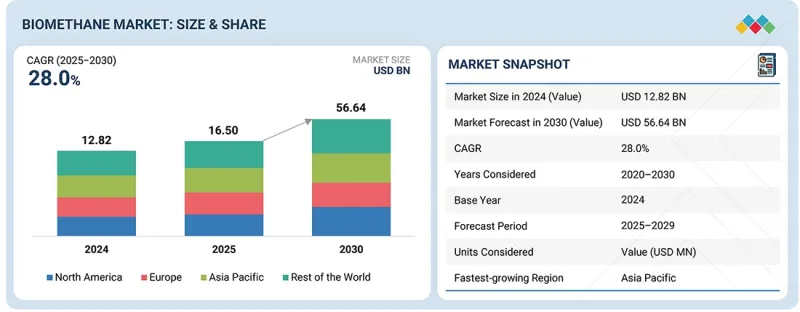
The biomethane market is estimated to reach USD 56.64 billion by 2030 from USD 16.50 billion in 2025, at a CAGR of 28.0% during the forecast period. The biomethane market is being propelled by the rising focus on circular economy practices that transform organic waste into energy resources that are worth. The mounting limitations on landfills and more stringent regulations on wastewater treatment are leading cities and factories to biomethane as an alternative.
| Scope of the Report | |
|---|---|
| Years Considered for the Study | 2020-2030 |
| Base Year | 2024 |
| Forecast Period | 2025-2030 |
| Units Considered | Value (USD Million/Billion); Volume (BCM) |
| Segments | by Feedstock, Production Process, End-use, Region |
| Regions covered | Europe, Asia Pacific, North America, South America, Rest of the World |
Price swings in natural gas are making it necessary for energy consumers to explore the domestic renewable gas market as a supplier. Advances in upgrading, liquefaction, and digital plant optimization technologies are already leading to a better operational efficiency and reliability. Meanwhile, there are more and more gas grid interconnections and certification schemes for renewable gas that are making the market more transparent and tradable, thus facilitating the wider commercial use of biomethane.
"By production process, thermal gasification is projected to be the fastest-growing segment of the biomethane market during the forecast period."
The thermal gasification method, as a production process, is expected to occupy the fastest position among the biomethane segments during the coming years because of its capability to turn various kinds of dry and lignocellulosic feedstocks into renewable gas. The main difference from biological processes is that thermal gasification can easily process forestry residues, industrial waste, and other materials that are hard to digest, thus widening the overall biomethane feedstock base. The combination of increasing interest in advanced waste-to-energy systems and stricter regulations on landfilling is a major factor behind the rapid adoption of the technique. Innovations in technology are increasing the yield, quality of syngas, and interlinkage of the processes, thus minimizing risks to the operation. Moreover, the heightened investment in low-carbon fuels and the introduction of policy frameworks that favor advanced renewable gas technologies are improving the commercial viability of thermal gasification projects.
"The industrial segment is expected to remain the fastest segment by application"
The industrial segment is projected to be the largest application area in the biomethane market owing to the prevailing trend of the adoption of cost-effective decarbonization measures in the energy consuming industries. A number of industrial activities are very much dependent on natural gas for their operations that require high-temperature heating, thus making electrification either technically complicated or too expensive for the near future. Biomethane is a direct alternative that can be integrated easily and that helps the industrial sector to cut down their Scope 1 emissions without making any significant changes to existing machinery or facilities. Regulatory compliance, taxes on carbon emissions and compulsory emissions reporting are among the factors that have been speeding up the trend of biomethane usage. Apart from that, contracts for the long-term supply of biomethane have made it possible for industries to have a stable price during the ups and downs of the fossil fuel market, whereas the corporate net-zero pledges and sustainability targets are pushing the industries to consider renewable gas as a feasible option for decarbonization through which they could achieve their targets.
"By region, Europe is expected to be the second-largest region in the biomethane market during the forecast period."
By region, the biomethane industry is forecasted to have Europe as the second-largest market, thanks to its developed renewable gas ecosystem and robust and favorable policies. Some European countries have already achieved advanced deployment of the technology but still, the expansion continues through replacement of old technology, upgrading of capacities, and integration of biomethane into the energy transition plans. European market is supported by a good natural gas supply system, well-defined sustainability certification process, and large-scale use in sectors such as industrial, and transportation. The collaboration between the power companies, big energy firms, and farmers' cooperatives is still driving the market. Besides, Europe's worry about nitrous oxide emissions, its goal to be less dependent on gas from outside, and its being more supportive of the recycling economy are also factors that put the region at the forefront when it comes to global biomethane demand and thus, Europe's being a major player in the market despite it being a bit late in the game compared to the Asia-Pacific and other regions.
Breakdown of Primaries:
In-depth interviews have been conducted with various key industry participants, subject-matter experts, C-level executives of key market players, and industry consultants, among other experts, to obtain and verify critical qualitative and quantitative information and assess future market prospects. The distribution of primary interviews is as follows:
By Company Type: Tier 1- 65%, Tier 2- 24%, and Tier 3- 11%
By Designation: C-Level Executives - 30%, Managers- 25%, and Others- 45%
By Region: North America- 20%, Europe- 40%, Asia Pacific- 30%, and RoW- 10%
Note: Others include product engineers, product specialists, and engineering leads.
Note: The tiers of the companies are defined based on their total revenues as of 2023. Tier 1: > USD 1 billion, Tier 2: From USD 500 million to USD 1 billion, and Tier 3: < USD 500 million
The biomethane market is dominated by a few major players that have a wide regional presence. The leading players in the biomethane market are Shell Biogas (United Kingdom), Air Liquide (France), BP p.l.c. (UK), Gasum Ltd (Finland), OPAL Fuels (US), Waga Energy (France), Vanguard Renewables (United States), Gothenburg Energy (Sweden), WELTEC BIOPOWER GmbH (Germany), PlanET Biogas Group (Germany), ETW Energietechnik GmbH (Germany), Clean Energy Fuels (United States), EQTEC PLC (Ireland), and GENeco (UK), among others.
Study Coverage:
The report defines, describes, and forecasts the e-fuel market by size, application, and fuel type. It also offers a detailed qualitative and quantitative analysis of the market. The report provides a comprehensive review of the major market drivers, restraints, opportunities, and challenges. It also covers various important aspects of the market. These include an analysis of the competitive landscape, market dynamics, market estimates in terms of value, and future trends in the biomethane market.
Key Benefits of Buying the Report
- The biogas market is mainly influenced by the global shift to decarbonized and eco-friendly energy systems, especially in areas where it is difficult to eliminate the use of fossil gas completely. The increasing worries about methane getting emitted, along with climate change, and energy security, are fast-tracking the biomethane usage as a renewable, low-carbon gas alternative to natural gas and hence, it is being adopted more and more. Biomethane is being generated from various waste streams including agricultural residues, animal dung, and municipal waste, thereby not only power generation and more but also being able to achieve the circular economy goals. Its complete compatibility with the existing gas infrastructure allows it to be used effortlessly in all the mentioned areas viz. transport, industrial heating, power generation, and grid injection. The stricter emission regulations and other related government policies, have led to a situation where investment in biomethane projects is becoming more and more common. At the same time, the advancements in the technologies used for anaerobic digestion, gas upgrading, and digital plant optimization are having a positive impact on the efficiency and scalability of the process. Alongside the above-mentioned factors, the corporate sustainability commitments are becoming a major driving force behind the global energy transition to a low carbon scenario, and thus, biomethane is gradually being identified as one of the key players.
- Product Development/Innovation: The biomethane industry is making strides through product and process innovations that aim to improve not only the efficiency of production but also the scalability and environmental performance. Among the most significant developments in this area are the new anaerobic digestion systems that are being created by companies. These systems are characterized by higher methane yields, greater flexibility in the types of feedstock used, and shorter retention times. Moreover, biogas upgrading technologies such as membrane separation, pressure swing adsorption, and cryogenic upgrading have all met and exceeded the quality requirements for biomethane and have done so with a lower energy footprint. The market trend is to promote the installation of small and flexible biomethane units that can take the place of big and centralized infrastructures as they come closer to waste sources and thus eliminate the long and costly transportation industry. Automation and digital monitoring system integration are already in place, providing support for the optimization of the process in real-time, maintenance based on predictions, and tracking of emissions. Furthermore, advances in digestate management, nutrient recovery, and biological methanation are also contributing to the increase in resource efficiency. Research and experimentation are continuously exploring co-digestion and the use of advanced waste streams, which are in fact increasing feedstock diversity and thus the contribution of biomethane to circular and low-carbon energy systems.
- Market Development: In September 2025, Hapag-Lloyd and Shell Biogas signed a multi-year deal for liquefied biomethane delivery to support the former's decarbonization programme. The coalition between the two companies, which started in 2023, allows Hapag-Lloyd's LNG dual-fuelled ships, to burn the eco-friendly marine fuel without the need for any modification of their machinery. Shell has already set up liquefied biomethane supply points at 22 bunkering places across the globe, thereby making the renewable fuel even more available. The biogas certified by ISCC EU and the like provides extensive lifecycle GHG reductions which enhance the reduction of emissions in not just fleet operations but also in customer supply chains.
- Market Diversification: TotalEnergies, in May 2025, made a deal through an SPA to divest half of the shares in Polska Grupa Biogazowa (PGB) which is the main biogas producer in Poland, to HitecVision. PGB has already acquired 20 units whose combined biomethane capacity amounts to more than 450 GWh and is also looking to reach 2 TWh by 2030. The alliance not just hastens PGB's foray into biomethane but also goes hand in hand with TotalEnergies' farmdown strategy to improve the renewable investment portfolio, while HitecVision seizes the opportunity of having a solid platform for driving growth in the biogas market in Poland which is still in the developing phase.
- Competitive Assessment: Assessment of rankings of some of the key players, including of TotalEnergies (France), Veolia (France), Chevron Corporation (United States), Shell Biogas (United Kingdom), Air Liquide (France), BP p.l.c. (United Kingdom), Raizen (Brazil), Gasum Ltd (Finland), Anaergia (Canada), EnviTec Biogas AG (Germany), Kinder Morgan (United States), Ameresco (United States), ENGIE (France), E.ON SE (Germany), Verbio SE (Germany), OPAL Fuels (United States) among others.
TABLE OF CONTENTS
1 INTRODUCTION
- 1.1 STUDY OBJECTIVES
- 1.2 MARKET DEFINITION
- 1.3 MARKET SCOPE
- 1.3.1 MARKET SEGMENTATION AND REGIONAL SCOPE
- 1.3.2 INCLUSIONS AND EXCLUSIONS
- 1.3.3 YEARS CONSIDERED
- 1.4 CURRENCY CONSIDERED
- 1.5 UNITS CONSIDERED
- 1.6 STAKEHOLDERS
- 1.7 SUMMARY OF CHANGES
2 EXECUTIVE SUMMARY
- 2.1 MARKET HIGHLIGHTS AND KEY INSIGHTS
- 2.2 KEY MARKET PARTICIPANTS: MAPPING OF STRATEGIC DEVELOPMENTS
- 2.3 DISRUPTIVE TRENDS IN BIOMETHANE MARKET
- 2.4 HIGH-GROWTH SEGMENTS
- 2.5 REGIONAL SNAPSHOT: MARKET SIZE, GROWTH RATE, AND FORECAST
3 PREMIUM INSIGHTS
- 3.1 ATTRACTIVE OPPORTUNITIES FOR PLAYERS IN BIOMETHANE MARKET
- 3.2 BIOMETHANE MARKET, BY REGION
- 3.3 BIOMETHANE MARKET, BY FEEDSTOCK TYPE
- 3.4 BIOMETHANE MARKET, BY PRODUCTION PROCESS
- 3.5 BIOMETHANE MARKET, BY END-USE APPLICATION
- 3.6 BIOMETHANE MARKET IN EUROPE, BY END-USE APPLICATION AND COUNTRY
4 MARKET OVERVIEW
- 4.1 INTRODUCTION
- 4.2 MARKET DYNAMICS
- 4.2.1 DRIVERS
- 4.2.1.1 Turning organic waste into low-cost renewable gas
- 4.2.1.2 Increasing biomethane output through advanced processing technologies
- 4.2.1.3 Government support through binding policy, incentives, and market integration
- 4.2.2 RESTRAINTS
- 4.2.2.1 Limited sustainable feedstock availability
- 4.2.2.2 Competition from alternative low-carbon and renewable gases
- 4.2.3 OPPORTUNITIES
- 4.2.3.1 Rapid scale-up via grid injection & national targets
- 4.2.3.2 Growth in heavy-duty transport & CNG/LNG/LBG market (road, shipping, buses)
- 4.2.4 CHALLENGES
- 4.2.4.1 High CAPEX/uncertain project economics
- 4.2.4.2 Gas network and injection constraints
- 4.2.1 DRIVERS
- 4.3 INTERCONNECTED MARKETS AND CROSS-SECTOR OPPORTUNITIES
- 4.3.1 INTERCONNECTED MARKETS
- 4.3.2 CROSS-SECTOR OPPORTUNITIES
- 4.4 STRATEGIC MOVES BY TIER 1/2/3 PLAYERS
5 INDUSTRY TRENDS
- 5.1 PORTER'S FIVE FORCES ANALYSIS
- 5.1.1 THREAT OF SUBSTITUTES
- 5.1.2 BARGAINING POWER OF SUPPLIERS
- 5.1.3 BARGAINING POWER OF BUYERS
- 5.1.4 THREAT OF NEW ENTRANTS
- 5.1.5 INTENSITY OF COMPETITIVE RIVALRY
- 5.2 MACROECONOMIC OUTLOOK
- 5.2.1 INTRODUCTION
- 5.2.2 PUBLIC CLEAN ENERGY SPENDING
- 5.2.3 ENERGY PRICE VOLATILITY
- 5.2.4 WASTE MANAGEMENT COSTS
- 5.2.5 AGRICULTURAL ECONOMICS
- 5.3 SUPPLY CHAIN ANALYSIS
- 5.4 ECOSYSTEM ANALYSIS
- 5.5 TRADE ANALYSIS
- 5.5.1 EXPORT SCENARIO (HS CODE 271111)
- 5.5.2 IMPORT SCENARIO (HS CODE 271111)
- 5.6 CASE STUDY ANALYSIS
- 5.6.1 BIOMETHANE PRODUCTION AT STEUBEN COUNTY LANDFILL (WAGA ENERGY)
- 5.6.2 VANGUARD RENEWABLES & ASTRAZENECA RNG AGREEMENT
- 5.6.3 PERDUE FARMS BIOMETHANE FROM WASTEWATER (GREENGAS USA)
- 5.7 KEY CONFERENCES AND EVENTS, 2025-2026
- 5.8 PRICING ANALYSIS
- 5.8.1 INDICATIVE PRICING OF BIOMETHANE MARKET, BY END-USE APPLICATION, 2024
- 5.8.2 AVERAGE SELLING PRICE TREND OF BIOMETHANE, BY REGION, 2020-2024
- 5.9 TRENDS/DISRUPTIONS IMPACTING CUSTOMERS' BUSINESSES
- 5.10 INVESTMENT AND FUNDING SCENARIO
- 5.11 IMPACT OF 2025 US TARIFFS-BIOMETHANE MARKET
- 5.11.1 INTRODUCTION
- 5.11.2 KEY TARIFF RATES
- 5.11.3 PRICE IMPACT ANALYSIS
- 5.11.4 IMPACT ON COUNTRIES/REGIONS
- 5.11.4.1 US
- 5.11.4.2 Europe
- 5.11.4.3 Asia Pacific
- 5.11.5 IMPACT ON END-USER INDUSTRIES
6 TECHNOLOGICAL ADVANCEMENTS, AI-DRIVEN IMPACT, PATENTS, INNOVATIONS, AND FUTURE APPLICATIONS
- 6.1 KEY EMERGING TECHNOLOGIES
- 6.1.1 MEMBRANE SEPARATION TECHNOLOGY
- 6.1.2 CRYOGENIC SEPARATION TECHNOLOGY
- 6.1.3 FEEDSTOCK PRE-TREATMENT TECHNOLOGIES
- 6.2 COMPLEMENTARY TECHNOLOGIES
- 6.2.1 PROCESS MONITORING & CONTROL SYSTEMS
- 6.2.2 DIGESTATE TREATMENT TECHNOLOGIES
- 6.3 ADJACENT TECHNOLOGIES
- 6.3.1 BIOGAS-TO-LIQUID TECHNOLOGIES
- 6.3.2 CARBON CAPTURE & UTILIZATION/STORAGE (CCUS)
- 6.4 TECHNOLOGY/PRODUCT ROADMAP
- 6.4.1 SHORT-TERM (2025-2027) | COMMERCIAL SCALE-UP AND MARKET CONSOLIDATION
- 6.4.2 MID-TERM (2028-2030) | SYSTEM INTEGRATION & COST OPTIMIZATION PHASE
- 6.4.3 LONG-TERM (2030-2035+) | NET-ZERO ALIGNMENT & MARKET MATURITY PHASE
- 6.5 PATENT ANALYSIS
- 6.6 FUTURE APPLICATIONS
- 6.7 IMPACT OF AI/GEN AI ON BIOMETHANE MARKET
- 6.7.1 TOP USE CASES AND MARKET POTENTIAL
- 6.7.2 BEST PRACTICES FOLLOWED BY OEMS IN BIOMETHANE MARKET
- 6.7.3 CASE STUDIES OF AI IMPLEMENTATION IN BIOMETHANE MARKET
- 6.7.4 INTERCONNECTED ECOSYSTEMS AND IMPACT ON MARKET PLAYERS
7 REGULATORY LANDSCAPE AND SUSTAINABILITY INITIATIVES
- 7.1 REGIONAL REGULATIONS AND COMPLIANCE
- 7.1.1 REGULATORY BODIES, GOVERNMENT AGENCIES, AND OTHER ORGANIZATIONS
- 7.1.2 INDUSTRY STANDARDS
- 7.2 SUSTAINABILITY INITIATIVES
- 7.2.1 WASTE VALORIZATION AND CIRCULAR FEEDSTOCK UTILIZATION
- 7.2.2 LOW-EMISSION PRODUCTION, UPGRADING EFFICIENCY, AND LIFECYCLE OPTIMIZATION
- 7.3 IMPACT OF REGULATORY POLICIES ON SUSTAINABILITY INITIATIVES
8 CUSTOMER LANDSCAPE & BUYING BEHAVIOR
- 8.1 DECISION-MAKING PROCESS
- 8.2 KEY STAKEHOLDERS INVOLVED IN BUYING PROCESS AND THEIR EVALUATION CRITERIA
- 8.2.1 KEY STAKEHOLDERS IN BUYING PROCESS
- 8.2.2 BUYING CRITERIA
- 8.3 ADOPTION BARRIERS AND INTERNAL CHALLENGES
- 8.4 UNMET NEEDS FROM VARIOUS END-USER/END-USE INDUSTRIES
- 8.5 MARKET PROFITABILITY
9 DISTRIBUTION MODES IN BIOMETHANE MARKET
- 9.1 INTRODUCTION
- 9.2 PIPELINE INJECTION
- 9.3 COMPRESSED NATURAL GAS
- 9.4 LIQUEFIED NATURAL GAS
10 END-USER TYPES IN BIOMETHANE MARKET
- 10.1 INTRODUCTION
- 10.2 INDUSTRIAL
- 10.3 COMMERCIAL
- 10.4 RESIDENTIAL
11 BIOMETHANE MARKET, BY FEEDSTOCK
- 11.1 INTRODUCTION
- 11.2 ENERGY CROPS
- 11.2.1 ENERGY CROPS PROVIDE FEEDSTOCK RELIABILITY IN BIOMETHANE VALUE CHAIN
- 11.3 AGRICULTURAL RESIDUES & ANIMAL MANURE
- 11.3.1 AGRICULTURAL RESIDUES & ANIMAL MANURE ANCHOR SCALABLE AND LOW-RISK BIOMETHANE SUPPLY
- 11.4 MUNICIPAL WASTE
- 11.4.1 MUNICIPAL WASTE EMERGES AS PRIMARY ENGINE OF SCALABLE, URBAN BIOMETHANE DEPLOYMENT
- 11.5 OTHER FEEDSTOCKS
- 11.5.1 INDUSTRIAL ORGANIC WASTE
- 11.5.2 SEWAGE SLUDGE
- 11.5.3 WASTEWATER
12 BIOMETHANE MARKET, BY PRODUCTION PROCESS
- 12.1 INTRODUCTION
- 12.2 ANAEROBIC DIGESTION & FERMENTATION
- 12.2.1 ANAEROBIC DIGESTION AND FERMENTATION FORM THE BACKBONE OF GLOBAL BIOMETHANE PRODUCTION
- 12.3 THERMAL GASIFICATION
- 12.3.1 THERMAL GASIFICATION EXPANDS BIOMETHANE PRODUCTION BEYOND BIOLOGICAL PATHWAYS
- 12.4 OTHER PRODUCTION PROCESSES
13 BIOMETHANE MARKET, BY END-USE APPLICATION
- 13.1 INTRODUCTION
- 13.2 TRANSPORTATION
- 13.2.1 TRANSPORT APPLICATIONS POSITION BIOMETHANE AS A LEADING DROP-IN DECARBONIZATION FUEL FOR MOBILITY
- 13.3 POWER GENERATION
- 13.3.1 BIOMETHANE STRENGTHENS THE POWER GENERATION MIX AS A DISPATCHABLE, LOW-CARBON ALTERNATIVE TO NATURAL GAS
- 13.4 INDUSTRIAL
- 13.4.1 INDUSTRIAL ENERGY TRANSITION INITIATIVES AND GOVERNMENT STRATEGIES TO SUPPORT GROWTH
14 BIOMETHANE MARKET, BY REGION
- 14.1 INTRODUCTION
- 14.2 NORTH AMERICA
- 14.2.1 US
- 14.2.1.1 US biomethane market is policy-driven and led by transportation demand
- 14.2.2 CANADA
- 14.2.2.1 Canada is supporting indigenous-led clean energy projects to advance energy independence and emissions reduction
- 14.2.3 MEXICO
- 14.2.3.1 Promising opportunities with strong potential from abundant waste and biomass resources
- 14.2.1 US
- 14.3 EUROPE
- 14.3.1 GERMANY
- 14.3.1.1 Germany's large-scale grid injection and strong policy support ensure market leadership
- 14.3.2 UK
- 14.3.2.1 Despite strong decarbonization potential, growth remains constrained by policy uncertainty and restrictive feedstock regulations
- 14.3.3 FRANCE
- 14.3.3.1 Strong targets and binding supplier obligations make France Europe's fastest-growing biomethane market
- 14.3.4 DENMARK
- 14.3.4.1 Denmark aims to replace fossil gas fully, but faces slowed growth after subsidy withdrawal
- 14.3.5 ITALY
- 14.3.5.1 Italy is scaling biomethane through strong policy funding, agricultural integration, and transport readiness
- 14.3.6 SWEDEN
- 14.3.6.1 High CO2 taxes, long-term policy support, and significant reliance on imported biomethane to propel growth
- 14.3.7 REST OF EUROPE
- 14.3.1 GERMANY
- 14.4 ASIA PACIFIC
- 14.4.1 CHINA
- 14.4.1.1 China is transitioning biomethane from waste-based power use to an industry-driven decarbonization fuel led by state utilities
- 14.4.2 INDIA
- 14.4.2.1 Strong government support, CBG blending mandates, and waste-to-energy policies accelerate biomethane adoption
- 14.4.3 REST OF ASIA PACIFIC
- 14.4.1 CHINA
- 14.5 REST OF THE WORLD
- 14.5.1 MIDDLE EAST & AFRICA
- 14.5.1.1 Pipeline of pilot and commercial projects is projected to offer sustained growth in MEA markets
- 14.5.2 SOUTH AMERICA
- 14.5.2.1 Promising initiatives in Brazil, Chile, and Colombia to spearhead growth of biomethane usage
- 14.5.1 MIDDLE EAST & AFRICA
15 COMPETITIVE LANDSCAPE
- 15.1 INTRODUCTION
- 15.2 KEY PLAYER COMPETITIVE STRATEGIES/RIGHT TO WIN, 2022-2025
- 15.3 REVENUE ANALYSIS, 2020-2024
- 15.4 MARKET SHARE ANALYSIS, 2024
- 15.5 COMPANY VALUATION AND FINANCIAL METRICS
- 15.6 BRAND COMPARISON
- 15.7 COMPANY EVALUATION MATRIX: KEY PLAYERS, 2024
- 15.7.1 STARS
- 15.7.2 EMERGING LEADERS
- 15.7.3 PERVASIVE PLAYERS
- 15.7.4 PARTICIPANTS
- 15.7.5 COMPANY FOOTPRINT, KEY PLAYERS, 2024
- 15.7.5.1 Company footprint
- 15.7.5.2 Region footprint
- 15.7.5.3 Feedstock footprint
- 15.7.5.4 Production process footprint
- 15.7.5.5 End-use application footprint
- 15.8 COMPANY EVALUATION MATRIX: STARTUPS/SMES, 2024
- 15.8.1 PROGRESSIVE COMPANIES
- 15.8.2 RESPONSIVE COMPANIES
- 15.8.3 DYNAMIC COMPANIES
- 15.8.4 STARTING BLOCKS
- 15.8.5 COMPETITIVE BENCHMARKING: STARTUPS/SMES, 2024
- 15.8.5.1 Detailed list of key startups/SMEs
- 15.8.5.2 Competitive benchmarking of key startups/SMEs
- 15.9 COMPETITIVE SCENARIO
- 15.9.1 DEALS
- 15.9.2 EXPANSIONS
- 15.9.3 OTHER DEVELOPMENTS
16 COMPANY PROFILES
- 16.1 KEY PLAYERS
- 16.1.1 SHELL
- 16.1.1.1 Business overview
- 16.1.1.2 Products/Solutions/Services offered
- 16.1.1.3 Recent developments
- 16.1.1.3.1 Deals
- 16.1.1.4 MnM view
- 16.1.1.4.1 Key strengths/Right to win
- 16.1.1.4.2 Strategic choices
- 16.1.1.4.3 Weaknesses/Competitive threats
- 16.1.2 GASUM LTD
- 16.1.2.1 Business overview
- 16.1.2.2 Products/Solutions/Services offered
- 16.1.2.3 Recent developments
- 16.1.2.3.1 Deals
- 16.1.2.3.2 Expansions
- 16.1.2.3.3 Other developments
- 16.1.2.4 MnM view
- 16.1.2.4.1 Key strengths/Right to win
- 16.1.2.4.2 Strategic choices
- 16.1.2.4.3 Weaknesses/Competitive threats
- 16.1.3 AIR LIQUIDE
- 16.1.3.1 Business overview
- 16.1.3.2 Products/Solutions/Services offered
- 16.1.3.3 Recent developments
- 16.1.3.3.1 Expansions
- 16.1.3.4 MnM view
- 16.1.3.4.1 Key strengths/Right to win
- 16.1.3.4.2 Strategic choices
- 16.1.3.4.3 Weaknesses/Competitive threats
- 16.1.4 BP P.L.C.
- 16.1.4.1 Business overview
- 16.1.4.2 Products/Solutions/Services offered
- 16.1.4.3 Recent developments
- 16.1.4.3.1 Deals
- 16.1.4.3.2 Expansions
- 16.1.4.4 MnM view
- 16.1.4.4.1 Key strengths/Right to win
- 16.1.4.4.2 Strategic choices
- 16.1.4.4.3 Weaknesses/Competitive threats
- 16.1.5 VERBIO SE
- 16.1.5.1 Business overview
- 16.1.5.2 Products/Solutions/Services offered
- 16.1.5.3 Recent developments
- 16.1.5.3.1 Deals
- 16.1.5.3.2 Expansions
- 16.1.5.4 MnM view
- 16.1.5.4.1 Key strengths/Right to win
- 16.1.5.4.2 Strategic choices
- 16.1.5.4.3 Weaknesses/Competitive threats
- 16.1.6 TOTALENERGIES
- 16.1.6.1 Business overview
- 16.1.6.2 Products/Solutions/Services offered
- 16.1.6.3 Recent developments
- 16.1.6.3.1 Deals
- 16.1.6.3.2 Expansions
- 16.1.6.4 MnM view
- 16.1.6.4.1 Key strengths/Right to win
- 16.1.6.4.2 Strategic choices
- 16.1.6.4.3 Weaknesses/Competitive threats
- 16.1.7 OPAL FUELS
- 16.1.7.1 Business overview
- 16.1.7.2 Products/Solutions/Services offered
- 16.1.7.3 Recent developments
- 16.1.7.3.1 Deals
- 16.1.7.3.2 Expansions
- 16.1.7.3.3 Other developments
- 16.1.8 CHEVRON CORPORATION
- 16.1.8.1 Business overview
- 16.1.8.2 Products/Solutions/Services offered
- 16.1.8.3 Recent developments
- 16.1.8.3.1 Deals
- 16.1.8.3.2 Expansions
- 16.1.9 E.ON SE
- 16.1.9.1 Business overview
- 16.1.9.2 Products/Solutions/Services offered
- 16.1.10 ENGIE
- 16.1.10.1 Business overview
- 16.1.10.2 Products/Solutions/Services offered
- 16.1.10.3 Recent developments
- 16.1.10.3.1 Deals
- 16.1.10.3.2 Expansions
- 16.1.10.3.3 Other developments
- 16.1.11 VEOLIA
- 16.1.11.1 Business overview
- 16.1.11.2 Products/Solutions/Services offered
- 16.1.11.3 Recent developments
- 16.1.11.3.1 Deals
- 16.1.11.3.2 Other developments
- 16.1.12 KINDER MORGAN
- 16.1.12.1 Business overview
- 16.1.12.2 Products/Solutions/Services offered
- 16.1.12.3 Recent developments
- 16.1.12.3.1 Deals
- 16.1.13 AMERESCO
- 16.1.13.1 Business overview
- 16.1.13.2 Products/Solutions/Services offered
- 16.1.13.3 Recent developments
- 16.1.13.3.1 Deals
- 16.1.13.3.2 Expansions
- 16.1.13.3.3 Other developments
- 16.1.14 CLEAN ENERGY FUELS
- 16.1.14.1 Business overview
- 16.1.14.2 Products/Solutions/Services offered
- 16.1.14.3 Recent developments
- 16.1.14.3.1 Deals
- 16.1.14.3.2 Expansions
- 16.1.15 GOTEBORG ENERGI
- 16.1.15.1 Business overview
- 16.1.15.2 Products/Solutions/Services offered
- 16.1.15.3 Recent developments
- 16.1.15.3.1 Expansions
- 16.1.1 SHELL
- 16.2 OTHER PLAYERS
- 16.2.1 ENVITEC BIOGAS AG
- 16.2.2 RAIZEN
- 16.2.3 VANGUARD RENEWABLES
- 16.2.4 ANAERGIA
- 16.2.5 WAGA ENERGY
- 16.2.6 WELTEC BIPOWER GMBH
- 16.2.7 ETW ENERGIETECHNIK GMBH
- 16.2.8 GENECO
- 16.2.9 PLANET BIOGAS GROUP
- 16.2.10 EQTEC PLC AND GROUP
17 RESEARCH METHODOLOGY
- 17.1 RESEARCH DATA
- 17.2 SECONDARY AND PRIMARY RESEARCH
- 17.2.1 SECONDARY DATA
- 17.2.1.1 List of key secondary sources
- 17.2.1.2 Key data from secondary sources
- 17.2.2 PRIMARY DATA
- 17.2.2.1 List of primary interview participants
- 17.2.2.2 Key industry insights
- 17.2.2.3 Breakdown of primaries
- 17.2.2.4 Key data from primary sources
- 17.2.1 SECONDARY DATA
- 17.3 MARKET SIZE ESTIMATION METHODOLOGY
- 17.3.1 BOTTOM-UP APPROACH
- 17.3.2 TOP-DOWN APPROACH
- 17.3.3 DEMAND-SIDE ANALYSIS
- 17.3.3.1 Demand-side assumptions
- 17.3.3.2 Demand-side calculations
- 17.3.4 SUPPLY-SIDE ANALYSIS
- 17.3.4.1 Supply-side assumptions
- 17.3.4.2 Supply-side calculations
- 17.4 GROWTH FORECASTS
- 17.5 MARKET BREAKDOWN AND DATA TRIANGULATION
- 17.6 RESEARCH LIMITATIONS
- 17.7 RISK ANALYSIS
18 APPENDIX
- 18.1 INSIGHTS FROM INDUSTRY EXPERTS
- 18.2 DISCUSSION GUIDE
- 18.3 KNOWLEDGESTORE: MARKETSANDMARKETS' SUBSCRIPTION PORTAL
- 18.4 CUSTOMIZATION OPTIONS
- 18.5 RELATED REPORTS
- 18.6 AUTHOR DETAILS
List of Tables
- TABLE 1 BIOMETHANE MARKET, BY FEEDSTOCK: INCLUSIONS AND EXCLUSIONS
- TABLE 2 BIOMETHANE MARKET, BY END-USE APPLICATION: INCLUSIONS AND EXCLUSIONS
- TABLE 3 BIOMETHANE MARKET, BY PRODUCTION PROCESS: INCLUSIONS AND EXCLUSIONS
- TABLE 4 BIOMETHANE MARKET, BY REGION: INCLUSIONS AND EXCLUSIONS
- TABLE 5 KEY MOVES AND STRATEGIC FOCUS OF TIER 1/2/3 PLAYERS
- TABLE 6 IMPACT OF PORTER'S FIVE FORCES ANALYSIS
- TABLE 7 BIOMETHANE MARKET: ROLE OF PLAYERS IN ECOSYSTEM
- TABLE 8 EXPORT DATA FOR HS CODE 271111-COMPLIANT PRODUCTS, BY COUNTRY, 2020-2024 (USD THOUSAND)
- TABLE 9 IMPORT DATA FOR HS CODE 271111-COMPLIANT PRODUCTS, BY COUNTRY, 2020-2024 (USD THOUSAND)
- TABLE 10 BIOMETHANE MARKET: LIST OF CONFERENCES AND EVENTS, 2025-2026
- TABLE 11 INDICATIVE PRICING TREND OF BIOMETHANE, BY END-USE APPLICATION, 2024 (USD/CUBIC METER)
- TABLE 12 AVERAGE SELLING PRICE TREND OF BIOMETHANE, BY REGION, 2020-2024 (USD/CUBIC METER)
- TABLE 13 US-ADJUSTED RECIPROCAL TARIFF RATES
- TABLE 14 EXPECTED CHANGE IN PRICES AND POTENTIAL IMPACT ON MARKET PLAYERS DUE TO TARIFFS
- TABLE 15 ADVANTAGES OF DIFFERENT PRETREATMENT TECHNOLOGIES
- TABLE 16 LIST OF PATENTS, BIOMETHANE MARKET, JANUARY 2024- OCTOBER 2025
- TABLE 17 RENEWABLE TRANSPORT FUELS (HEAVY-DUTY & LONG-HAUL MOBILITY)
- TABLE 18 INDUSTRIAL DECARBONIZATION (LOW-CARBON HEAT & PROCESS ENERGY)
- TABLE 19 GRID BALANCING & ENERGY STORAGE (FLEXIBLE POWER SUPPORT)
- TABLE 20 CARBON-NEGATIVE ENERGY SYSTEMS (NEGATIVE EMISSIONS PATHWAYS)
- TABLE 21 DECENTRALIZED WASTE-TO-ENERGY SYSTEMS (LOCAL ENERGY GENERATION)
- TABLE 22 TOP USE CASES AND MARKET POTENTIAL
- TABLE 23 BEST PRACTICES: COMPANIES IMPLEMENTING USE CASES
- TABLE 24 BIOMETHANE MARKET: CASE STUDIES RELATED TO GEN AI IMPLEMENTATION
- TABLE 25 INTERCONNECTED ECOSYSTEMS AND IMPACT ON BIOMETHANE MARKET PLAYERS
- TABLE 26 NORTH AMERICA: REGULATORY BODIES, GOVERNMENT AGENCIES, AND OTHER ORGANIZATIONS
- TABLE 27 EUROPE: REGULATORY BODIES, GOVERNMENT AGENCIES, AND OTHER ORGANIZATIONS
- TABLE 28 ASIA PACIFIC: REGULATORY BODIES, GOVERNMENT AGENCIES, AND OTHER ORGANIZATIONS
- TABLE 29 REST OF THE WORLD: REGULATORY BODIES, GOVERNMENT AGENCIES, AND OTHER ORGANIZATIONS
- TABLE 30 STANDARDS RELATED TO THE BIOMETHANE MARKET
- TABLE 31 BIOMETHANE MARKET: RELEVANT STANDARDS
- TABLE 32 INFLUENCE OF STAKEHOLDERS ON BUYING PROCESS, BY END USER
- TABLE 33 KEY BUYING CRITERIA, BY END-USE APPLICATION
- TABLE 34 PRIMARY DISTRIBUTION PATHWAYS FOR BIOMETHANE
- TABLE 35 BIOMETHANE FOR INDUSTRIAL END USERS
- TABLE 36 CASE STUDIES: COMMERCIAL BIOMETHANE ADOPTION
- TABLE 37 BIOMETHANE MARKET, BY FEEDSTOCK, 2020-2024 (USD MILLION)
- TABLE 38 BIOMETHANE MARKET, BY FEEDSTOCK, 2025-2030 (USD MILLION)
- TABLE 39 ENERGY CROPS: BIOMETHANE MARKET, BY REGION, 2020-2024 (USD MILLION)
- TABLE 40 ENERGY CROPS: BIOMETHANE MARKET, BY REGION, 2025-2030 (USD MILLION)
- TABLE 41 AGRICULTURAL RESIDUES & ANIMAL MANURE: BIOMETHANE MARKET, BY REGION, 2020-2024 (USD MILLION)
- TABLE 42 AGRICULTURAL RESIDUES & ANIMAL MANURE: BIOMETHANE MARKET, BY REGION, 2025-2030 (USD MILLION)
- TABLE 43 MUNICIPAL WASTE: BIOMETHANE MARKET, BY REGION, 2020-2024 (USD MILLION)
- TABLE 44 MUNICIPAL WASTE: BIOMETHANE MARKET, BY REGION, 2025-2030 (USD MILLION)
- TABLE 45 OTHER FEEDSTOCKS: BIOMETHANE MARKET, BY REGION, 2020-2024 (USD MILLION)
- TABLE 46 OTHER FEEDSTOCKS: BIOMETHANE MARKET, BY REGION, 2025-2030 (USD MILLION)
- TABLE 47 BIOMETHANE MARKET, BY PRODUCTION PROCESS, 2020-2024 (USD MILLION)
- TABLE 48 BIOMETHANE MARKET, BY PRODUCTION PROCESS, 2025-2030 (USD MILLION)
- TABLE 49 ANAEROBIC DIGESTION & FERMENTATION: BIOMETHANE MARKET, BY REGION, 2020-2024 (USD MILLION)
- TABLE 50 ANAEROBIC DIGESTION & FERMENTATION: BIOMETHANE MARKET, BY REGION, 2025-2030 (USD MILLION)
- TABLE 51 THERMAL GASIFICATION: BIOMETHANE MARKET, BY REGION, 2020-2024 (USD MILLION)
- TABLE 52 THERMAL GASIFICATION: BIOMETHANE MARKET, BY REGION, 2025-2030 (USD MILLION)
- TABLE 53 OTHER PRODUCTION PROCESSES: BIOMETHANE MARKET, BY REGION, 2020-2024 (USD MILLION)
- TABLE 54 OTHER PRODUCTION PROCESSES: BIOMETHANE MARKET, BY REGION, 2025-2030 (USD MILLION)
- TABLE 55 BIOMETHANE MARKET, BY END-USE APPLICATION, 2020-2024 (USD MILLION)
- TABLE 56 BIOMETHANE MARKET, BY END-USE APPLICATION, 2025-2030 (USD MILLION)
- TABLE 57 BIOMETHANE MARKET, BY END-USE APPLICATION, 2020-2024 (BCM)
- TABLE 58 BIOMETHANE MARKET, BY END-USE APPLICATION, 2025-2030 (BCM)
- TABLE 59 TRANSPORTATION: BIOMETHANE MARKET, BY REGION, 2020-2024 (USD MILLION)
- TABLE 60 TRANSPORTATION: BIOMETHANE MARKET, BY REGION, 2025-2030 (USD MILLION)
- TABLE 61 POWER GENERATION: BIOMETHANE MARKET, BY REGION, 2020-2024 (USD MILLION)
- TABLE 62 POWER GENERATION: BIOMETHANE MARKET, BY REGION, 2025-2030 (USD MILLION)
- TABLE 63 INDUSTRIAL: BIOMETHANE MARKET, BY REGION, 2020-2024 (USD MILLION)
- TABLE 64 INDUSTRIAL: BIOMETHANE MARKET, BY REGION, 2025-2030 (USD MILLION)
- TABLE 65 BIOMETHANE MARKET, BY REGION, 2020-2024 (USD MILLION)
- TABLE 66 BIOMETHANE MARKET, BY REGION, 2025-2030 (USD MILLION)
- TABLE 67 BIOMETHANE MARKET, BY REGION, 2020-2024 (BCM)
- TABLE 68 BIOMETHANE MARKET, BY REGION, 2025-2030 (BCM)
- TABLE 69 NORTH AMERICA: BIOMETHANE MARKET, BY FEEDSTOCK, 2020-2024 (USD MILLION)
- TABLE 70 NORTH AMERICA: BIOMETHANE MARKET, BY FEEDSTOCK, 2025-2030 (USD MILLION)
- TABLE 71 NORTH AMERICA: BIOMETHANE MARKET, BY PRODUCTION PROCESS, 2020-2024 (USD MILLION)
- TABLE 72 NORTH AMERICA: BIOMETHANE MARKET, BY PRODUCTION PROCESS, 2025-2030 (USD MILLION)
- TABLE 73 NORTH AMERICA: BIOMETHANE MARKET, BY END-USE APPLICATION, 2020-2024 (USD MILLION)
- TABLE 74 NORTH AMERICA: BIOMETHANE MARKET, BY END-USE APPLICATION, 2025-2030 (USD MILLION)
- TABLE 75 NORTH AMERICA: BIOMETHANE MARKET, BY COUNTRY, 2020-2024 (USD MILLION)
- TABLE 76 NORTH AMERICA: BIOMETHANE MARKET, BY COUNTRY, 2025-2030 (USD MILLION)
- TABLE 77 NORTH AMERICA: BIOMETHANE MARKET, BY COUNTRY, 2020-2024 (BCM)
- TABLE 78 NORTH AMERICA: BIOMETHANE MARKET, BY COUNTRY, 2025-2030 (BCM)
- TABLE 79 US: BIOMETHANE MARKET, BY END-USE APPLICATION, 2020-2024 (USD MILLION)
- TABLE 80 US: BIOMETHANE MARKET, BY END-USE APPLICATION, 2025-2030 (USD MILLION)
- TABLE 81 CANADA: BIOMETHANE MARKET, BY END-USE APPLICATION, 2020-2024 (USD MILLION)
- TABLE 82 CANADA: BIOMETHANE MARKET, BY END-USE APPLICATION, 2025-2030 (USD MILLION)
- TABLE 83 MEXICO: BIOMETHANE MARKET, BY END-USE APPLICATION, 2020-2024 (USD MILLION)
- TABLE 84 MEXICO: BIOMETHANE MARKET, BY END-USE APPLICATION, 2025-2030 (USD MILLION)
- TABLE 85 EUROPE: BIOMETHANE MARKET, BY FEEDSTOCK, 2020-2024 (USD MILLION)
- TABLE 86 EUROPE: BIOMETHANE MARKET, BY FEEDSTOCK, 2025-2030 (USD MILLION)
- TABLE 87 EUROPE: BIOMETHANE MARKET, BY PRODUCTION PROCESS, 2020-2024 (USD MILLION)
- TABLE 88 EUROPE: BIOMETHANE MARKET, BY PRODUCTION PROCESS, 2025-2030 (USD MILLION)
- TABLE 89 EUROPE: BIOMETHANE MARKET, BY END-USE APPLICATION, 2020-2024 (USD MILLION)
- TABLE 90 EUROPE: BIOMETHANE MARKET, BY END-USE APPLICATION, 2025-2030 (USD MILLION)
- TABLE 91 EUROPE: BIOMETHANE MARKET, BY COUNTRY, 2020-2024 (USD MILLION)
- TABLE 92 EUROPE: BIOMETHANE MARKET, BY COUNTRY, 2025-2030 (USD MILLION)
- TABLE 93 EUROPE: BIOMETHANE MARKET, BY COUNTRY, 2020-2024 (BCM)
- TABLE 94 EUROPE: BIOMETHANE MARKET, BY COUNTRY, 2025-2030 (BCM)
- TABLE 95 GERMANY: BIOMETHANE MARKET, BY END-USE APPLICATION, 2020-2024 (USD MILLION)
- TABLE 96 GERMANY: BIOMETHANE MARKET, BY END-USE APPLICATION, 2025-2030 (USD MILLION)
- TABLE 97 UK: BIOMETHANE MARKET, BY END-USE APPLICATION, 2020-2024 (USD MILLION)
- TABLE 98 UK: BIOMETHANE MARKET, BY END-USE APPLICATION, 2025-2030 (USD MILLION)
- TABLE 99 FRANCE: BIOMETHANE MARKET, BY END-USE APPLICATION, 2020-2024 (USD MILLION)
- TABLE 100 FRANCE: BIOMETHANE MARKET, BY END-USE APPLICATION, 2025-2030 (USD MILLION)
- TABLE 101 DENMARK: BIOMETHANE MARKET, BY END-USE APPLICATION, 2020-2024 (USD MILLION)
- TABLE 102 DENMARK: BIOMETHANE MARKET, BY END-USE APPLICATION, 2025-2030 (USD MILLION)
- TABLE 103 ITALY: BIOMETHANE MARKET, BY END-USE APPLICATION, 2020-2024 (USD MILLION)
- TABLE 104 ITALY: BIOMETHANE MARKET, BY END-USE APPLICATION, 2025-2030 (USD MILLION)
- TABLE 105 SWEDEN: BIOMETHANE MARKET, BY END-USE APPLICATION, 2020-2024 (USD MILLION)
- TABLE 106 SWEDEN: BIOMETHANE MARKET, BY END-USE APPLICATION, 2025-2030 (USD MILLION)
- TABLE 107 REST OF EUROPE: BIOMETHANE MARKET, BY END-USE APPLICATION, 2020-2024 (USD MILLION)
- TABLE 108 REST OF EUROPE: BIOMETHANE MARKET, BY END-USE APPLICATION, 2025-2030 (USD MILLION)
- TABLE 109 ASIA PACIFIC: BIOMETHANE MARKET, BY FEEDSTOCK, 2020-2024 (USD MILLION)
- TABLE 110 ASIA PACIFIC: BIOMETHANE MARKET, BY FEEDSTOCK, 2025-2030 (USD MILLION)
- TABLE 111 ASIA PACIFIC: BIOMETHANE MARKET, BY PRODUCTION PROCESS, 2020-2024 (USD MILLION)
- TABLE 112 ASIA PACIFIC: BIOMETHANE MARKET, BY PRODUCTION PROCESS, 2025-2030 (USD MILLION)
- TABLE 113 ASIA PACIFIC: BIOMETHANE MARKET, BY END-USE APPLICATION, 2020-2024 (USD MILLION)
- TABLE 114 ASIA PACIFIC: BIOMETHANE MARKET, BY END-USE APPLICATION, 2025-2030 (USD MILLION)
- TABLE 115 ASIA PACIFIC: BIOMETHANE MARKET, BY COUNTRY, 2020-2024 (USD MILLION)
- TABLE 116 ASIA PACIFIC: BIOMETHANE MARKET, BY COUNTRY, 2025-2030 (USD MILLION)
- TABLE 117 ASIA PACIFIC: BIOMETHANE MARKET, BY COUNTRY, 2020-2024 (BCM)
- TABLE 118 ASIA PACIFIC: BIOMETHANE MARKET, BY COUNTRY, 2025-2030 (BCM)
- TABLE 119 CHINA: BIOMETHANE MARKET, BY END-USE APPLICATION, 2020-2024 (USD MILLION)
- TABLE 120 CHINA: BIOMETHANE MARKET, BY END-USE APPLICATION, 2025-2030 (USD MILLION)
- TABLE 121 INDIA: BIOMETHANE MARKET, BY END-USE APPLICATION, 2020-2024 (USD MILLION)
- TABLE 122 INDIA: BIOMETHANE MARKET, BY END-USE APPLICATION, 2025-2030 (USD MILLION)
- TABLE 123 REST OF ASIA PACIFIC: BIOMETHANE MARKET, BY END-USE APPLICATION, 2020-2024 (USD MILLION)
- TABLE 124 REST OF ASIA PACIFIC: BIOMETHANE MARKET, BY END-USE APPLICATION, 2025-2030 (USD MILLION)
- TABLE 125 REST OF THE WORLD: BIOMETHANE MARKET, BY FEEDSTOCK, 2020-2024 (USD MILLION)
- TABLE 126 REST OF THE WORLD: BIOMETHANE MARKET, BY FEEDSTOCK, 2025-2030 (USD MILLION)
- TABLE 127 REST OF THE WORLD: BIOMETHANE MARKET, BY PRODUCTION PROCESS, 2020-2024 (USD MILLION)
- TABLE 128 REST OF THE WORLD: BIOMETHANE MARKET, BY PRODUCTION PROCESS, 2025-2030 (USD MILLION)
- TABLE 129 REST OF THE WORLD: BIOMETHANE MARKET, BY END-USE APPLICATION, 2020-2024 (USD MILLION)
- TABLE 130 REST OF THE WORLD: BIOMETHANE MARKET, BY END-USE APPLICATION, 2025-2030 (USD MILLION)
- TABLE 131 REST OF THE WORLD: BIOMETHANE MARKET, BY REGION, 2020-2024 (USD MILLION)
- TABLE 132 REST OF THE WORLD: BIOMETHANE MARKET, BY REGION, 2025-2030 (USD MILLION)
- TABLE 133 REST OF THE WORLD: BIOMETHANE MARKET, BY REGION, 2020-2024 (BCM)
- TABLE 134 REST OF THE WORLD: BIOMETHANE MARKET, BY REGION, 2025-2030 (BCM)
- TABLE 135 MIDDLE EAST & AFRICA: BIOMETHANE MARKET, BY END-USE APPLICATION, 2020-2024 (USD MILLION)
- TABLE 136 MIDDLE EAST & AFRICA: BIOMETHANE MARKET, BY END-USE APPLICATION, 2025-2030 (USD MILLION)
- TABLE 137 SOUTH AMERICA: BIOMETHANE MARKET, BY END-USE APPLICATION, 2020-2024 (USD MILLION)
- TABLE 138 SOUTH AMERICA: BIOMETHANE MARKET, BY END-USE APPLICATION, 2025-2030 (USD MILLION)
- TABLE 139 BIOMETHANE MARKET: OVERVIEW OF STRATEGIES ADOPTED BY KEY PLAYERS, JANUARY 2022-JULY 2025
- TABLE 140 BIOMETHANE MARKET: DEGREE OF COMPETITION, 2024
- TABLE 141 BIOMETHANE MARKET: REGION FOOTPRINT
- TABLE 142 BIOMETHANE MARKET: FEEDSTOCK FOOTPRINT
- TABLE 143 BIOMETHANE MARKET: PRODUCTION PROCESS FOOTPRINT
- TABLE 144 BIOMETHANE MARKET: END-USE APPLICATION FOOTPRINT
- TABLE 145 BIOMETHANE MARKET: DETAILED LIST OF KEY STARTUPS/SMES
- TABLE 146 BIOMETHANE MARKET: COMPETITIVE BENCHMARKING OF KEY STARTUPS/SMES
- TABLE 147 BIOMETHANE MARKET: DEALS, JANUARY 2022-JULY 2025
- TABLE 148 BIOMETHANE MARKET: EXPANSIONS, JANUARY 2020-DECEMBER 2025
- TABLE 149 BIOMETHANE MARKET: OTHER DEVELOPMENTS, JANUARY 2020-DECEMBER 2025
- TABLE 150 SHELL: COMPANY OVERVIEW
- TABLE 151 SHELL: PRODUCTS/SOLUTIONS/SERVICES OFFERED
- TABLE 152 SHELL: DEALS
- TABLE 153 GASUM LTD: COMPANY OVERVIEW
- TABLE 154 GASUM LTD: PRODUCTS/SOLUTIONS/SERVICES OFFERED
- TABLE 155 GASUM LTD: DEALS
- TABLE 156 GASUM LTD: EXPANSIONS
- TABLE 157 GASUM LTD: OTHER DEVELOPMENTS
- TABLE 158 AIR LIQUIDE: COMPANY OVERVIEW
- TABLE 159 AIR LIQUIDE: PRODUCTS/SOLUTIONS/SERVICES OFFERED
- TABLE 160 AIR LIQUIDE: EXPANSIONS
- TABLE 161 BP P.L.C.: COMPANY OVERVIEW
- TABLE 162 BP P.L.C.: PRODUCTS/SOLUTIONS/SERVICES OFFERED
- TABLE 163 BP P.L.C.: DEALS
- TABLE 164 BP P.L.C.: EXPANSIONS
- TABLE 165 VERBIO SE: COMPANY OVERVIEW
- TABLE 166 VERBIO SE: PRODUCTS/SOLUTIONS/SERVICES OFFERED
- TABLE 167 VERBIO SE: DEALS
- TABLE 168 VERBIO SE: EXPANSIONS
- TABLE 169 TOTALENERGIES: COMPANY OVERVIEW
- TABLE 170 TOTALENERGIES: PRODUCTS/SOLUTIONS/SERVICES OFFERED
- TABLE 171 TOTALENERGIES: DEALS
- TABLE 172 TOTALENERGIES: EXPANSIONS
- TABLE 173 OPAL FUELS: COMPANY OVERVIEW
- TABLE 174 OPAL FUELS: PRODUCTS/SOLUTIONS/SERVICES OFFERED
- TABLE 175 OPAL FUELS: DELAS
- TABLE 176 OPAL FUELS: EXPANSIONS
- TABLE 177 OPAL FUELS: OTHER DEVELOPMENTS
- TABLE 178 CHEVRON CORPORATION: COMPANY OVERVIEW
- TABLE 179 CHEVRON CORPORATION: PRODUCTS/SOLUTIONS/SERVICES OFFERED
- TABLE 180 CHEVRON CORPORATION: DEALS
- TABLE 181 CHEVRON CORPORATION: EXPANSIONS
- TABLE 182 E.ON SE: COMPANY OVERVIEW
- TABLE 183 E.ON SE: PRODUCTS/SOLUTIONS/SERVICES OFFERED
- TABLE 184 ENGIE: COMPANY OVERVIEW
- TABLE 185 ENGIE: PRODUCTS/SOLUTIONS/SERVICES OFFERED
- TABLE 186 ENGIE: DEALS
- TABLE 187 ENGIE: EXPANSIONS
- TABLE 188 ENGIE: OTHER DEVELOPMENTS
- TABLE 189 VEOLIA: COMPANY OVERVIEW
- TABLE 190 VEOLIA: PRODUCTS/SOLUTIONS/SERVICES OFFERED
- TABLE 191 VEOLIA: DEALS
- TABLE 192 VEOLIA: OTHER DEVELOPMENTS
- TABLE 193 KINDER MORGAN: COMPANY OVERVIEW
- TABLE 194 KINDER MORGAN: PRODUCTS/SOLUTIONS/SERVICES OFFERED
- TABLE 195 KINDER MORGAN: DEALS
- TABLE 196 AMERESCO: COMPANY OVERVIEW
- TABLE 197 AMERESCO: PRODUCTS/SOLUTIONS/SERVICES OFFERED
- TABLE 198 AMERESCO: DEALS
- TABLE 199 AMERESCO: EXPANSIONS
- TABLE 200 AMERESCO: OTHER DEVELOPMENTS
- TABLE 201 CLEAN ENERGY FUELS: COMPANY OVERVIEW
- TABLE 202 CLEAN ENERGY FUELS: PRODUCTS/SOLUTIONS/SERVICES OFFERED
- TABLE 203 CLEAN ENERGY FUELS: DEALS
- TABLE 204 CLEAN ENERGY FUELS: EXPANSIONS
- TABLE 205 GOTEBORG ENERGI: COMPANY OVERVIEW
- TABLE 206 GOTEBORG ENERGI: PRODUCTS/SOLUTIONS/SERVICES OFFERED
- TABLE 207 GOTEBORG ENERGI: EXPANSIONS
- TABLE 208 ENVITEC BIOGAS AG: COMPANY OVERVIEW
- TABLE 209 RAIZEN: COMPANY OVERVIEW
- TABLE 210 VANGUARD RENEWABLES: COMPANY OVERVIEW
- TABLE 211 ANAERGIA: COMPANY OVERVIEW
- TABLE 212 WAGA ENERGY: COMPANY OVERVIEW
- TABLE 213 WELTEC BIPOWER GMBH: COMPANY OVERVIEW
- TABLE 214 ETW ENERGIETECHNIK GMBH: COMPANY OVERVIEW
- TABLE 215 GENECO: COMPANY OVERVIEW
- TABLE 216 PLANET BIOGAS GROUP: COMPANY OVERVIEW
- TABLE 217 EQTEC PLC AND GROUP: COMPANY OVERVIEW
- TABLE 218 LIST OF PRIMARY INTERVIEW PARTICIPANTS
- TABLE 219 DATA OBTAINED FROM PRIMARY SOURCES
List of Figures
- FIGURE 1 BIOMETHANE MARKET SEGMENTATION AND REGIONAL SCOPE
- FIGURE 2 BIOMETHANE MARKET HIGHLIGHTS AND KEY INSIGHTS
- FIGURE 3 GLOBAL BIOMETHANE MARKET, 2025-2030 (USD MILLION)
- FIGURE 4 MAJOR STRATEGIES ADOPTED BY KEY PLAYERS IN BIOMETHANE MARKET, 2022-2025
- FIGURE 5 DISRUPTIONS IMPACTING GROWTH OF CIRCUIT BREAKER MARKET
- FIGURE 6 HIGH-GROWTH SEGMENTS IN BIOMETHANE MARKET, 2025-2030
- FIGURE 7 ASIA PACIFIC TO REGISTER HIGHEST GROWTH DURING FORECAST PERIOD
- FIGURE 8 STRONG POLICY SUPPORT FOR DECARBONIZATION AND WASTE-TO-ENERGY SOLUTIONS ACCELERATES GLOBAL BIOMETHANE MARKET GROWTH
- FIGURE 9 ASIA PACIFIC TO REGISTER HIGHEST CAGR IN BIOMETHANE MARKET FROM 2025 TO 2030
- FIGURE 10 AGRICULTURE RESIDUE AND ANIMAL MANURE SEGMENT TO ACCOUNT FOR LARGEST MARKET SHARE IN 2030
- FIGURE 11 ANAEROBIC DIGESTION & FERMENTATION SEGMENT TO CAPTURE LARGEST MARKET SHARE IN 2030
- FIGURE 12 TRANSPORTATION SEGMENT TO HOLD LARGEST MARKET SHARE IN 2030
- FIGURE 13 POWER GENERATION SEGMENT AND GERMANY HELD LARGEST SHARE OF BIOMETHANE MARKET IN EUROPE IN 2024
- FIGURE 14 BIOMETHANE MARKET: DRIVERS, RESTRAINTS, OPPORTUNITIES, AND CHALLENGES
- FIGURE 15 BIOMETHANE PRODUCTION IN EUROPE (BCM), 2015-2024
- FIGURE 16 UPGRADING TECHNOLOGIES FOR BIOMETHANE PRODUCTION IN EUROPE, 2024
- FIGURE 17 PORTER'S FIVE FORCES ANALYSIS
- FIGURE 18 BIOMETHANE MARKET: SUPPLY CHAIN ANALYSIS
- FIGURE 19 BIOMETHANE MARKET: ECOSYSTEM ANALYSIS
- FIGURE 20 EXPORT SCENARIO FOR HS CODE 271111-COMPLIANT PRODUCTS, BY COUNTRY, 2020-2024
- FIGURE 21 IMPORT SCENARIO FOR HS CODE 271111-COMPLIANT PRODUCTS, BY COUNTRY, 2020-2024
- FIGURE 22 AVERAGE SELLING PRICE TREND OF BIOMETHANE, BY REGION, 2020-2024 (USD/CUBIC METER)
- FIGURE 23 BIOMETHANE MARKET: TRENDS/DISRUPTIONS IMPACTING CUSTOMER BUSINESS
- FIGURE 24 INVESTMENT AND FUNDING SCENARIO, 2024
- FIGURE 25 TWO-STAGE MEMBRANE SEPARATION PROCESS FOR BIOMETHANE UPGRADING
- FIGURE 26 CRYOGENIC SEPARATION PROCESS FOR BIOMETHANE UPGRADING
- FIGURE 27 BIOMETHANE MARKET: PATENTS GRANTED AND APPLIED, 2016-2025
- FIGURE 28 FUTURE APPLICATIONS IN BIOMETHANE MARKET
- FIGURE 29 BIOMETHANE MARKET: DECISION-MAKING FACTORS
- FIGURE 30 INFLUENCE OF STAKEHOLDERS ON BUYING PROCESS, BY END USER
- FIGURE 31 KEY BUYING CRITERIA, BY END-USE APPLICATION
- FIGURE 32 BIOMETHANE DISTRIBUTION THROUGH PIPELINE INJECTION
- FIGURE 33 BIOMETHANE DISTRIBUTION AS COMPRESSED NATURAL GAS
- FIGURE 34 BIOMETHANE DISTRIBUTION AS LIQUIFIED NATURAL GAS
- FIGURE 35 BIOMETHANE MARKET, BY FEEDSTOCK, 2024
- FIGURE 36 BIOMETHANE MARKET, BY PRODUCTION PROCESS, 2024
- FIGURE 37 BIOMETHANE MARKET, BY END-USE APPLICATION, 2024
- FIGURE 38 ASIA PACIFIC TO RECORD HIGHEST CAGR DURING FORECAST PERIOD
- FIGURE 39 BIOMETHANE MARKET SHARE, BY REGION, 2025
- FIGURE 40 EUROPE: BIOMETHANE MARKET SNAPSHOT
- FIGURE 41 ASIA PACIFIC: BIOMETHANE MARKET SNAPSHOT
- FIGURE 42 BIOMETHANE MARKET: SEGMENTAL REVENUE ANALYSIS OF KEY PLAYERS, 2020-2024
- FIGURE 43 MARKET SHARE ANALYSIS OF COMPANIES OFFERING BIOMETHANE, 2024
- FIGURE 44 COMPANY VALUATION
- FIGURE 45 FINANCIAL METRICS
- FIGURE 46 BIOMETHANE MARKET: BRAND COMPARISON
- FIGURE 47 BIOMETHANE MARKET: COMPANY EVALUATION MATRIX (KEY PLAYERS), 2024
- FIGURE 48 BIOMETHANE MARKET: COMPANY FOOTPRINT
- FIGURE 49 BIOMETHANE MARKET: COMPANY EVALUATION MATRIX (STARTUPS/SMES), 2024
- FIGURE 50 SHELL: COMPANY SNAPSHOT
- FIGURE 51 GASUM LTD: COMPANY SNAPSHOT
- FIGURE 52 AIR LIQUIDE: COMPANY SNAPSHOT
- FIGURE 53 BP P.L.C.: COMPANY SNAPSHOT
- FIGURE 54 VERBIO SE: COMPANY SNAPSHOT
- FIGURE 55 TOTALENERGIES: COMPANY SNAPSHOT
- FIGURE 56 OPAL FUELS: COMPANY SNAPSHOT
- FIGURE 57 CHEVRON CORPORATION: COMPANY SNAPSHOT
- FIGURE 58 E.ON SE: COMPANY SNAPSHOT
- FIGURE 59 ENGIE: COMPANY SNAPSHOT
- FIGURE 60 VEOLIA: COMPANY SNAPSHOT
- FIGURE 61 KINDER MORGAN: COMPANY SNAPSHOT
- FIGURE 62 AMERESCO: COMPANY SNAPSHOT
- FIGURE 63 CLEAN ENERGY FUELS: COMPANY SNAPSHOT
- FIGURE 64 GOTEBORG ENERGI: COMPANY SNAPSHOT
- FIGURE 65 BIOMETHANE MARKET: RESEARCH DESIGN
- FIGURE 66 KEY DATA FROM SECONDARY SOURCES
- FIGURE 67 INSIGHTS FROM INDUSTRY EXPERTS
- FIGURE 68 BREAKDOWN OF PRIMARIES: BY COMPANY TYPE, DESIGNATION, AND REGION
- FIGURE 69 BIOMETHANE MARKET: BOTTOM-UP APPROACH
- FIGURE 70 BIOMETHANE MARKET: TOP-DOWN APPROACH
- FIGURE 71 KEY METRICS CONSIDERED TO ANALYZE DEMAND FOR BIOMETHANE
- FIGURE 72 KEY METRICS CONSIDERED TO ASSESS SUPPLY OF BIOMETHANE
- FIGURE 73 BIOMETHANE MARKET: SUPPLY-SIDE ANALYSIS
- FIGURE 74 INDUSTRY CONCENTRATION, 2024
- FIGURE 75 BIOMETHANE MARKET: DATA TRIANGULATION
- FIGURE 76 BIOMETHANE MARKET: RESEARCH LIMITATIONS
- FIGURE 77 BIOMETHANE MARKET: INSIGHTS FROM INDUSTRY EXPERTS

